
exchemist
Senior Members
-
Joined
-
Last visited
Everything posted by exchemist
-
Room 1303 I thought but otherwise yes, that exchange has been standard on the Far East business raveller circuit for several decades. Back to the subject, I'm not sure where all these people are who would be willing to take part on a huge programme like this, even f it the science stacks up, which I am far from convinced about.
-
On cosmology? I think chiefly the issues of dark matter and dark energy. Both of these are placeholder labels for observed phenomena, crying out for explanations that physics is currently unable to provide. Regarding the laws of physics and the big bang, my understanding is that if one extrapolates back far enough one reaches a regime in which these laws either don't apply or become meaningless. I agree with you that it is just an assumption that the laws of physics are the same throughout space and history, but there seem to be no compelling reasons to believe otherwise. Our model of cosmology fits with observations, using that assumption so, that being so, Ockham's Razor is invoked. However one of the models for dark matter (MOND) suggests maybe the laws of physics may not be quite as we assume, at large enough scales etc. So it would be unfair to say nobody in physics is prepared to think outside the box on the question.
-
By coincidence there's an article in today's Guardian from a law prof at Amherst College, that touches on this. I quote it in full: "January 6 demonstrated that longstanding democracies can readily resist a disorganized effort at a coup. They are less equipped to withstand the normalization of exceptional measures: the use of federal agents to quell domestic protest, the staging of police raids on the homes of leaders’ political opponents, the pretextual invocations of emergency powers. Each of these steps may seem temporary and targeted; they may even enjoy a thin patina of legality. But over time, a democratic order turns into what Ernst Fraenkel, a German-Jewish lawyer whose book The Dual State stands as one of the first and most perceptive examinations of Hitler’s regime, called a “prerogative state” – a government in which the executive “is released from all legal restraints and depends solely on the discretion of the persons wielding political power”. So let us be clear: Trump’s commandeering of control of the Washington DC police department was simply an opening salvo. While Americans were greeted with images of soldiers in combat gear, toting rifles and establishing roadblocks and checkpoints near the National Mall, Trump was already tasking defense secretary, Pete Hegseth, with creating “specialized units” of the national guard to be “specifically trained and equipped to deal with public order issues”. What are the politics behind this militarization of domestic policing? Trump says he alone has the will and resources to pacify the “killing field” of Chicago, but clearly his “crime fighting” justification is no more than a ruse. Statistics – that is, reality – tell us that the crime rate in Washington DC was at a 30-year low when Trump sent in the troops. Which is not to deny the rhetorical power of ruses. Installing soldiers in Democratic strongholds allows Trump to present himself as the protector of law and order, especially to Maga supporters who have been trained by rightwing news outlets to view the nation’s largest and most multiethnic metropolitan areas as dens of inequity and vice. Never mind that this is the president who pardoned members of the lawless mob that stormed the Capitol, fired career justice department prosecutors who worked to hold insurrectionists to account, and has installed in the department the likes of Jared Lane Wise, an insurgent who was charged with urging his fellow rioters to kill members of the police. Militarizing the police also serves Trump’s politics of intimidation. Here we can connect the deployment of troops on the National Mall to the FBI’s raid on John Bolton’s residences. Both are disturbing displays of the kind of force more familiar to a police state than to a constitutional democracy. The fact that both acts were formally legal – two federal magistrates signed off on the Bolton warrants, while several statutes specific to the District of Columbia authorized the president’s use of the national guard – makes them textbook examples of the kind of dictatorial creep that Fraenkel diagnosed. Deploying troops to police Chicago would, of course, represent a far more alarming and legally dubious exercise of executive power. The Posse Comitatus Act of 1878, a post-Reconstruction law, essentially bars presidents from using troops as domestic police. But we would be naive to conclude that federal law provides an adequate safeguard against the consolidation of the prerogative state. The Insurrection Act carves out disturbing exceptions to the Posse Comitatus Act, allowing the president, in cases of “rebellion”, to deploy the military to enforce federal law. Would a supreme court that has held that a president enjoys broad immunity from future prosecution for all “official acts”, no matter how nefarious, question a president’s determination of what constitutes a “rebellion”? While the appearance of troops on the streets of Chicago or New York may frighten marginalized communities from exercising their basic rights of free movement, it may also trigger an equally dangerous and predictable response. The specter of city streets patrolled by soldiers trained to fight enemy combatants, not US citizens, may well serve not to quell violence but to invite it. The prospect of protests turning ugly and violent is all too real. The deployment of troops, under the pretext of responding to an emergency, then works to create the very emergency that justifies an ever-greater deployment. The danger is this is precisely what the president wants. Why? Trump has already aggressively inserted himself in the battle over the 2026 midterms, pushing Texas to further gerrymander its already gerrymandered districts; jesting that war may supply a justification for delaying elections; and pledging to issue an executive order ending mail-in ballots – while clearly lacking the authority to do so. What if he were to deploy troops to polling places on election day? In principle, a strong edifice of law explicitly bars such a deployment on election day, but imagine the president, in the wake of a series of violent protests, invokes the Insurrection Act to “safeguard” polling stations from domestic unrest? Now we have armed soldiers at polling stations, handling ballots, and “monitoring” the chain of custody – all done in the name of protecting democracy. Legally, such a deployment would stretch the Insurrection Act beyond recognition, but courts deliberate slowly; elections are decided in days. As Fraenkel noted, authoritarianism does not operate outside law; it manipulates law until legality and illegality are indistinguishable." So while I concede that I may be jumping at shadows, being a European, I can relate pretty strongly to Fraenkel's analysis. We've seen this all before. I don't really see what makes the US so fundamentally different, especially as it seems this is what to close to half the country either wants, or is happy to accede to.
-
Not if your idea has no observable consequences it isn't. If you can't address this requirement of science, I suspect your idea will be binned pretty rapidly.
-
I naturally hope, fervently, you are right. But the speed and comprehensiveness with which the US system has already been neutered or dismantled does not make me optimistic that the Project 2025 people around Trump won't have a plan to deliver the mid terms safely into their hands. The docility of Congress is key to all the rest, as it is that which gives Trump carte blanche to act like an absolute monarch. If Congress sets the dates, the current supine Congress could easily agree to postpone them.
-
What you mean is it would not be science, then. Period. If you can't show, or least suggest, what observable effects should be associated with your theory, you aren't doing science. You have been told this before. Using buzzwords like "paradigm shift" doesn't absolve you of the need to link your hypothesis to observation. That's a fundamental part of science. "Framework" likewise is a buzzword, one that is now fast becoming a cliché as it is particularly favoured by AI, that does not get round this requirement.
-
Quite. "Bags tables" reminds me of "Ass ruin torino fee, strangle ache, etc." (I expect you know that one. It starts: "Morny, ruin sorbees".)
-
No, but close to a majority voted for a dictator at the last presidential election. Not just the hardcore MAGA morons.
-
For this to be a scientific theory, you would need to be able to describe exactly what a "unit of polymorphic spacetime" is and how one could, at least in theory, test for its existence. In other words you should be able to say what observable consequences there should be from their existence. Can you do either of those things?
-
Yes my expectation is that riots will be stirred up on some pretext or other (and blamed on pinko woke libtard Democrats), so that a state of emergency can be declared and the mid term elections suspended. It is what we have seen all over the world in similar situations, where an authoritarian wants to hold onto power without explicitly abandoning the fig leaf of democratic process. But maybe they hope the gerrymandering of voting districts will be enough. We'll see.
-
While this has already been adequately covered by others, I think one concept that could help understanding is what used to be called in my day "dative" bonds. These are bonds in which both electrons can be thought of as coming from only one of the two atoms, instead of the more standard idea of one from each. Dative bonds were shown by an arrow, e.g. O=O->O indicating from which atom the 2 electrons notionally come. Thus for your ozone diagram, the central atom donates one of its lone pairs to share with the oxygen on the right, thereby completing its octet, but at the expense of acquiring a +ve charge, because both electrons would need to stay on the central atom if it were to remain electrically neutral. This charge separation (polarisation) is observed experimentally, by the way, so it is real. The second idea is the notion of so-called "resonance hybrids". This is the idea that as the single bond can just as well be on the left as on the right, the bonding in the molecule will actually be a mixture of the left and right options, with one and a half bonds to each and half a -ve charge on both the outer oxygen atoms. (You may know that the bonding of benzene is likewise a mixture of the 2 Kekulé bonding schemes with alternate single and double bonds, the real molecule having one and a half bonds between all atoms, indistinguishably.) The term "resonance" hybrid is now out of favour as there is no physical "resonance": it's just a static mixture of the 2 bonding options. If you do the bonding with "proper" quantum mechanics, using the "molecular orbital" method, you get exactly the same result, viz. an electron density across the molecule that corresponds to a "mixture" of the two structures. So it's an easy way to represent the bonding that gives the right answer, most of the time at least, without getting into MO theory.
-
That sounds like a quite likely explanation. Ah so that's it. Quite nice in a way that old Tube stock gets a new lease of life on the Isle of Wight. I've never been there, though I visit Portsmouth regularly to catch the overnight ferry to St Malo. I should go one day. They have a lot of fossils, I understand. Apart from ancient Underground trains, I mean......
-
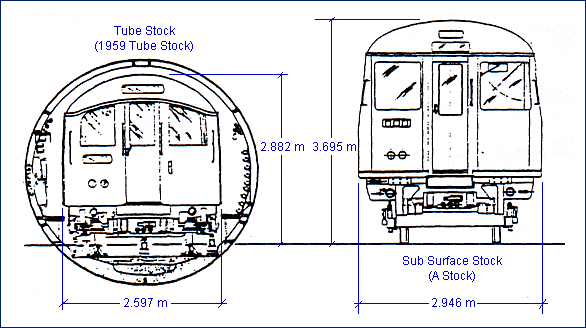
I know. But for some reason those always seem to have been Tube stock. This one is ex District Line, so built to the full BR loading gauge rather than having to fit into a 12ft diameter tube: The pic shows A stock which served on the Metropolitan Line, but the dimensions are almost the same. I can't think why the Isle of Wight chooses Tube stock. They're not all dwarves, are they?
-
The operating principle is fast recharging at termini, from connectors on the track. Not battery swapping, which would be far too slow and laborious, and probably could not be done alongside a busy railway platform. No, it must be something to do with the discharge characteristics of the battery system, I think. Could be the heat issue mentioned by @StringJunky .
-
Being an Underground train it’s an Electric Multiple Unit carrying passengers, rather than a locomotive hauling a load. But indeed, they don’t say how many people and what weight of monitoring equipment was on board , compared to a full complement of passengers. The branch lines in the Thames Valley are fairly flat, I think, so I don’t think there would be many steep gradients. But in real service I’ve no doubt the inefficiencies of stop start operation would bring the effective range down quite a lot. There’s a YouTube video of the run which I watched. I was interested that they depleted the six battery packs sequentially rather than all together. I don’t know why that would be an advantage. They finished with one pack almost unused.
-
I thought this was interesting: https://www.bbc.co.uk/news/articles/c2l7ry7zp5po The run was a bit artificial, in that they ran the train at ~40mph rather than its top speed of 60mph, but I think it has to be seen as a proof-of-concept demonstration for the public (and doubtless for the politicians who may need to come up with funds to build battery trains and install charging equipment.) The idea is for GWR eventually to replace its ageing diesel multiple units, used for local start-stop services on non-electrified branch lines, with battery trains. This train is very familiar to Londoners like me, as it is converted from a withdrawn District Line Underground train. It normally runs, as a battery train, on a trial commercial GWR shuttle service, which has now been in operation for a year. There are contacts between the running rails at each terminus, which allow fast charging while the train is waiting between scheduled journeys. The shuttle route is only about 3 miles long, on a branch line between West Ealing and Greenford. However the aim has been to test the robustness of the charging system and batteries over many cycles, in all weathers, rather than run long distances which would give comparatively little useful information about the critical components of the concept. The 200 mile route was Reading-London Paddington, then Paddington-Oxford and back, then return to Reading. The first time an Underground train has been to Oxford! The previous record was 130 miles, in Germany. I suspect to implement this at scale they may want a train able to reach 70-80mph, with a range between charging termini of 50-80 miles or so. It looks to me as if the batteries on this train could just about do that, in a train with more powerful motors.
-
This whole thread is about a psychological condition. So bye bye, eh? 😁
-
The OP, which proposed a role for natural selection in determining the prevalence of narcissism. Natural selection is founded on relative reproductive success.
-
No it didn’t. But you hastily deleted your first offensive response (thank you, I appreciate that), though not before I had read it, and now, later, you have come up this instead.😁 You make a good point. More men seem to have NPD than women* but there are women with it too. I suppose I didn’t consider them in the context of an evolutionary mechanism, as being child-bearing their scope for spreading their genes around is a lot less than for promiscuous men. And being less physically strong, their capacity for forcing themselves on someone sexually is less. * https://en.wikipedia.org/wiki/Sex_differences_in_narcissism
-
Haha, H G Wells's "War of the Worlds" in reverse?
-
Ah so your thought was that maybe natural selection should have eliminated narcissism. Is that it? Well I can see a few difficulties with that hypothesis. First, do we know that a tendency to narcissism is a hereditary trait? If not, e.g. if it arises chiefly through factors in upbringing, then natural selection would not operate on it. Second, supposing for the sake of argument it is an inherited trait, is there any reason to suppose that narcissists have, over the course of human evolutionary history, had a lower rate of reproductive success than non-narcissists? After all, they are perhaps more likely to be sexual predators, which would have increased their success. Third, the lack of empathy that seems to be a feature of narcissists may have given them an advantage, socially, in ruthless in pursuit of their objectives. So they may have tended to rise to positions of social power, enabling them to mate with more females. P.S. Bear in mind that evolutionary process typically take a long time to change the characteristics of a whole population, so one would have to look back to prehistoric times when considering the mechanisms at work. P.P.S. It is hard not to think of Trump, when considering this subject😁
-
OK, but what then did you mean?
-
"Invent"? There are all manner of disorders in all kinds of organisms. Surely there is no need to invoke any idea of design here?
-
Seems to me from the discussion this comes down to dispelling the simplistic, wrong (and potentially nazi-like?) notion that there is a gene for "strength" and another for "weakness", so the "weak" should be allowed to die off. Whereas in fact it doesn't work like that, because it's a multidimensional issue, so"strength" along one axis tells you nothing about other axes.
-
Sounds to me as if they may be falling into what I think of as the "Dawkins Trap" of treating religion and science as alternative accounts of the physical world, whereas their roles in human thought are in my opinion quite different. Science provides an account of the natural, physical world. Religion is not about that but is a guide to help human beings live their lives. So the undeniable fact that science can and does make errors is beside the point. Of course it does, like any human enterprise. But it isn't trying to guide people as to how to live their lives. Its methodology depends on scepticism in its older sense (e.g. as in Robert Boyle's "The Sceptical Chymist"), that is, requiring observational confirmation of phenomena to justify hypotheses, before accepting them as explanations. It is undeniable that applying this principle has met with enormous success. Without it, we would not have modern science at all. Moreover this reliance on confirmed observation is the mechanism by which the inevitable errors and false leads are corrected, over time. Conversely, if and when religion strays from its purpose and purports to explain the physical world, it is often shown by observation either to be wrong or else to be proposing ideas that can't be tested by observation. In the latter case such ideas are ipso facto not scientific, so science has nothing to say about them one way or the other. You, by the sound of it may be a physicalist, that is, one whose worldview is that the physical world as portrayed and investigated by science is all there is. That's a point of view, but it is not the only position that followers of science can take. Many scientists are also religious believers. In fact historically this was normal. Quite a number of scientists in the c.19th and c.18th were clergymen.