
exchemist
Senior Members
-
Joined
-
Last visited
Everything posted by exchemist
-
You don't have Siri or equivalent, permanently active, in your TV though, do you? Obviously if you have Siri active, you have chosen to have it listen to your voice for commands. What this is about is having an IT system listen to (and send data on) your voice without your consent.
-
Do you know that ? I should have though that could be grounds for a lawsuit for invasion of privacy. Can I read about this somewhere? (As it happens, I don't have a TV, but I think it would be scandalous if true.)
-
It's a new feature on a number of forums I subscribe to. It started about a year ago, I think. When you attempt to navigate between threads, or return to the home screen, you sometimes - not always - get instead a full page ad, which you have to cancel before you can see the screen you want. For what it's worth I'm on Apple with Safari as my browser. What makes it newly tiresome for me is this aggressively advertised Chinese outfit TEMU, presenting you with a totally random range of crap, sometimes including completely unidentifiable objects. I've no idea who these people are - a sort of Asiatic Amazon perhaps? - but they are of zero interest.
-
Actually that suspicion about phone mics is something I have also heard from other people. Either it's just a meme or there is something in it. Perhaps we should look the topic up on the web, oh wait ..........
-
I'm no expert in this area but I'll have a go, to start off the discussion. I presume the warping you refer to is due to thermal expansion of the metal, in those areas where it gets hot, whereas the rest of it stays cool. There is a table of coefficients of thermal expansion here: https://www.engineeringtoolbox.com/thermal-expansion-metals-d_859.html According to this, the coefficient for stainless steel almost double that of mild steel, so it would be expected to expand more with heat and warp more. This is just for metals but here is one that includes glass: https://www.engineeringtoolbox.com/linear-expansion-coefficients-d_95.html According to this, plate glass is similar to stainless steel while unqualified "glass" is similar to mild steel. Given that glass is brittle, it will crack if it experiences too wide a temperature variation across the specimen. That being so I am wondering what the design of this cooker is and whether you may have inadvertently removed something that avoids a large temperature differential from being created, or else you have not included a gap, or cut, or flexible fixing, somewhere, that permits differential thermal expansion. Alternatively it may be a question of thickness. Frying pans are commonly made of steel and cheap ones can bow upward in the centre if they are too thin. However better quality ones (heavier, thicker ones) seem not to, presumably because they can contain the thermal stresses within the metal without bending appreciably. Regarding glass if, it was not just glass but Pyrex, this has a lower coefficient of expansion (~3 x 10⁻⁶mm/mm/ Cdeg) than any of the above materials and can be made thicker and a lot more thermally resistant. P.S. cross-posted just now with @swansont
-
I don't think whatever algorithm selects the ads to display considers the forum they are displayed on. It's probably much more to do with what it thinks based on whatever it has gleaned about your browsing and on-line purchase history. Since I do what I can to minimise this , e.g. via blocking trackers, I get weird ad selections: funeral services, drilling machinery, women's fashion and ads in Chinese characters. (When I looked up a few words in Dutch for another forum, I started getting Dutch websites popping up on my search engine too - it's all rather creepy.) All a bit baffling and annoying, but I tell myself the alternative would be that we would have to pay a subscription for a forum like this, so it doesn't do to grumble too much.
-
This looks like another example of “enshittification” : https://en.wikipedia.org/wiki/Enshittification Cory Doctorow gave an excellent lecture on this in January. Here is a link to the transcript. It’s very well written, rather in the style of Michael Lewis’s Liar’s Poker: https://doctorow.medium.com/my-mcluhan-lecture-on-enshittification-ea343342b9bc Long, but very readable - and worth the read. He muses that we may be entering the enshittocene era.
-
Philosophy is not a pseudoscience.
-
That's how I interpret the diagram. Though one has to keep in mind this is binding energy per nucleon. What intrigues me, not being a nuclear physicist, is the spike at helium, and the smaller one at oxygen. These elements seem to have stability that lies off the curve. Are they filled nuclear shells or something?
-
I don’t think so.
-
But what's the point? All you do is make deuterium, which we can easily extract from seawater anyway, from alpha particles, by a process with <0.01% efficiency that consumes a lot of energy however it is supplied. What have you achieved? A net fission of helium into deuterium. What use is that?
-
As the little "m" s appear once on each side of your equation you can cancel them, but that leaves the big M. So the "a" in F=ma should be set equal to GM/r². There has to be an M in it because the acceleration due to gravity depends on whether you are standing on, say, the Earth, or the Moon which has less mass and therefore weaker gravity. Newton's expression is completely general and can be used for any body, dialling up and down M according to the mass of the body in question.
-
Irrelevant. All you need to know is the binding energy per nucleon of the reactant species at the start and of the product species at the end and do the arithmetic. The route by which you carry out the change has no effect on the overall energy change between the two. What you are proposing is the reverse of the fusion people are trying to achieve with Tokamaks etc. You are turning a helium nucleus into 2 deuterium nuclei rather than the fusion process of turning 2 deuterium nuclei (or one deuterium and one tritium) into helium. Since that process releases energy, which is why people are trying to do it, your proposed process must necessarily absorb the same amount of energy. The binding energies per nucleon are shown on this graph, which shows the enormous gap between ²H and ⁴He:
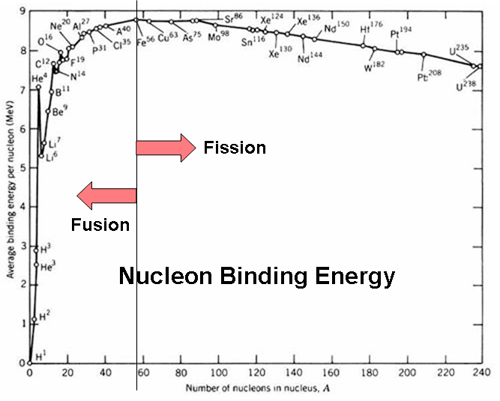
-
What you are now writing seems to have no connection to your original question. A discussion of reaction mechanisms and formal charges seems to have nothing to do with how you can tell that a reaction is complete or not. I can't comment any further unless you can be clearer about what you are trying to do.
-
I think that will depend on the reaction in question, won't it? Do you have a particular type in mind?
-
The pictures don't help without a lot more explanation. What are you talking about?
-
Your premise appears to be false. Renewable generation is now competitive with fossil fuel electricity production: https://www.weforum.org/agenda/2020/06/cost-renewable-energy-cheaper-coal/
-
But that process has nothing to do with the one you were asking us to consider. What you were proposing was conversion of ²He into D. That process, which is only followed in <0.01% of cases, is indeed β+ decay, but it is not fusion. The net conversion achieved by your proposal, starting from α-particles, is ⁴He -> D. This is a convoluted fission process, not fusion and, surprise, surprise requires a net input of energy to achieve it.
-
Yup, so 2/10 of F-all . You think you can run a viable fusion reactor on that basis?
-
If you consult the table in the link I provided, you will see >99.99% decay into 2 x 1H, i.e. the 2 protons just fly apart. But it doesn't.
-
No. The half life is apparently << nanosecond: https://en.wikipedia.org/wiki/Isotopes_of_helium According to my understanding there is no Coulomb “barrier” anyway, in the sense of the repulsion diminishing at very short distances. The repulsion goes on up without limit, so far as I know. Nuclear stability relies on the strong interaction outweighing it, which for 2He it apparently doesn’t.
-
No. A pair of protons with no neutrons would be unstable and fly apart - and you need neutrons in your fusion reaction anyway, to make helium, which is the product of the reaction. Fusion is usually between deuterium and tritium, leading to helium + a neutron that carries away most of the liberated energy. Deuterium is sourced naturally from water while tritium is "bred" by letting the escaping neutrons react with lithium in a "breeding blanket" surrounding the reaction chamber.
-
I think there is something wrong here. My understanding is that the entropy corresponds to the information needed to fully describe the system that is absent. Or actually a better word might be unavailable. So you can't equate entropy with information, but to its unavailability. There is a discussion of this here: https://physics.stackexchange.com/questions/75146/entropy-and-information
-
Is the journal reputable or is it one of those potentially predatory ones that appear on Beall’s List, for example? You can I think share the name of it if you like. I can’t see why doing so would be a problem.
-
You are not making any sense at all.