
PhilGeis
-
Joined
-
Last visited
Posts posted by PhilGeis
-
-
-
Follow up
Clorox Agrees to Pay $14.15 Million Civil Penalty for Failure to Immediately Report Bacterial Hazard with Pine-Sol Scented Multi-Surface Cleaning Products
-
The (very) older folks may remember initial polio vaccination in US - 1st the injected Salk and the later, sugar-cubed Sabin. Neither went without issue.
https://pmc.ncbi.nlm.nih.gov/articles/PMC1383764/pdf/0156.pdf
-
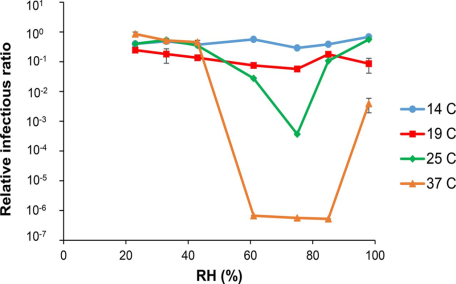
Not so confident in the cold/harden envelope concept. Couldn't find support in literature and infective expsure is likely an indoor phenomenon where indoor temperature would be controlled.
https://journals.asm.org/doi/full/10.1128/aem.00551-18
above article includes this graph - temperature does impact infectivity(a flu virus surrogate) esp. in mod to higher RH. Recall it is commonly assumed folks are exposed to lower hummidities in indoor auir in winter.
t
-
Recall of baby formula reportedly contaminated with botulinum toxin.
Honey has been another source of the issue. . https://www.nature.com/articles/7211651
-
-
On 5/15/2025 at 8:26 AM, dimreepr said: Indeed, boring old morality verses what I want, no contest, I'll happily kill my descendents; it's virtually ethical... 🙄
On 5/15/2025 at 8:26 AM, dimreepr said: Indeed, boring old morality verses what I want, no contest, I'll happily kill my descendents; it's virtually ethical... 🙄
He's killing no descendants. Please - as scientists let's proceed by the risk assessment process not sensational hyperbole.
-
-
Contamination is not typically cause for household product recall as the product pH, Aw, salt, surfactant levels etc. limit contamination to low risk bugs. Manuf hygiene is only roughly controlled due to volumes and preservatives are weak to control sensitization. Product may/prob not be held for micro results as volumes can exceed reasonable warehouse control.
Problems are uncommon hopefully low-risk and limited so addressed by unannounced market recovery from retail to minimize customer of experience odor, appearance and performance issues. None want monetary impact/bad press/regulatory exposure of public recall so risk assessment is established in advance to avoid the passion of the moment. Not to dwell too much but it is passionate - manufacturing has stopped, need to find space for product on hold and recovered, competitors take store shelves, organizations blame one another, etc.
Woolite is made by Reckitt (of Lysol, Dettol) whose health and reputational risk assessments are well developed. I'm not familair with their assessment but have known their folks and certainly respect their decision.
-
Woolite is used for hand washing of "delicate" garments.
cutaneous infection from detergent - but it is pseudomallei again https://www.academia.edu/download/41703997/360.pdf
-
Edited by PhilGeis
3 hours ago, CharonY said:It is also a soil bacterium.
Sure - as noted, the bug is in soil as well. The ;point was the dynamic of the microbe's pathogenicity and the level of immunocompromise of the person(s) exposed.
another example - different bug, diff route of exposure and diff vulnerability of the exposed https://academic.oup.com/jid/article-abstract/158/3/655/2190564
consider that ~20% and prob more of the population is in some state of immunocompromise https://www.sciencedirect.com/science/article/abs/pii/0168160596009968
Woolite prob is not an unique phenomenon - just one that involved a bug/bug type of some degree of risk due to it's +/- neutral pH. Other more mainstream concentrated liquid laundry detergents pH ~9 suffer contamination by alkalophilic xerophilic bacteria. The latter does not appear in the literature as such. Here's an example from the soap industry https://onlinelibrary.wiley.com/doi/abs/10.1111/ics.12401
-
Different pseudomonad and aerosol exposure
-
-
fyi
Woolite contamination. Some may household cleaner contamination from a few years back - https://www.goodhousekeeping.com/health/a42805515/fabuloso-cleaner-recall-full-list/
-
Please note temperature control important to flu vaccine stability.
https://www.naccho.org/uploads/downloadable-resources/storage-of-influenza-vaccine-MDH-3.pdf
-
-
On 10/10/2023 at 12:03 PM, swansont said:
While citations are good, your citation refers to efficacy of disinfectants, which was not the subject of the responses (aka assertions)
Dry conditions for two months will indeed kill some bacteria, but not all of the common ones, and most viruses. Higher temperatures (which one might expect on a laptop) tend to shorten the time.
https://www.ncbi.nlm.nih.gov/pmc/articles/PMC1564025/
Please read the citations offered. The article reported the flora recovered from keyboards.
Potential pathogens cultured from more than 50% of the computers included coagulase-negative staphylococci (100% of keyboards), diphtheroids (80%), Micrococcus species (72%), and Bacillus species (64%). Other pathogens cultured included ORSA (4% of keyboards), OSSA (4%), vancomycin-susceptible Enterococcus species (12%), and nonfermentative gram-negative rods (36%)
-
Wish folks would offer some citations for their assertions
-
-
Edited by PhilGeis
Continuation of current discussion
Info largely based largely based personnel communications - leaked info. Release/declassifying of investigation will help understand issue and considerations of FBI and DOE - if it is released.
-
Edited by PhilGeis
Wuhan lab scientists were the first to contract COVID-19: report
https://www.microbiologyresearch.org/content/journal/ijsem/10.1099/ijs.0.65021-0
vs. 2021 claim it was a wet market vendor and a WHO claim it was an accountant
-
Edited by PhilGeis
Think a bit oversold at this point. "International group" may not be so correct. French lab examination of sequences posted to a public genomic database by Chinese researchers and subsequently removed.
Seems others could reproduce findings but see nothing in literature yet.
WHO asked for the data, not aware it's been released/
But there is relevant previous (to above) discussion relevant to racoon dog association.
-
China offers a new theory and vector for wet market source - "racoon dog'
-
Edited by PhilGeis
Fauci said Saturday that a coronavirus lab leak could still be considered a "natural occurrence" if the definition of lab leak meant that someone was infected in the wild and went "into a lab," was studied in a lab, and then "came out of the lab."
and
"The other possibility is someone takes a virus from the environment that doesn't actually spread very well in humans, and manipulates it a bit, and accidentally it escapes or accidentally infects someone and then you get an outbreak,
Contamination
in Microbiology and Immunology
Think it best it best if this discussion be closed as it has no "point". I'm off to post a muffin recipe.