
RyanJ
-
Joined
-
Last visited
Posts posted by RyanJ
-
-
Edited by RyanJ
10 hours ago, swansont said:If the energy from the result approaches or exceeds a few percent of mc^2, that an indication that you need to use a relativistic treatment
What would that look like? Would that require something like this:
- Calculate the acceleration due to gravity (g) using [math]g = \frac{GM}{r^2}[/math]
- Calculate the time taken to fall over the distance h under the influence of g using [math] t = \sqrt{\frac{2h}{g}}[/math]
- Calculate the terminal velocity of the object after falling for time t using [math] v = v_0+gt[/math]
- Calculate the kinetic energy at the end of the fall using the relativistic kinetic energy equation [math]k_e = m_0 × c^2 × (\sqrt{1 - \frac{v^2}{c^2}} - 1)[/math]
While this seems correct outwardly, I can see some issues. It assumes that the acceleration is uniform over the time of the fall and it doesn't factor in that there is an upper speed limit due to relativistic effects. I don't know how to account for the latter, for small heights it's a non-issue but for larger ones, the speed quickly exceeded what is actually possible - implying my model and method is ultimately faulty.
-
Hi all.
I've been trying to calculate how much energy would be released from dropping things onto the surface of a neutron star from certain heights. I'm using...
[math]\Delta E = GMm (\frac{1}{r_2} - \frac{1}{r_1})[/math]
To calculate the potential energy that could be released. Where G is the gravitational constant, M is the mass of the neutron star, m is the mass of the falling object, r2 is the radius of the neutron star plus the height and r1 is the radius of the neutron star. Phew!
Would this be the correct formulation to use here? I don't know if I would need to take relativistic effects into account here (and I wouldn't know where to start with that, so advice would also be welcome). Are there any other factors I need to consider here? What proportion of that potential energy would realistically be released from such a collision?
I'm trying to get back into practising using mathematics and physics in practice, I'm feeling seriously rusty. I also recall hearing something along the lines of "dropping a marshmallow onto the surface of the neutron star releases as much energy as an atomic bomb" and I wanted to put that claim to the test.
I think this is the correct forum, but if not I would appreciate it if the thread could be moved.
Thanks! -
Hi all!
It has been quite a while since I last posted here. Again.I'm currently interested in supernovae and the exotic stellar remnants that are left behind from such events. I'm interested in the physics and science surrounding this subject, it's something that I currently have an interest in and want to learn more about. I'm considering doing a degree in astrophysics as I've found myself with quite a bit more free time recently. I'm brushing up on my physics (it's been a while since I used it).
I have no problem with them being technical and in-depth and would prefer the details as opposed to the popular science explanations, though I'll happily take a look at those too. I've gone through as much YouTube as I can find on the subject, but I find myself wanting for more information about the subjects. I'm not afraid of getting my hands dirty with the math and whatnot.
I'd also be interested in any books about the more theoretical stellar remnants, such as quark stars.
If anyone has any suggestions then I would more than welcome them.
Thanks! -
I second bascule. However Ruby does have some very strange language syntax structures and some people find it difficult to move to other languages like PHP or C afterward.
Personally I started head first with C++ and it never did me any harm. Except for that dent on my head just won't go away after bashing it against my computer in frustration for weeks on end.
-
Please add Wolfram Alpha (http://www.wolframalpha.com) to the main post too as it can do all sorts of useful chemistry calculations (I'll post a thread for that later).
-
Who is the book's author and when was it written?
Look here under "useful books"
 I had doubts then about the existence of iron (VIII). If it doesn't exist, then I wonder why not?
I'd agree with Woelen, doing some quick research turned up no useful information about iron(VIII) compounds so I'd guess their either can't exist (due to stability problems) or only exist at low energies and then only in solution.
-
-
Here are three more for you guys
1. Mercury is so dense that a cannon ball can float on it!
2. Thiols are the strongest smelling substances in existence (apparently). The human nose can detect them in as little as one part in 50 billion! These are used as an additive in natural gas.
An example of their potency was shown in two experiments carried out at Esso research. They were attempting to crack trithioacetone south of Oxford in 1967. A stopper was accidentally removed from a bottle containing the resulting residue and within seconds people in a building 200 feet away were feeling nausious and sick! Too this day we do not know the compound responsible, it was either dithiol or 4-methyl-4-sulfanylpentan-2-one but nobody has been brave enough to find out which.
3. Humans, for some reason, are extremely sensitive too the taste of the main flavouring in grapefruit, able to detect it in concentrations as around 2*10-5 parts per billion! This is almost equal too 10-4 milligrams in a tonne of water or one drop in a good-sized lake! Amazing!
-
-
-
Hi everyone!
Please post all contributions you have here so a moderator can add them to the first post which is locked to keep it clean.
Also, please make shure that any links and information complies with the Hazardous Materials and Synths rules or it will not be added and you will probably get a warning.
Thanks for your contributions!
Cheers,
Ryan Jones
-
Hi everyone!
I have talked with woelen about this and he thinks its a good idea so here goes.
This thread is for chemistry links and information that could be useful to other people. Books and useful information are also welcome.
Links from the forums:
-
Reference:
-
Collecting elements - Lots of information about buying and collecting elements.
-
Hazardous Materials and Synths - Always read before posting something potentially dangerous.
-
The periodic table - Lots of periodic table links.
-
A latex tutorial - A lot of info on how to use Latex in the SFN forum software, nice for formulas, equations and so on.
-
Making Things / Experiments:
-
Making hydrochloric acid - How to make hydrochloric acid.
-
Phosphorus extraction - How to extract phosphorus.
-
Fluorine - Lots of information about fluorine.
-
Hydrogen peroxide - Concentrating hydrogen peroxide.
-
Making nitric acid - An interesting discussion about making nitric acid.
-
Aluminium powder - How to make aluminium powder at home.
-
Be very careful with old potassium - A warning about old potassium.
-
Iodine "tincture" - Seperating iodine from iodine tincture.
-
Bromine - Lots of information about bromine.
-
Selenium allotropes - All about selenium allotropes.
-
Making Sodium Iodide - Ideas for making sodium iodide.
-
Tin extraction - Ideas for extracting tin.
-
Making sulphuric acid - An interesting discussion about making sulphuric acid.
-
Purple gold - How to make purple gold!
-
A simply shocking source of sodium metal - An amazing source of pure sodium metal.
-
Making dimanganese heptoxide - Experiment with the extremely sensitive Mn2O7
-
Interesting Synths - Some interesting synths, nothing very dangerous.
-
Interesting threads:
-
Strongest possible acid - An interesting discussion about the strongest possible acid.
-
PyroChemistry - PyroChemistry discussion #1.
-
Collecting elements - An interesting discussion thread about collecting elements.
-
Thermite - A big discussion thread about thermites.
-
Bromine is too sweet - An interesting discussion about bromine.
-
Inert metals - A discussion about the inert metals (ends up in a debate!).
-
The king of the elements - A debate about which element is the best.
-
Good and bad chemical smells - A collection of good / bad smelling chemicals - add your own!
-
Glass is a fluid - Is glass a liquid or a solid?
-
Strongest acid known - An interesting discussion about the strongest acid known.
-
Strongest oxidiation & reducing agents - An interesting discussion about the strongest oxidiation & reducing agents known.
-
Official pyrotechnics thread - PyroChemistry discussion #2.
-
Chemicals with funny names - Very funny!
-
What is the most indestructible solid known to man? - An interesting debate and still do conclusion!
General links:
-
Wikipedia chemistry section - Information and more information... what more can I say?
-
IUPAC nomenclature - The standards for naming compounds, ions and just about everything else in chemistry.
-
The chemistry archive - Links to lots of sites... very useful.
-
Writing SMILES - Very useful for organic chemistry, makes writing structures simple.
-
Woelen's site - Always useful for reference and looking up experiments.
-
General chemistry stuff - Useful ifnroamtion and articles, some interesting things to read.
-
Compound information lookup - Very useful for research.
-
Chemistry guide - Brilliant resource for learning about chemistry.
-
Functional group reactions - Very useful quick reference resource.
-
Chemical glossary - Another useful lookup resource.
-
Chemistry books online - Another great idea from Wikibooks.
-
MSDS data sheet lookup - Great safety information (Invaluable).
-
Household products database - Always interesting to know what things contain!
-
Table of nuclides - Great resource for isotope research.
-
Chemdex - Lots of links and information.
-
Chemistry articles - Always an interesting read.
-
Science madness: online books - More books online!
-
About chemistry - Great online reference.
-
General chemistry online - A great online tutorial.
-
Chemistry coach - Another great online tutorial.
-
Water - All you ever wanted to know about water and more!
-
Flash based periodic table - a very interesting and unique way to display the perodic table.
-
Chemical profiles - Great for chemical research with information on lots of compounds.
-
Webqc's info on elements - a nice summary of properties of elements, which links to individual articles about the elements.
Useful Books:
-
CRC Handbook of chemistry and physics
-
Chemistry of the elements
-
Organic chemistry
-
Inorganic chemistry second edition
-
Inorganic chemistry by Shrier & Atkins
-
Chemistry third edition
-
General Chemistry
Software:
-
ChemSketch 8.0 - Drawing molecules, free.
-
XDrawChem 1.9.9 - Drawing molecules, free.
-
ChemDraw 10.0 - Drawing molecules, paid.
-
PubChem online molecule editor - Drawing molecules, online.
Cheers and thanks for contributing!
Ryan Jones
-
-
Here are a few more:
1) http://arxiv.org/archive/math
1) Lots of math papers (Very interesting stuff).
2) http://www.understandingcalculus.com/
2) Have not read it all yet but what I have read was good

2) http://en.wikibooks.org/wiki/Wikibooks:Mathematics_bookshelf
2) Interesting books online, useful for reference.
Cheers,
Ryan Jones
-
I'm one of moderators of this international math forum (largest online in the EARTH)
http://www.artofproblemsolving.com
This site is rather dedicated to pure problem solving than college courses but it does have forums for college level and international forums (i.e. forums for Spanish people' date=' etc..)[/quote']
... never seen that site before, thanks for sharing!
Also, thanks too Dave for making the thread sticky
Cheers,
Ryan Jones
-
-
Here are some more:
1) http://www.goldennumber.net/
1) All you ever wanted to know about Phi.
2) http://www.worldwideschool.org/library/books/sci/math/MiscellaneousMathematicalConstants/chap98.html
2) Big list of mathematical constants, useful for very (and I mean very) accurate calculations.
3) http://dmoz.org/Science/Math/Geometry/
3) More geometry stuff.
3) http://dmoz.org/Science/Math/Geometry/
3) More geometry stuff.
4) http://www.scenta.co.uk/tcaep/
4) Science and maths information – lots of stuff like a table of constants etc.
5) http://www.sosmath.com/wwwsites.html
5) More maths website, the whole site is useful.
6) http://www.numbertheory.org/ntw/N4.html
6) Lots of information on Number Theory!
Cheers,
Ryan Jones
-
-
Every other section has one... this one should too (If it has I can't find it sorry).
So I'll start off:
1) http://linuxfreak87.googlepages.com/
1) Covers a lot of stuff, Maths and some physics.
2) http://mathworld.wolfram.com/
2) Amazing maths resource, lot of advanced stuff.
3) Basic and advanced maths here. Good tutorials.
4) Again more good tutorias and weekly challanges.
5) http://mathforum.org/dr.math/
5) LOTS of question solutions here, examples too. This one has helped me a lot in the past and still does
6) http://www.ics.uci.edu/~eppstein/junkyard/
6) Lots of fun geometry, useful stuff and interesting stuff here.
7) http://en.wikipedia.org/wiki/Category:Mathematics
7) As always Wikipedia is a great resource for one and all.
8) http://www.research.att.com/~njas/sequences/Seis.html
8) If your interest is number sequences this is the place to go. Useful for research.
9) Equations, equations and yes you guessed - MORE equations. Very useful resorce for reference.
10) http://home.att.net/~numericana/
10) Lots of interesting stuff and some other useful links too.
11) http://www.mcs.surrey.ac.uk/Personal/R.Knott/
11) Lots of interesting stuff, the mysteries of the Fibonacci Numbers etc.
12) http://integrals.wolfram.com/
12) Very useful too, online integral solver!
13) Maths in music, what next?
If you have more to add pease share them
Cheers,
Ryan Jones
-
Heres one (related to another thred I just replied too):
During the formation of a black hole as a star shrinks past a point known as the Schwarzschild radius the colapse sems to stop, this is due to the light rays being bent (Or slowed down depends on how you look at it) even more by the ever increasing gravity and this gavthem their former name "frozen stars". Despite this if youwere on the sufac you would see the collapse progress as normal not tht you would have a lot of time to enjoy your discovery

Cheers,
Ryan Jones
-
-
Yup, fractals apprear everywhere.
here are a fe more (thanks Wikipdia)
http://en.wikipedia.org/wiki/Image:Glue1_800x600.jpg
http://en.wikipedia.org/wiki/Image:Square1.jpg
http://en.wikipedia.org/wiki/Image:Microwaved-DVD.jpg
http://en.wikipedia.org/wiki/Image:Fractal_Broccoli.jpg
As we have said found everywhere
The idea of a self-crystalising fractal sounds pretty annoying as fractals are based of unpredictable chaeoic systems...
Cheers,
Ryan Jones
-
-
-
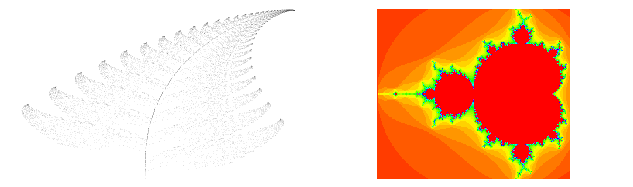
many patterns in nature seem tofollow fractal-type patterns...
For example leaves of ferns: http://mathworld.wolfram.com/images/eps-gif/Fractal2_1000.gif
Cheers,
Ryan Jones


Material Falling Onto Neutron Stars
in Relativity
Thank you. I need to take a bit of time to digest the implications of the equation you've presented so I can get a good understanding of what it is doing and why.