

tar
-
Joined
-
Last visited
Posts posted by tar
-
-
P.S. Newtonian physics wins locally, MOND and Dark Matter do about the same at the billion ly range with MOND having a slight edge and Dark Matter wins explaining the Early Universe. I would suggest evaluating the usefulness of predictions about local stuff, stuff a billion years away and stuff 14 billion years away.
If we want to live in the past and live in people's imagination and revel in the formulas of relativity and dark matter and dark energy calculations I suppose Dark Matter is a workable theory.
But when it comes to practicality, explaining stuff that affects us now, I am not sure Dark Energy and Dark Matter are worth the invisible paper its written on.
I have a prediction about the clumping noticed in the Background Microwave Radiation. Its going to produce strings of galaxies and voids. Like soap bubbles. The strings of galaxies being the soap and the voids being the air in the bubble.....hey look at that. 10B years later that's what the place looks like.
-
in my model every observer is the same age, the age of the universe by definition includes all observers
and another postulate is that currently the Universe is only in ONE arrangement and ALL components are exactly the age of the Universe.
Different observers will order events differently based on their distances from the events but all events happen only once and causality is never broken.
Another postulate is the Universe fits together perfectly. And does not change according to our whims unless we physically modify it to match our internal model.
3 minutes ago, swansont said: From the linked article:
- the fluctuations in the cosmic microwave background, including the “acoustic peaks” that simply cannot exist without some form of dark matter.
- the clustering pattern seen in the large-scale structure of the Universe
- the behavior of two clusters of galaxies colliding
3 minutes ago, swansont said: From the linked article:
- the fluctuations in the cosmic microwave background, including the “acoustic peaks” that simply cannot exist without some form of dark matter.
- the clustering pattern seen in the large-scale structure of the Universe
- the behavior of two clusters of galaxies colliding
I apologize, I did not read the link yet. I will now. However the explanations you noted all have to do with current observations of stuff that happened Billions of years ago and errors could have been made in measurements and assumptions. If a premise is false, you cannot arrive at a true conclusion.
For instance if I observe the distant truck is the same size and shape as the toy truck in my yard, I can not say that therefore the toy truck can hold 4 yards of material due to squeezing effect of dark energy and matter.
Well thanks for the article Swansont but I don't understand the cosmic background radiation clustering stuff. Nor the galaxies colliding stuff.
The radio information we see coming from all portions of the sky shows us what the universe around us looked like 14Billion years ago. Those volumes of space now still contain matter and I would assume it is matter that has evolved from the first matter for the last 14Bilion years, so any findings about the state of the universe now, based on 14Billion year old information is nothing that needs explaining. I is what it is. Or is what it was.
The other thing in the article that I had NO idea about what it was showing was the red and blue stuff seen when galaxies collide. I am not sure you can get a before and after picture of galaxies colliding. They are massive and the collision would take a LONG time. If light takes 100k years to cross a galaxy another galaxy would take millions of years to cross a galaxy.
All in all, the article said MOND wins over dark matter in explaining the rotation of distant galaxies but fails explaining other observations from farther away and from a younger Universe. Maybe things now are different then things then. For instance, the Universe is bound to look different when everything is Hydrogen compared to how it would look after generations of stars builing heavier elements.
Regards, TAR
-
Swansont. I am still liking MOND better.
What, other than the rotation of distant galaxies does dark matter explain? Does it answer any local questions?
Regards, TAR
I am not a believer in time dilation.
I think if the traveling twin counted the ticks of a distant pulsar and the stay at home twin counted the ticks from the same pulsar, both twins would have counted the same number of ticks upon the return of the traveling twin. Regardless of the speed and direction of travel of the traveling twin. Any slowing of the home clock observed by the traveling twin on the way out would be reversed the way back as the stay at home clock would appear to be running fast as the light from the clock is blue shifted. Red shifted while traveling away, blue shifted while traveling home, cancelling out and resulting in no time dilation.
I think the flying Cesium clocks might be explained by which way the clocks were positioned in the aircraft, as there are moving photons within the clock apparatus. If the emiitter is faacing against the wind so to speak the receiver will receive a redshifted signal. My thought, along the MOND direction is a photon just goes where its pointed, the wave just goes out in an arc. It does not know or care how the emitter is moving. The Plane is moving, the Earth is moving, rotating and revolving, the Sun is moving round the center of the Galaxy. Whether the clock slows down or speeds up or slows down compared to the stay at home clock depends ont eh blue shift or red shift induced by these various motions on the photons traveling between the emitter and receiver. A difference can occur in the readout of the clock based on blueshift and redshift with time never dilated.
-
perhaps gravity from a star arrives on Earth at the same moment that the light from the star arrives, so one can assume the vector in the noted position, but whan looking at a distant Galaxy the Gravity from one observed star "got to" the other observed stars a billion years ago. The apparent vectors no longer apply. We get or vector information now but all the masses in the distant gallacy did NOT get their gravity from all the other stars at the same isnstant. It took time.
-
Well consider vectors then. Any rotational equation would include all the vectors of the force all the masses apply on all the others.
Are the vectors pointing in the right direction? If all the mass is considered in a static position at a particular moment in time, you have two potential error causes, Each objects gravity might be considered coming from a position it no longer is in and various models and equations and averages might by using different assumptions, averaging apples to oranges.
And the various components that average in to equation might be different Distances from the target mass. Meaning their gravity, in terms of their angular relationship with the target might not be coming from the assumed vector.
-
Thread. Philosophically speaking, I am saying that the equation modeling the rotation of distant galaxies is NOT returning the results witnessed.
When your model of reality does not match reality you have two choices. Change reality or change your model.
I vote for change your model.
I saw the other day scientists are suggesting there is a parallel universe running backward in time that would explain dark energy. REALLY?
How far down the wrong path are you guys willing to go?
At some point you begin to look plain silly.
I am trying to throw you guys a lifeline here.
Instead of entertaining my idea and looking for a time lag adjustment to the equations you just keep doubling down with this dark matter, dark energy crap. You are just digging your hole deeper. You are not doing science.
here is another possible source of the required mass. I just thought of it when I mentioned the Heliopause. There is a whole lot of particles that go out on waves of energy from the Sun that seem to congregate in the area of space affected by the waves coming in from the neighboring stars. If each star has this shell of "Sea Foam", how much mass would that add?
-
I did not switch off the Sun's gravity. I reduced it to the size of a walnut put it in a craft and moved it. I is a thought experiment. If such happened, how would the motion of the Earth, within the galaxy be affected?
More importantly for the discussion, according to the laws of physics, WHEN would the resultant gravitational changes reach Earth? Hypothetically, speaking. Just to establish how the change in position of masses at huge distances affects the local gravity fields.
My goal here is not to abandon physics. Not at all. I am looking to explain the rotation of distant galaxies without using Dark Matter. (other than dust and non luminous objects)
14 minutes ago, exchemist said: Your alien scenario is not possible in reality though. Mass and energy can be interconverted but their gravitational effect is the same. There is no known mechanism by which gravity can be suddenly switched off, reduced or increased.
It is NOT impossible to consider this thought experiment. We have at least one black hole in the Galzaxy and huge masses are moving along with us around the center of the galaxy at various speeds. Elements in one spiral arem outside or inside our arm might exert more gravitation force on us than similar objects in our own arm very close to the center or out near the tip of our arm. Understanding the rotation of a Galaxy is NOT the same problem as understanding rotational dynamics in the lab or in the solar system.
I am also approaching this from a philosophical point of view. What we see happening in a distant galaxy is NOT what that Galaxy is doing now. Its old news.. We have NO way to know what is going on in that area of space right now. We wont know for a billion years, at which point that area of space would have advanced ANOTHER Billion years. So in reality, it will NEVER affect us more than it is affecting us now, so for all intents and purposes, what we see is happening now, for us. Philosophically speaking you cannot know what the Universese will be doing in 300 billion years, because there is no way to ever know what the entire universe is doing at the moment. One can speculate, but no way to verify what the universee will eveen "look" like in 300B years much less say what configuration all its components will be in in 300billion years.
This is the philosophical angle I am approaching this dark matter issue from. If you need to make up an imaginary substance to account for the observed rotation of a distant galaxy. as a scientist, I would think you might search instead for a logical answer, using everything you already know about the place. If dark matter exists in distant galaxies it should exist here as well. If it exists here, someone would have noticed it before. If it effects rotational characteristics of distant Galaxies it should affect OURS TOO. We should have some within our Heliopause. If we can't find it here, maybe it doesn't exist. In which case we need a different reason to explain the apparent and calculated rotation of a distant galaxy based on the red shift of super novas. I am suggesting we add some term in our angular momentum calculations that includes the lag time of gravitationl force over distances on the order of 10s of thousands of lightyears. If no term is currently in the equation, the equation is likely faulty. In my estimation.
-
19 minutes ago, exchemist said: Oh I see. well, Doppler shift gives you a fix on the speed towards or away from you, and you can presumably do that using 2 points on opposite sides of the galaxy that are roughly equidistant from you, so the light you are using came from the galaxy at roughly the same point in time, i.e. when the galaxy was the same age.
As for gravity, it is only changes in the gravitational field which propagate at the speed of light. So since the mass stays pretty constant, the field won't be changing significantly.
14 minutes ago, tar said: I fully accept the speed of light is finite and invariant.
Where my argument is is that the application of conservation of momentum and gravitational rotation to Galaxies may be a different problem that the application of such laws to Solar Systems BECAUSE the Galaxy is so much bigger than the solar system and it takes time for one side of the galaxy to communicate its position to the other side.
My thought is, if you factor this time lag of 100K years into the equations you might not need dark matter to true the equation.
19 minutes ago, exchemist said: Oh I see. well, Doppler shift gives you a fix on the speed towards or away from you, and you can presumably do that using 2 points on opposite sides of the galaxy that are roughly equidistant from you, so the light you are using came from the galaxy at roughly the same point in time, i.e. when the galaxy was the same age.
As for gravity, it is only changes in the gravitational field which propagate at the speed of light. So since the mass stays pretty constant, the field won't be changing significantly.
well yes I get that. But we are using equations that work at Solar system scales and the gravity of various planets affects the rotational speed of the others, The length of the year is most likely affected by where Jupiter is, outside us, perpendicular to us ahead or perpendicular to us behind or opposite us, in relation to our orbit around the Sun. In a Galaxy you get this spiral pattern emerge. WHY? Is that effect built into the calculations of conservation of angular velocity? I am suggesting that there is something about the rotation of HUGE systems that is different than the rotation of just really big systems.
For instance, run this thought experiment. An alien with advanced tech turns the sun into a black hole and takes it home. How would this affect our orbit? When would we feel the first affects? 8mins later? After mins we wuuld change our orbit, still attracted to the craft holding the black hole that was our Sun. and we would try to orbit the craft being pulled toward where the craft was 8 mins ago, then 10 mins ago then 20 and so on as the craft continuied its homeward bound trip. The gravity would lessen as the distance increased, and when the craft got home we would be affected by the Sun's gravity about as much as we are currently affected by the Home Star of the alien that took our Sun. We would most likely just move in a straight line in whatever direction we where headed when the Sun was taken, plus whatever momentum we had in the direction the Sun was revolving around the center of the Galaxy.
-
19 hours ago, swansont said: Some of the galaxies we observe are oriented perpendicular to us, which simplifies the issue of light travel time. In any event, it’s a solvable issue. Spiral galaxies are rotating; the spirals are not some accident of light travel time. The thing you’re not taking into account is that we get red- and blue-shift information from spectrographic analysis, which tells us a velocity component. We can get actual rotation information.
Conservation of angular momentum is a real thing.
IOW, your concern about the finite (and invariant) speed of light is not consistent
19 hours ago, swansont said: Some of the galaxies we observe are oriented perpendicular to us, which simplifies the issue of light travel time. In any event, it’s a solvable issue. Spiral galaxies are rotating; the spirals are not some accident of light travel time. The thing you’re not taking into account is that we get red- and blue-shift information from spectrographic analysis, which tells us a velocity component. We can get actual rotation information.
Conservation of angular momentum is a real thing.
IOW, your concern about the finite (and invariant) speed of light is not consistent
I fully accept the speed of light is finite and invariant.
Where my argument is is that the application of conservation of momentum and gravitational rotation to Galaxies may be a different problem that the application of such laws to Solar Systems BECAUSE the Galaxy is so much bigger than the solar system and it takes time for one side of the galaxy to communicate its position to the other side.
My thought is, if you factor this time lag of 100K years into the equations you might not need dark matter to true the equation.
-
21 hours ago, exchemist said: Why does this matter? Sure, when we see light from a distant galaxy it was emitted in the past but there is, so far as I am aware, no suggestion the rotational behaviour of any given one is different from others at different distances, i.e. seen at different stages of the evolution of the cosmos. That being so, there is no evidence that the laws of physics have changed over time. So the problem of dark matter remains one to be solved on the basis of present day physics. Isn't it? Why then would the time the light was emitted be important?
21 hours ago, exchemist said: Why does this matter? Sure, when we see light from a distant galaxy it was emitted in the past but there is, so far as I am aware, no suggestion the rotational behaviour of any given one is different from others at different distances, i.e. seen at different stages of the evolution of the cosmos. That being so, there is no evidence that the laws of physics have changed over time. So the problem of dark matter remains one to be solved on the basis of present day physics. Isn't it? Why then would the time the light was emitted be important?
My argument is in the manner in which we decide how fast a body 100,000ly across is rotating. When you use a gravitational law to decide speed of rotation of the whole, based on the speed of one part, you are assuming the whole galaxy is within the same equation. You can contain the whole galaxy in you imagination at one time, but the galaxy itself does not operate in that fashion. One part of the galaxy is happening 100k lightyears separated from the the other end. My argument is that the extra invisible mass required to true the gradational rotation equation would not be necessary if we factor in the time it takes light and gravity from one end of the galaxy to reach the other end.
20 hours ago, MigL said: When we had this conversation years ago, you were made to understand why there cannot be a common 'now'.
None of us have changed our minds, but you seem to have gone back to your original misunderstanding.
Obviously our 'nows' have diverged, and are not common anymore 😄.I would like to revisit that discussion about the two nows because I came up with a mental experiment that would allow me to illustrate what I mean about the two nows.
The other month I was testing out my base256, Base Byte system and found if you arrange 8 pennies around a center point like a binary string wrapped around a center point you can represent any number between 0 and 255 by flipping the pennies, head being 1, tail being 0. Then consider another 8 pennies in the "place" to the left. ...anyway you can represent HUGE numbers to the exact unit...as each penny is worth double the previous penny. So lets say we lay out the exact number of orbits of a hydrogen election since the hydrogen emerged. 14billion years worth of orbits. EVERY hydrogen atom in the Universe is THAT old. That is how old EVERY hydrogen atom in the Universe is NOW.)
So now hypothetically, with instant communication with an observer on Alpha Proxima have the observer send us the age of hydrogen in orbits since the first Hydrogen atom using light speed communication.
Lets say the hydrogen time now, when we send the request is X. When we GET the hydrogen time from Alpha, it will be X plus 4.24years worth of hydrogen cycles here, and the age Alpha sent us would be X.
We can thusly determine Alpha is 4.24 lys from here and assume that if we ask again with our instantaneous communication for Alpha to send us the Age of Hydrogen, NOW they will send us the AGE X+4.24years worth of hydrogen ticks.
This illustrates my two NOWS. One occurring here on Earth, and the other occurring Everywhere at once.
-
16 hours ago, MigL said: What does that mean ??
You've been here long enough to know that there is no common now.
MigL, I disagree. There is no now that we all agree on the definition of. I proposed two nows in another thread. I know that did not go over to well here, but I still model the universe based on that idea.
Consider perhaps that there IS a common now, give or take several seconds, or the time it takes light speed signals to go from one side of the Earth to the other.
We are all IN the same now, so that must be our common now. When we had this discussion years ago we were all in the same now then. Now we all have experienced the same now continually until this one, and we still are all in the same now. There is only one instance of Earth. The configuration it was in several years ago....all the configurations in-between... and the configuration it is in now.
Regards, TAR
3 hours ago, pinball1970 said: We don't. If there is a small explosion on the moon from a meteor strike and we see it via a decent ground based telescope, then the event occurred just over a second before.
If it is on the sun then it's 8 minutes before, outer planets hours and stars in our galaxy, years.
In terms of galaxies they can look at Doppler shift and those events can be billions of years in the past.
Scientists can get a lot of information from this as they effectively have a three dimensional history of the past, right back to the earliest galaxies detected by the James Webb space telescope, the record holder at the moment is a galaxy that formed 280 million years after the BB. (CMBR too plus some unconfirmed early objects at z=25)
Understood, Pinball1970, but your 3D history is made up of components of various ages. The entities we see now that existed 13 billion years ago STILL exist. They have no way of leaving the universe, all they can do is evolve for 13billion years. They are still out there. My guess would be those areas of space now look something like it looks around here. Of course there is no way to verify that, we will have to set our equipment on record and review the tape in 13B years to see that area of space evolve into what it looks like around here.
Regards, TAR
-
Thread, sorry for the misdirection but I was trying to find a shape that would both tessellate space along the 7 axis and be an element of itself. This I have not yet achieved. Seems the best candidate for tessellating space for my purposes is the rhombic dodecahedra which has 6 axis if you put the toothpicks in the center of each of the 12 faces. And 7 axis if you put the toothpicks at the vertices.
I do not have a clear understanding of how and why this works out. Maybe it does not. Maybe I cannot use the Rhombic Dodecahedra to build out into the same matrix as spheres build out into.
Seems this idea is still a work in progress. But as of now, I don't know if I have a good candidate for a unit volume that can tessellate space AND be arranged in 3 intersecting square planes and 4 intersecting hexagonal planes.
Seems there SHOULD be a shape that one could make, starting with a sphere in the matrix and "adding" clay in the voids between the spheres, filling the void just halfway to the next sphere.
I just have not come up with that shape yet. I try mashing spheres together around a central sphere and then taking the 12 outside balls off and see what shape I have left but its always been hard to discern the exact shape of the elemental shape that fills the voids.
I will check back in if I make any progress.
Regards, TAR
The truncated octahedron is looking good again.
-
One element of this that I think is VERY crucial that is not always clearly defined is WHEN are you taking your static picture of the rotating mass.
That is when you are building your mental image of the rotating mass you are taking the whole model as if it is happen at the same time.
Is this arrangement the way we see it, the way it was when the light and gravity left the various components, or is it projecting where the elements would be now after all the time it took the light and gravity to get here?
We only understand something based on the model of it that we build in our heads, or on a piece of paper or out of paper mâché hanging from the roof on wires, or on a computer screen.
If part of our model is built using a different time perspective, than another part of the model, the model would tend to be incorrect and not be an analog version of what is really happening.
The whole galaxy is not in the same place at the same time. That is the Galaxy only has ONE configuration at the moment, and we can't see what that configuration is. All our information about the galaxy, the position of the stars and dust we see is old news. The closer stuff more recent than the further stuff but the only TRUE model of the galaxy would be to pick a time and build the model of the ONE configuration the Galaxy is currently in, by projecting the observed position of the stars and their motion over the time it took the image of said star to get to us.
Everyone is assuming scientists take into account the travel time of light when making the calculations of the rotation of distant Galaxies. But do they? When they build their model, are they calculating what is was doing, what it is doing or what it looks like its doing?
To illustrate my point let me ask how many supernovas are currently extant in our galaxy?
So there are two ways to look at it. From here and now. From a God like perspective where the whole galaxy is in only one configuration at the moment.
To use a gravitation law equation on the rotation of the galaxy you have to take the whole galaxy as happening at the same time.
To apply this equation to our own Galaxy is already problematic as the various components we witness are reporting their positions to us over a 10,000year period of time.
When we see a supernova in a distant galaxy, that happened a billion years ago.
how could we figure out how fast that galaxy is rotating now, based on Billion year old information?
-
I am keeping my profile picture because it has close loved ones two of which are no longer alive, but still a solid part of me.
Here is me 5 years ago, I look about the same, just 5 years older.

66 or 67 in the picture, 71 now, but I have been working on this thread for a number of years and plan on continuing my work toward a math that will handle "3d" space without the use of PI, and/or arrive at a better understanding of what PI is. I know its the ratio of the diameter of a circle to its diameter, but its just a ratio. And any figuring you do with PI or Trig is only an approximation. I am thinking it would be helpful to develop a math where you could use whole numbers and repeating fractions and not need to use approximations to a given number of decimal places. In the past, in this thread when I was working with spherical angles they would never add back up exactly to 180 or 60 or 90 or 360 because the component angles were approximations based on the use of PI taken out to a certain decimal place.
If you calculated the volume of one of the 12 sections of the sphere you would not get exactly Volume/12, if you base your calculations on the Radius of the sphere and PI and various trigonometric and spherical geometric calculations.
I am looking for a way to find the exact volume, based on an exact unit volume.
for instance, if I take my 85.5g sphere of clay and divide it into 12 equal size identical shapes, each section will weigh exactly 7.125 grams. Pi would not be required to arrive at this answer.
-
Thread,
I have been having trouble over the past years of this work I am doing on the 12 sections of the sphere, understanding the relationship between the 6 axis presented by the spheres arranged equally around a central sphere and the 7 axis created by the 4 intersecting hexagonal planes and the 3 intersecting square planes that become apparent when you build the matrix outward. As you build out layer by layer the shape takes on more and more the shape of a truncated octagon. The other day I built a truncated octagon by starting with 4 balls in a tetrahedral orientation ant built out a layer around it, staying true to stacked hexagon parallel planes. When you do this you wind up with two 12 element hexagonal plane sections with a 7 element section on top and another on the bottom. (7 element section being a central sphere surrounded exactly on the same plane by 6 identical spheres. 7+12+12+7 or 38 elements. After squishing the parallel sides flat and smoothing it all out and sharpening up the edges I got a perfect truncated octagon with 6 square sides and 8 hexagonal sides. All the sides have parallel sides of the same shape on the other side of the element which suggests one can stack elements out along each of the 14 axis. This shape, the truncated octahedron fills space. So it seems promising to be able to use a truncated octahedron as a unit volume.
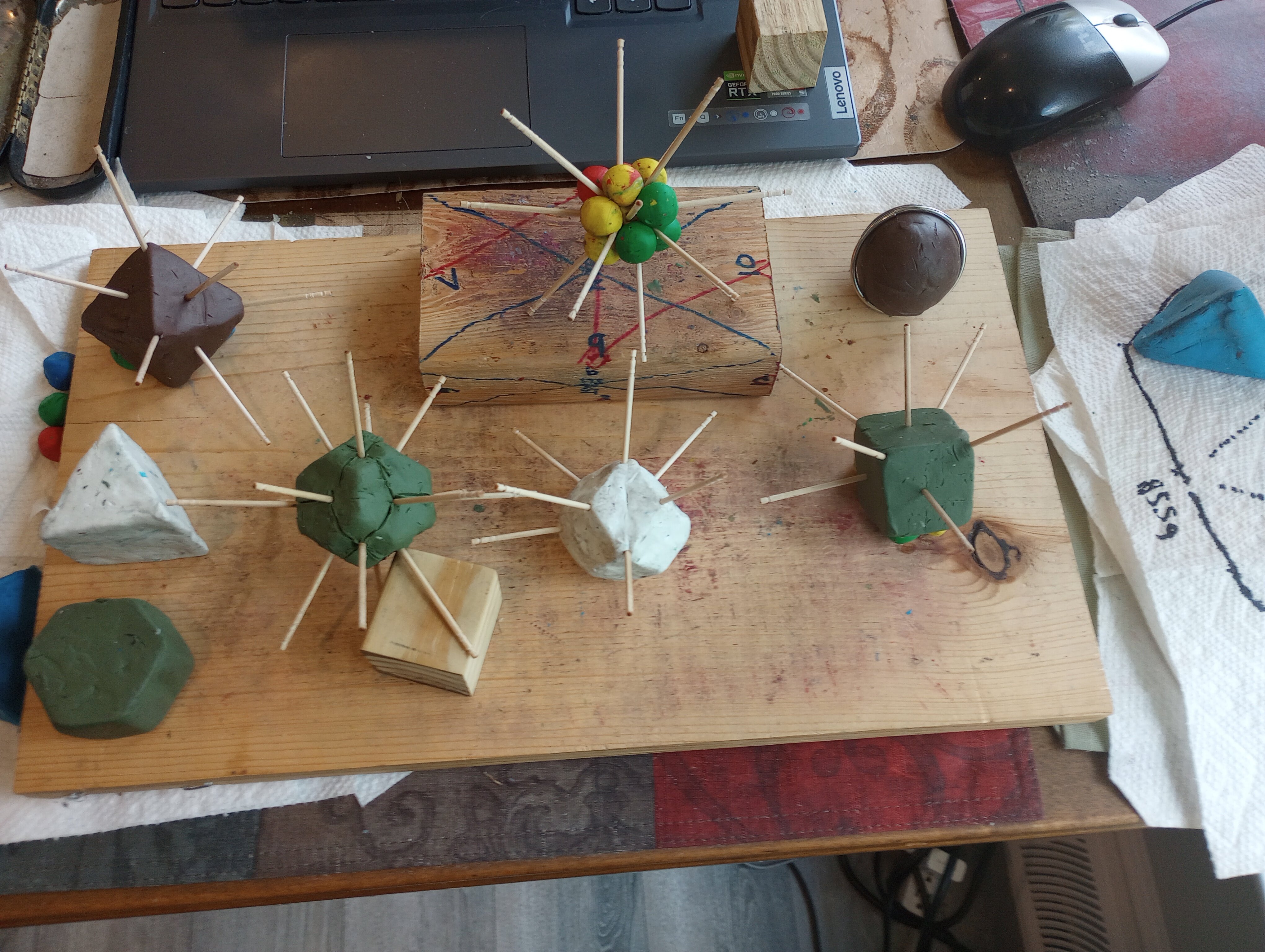
The rhombic dodecahedron also fills space but the sides stack along 12 axis. I had a had time visualizing what was going on and the relationship between the shapes since they both seemed to be based on the same 4 hex, 3 square planes. Using toothpicks to show the various axis I now understand the relationship. Here I post a picture of the Space filling Polyhedra the Cube, the Triangular Prism, the Hexagonal Prism, the Truncated Octahedron and the Rhombic Dodecahedron. (green and white figures), with the seven axis shown with toothpicks to show the same 4hex,3square matrix exists in all three permutohedron. The Cube, the Truncated Octahedron, and the Rhombic Dodecahedron.
Interestingly the Dodecahedron with the pentagonal sides LOOKS like it would dense pack but it does not, when you try it, you are left with spaces, close, but no cigar.
Also the Pentagonal sided Dodecahedron is NOT consistent with the matrix that you get when you build out the 12 sections of the sphere I am discussing in this thread.
Regards, TAR2
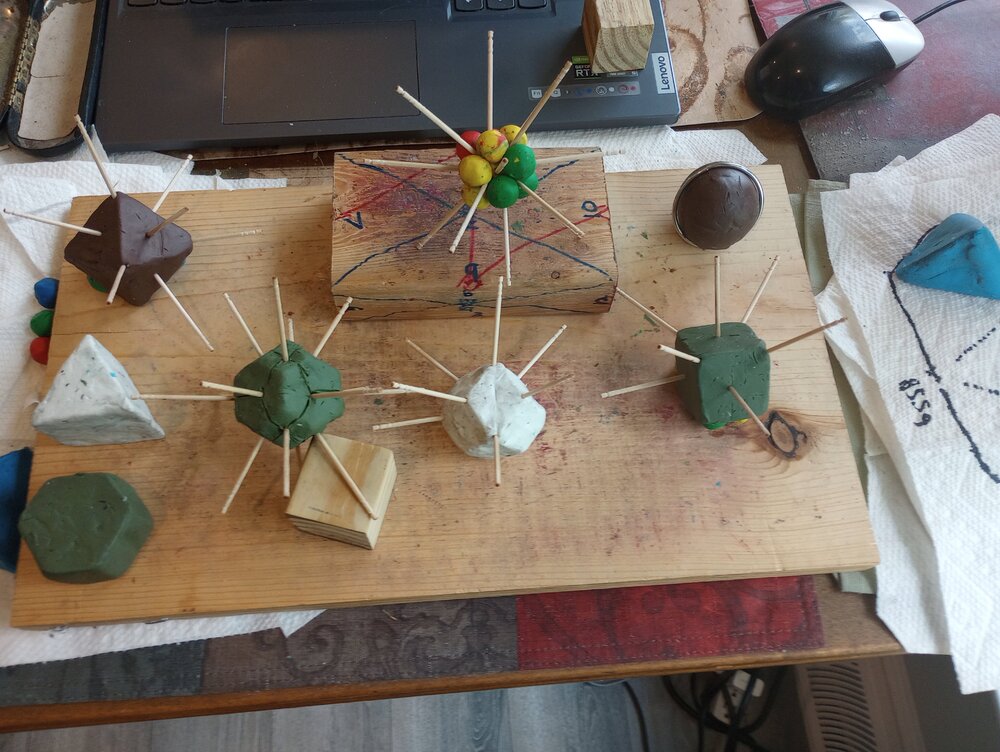
This recent breakthrough of mine, that 38 elements of the spherical close packing matrix can be used to build a truncated octagon, together with the fact that the truncated octagon can fill space leads me to a yet to be proven hypothesis that you can use the truncated octagon as a unit of volume.
Work in progress.
simultaneously I am working on whether you could use the rhombic dodecahedron as a unit of volume.
Looking for the most elegant solution.
-
I got my axis and directions mixed up.
The 12 directions I was talking about are in the direction of the faces of the rhombic dodecahedron, there are 14 directions using the truncated octagon. The names of these 14 directions would be
up/down
Then 60 forward from up
60 degrees to the left of that still 60 degrees lower than up
60 more counter clockwise
60 more which is 60 degrees lower than up and 60 degrees backward
60 degrees more
60 degrees more with each of the last 6 having the opposite direction.
Each direction having 6 surrounding directions 60 degrees away.
-
interestingly if you want to build a truncated octagon out of spheres, to get all the right angles and distances, you can do it in the following manner
put three spheres together in an equilateral triangle
put another three together and put them on top other three turning the three 60 degrees so they fit into the other three to make a octagonal shape
build two stacked hexagonal planes by putting spheres right around the three you started with on each plane. You should then have two hexagonal planes with 12 spheres in each, 9 around the center three. Put the planes together with the three ball sides mating with the two ball sides of each 12 ball hexagon plane section. Then build a 7 ball hexagon plane section and put it on top of the two and another 7 ball hexagonal plane section for the top. The top and bottom sections will fit onto the neighboring plane just right to make the truncated octagonal shape. Make each of 8 square sides flat as well as each of 6 hexagonal sides and you have a 7 D TAR unit volume. 14 sides all pointing in one of the required directions with a parallel side facing in the opposite direction. Each pentagonal side with an opposite and parallel pentagonal side and each square side with an opposite square side.
I made the shown truncated octagon out of 38 spheres 7+12+12+7 totaling 85.5g. This is the same volume of clay that made a sphere that exactly fit though a ring with a 2 inch outside diameter. All the figures on the paper were made with 85.5g of clay to visualize the relationship between the figures. So whatever volume you want as your unit volume, divide that volume into 38 equal portions and build the unit volume truncated octagon out of the 4 octagonal plane sections noted.
Copyright TAR2 (Thomas A. Roth) August 2025.
There are several figures shown that were built earlier before I used the 85.5g as the volume of the sphere that fits through the 2 inch outside diameter ring.
The truncated octagon shape made out of balls was a model I made out of 3g balls. When I made the actual truncated octagon I counted the balls in the model, found there to be 38 and divided an 85.5 gram lum[p of clay up into 38 pieces by rolling an 85.5g lump of clay into a 190mm long log, marking off 10mm sections, cutting the sections and then dividing each of the sections in half, giving me 38 lumps of clay I rolled into little balls it built into the truncated octagon shape mentioned, out of the hexagonal plane sections, pressed it all together side by parallel side between two boards.
-
the7 axis in the rhombic dodecahedron goes through the corners between the flat diamond faces and you cant line the corners up and fill space. Has to be faces. So if you want to build the required unit volume shape, it needs 14 faces. each face the same distance from the center of the shape. This IS the truncated octagon..
If anybody uses this idea to build a unit volume for computer rendering, I would appreciate a mention. Perhaps call a unit volume "the 7 D TAR"
-
As I continue to work on this rhombic dodecahedral I find it is VERY possibly the basis of a new way to describe space. Not in 3 dimensions, but in 7. The seven axis are
up/down,
forward/back,
left/right
up-right-forward/down-left-backward
up-left-forward/down-right-backward
up-left-backward/down-right-forward
up-right-backward/down-left-forward
Basically the corners and the center of each side of a cube, describing 14 directions. If you place a ball on the center of each edge of the cube you will have the 12 balls around a center ball arrangement I have been talking about in this thread. The twelve sections of the sphere. If you continue to build balls out, each ball with the same angular relationship to the other balls, a truncated octahedron begins to take shape.
A truncated octahedron is a permutohedron and fills space. Turns out you can take a central "ball" in the shape of a truncated octahedron, and put 12 truncated octahedrons around it. The center of each the same distance away from the center of all neighboring rhombic dodecahedra.
Notice from right to left starting with the tetrahedron on the right, that exactly the same seven axis are present in the tetrahedron, the truncated tetrahedron or octagon, the truncated octagon, the cube, the cuboctahedron, and the rhombic dodecahedron. Next to the truncated octagon is the 12 sections of the sphere built out several layers and it builds out into a truncated octagon shape. It consists of 3 square planes and 4 intersecting hexagonal planes all tilted to each other in the exact same arrangement. This arrangement appears when you put twelve balls around a center ball, building a hexagon equator, a three ball north pole and a 3 ball south pole with the triangle of the three north balls opposite the three south balls.
Imagining a truncated octahedron as your origin, and a truncated octahedron of the same volume as your unit of volume you can build out in all directions, with no gaps.
This give us several advantages in describing space. You don't need PI or Sines and Cosines to describe lengths and distances, to find every location in Cartesian Coordinates.
You can find every location in space based on a direction (one of 14) from the home truncated octahedron, and the number of volumes out to a second "home" truncated octahedron from which a direction and number of volumes will get you to ANY truncated octagon in space. Perhaps more coordinates are required to describe a volume, but you don't have any approximations. You can deal in whole numbers.
I also see this matrix of truncated octagons useful in 3D computer imagery as you can build ANY shape out of these identical volumes. If you can give the coordinates of any truncated octagon in space than you can build ANY shape in space. If you need more precision, you start your home truncated Octagon at a smaller volume. or distance between parallel sides.
The truncated octagon can be used as a 7D pixel and you could render any "Three Dimensional" shape.

I mixed up two packing permutahedrons in that one of my sentences there because both the truncated octagon and the rhombic dodecahedron seem to be based on the same 7 axis, however I think when we talk about centers and positions, which is required if we are going to use unit volumes, I think the truncated octagon works out better than the rhombic Dodecahedron. I did not mean you use rhombic Dodecahedron in that sentence, I meant to use Truncated Octahedron as that is the Shape you build as you build out spheres from a central sphere.
-
9 minutes ago, exchemist said:
While changes in a gravitational field will propagate at c, a static field, like that exerted by the centre of mass of a galaxy, has no “speed”. And this is just another vague idea, thrown out by you seemingly at random, with no attempt to work it out to show how it might produce the effect on rotation rate that we observe.
If you want to make a serious scientific suggestion, you have to show how your idea might produce the observed effects.
If the spiral arm of a galaxy contains a lot of stars and mass and you pick a point on the fringes of the galaxy the gravitational pull of the arm will speed up a mass that is "behind" it, rotationally and retard the rotational movement if it is"ahead" of the arm and the arm would add to the gravitation mass of the center of the galaxy if center of mass of the arm was between the fringe point and the center of mass of the galaxy. Thus "when" the arm is in the various positions relative to the fringe point matters in terms of the acceleration the arm's mass will impart on the fringe point.
swansont, the galaxy pictured was seen from its axis of rotation. All the fringe was equal distant more or less. An edge on galaxy the far side would be further away and hence what you saw of it was its position a long time before what you see on the closer edge.
Regards, TAR
9 minutes ago, swansont said:Because that’s how rotation works.
You are missing information here. You can get doppler shift information even if it’s only a component of the velocity.
If the galaxy was edge-on, you can get the information from the opposite edges, which would in fact be the same distance away, but wouldn’t get the information from the interior part, since you can’t see it.
The individual parts still had gravitational pull. And at distances far enough away, it won’t matter if the mass is concentrated or not (it’s why a black hole has the same gravitational attraction as a normal star of equal mass, as long as you’re further away than the radius of the star. (i.e. the earth wouldn’t notice a gravity difference if the sun were a 1 solar mass BH)
edge on the close edge is more recent than the far edge. Looking from the axis of rotation the edges are all approximately equal in age.
If my theory is correct the rotational speeds of galaxies viewed from the axis of rotation would be more consistent with Kepler's law than galaxies viewed edge on.
I do not know if there are observations categorized in this manner. Edge on or from the axis of rotation.
not theory, not even hypothesis. If my speculation is correct the edge on galaxy would be figured to require more dark matter to explain its rotation than the axis viewed galaxy because the time component is not throwing off the observation as much in the axis view
-
5 minutes ago, swansont said:
The center isn’t rotating, and I addressed the issue of timing, though you didn’t quote that part.
I am not sure why you know the center is not rotating. Don't you have to watch a galaxy for a thousand years before you notice a change in position of a unique star? You can only use red shift and blue shift if the galaxy is edge on. Looking at it form the axis you don't know any of it is rotating.
1 minute ago, swansont said:The effect of the mass doesn’t “turn on” when it forms a clump with another mass. It’s always on.
SwansonT, long time no argue with. Good to see you.
Well Jupiter did not have a strong gravitational pull until it formed out of the accretion disc of the solar system.
You cannot measure Jupiter's gravitational effect on Sirius unless there is a Jupiter.
'
-
Thread.
Lets say mass accretes and tiny pieces of matter gather in one location to make a massive object. This mass does not instantly affect all the rest of the universe, does it?
Objects close to it I would imagine are effected first and objects further away later. After a time X after accretion a close object has been subjected to its gravity for nearly all of time X whereas an object far away from the accretion is yet to fell its effects.
-
30 minutes ago, exchemist said:
That is what MOND tries to do. But that is based on an actual model with detailed calculations to support it. What you seem to be doing is pulling random ideas out of your arse, with no attempt at quantifying their effect to show how they might explain what we observe. That’s no good.
yes i like the MOND solution. I am maybe turning to looking for an explanation of the difference in gravity effects at large distances that would help base the MOND solutionk that involves the delay in gravity's effect on distant objects based on the "speed" of gravity. Thus timing and the consideration of which parts of the model exist "at the same time" becomes pertinent.
Regards, TAR
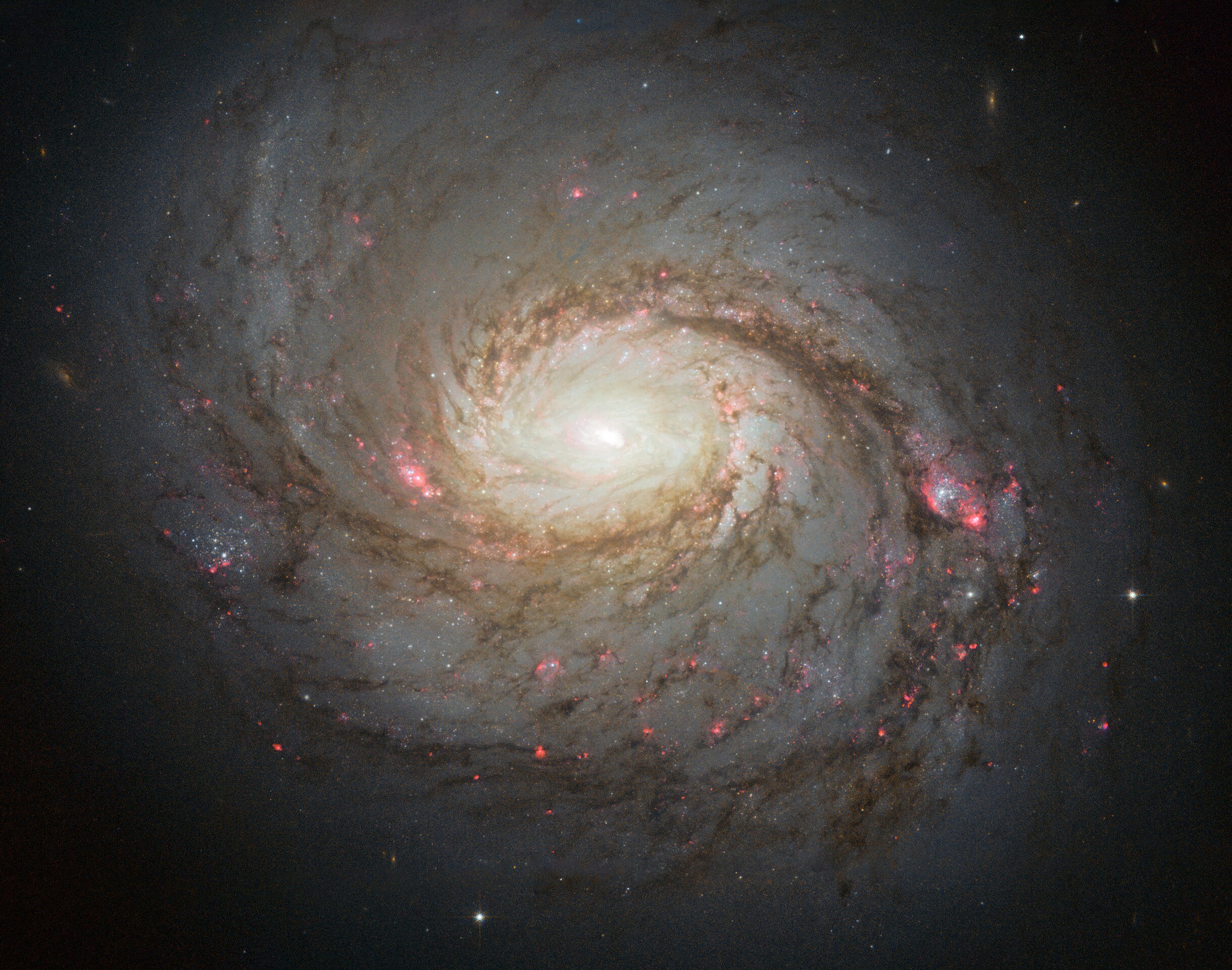
22 minutes ago, swansont said:like NGC 1068? Notice anything about it?
https://en.m.wikipedia.org/wiki/Spiral_galaxy
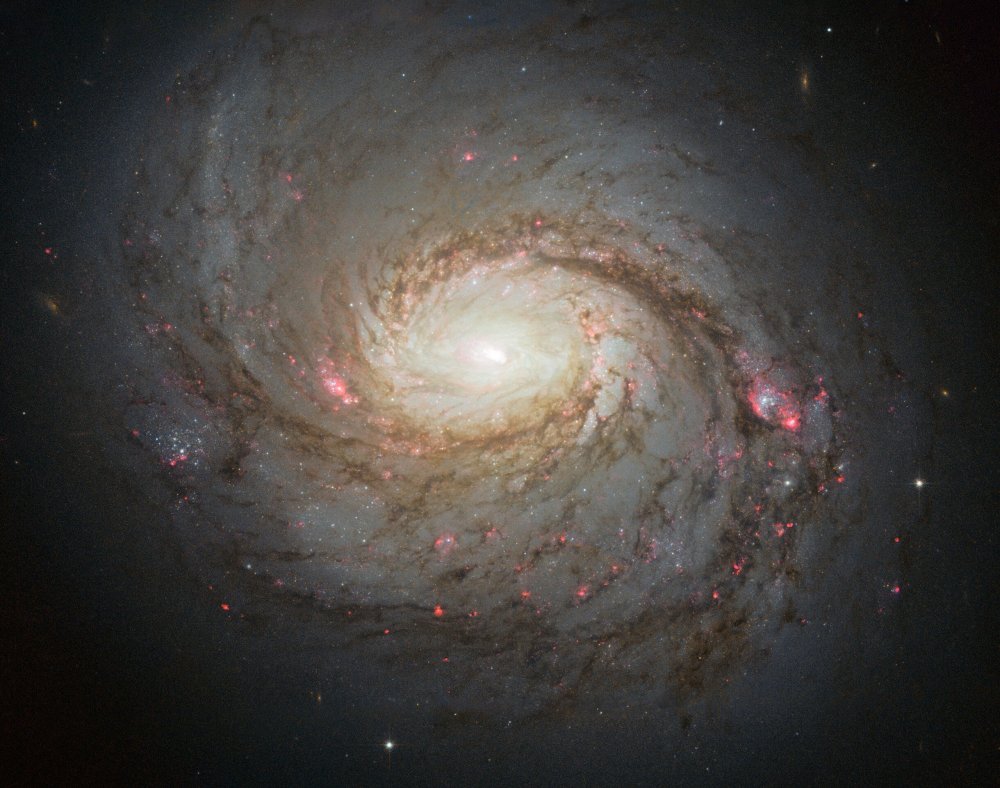
There’s always uncertainty but we can quantify it.
The thing about spiral galaxies is that the motion is tangential, not radial, so it really doesn’t matter when the time-tag of the measurement is. I don’t see where you've made the case that it matters
I notice that we are seeing it from its axis of rotation. That is, if we look at a galaxy edge on the closer part of the galaxy is on the edge closest to us but here the fringes of the galaxy are all the same distance, hence happening at the same time as the other portions of the fringe. Although I would still imagine that the center of the pictured galaxy is closer to us then are its fringes. Thus implying that we see the rotation near the center before we see the rotation at the fringes that was occurring simultaneously
Regards, TAR
-
I understand I am lacking in the math department exchemist, but I am not there yet with this idea. I am trying to set the assumptions and groundwork for expecting the universe to be connected to itself and be composed of ordinary matter and energy that we have been studying for years and know a lot about.
If something only fits the math and has not correlation to reality and ordinary matter and energy, what is the use of it?
It is like people finding PI to the quadrillionth digit. Why? You cannot measure or fabricate to that precision so what is it for?
I think math is very useful, but it is a symbol system. You have to know what is standing for what. You have to be able to say it words to know what you are setting to what and what relationship you wish to illustrate.
You cannot for instance figure that half a cow will give half as much milk. Half a cow would give half as much hamburger.


Is there such a thing as Anti Time
in Speculations
So two things. One, when we speak of opposites do we mean opposite is "Some" way or opposite in many or ALL ways?
I am not sure what Feynman might mean by a particle traveling backward in time. There seems to a causal arrow where one event causes another. How could something be uncaused? Once it has happened the arrangement of the Universe is different and there is, in my estimation NO way to set the universe up in the exact arrangement of the prior moment. So no time travel is possible. You cannot undo the universe, and you cannot put the entire universe into a future configuration.'
So anti time might be the reversal of the casual arrow, but what would that mean? How could an explosion become a bomb? It makes no sense. All those photons from the explosion would have to be retrieved and there is no even hypothetical way you could do that.
Which brings up another aspect of this and that is what can happen in one's mind cannot necessarily happen in reality. So even if YOU can think of the opposite of something, that does not mean reality can do it.
Regards, TAR