

Khanzhoren
Members
-
Joined
-
Last visited
Everything posted by Khanzhoren
-
In my opinion, if the relationship of this quantum phase space with the canonical commutation relations and linear canonical transformations is considered directly, one may defines it directly as the set of momenta and coordinates operators that are related to each other by these linear canonical transformations (which leave the canonical commutation relations covariant.) According to the uncertainty relations, one cannot simultaneously have exact values for both momentum and position. Yet, the very definition of a classical phase space pre-supposes the opposite. In my opinion, therefore, the existence of negative probability densities reflects this problem that exists from the very definition of the classical phase space. I acknowledge that this approach, which uses these 'quasiprobabilities,' yields results... but it's probably not the best approach to maintain the classical definition for the phase space itself.
-
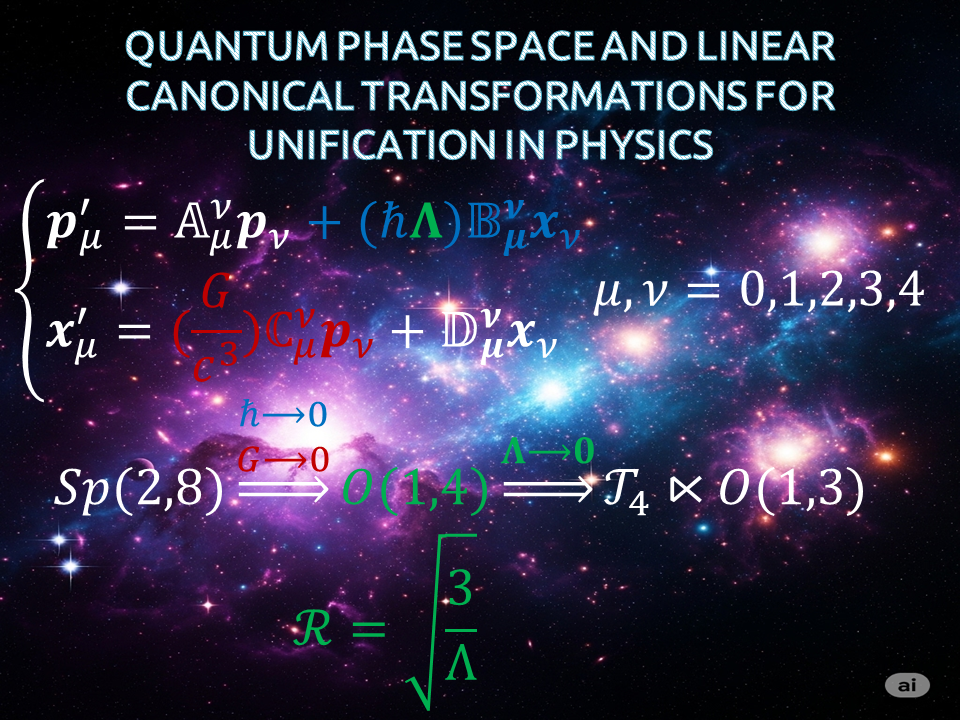
Hello everyone. This was seen on a Facebook group . Any comments/expertise are welcome. A Quantum phase space-based approach to unification The theory of relativity unifies space and time through the concept of spacetime, and changes of reference frames are described by Lorentz transformations, which "mix space and time." In this unification approach, energy-momentum is unified with spacetime through the concept of quantum phase space, and changes of reference frames are described with linear canonical transformations, which "mix energy-momentum and spacetime. " The concept of phase space originates from the Hamiltonian analytical formulation of classical mechanics. This concept has important applications, for instance, in statistical physics, but it is not compatible with the uncertainty relations of quantum physics. The search for a solution to this problem led to the introduction of the concept of Quantum Phase Space (QPS). A further challenge in introducing Quantum Phase Space (QPS) involves identifying its associated symmetry group. This group can be shown to be identifiable with the group of Linear Canonical Transformations (LCTs) which is isomorphic to a symplectic group. These LCTs are known in signal processing and optics as integral transforms that generalize fractional Fourier transforms. However, it can be demonstrated that they are equivalent to linear transformations that keep quantum canonical commutation relations covariant. Their relativistic and multidimensional generalizations can then be used to describe changes of reference frames in physics, thereby generalizing De Sitter, Poincaré, and Lorentz transformations, potentially incorporating quantum and gravitational effects. The illustrative picture shows that the “effects of the mixing between spacetime and energy-momentum"—considered to be potential quantum and gravitational effects—are linked to the extremely small values of the product of the Planck and cosmological constants, and the ratio of the gravitational constant to the speed of light cubed. Consequently, these effects might only be detectable at very large distances or with very high energies." It is also assumed that the approach corresponds to a spacetime whose vacuum is a De Sitter space with a (1,4) signature, which could be in agreement with a positive, non-zero cosmological constant. The mathematical formulations of physical theories rely on the concepts of space and symmetry groups. We can consider using the concept of QPS and its corresponding symmetry group, formed by LCTs, to better reformulate relativistic quantum physics. This reformulation could aid in the search for solutions to open problems in physics and cosmology, such as: quantum time operator, quantum measurement, unification of interactions, quantum gravity, neutrino oscillations and masses, matter-antimatter asymmetry, dark energy, and dark matter, etc. source : https://www.facebook.com/photo/?fbid=644632251991561&set=g.1790761467631151
-
Hello everyone, I recently heard about the concept of "celestial holography". The sentence that first caught my attention with this notion is the following: "Celestial holography proposes that our universe can be understood as a projection on the night sky" (found in this link : https://www.pppl.gov/events/2024/colloquium-celestial-hologram-stargazing-quantum-gravity-and-back). I would therefore like to ask for more explanations (if anyone knows more) or simply opinions related to this concept and its possible applications and importance for physics. Thanks
-
It is clear that some large scale phenomena like geological processes and formation of stars cannot be reproduced in a relatively limited space and time and they are still occuring so there are some other ways to observe/study them more or less directly. Regarding the origin of life, it is unique in the sense that it is a key step in evolution around which there are still many important unresolved questions. I naturally wonder about a possible reproducibility in the laboratory or not; I think it's an obvious question to ask.
-
What do you mean? Anyway, perhaps there are misunderstandings, or perhaps I didn't express myself clearly, but to be clear: my previous statement concerns solely, at its level, the problem of the experimental observation of the abiogenesis process.
-
It seems to me that there are some misunderstandings in our discussion. So, I will simply rephrase my question differently : Do you think it would be possible to observe the abiogenesis process in a laboratory and within a reasonable timeframe?
-
As a reminder, I asked this question because another person previously mentioned a long duration to conclude that direct observation (possibly in laboratory) would probably not be possible due to this . Then you spoke about duration in relation to chemical kinetics when i asked why He/she said that. May be you don't understand what I mean by direct observation Or perhaps I expressed myself poorly. Anyway I mean by it " an experimental observation of the transition of a non-living system to a living system in a laboratory or something like that ". Otherwise, as far as I know, modern physics also has an experimental aspect of this kind.
-
I understand your explanations very well and they are not really new things for me. But let's say typically, has anyone ever given a realistic quantitative estimate of the duration of the chemical process that could correspond to abiogenesis?
-
I know a little about chemistry but without being a chemist. If you can go in-depth into the explanations I can follow and it would be appreciated. Thanks
-
However, as well-known, a living organism can be microscopic, even with a relatively low number of constituent molecules.
-
why do you say that ? I asked Why do you think a seemingly molecular process would take so long?
-
Why do you think an apparently molecular process would take so long? Indeed, if it were a process on a larger scale (stellar, geological, etc.), it would be more understandable if it required so much time.
-
That's correct, but I'm referring to a direct experimental observation of the phenomenon (possibly in a laboratory), of course. This process is also probably rarer than we might have thought, given the fact that the existence of extraterrestrial life eventually seems to be very difficult to confirm.
-
What I simply wanted to say is that, if I'm not mistaken, there hasn't been any direct evidence or direct observation of the process of abiogenesis, so it remains theoretical. This statement is unrelated to the hypothesis of the existence or non-existence of a god
-
Thank you for your comment and the links. However, I didn't really say that the understanding of the (theory of the) mechanism is not advanced enough... Rather, I asked if there has ever been any direct experimental evidence of the transition from "non-living" to "living"."In the absence of direct observation, even the most advanced theories remain debatable and hypothetical.
-
Thank you for your comment. Perhaps it would be better to reclassify this theory in the field of mathematics rather than physics? Until its capabilities in physics are truly proven? Indeed, some people say that this theory absorbs too many 'resources' and 'possibilities' that could have been used for more fruitful things (for physics).
-
Can there be more than one 'most powerful'? Even if there are several possible gods, there must be one who is the strongest? The God of gods ? the top of the pyramid ? I more or less agree with you on some points... But when I talked about a gap, I was thinking about the fact that (if I'm not mistaken) there has never been direct experimental proof for the passage from the 'non-living' to the 'living', for example? And the fact of flying or other things that distinguish animals from others are certainly big steps in evolution... But the fact that humans are able to 'reflect' on evolution itself, on the origin and global behavior of the universe, the meaning of existence, self-consciousness, etc., seems quite remarquable and still mysterious compared to any other differences.
-
Basically, if the God exists, it must be, by definition, the most powerful deity and the most poweful beings . But how can we define "power" when talking about gods? Anyway, If other more mysterious (higher?) beings than human exist, there must eventually exist more mysterious (higher ?) attributes that distinguish them. A question that can arises is the following: Are humans the pinnacle of self-consciousness and intelligence? Are there "things" deeper (higher ?) than "human consciousness" and "human intelligence"? Indeed, it seems that these are the main attributes that distinguish humans from other living beings, just as life distinguishes living beings from non-living things. But another mystery is that there seems to be a "big gap" between the non-living and the living, just as there seems to be a "big gap" between human consciousness and intelligence compared to those of animals, whereas from a physico-chemical and biological point of view, the differences do not seem to be big enough.
-
It is conceivable to argue that if this theory is correct, it must necessarily correspond to some things that we should be able to test with existing means in one way or another. Relativity was able to be tested in a certain way after some time, as was Quantum Mechanics (And they rapidly explained, in a remarkable manner, many experimental facts that required their introduction). Admittedly, there were predictions like gravitational waves for General Relativity or certain aspects of quantum mechanics that took time to be discovered, tested or understood in depth. But these two theories (like others) were able to begin to be tested in some way fairly early on. String theory has been around for decades now, It should have led to some testable things (in one way or another) if it is correct. Anyway, This is just a simple thought, and it might be wrong
-
As it is known, many classical properties (defined, known, and measured within the framework of classical physics) of solids or other similar systems are truly understandable only by using quantum physics through condensed matter physics. The properties that manifest "classically", including the concept of size, are consequences of underlying quantum phenomena. We can therefore possibly have a quantum definition of size that (rigorously) differs from the elementary classical definition , but which reduces to the equivalent concept in classical physics under certain conditions: this is what is done when defining the size of an atom or a molecule for example. Even for something considered as fundamental as an electron, quantum field theory states that it is subject to vacuum fluctuations, these properties are intrinsically linked to its interactions with virtual particles and the associated creation-annihilation processes according to the energy scales considered (...) So even the description of the properties of a single particle considered as fundamental need a many particles (quantum) theory . Does the concept of size really make no sense in this context? Perhaps we could eventually introduce a quantum concept of "size" for an electron which could be an extension of the classical concept and reduces to the latter in certain conditions? Maybe this size depends on the energy scale? The question is probably still open ? Now what about things like the "gravitational singularities" that are discussed in this thread? It is known that a black hole, for example, results from the gravitational collapse of a system formed by a large number of particles (it is a composite system ... like a molecule or a solid). Couldn't we talk about its "size" in relation to a quantum description taking into account the localizations and movements of its constituents (governed by uncertainty relations, among other things)?
-
I agree with you I don't entirely agree with you because one also talks about the size of an atom, a molecule, or a solid, for example, within the framework of quantum physics (even if it's not exactly the same as the classical concept). These "sizes" moreover depend on the localization, movement, and interactions of the constituents with the environment. These are described by quantum mechanics and are related to the uncertainty principle, among other things. I agree with you because actually, when I said quantum description, I was referring to a quantum theory of gravity as well.
-
It is evident that the rock existed before the astronaut arrived. Didn't the universe itself exist before humans appeared? In my view, the existence of matter and its macroscopic properties does not strongly depend on the existence of conscious being that could make a 'measurement' but on the interactions between its constituents and with the environment. I am in favor of a view (related to the concept of quantum decoherence : https://en.wikipedia.org/wiki/Quantum_decoherence) which affirms that the properties of matter already result from the interactions that exist between its constituents and its environments (independent of the existence of a conscious observer). But the arrival of the observer could simply change certain things depending on their actions on the system. That being said, it is clear that, in Reality, the cat is already either alive or dead according to the results of the interactions of the cat's constituents with their environment (as described by the concept of quantum decoherence) without the need for the intervention of conscious observer to look.
-
I think that the transformations under consideration are not conventional 3-parameter LCTs but rather some kind of multidimensional generalization of them wherein (among other things) spacetime replaces time.
-
Why ?
-
In quantum theory, due to the uncertainty principle, the exact values of coordinates (position) and momenta (related to velocity) cannot generally be known simultaneously. Consequently, a description of acceleration is not trivial ... However, Ehrenfest's theorem ( https://en.wikipedia.org/wiki/Ehrenfest_theorem) allows us to describe the time evolution of the mean values of quantum observables. Thus, we can still consider for a quantum particle an instantaneous average position (in the quantum sense of mean values), a kind of mean value of velocity (time derivative of the average position), and subsequently a kind of mean value of acceleration: it suffices to use Ehrenfest's theorem to relate these quantities. One can even show that there are some equivalents to Newton's laws in terms of these mean values"
