Luc Turpin
Senior Members
-
Joined
-
Last visited
Everything posted by Luc Turpin
-
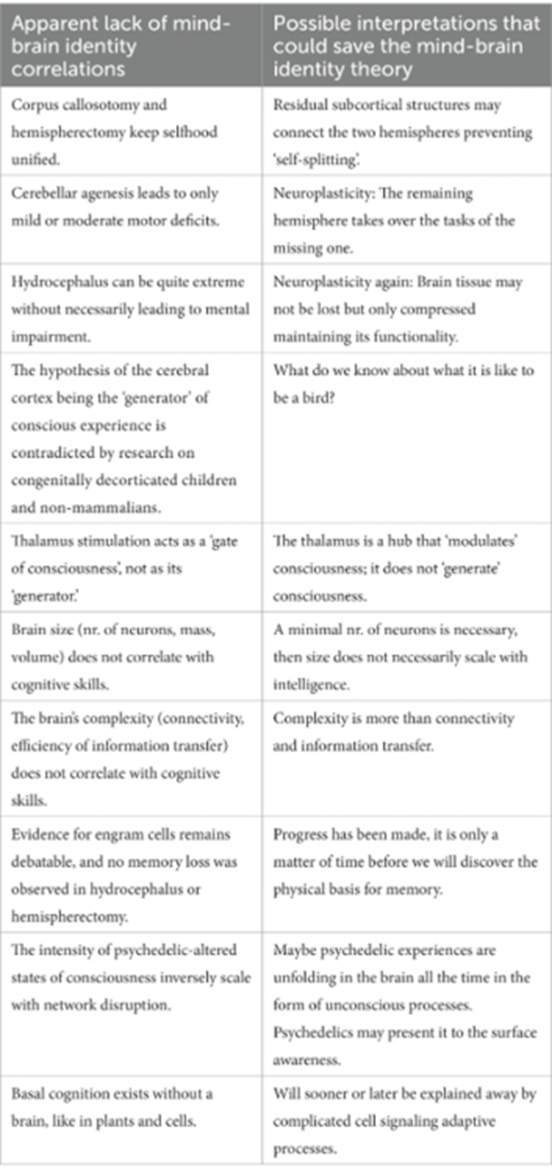
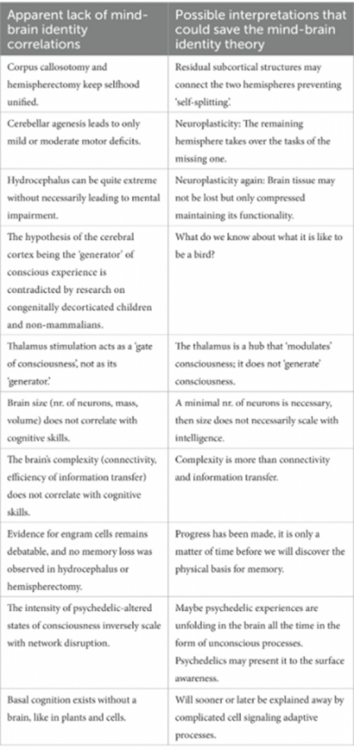
I agree on the three main points of your post: 1-responses to stimuli based on a comparative assessment; 2- brain energy requirements; 3- need of a physical entity for brain. And to provide us with more matter (pardon the pun) for discussion, I am providing key information that I obtained from the article that I referenced earlier. https://www.frontiersin.org/articles/10.3389/fpsyg.2023.1150605/full. Some elements of the article also validate some of the claims that I made earlier in our discussion. No evidence of a single brain region, area, organ, anatomical feature; From single brain region, to compartmentalized to a network system for consciousness without consensus; No brain region does only one thing; no neurons have only one function. Corpus callosotomy does not create two consciousnesses; patients denied being different; Hemispherectomy - one could not tell the difference between humans having a whole brain or only half of one. Only a thin sheet of actual brain tissue in man with 75/100 iq with a job, family and normal life; Children with almost no cortical tissue in vegetative state developing signs of perception Brain size does not matter (mouse lemurs, brains 1/200th the size of monkeys’ but perform equally well on a primate intelligence test; Brain complexity - information transfer through the neural network in human comparable to mouse; Neocortex only in humans and other mammals, but not in birds, fish, octopuses, amphibians and reptiles. However, example a birds performing cognitive feats despite forebrains consisting of lumps of gray cells; cephalopods and crustaceans are sentient Loss of memory due to injury regained after years; Credible reports of terminal lucidity; whereby severely diseased dementia patients with ravaged brains recover full cognition for a short period of time before death Intensity of metabolic activity does not play role in generating conscious experience; Memory is not stored in a specific brain area like a digital computer; Information does not scale with brain size; Flatworm cut in two, regenerate and both keep conditioned memory; Synaptic connectivity is challenged for long-time memory; Plants, multicellular and single-celled lifeforms, without any neural substrate have cognition Finally, here is a table that summarizes the summary No worries, as I make mistakes all of the time.
-
https://www.frontiersin.org/articles/10.3389/fpsyg.2023.1150605/full This summarizes my position. Please read it to understand where I and some scientists are coming from! On cerebellum – from the article link above – ‘For example, the cerebellum is almost exclusively dedicated to motor control functions, and its impairment leads to equilibrium and movement disorders. However, it does not affect one’s state of consciousness. Its role in ‘generating’ experience seems to be marginal, if any. There are also rare cases of people who live without a cerebellum (‘cerebellar agenesis’) and have only mild or moderate motor deficits or other types of disorders (Feng et al., 2015). This is a fact that seemingly confirms the brain’s proverbial neuro-plasticity, which we will see next through other extraordinary examples.’ On thalamus – from the article link above ‘The thalamus is responsible for sensory information processing. It is known that its main job is to function as a relay and feedback station between sensory brain areas and the cerebral cortex. For example, it functions as a hub between the optical nerves that transport the visual information coming from our retinas to the visual cortex. Even if one remained conscious by turning down the functionality of the thalamus, one would no longer see anything because the neural pathways between the retina and the visual cortex are interrupted. From that, however, nobody would conclude that the thalamus is the seat of the visual experience for which the visual cortex is responsible, as we know that it is a ‘hub,’ a ‘transducer’ or a ‘filter.’ From this perspective, the thalamus’ function is to ‘integrate’ the information flow of the several brain areas; if this is disrupted, it leads to a ‘loss’ of consciousness. Thus, these findings do not tell us much about the generation of conscious experience. However, if there is not one single ‘seat of consciousness,’ could it be that the combination and activity of some or all of the different brain areas do ‘produce’ the subjective experience?’ Both topics covered in the Mind thread! Still looking for an article stating that new findings are not yet integrated into theory. However, I still hold the claim that through the numerous readings that I did, it appears to be the case – my statement. From now on, I will not take for granted that initial references in first post were consulted. Got it 'While these (mostly ignored) findings", From summary of same article referenced above.
-
I had this in my original listing of references, but removed it because it was not current enough (2014). This is one of only a few that says that we are doing so. And much has happened since 2014 that has not gotten into theory.Science is moving so fast these days that what you learn in your first year university studies is perennial by the fourth year of graduate studies. also, read only second part of my last post as the first part is a repeat. did not want to be such a bother
-
Senior Members 4 107 Author Posted just now I provided a total of 55 references on where is mind in brain, where is mind in nature and how mind is produced in brain (see original post). I guess that not everyone looked into them.This is my starting basis for claims that I make. Some are more scientific than others. If it is insufficient, I can add more. And this is the evidence that support the claim that we should have a different take on mind-brain connection. I can try and find articles for my assertion (your second post), but this was based on comments made by some, not many, in the neuroscientific field..They also contend that there is a lot of catching up to do. the assertion that theory does not match evidence is my own with the assistance of evidence found in some of the references provided and assertions made again by some in the neuroscience field. I can change tack if required. finally, I knew at the very first posting, that this would be a controversial topic, but a discussion on it is still warranted. i seek your guidance or can withdraw if asked. Apologies for submitting by error the same post twice. Also, I am French and this is not my preferred writing language. I do not wish to be right, or defensive, but to explain only the 55 references that I posted were to back my claims on where is mind in brain, where is mind in nature and how does mind work through brains, not on my claim that science has a lot of catching up to do. This is mine and some neuroscientists point of view, and stand behind it and assume responsibility for it. But, I am open to the possibility that I was wrong in claiming this without providing direct evidence. However, I have been following other threads and have seen circumstances where claims are made without background.. my original intention in posting on mind was to offer some evidence on a controversial issue (consciousness), have a fruitful discussion as I am having with some members and change someone and myself stance on the subject matter based on discussion and evidence. I am now pondering what to do next or how to proceed moving forward. Looking at the references and thread could be helpful. Please read only second part of post as first part is a repeat.
-
I provided a total of 55 references on where is mind in brain, where is mind in nature and how mind is produced in brain (see original post). I guess that not everyone looked into them.This is my starting basis for claims that I make. Some are more scientific than others. If it is insufficient, I can add more. And this is the evidence that support the claim that we should have a different take on mind-brain connection. I can try and find articles for my assertion (your second post), but this was based on comments made by some, not many, in the neuroscientific field..They also contend that there is a lot of catching up to do. the assertion that theory does not match evidence is my own with the assistance of evidence found in some of the references provided and assertions made again by some in the neuroscience field. I can change tack if required. finally, I knew at the very first posting, that this would be a controversial topic, but a discussion on it is still warranted. i seek your guidance or can withdraw if asked.
-
I respectfully beg to differ!
-
It is helpful for debate to be challenged. Yes, I am making broad claims because this is a forum and it is good for discussion. I do not pretend that all of my claims are 100% accurate, hence the need for discussion and challenge. And my claims would not make it in the scientific literature , without insurmountable evidence, but again this is a forum. if I am incorrect in this assertion, forum administrators will advise me and I will make a course correction. Also, no, I am not dismissive as I consider any objections to my claims as being constructive and in need of consideration. As for many researchers doing it and me just being unaware, I hope that you are right and I wrong, but I don’t see it as much as it being deserved in the literature that I consult. Finally, neuroscientists are doing their best at keeping abreast of ever faster new scientific discoveries, hence again the need to pause once in a while to reassess the situation.
-
Mind-brain theory has a lot of catching up to do with what observation and findings are telling us about it. A minority still believe that mind is strictly restricted to brains, and an artifact of it. I am not so sure about this anymore.
-
Presented as a general interest piece for those wishing to know more about evolution and its ramifications. Hope that by posting, I am not treating it as a blog! Thank you for the guidance; I am new at it.
-
https://phys.org/news/2023-10-scientists-philosophers-nature-evolutionary-law.html
-
Read and re-read your post; written with clarity. Again, I basically held the same belief about the mind and brain connection as you, with one being the sole property of the other. However, observation appears not to quite match up with what one would expect from a strict mind-brain connection. To be begin with, consciousness or one of its derivatives is prevalent in the natural kingdom: monera, protista, fungi, plantae, animalia. There is ample evidence for this and, to me, that is quite unexpected from a strict mind-brain connexion. For example, monera, protista, fungi and plantae lack most of what is considered to be normally required for cognition. They have no brains; therefore, no brain structure nor neurons. but still exhibit thinking. The chemistry used in making cognition is similar at times and different at other times, while engendering basically the same kind of cognition. It is also not corelated with brain size and not as strongly correlated to brain complexity as one might expect (from bees to whales). It has "cropped up" many times during evolution and the same basic principles of cognition appear whether it be on land, water or air (agreed that evolution and the environment shape it, but it remains basically the same kind of cognition). There is also overall indifference to brain structure. Cephalopod brains, as they have many, do not resemble very much those of mammalian brains, but still bring about basically the same kind of cognitive skills. As for anthropomorphism, I too thought that humans were subjectively attributing feelings, emotions and cognition to animals, but again a plethora of observations and studies seem to clearly indicate that something is really going on here. Where all of this goes from here, I do not know. However, it would be beneficial for science at this stage to revisit some of the cornerstone hypothesis of the mind brain connexion to see if they are still valid in their current state or in need of modification to concur with evidence. And how brain creates mind (the hard problem) remains entirely unaddressed. A pleasure discussing with you!
-
https://www.nhm.ac.uk/discover/octopuses-keep-surprising-us-here-are-eight-examples-how.html https://scitechdaily.com/single-cells-are-more-intelligent-than-scientists-previously-thought/ https://phys.org/news/2023-11-silky-ants-aphids-medicine-sick.html https://phys.org/news/2023-11-underground-fungi-forests.html Note: For generalisation, I provided summaries of studies and not individual studies used for these summaries; individual studies can be obtained if required.
-
I agree that the thalamus is a good candidate for the center of mind in human brains. However, where it breaks down for me is when observing animals with no thalamus (octopus, etc.) showing signs of deep thinking and other living things, even flowers showing signs of going beyond reacting to their environments. Bees, showing altruistic behaviors, bacteria appearing to think. The thalamus may be needed for reptilian and mammalian thinking, but not for others, including amphibians and insects. I will be overstretching the envelope beyond belief and may be perceived as a heretic, but its as if mind adapts to material circumstance instead of the opposite Just an impression that is by no means corroborated with anything. Also, can you substantiate on mental matrix?
-
First line - when I say that nothing confirmed so far as to the role of some sort of integrated system, its not me that is saying it, but neuroscientists who are testing out these hypotheses on an almost daily basis. They say that nothing is confirmed so far. If it was the case, Christof Kock would have won the bet (see initial post). Second line- I do not have any capability whatsoever of dismissing or not an hypothesis. Seth's hypothesis might be right, but possibly wrong, iNow's hypothesis about the cerebrocerebellum being involved in mind as a whole might be right but possibly wrong and my hypothesis might be right, but most probably wrong. Only evidence and neuroscientist's interpretation of the data will tell. On an additional note, to the cerebrocerebellum playing an execute role in planning motor actions, I do not doubt that this is right, but an execution role in planning motor actions is still far from where (center) or how the 'I" in consciousness is formed in the brain. Again, I am not searching for the center of consciousness in brain, its the scientists that are doing so. And I an not the arbitrator of who is right or who is wrong. I have ideas and you have ideas and none are better or worse than any until proven otherwise.
-
I also think that some sort of integrated system is at play, but nothing confirmed so far. I am not making the assumption that there is a center, but most-many neuroscientists do, and they want to know this, because it would pin-down where it comes from. please substantiate on multiple leaps that i am making. Part of science is also about making assumptions
-
Good point on intelligence; I replace it with thinking instead. On neural functions required for higher level of consciousness, you would be surprised as I was of finding out how some lower level living things are aware of their environment. But, agree that it is not in the form of what humans show. I agree with your basic premise in paragraph two that its instinct and thought. I believe that you were asserting that it was only instincts. Third paragraph, please tell me more as this is one of many areas that I need to comprehend much better. Agree a bit on your first statement, but their reasoning is rock solid sound and based on experimentation and applied mathematics. On the third paragraph, I explore panpsychist at times but I am compelled by evidence, and there is no solid evidence for it. Maybe in the future.
-
One more location that is added to the list of where mind could be in the brain. The RAS is located in the brainstem and I guess that this affects all of the brain. We also lose consciousness when we are in a coma or when we are asleep. Different brain regions being dampepended or activated causing a temporary loss of consciousness. Where is the center of mind or consciousness in the brain remains uncertain. My position at this stage, based on evidence, is that brains are not always needed to produce consciousness, but living matter is required. My position could move backward or forward depending on evidence.
-
So, my imperfect understanding of it is this: consciousness is not needed to explain quantum mechanics. It, (QM) stands alone not needing consciousness. Its not part of it, so says most physicists. However, Penrose uses quantum mechanics to explain consciousness. I too feel that there might be a role for consciousness in QM, but this statement has not validity, because it is just a hunch and that does not count for anything.
-
Many, many thanks to you yes, will need time to digest it all
-
a lot of good information; need to think before responding; will post something this evening,eastern standard time
-
And so gratefull for it
-
Noted i go where the evidence goes, and sometimes I go grudgingly!
-
I am getting better at following your reasoning, which is very sound.
-
Substantive response. Needed to think before responding For me and some neuroscientists, mind is on top and consciousness, intelligence, subjective experience all come from mind; while others talk about consciousness only (without mentioning mind), but with some sense of interchangeability with mind. If for the sake of clarity, we use consciousness only in that sense then this is good with me. But, I am in agreement with your statement that consciousness is the progenitor of that quality or attribute we perceive as mind. As for consciousness requiring brain functions, there are many examples of at least intelligence occurring without brains in living things (see second reference section of my original post). Where I think we differ substantially is when discussing where mind or consciousness comes from. Your point of view, if I understood it correctly (not because of the text, which is well written) is that its a result of stimulus-response or reacting to the environment in which the organism lives. I have to say that my former position on this matter was the same as yours a few years ago. But, mounting evidence appears to show that there is thinking being done and decision-making going on in living things. When first confronted with these findings (and they are not conclusive, I affirm), I was first baffled and then denied their implications. But, with so much findings pointing toward some form of thinking in almost all living things, one needs at the very least to start considering that there might be more than mindless reactiveness going on. Also, your description of how consciousness comes from or is derived by brain appears sound. I now understand why iNow (I think) was bringing homeostasis in the discussion. But the hardware problem (how the brain works) is easier than the software problem. How do you get flesh to create such a deep and profound subjective experience; that is unanswered (see original post). Finaly, I understand that I have a divergent point from most of you, and that is very healthy for discussion purposes. I too sense (not very scientific) that QM may have something to do about it, but, again, most physicists, I believe, do not. Most that do appear to be on the fringe of QM. One noted exception is Roger Penrose a mathematician, mathematical physicist, philosopher of science and Nobel Laureate. He does not involve consciousness to explain quantum mechanics, but rather tries to involve quantum mechanics to explain consciousness. E.g. uses the theory to explain consciousness, but does not say that it is part of it.
-
Please explain!