Luc Turpin
Senior Members
-
Joined
-
Last visited
Everything posted by Luc Turpin
-
I will try and be more specific. When bias threatens objectivity it is bad. When bias is acknowledged and mitigated with no effect on outcome, it can become indiferent. When bias is purposefully used to determine or not, or manipulate an outcome, then it is good. I hope less platitude this time. Obviously agree,
-
I concede that I have not demonstrated this kind of bias in science. However, the possibility of the results of the study showing such bias was originally introduced by the authors, not by myself. Notwithstanding, I grant that it was a reflection from the authors and of myself that it could be, not that it was. A second read of the paper combined with Genady's comment were required for me to come to this realization. To be clear, I am not stating that there isn't any of this kind of bias at work in science, but that at this point in time, I cannot demonstrate it. Also, I do not agree with your final statement that it is as "yet another unsupported claim of bias". There are studies out there claiming bias in science, but bringing them up on this platform is construed as cherry picking. Caught between a damned if you do rock and a damned if you don't hard place. As an end note, there is bias in science, there are many kinds of biases interacting with science, the cumulative effect of all of these biases on science is unknown, and claiming no effect is foolish. There only remains doubt as to the significance of the impact of bias on science. Upon reading studies about it, I suspect a high degree of impact, but concede again, that I cannot as yet demonstrate it. All that I can do is bring up studies or authors that have a like minded impression of the situation. Finaly, as long as there will be people at play in the scientific process, there will be bias in it.
-
Valid point!
-
So, how equations are written down has no effect on how we think of and process physics? The introductory text of the article accompanying the paper states: "A strange pattern running through the equations of physics may reveal something fundamental about the universe or could be a sign that human brains are biased to ignore more complex explanations of reality – or both." Upon reading the article and paper a second time, if equations of physics are not revealing something fundamental about the universe, than what else is at play here other than bias? What could explain that all three sets of equations would follow a same pattern? Other than bias? A bias caused by the way human brains work and that entices us to ignore more complex explanations of reality is still a bias; and an important one. The use of one form of language over another or the preferential use of some symbols over others is a form of implicit bias, is it not?
-
Hope that it is helpful The brain relies on shortcuts all the time. We use what we’ve learned from our environment to make quick assumptions about whom to trust, how to behave, what to say. But shortcuts can sometimes lead us astray. You can’t always trust your brain. Our eyes play tricks on us. Our minds fill in the gaps of what we think we see. But is that actually what’s there? Check out the two blue circles. They look like different sizes. But look again! A new perspective shows what they really are: two identical circles. Now check out these two squares—A and B. They look like different colors. A is darker than B, right? But look again! A new perspective shows what they really are: two identical squares. Two groups of circles appear on screen. The blue circle in the left group is surrounded with larger purple circles, where as the blue circle on the right is surrounded with smaller circles. The blue circle on the left appears to be smaller than the blue circle on the right. Two lines are drawn between the two circles, revealing that they are in fact the same size. The circles fade off screen. A checkerboard appears on screen and a cylinder casts a shadow on the checkerboard. Two of the squares are highlighted. Square A is surrounded with squares that are lighter color, where as square B is surrounded with squares that are darker color. Square A appears to be darker than square B. A line is drawn between the two squares, revealing that they are the same color. Still don't believe your eyes? These visual illusions work because the surrounding context of an image shapes what we see. Context is so powerful because it sets up our expectations of what we might see. And once we have that expectation, we can’t see it any other way! Titchener Circles Illusion When the center blue circle is surrounded by big pink circles, the center blue circle looks smaller than when it is surrounded by small pink circles. Checkered Shadow Illusion When the “A” and “B” squares are surrounded by a checkerboard pattern, our mind fills in the blanks and sees the “A” and “B” squares as different colors. Mindbugs are engrained patterns of thought that lead to errors in how we perceive, remember, reason, and make decisions. Dr. Mahzarin R. Banaji, Professor of Psychology, Harvard University Listen In From Mindbugs to Bias Transcript Bias is a process and builds over a lifetime. Familiarity Babies quickly learn to prefer people from familiar groups. A baby might prefer a face that matches the gender or race of their primary caregiver. At just a few hours old, newborn infants already prefer listening to a language that they heard in the womb over an unfamiliar language. Similarity Toddlers notice similarities and differences across groups defined by language, gender, or race, and they start to more clearly separate people along these dimensions. The adults around them fill in “value gaps” by subtly communicating about the kinds of people that are safe or smart. This teaches children whom they should approach and avoid. Belonging With further learning, children figure out who they are in the world. They learn the meaning of their own race, gender identity, sexual orientation, socioeconomic status, religion, and more. As a result, they also come to feel belonging, preferring their in-groups (“us”), and perhaps expressing negative attitudes toward out-groups (“them”). Confirming The process of building and maintaining bias continues into adulthood. Throughout our lives, we use confirmation bias to see only what we expect to see in our environment. We take in only the examples that align with our preexisting notions and stereotypes. We discard the counter-examples that would challenge these world views. Implicit bias is like the smog that hangs over a community. It becomes the air people breathe. Shankar Vedantam, Journalist Listen In Practice Makes Perfect Transcript Get Inside Your Head. What about my brain? Is there bias there too? The amygdala, hippocampus, and prefrontal cortex make up the control panel for bias. The amygdala fires up for our fears, the hippocampus records our memories, and the prefrontal cortex controls our ability to reason and reconsider. What part of the brain do you think is responsible for each reaction? What part of your brain is working here? You see a man walk into a fancy glass building. He’s carrying a briefcase and wearing an expensive suit. Six months later, you see another fancy glass building and assume, “that must be filled with men with briefcases and expensive suits.” Is it the prefrontal cortex, hippocampus, or amygdala? It's the hippocampus! This organ is the brain’s memory bank. The hippocampus notes the associations we make and reminds us of them later on. In this case, it creates a connection (in fact, a stereotype) between fancy glass buildings and men with briefcases. What part of your brain is working here? You’re deeply afraid of snakes. Suddenly, a snake slithers into the room. Your mind makes a snap judgment, immediately sending the message: “Fright! Fear! Flee!” You run and jump on a nearby table to avoid the snake. Is it the prefrontal cortex, hippocampus, or amygdala? It’s the amygdala! This is the “fear center” of the human brain. Fully developed just before a full-term baby’s birth, the amygdala sparks many of our emotions, fears, and impulse reactions. What part of your brain is working here? That snake is still in the room. Your amygdala has registered fear and the hippocampus reminded you to be afraid of snakes. You begin to calm down and realize that you don’t have to panic! The snake is across the room and, now that you see it more clearly, it doesn’t look so scary after all. Is it the prefrontal cortex, hippocampus, or amygdala? It’s the prefrontal cortex (PFC)! This is where the brain settles things. We can use our PFC to reason through different perspectives, weigh pros and cons, or even revise our previous assumptions about things and people. Bias is in our brains and baked into our environments from early in childhood. But having bias does not mean that we are destined to be bad people. Those same brain processes can sometimes be used for good. As humans, we can recognize both what we have in common and what we hold as unique differences. Listen in on a conversation between a young scientist and a celebrated philosopher to learn about the nature of our biases and identities. Dr. Tessa Charlesworth, a psychologist at Harvard, and Dr. Kwame Appiah, an emeritus professor and author, share their thoughts here. Next SectionBias IRL*(*in real life) Bias is a process initiated even before we are born. It is a process of learning about the structures and associations embedded in the world around us. But what actually are those structures in the world? Where is bias in real life? This link was given with the original article that I posted; it was at the very end of the article.
-
I keep saying bias, because the co-authors (Andrei Constantin, Deaglan Bartlett, Harry Desmond, Pedro G. Ferreira) allege that it is. And it is the unintentional kind brought about by how our brains work (again not mine introducing the subject, but the authors). The kind that is "baked-into" our way of perceiving and thinking; similar in general terms, but not precicely this: https://biasinsideus.si.edu/online-exhibition/the-science-of-bias Without notice, familiarity, similarity, belonging and confirming all play a role in the way science is done.
-
Maybe you are right that I am the only person who reads it as I do. I am not trying to attack science or scientists, most of the time, but wonder based on an outsider's perspective if there is not an over abundance of confidence in science, and this is my perception of you, swansont and most members participating in discussions with me; that you might have an over confidence in science. To me, questioning even the foundations of science is sound and healthy, not destructive. I think I do answer questions, but might not be giving the answer that is expected. There is joy in finding patterns. And when patterns replicate, then there is even more joy in the endeavour, because this could mean that we might be on to something. I don't think that it is as simple as that. Scientists cling to theories even when experimentation does not match. I presented a study that may be an indication of bias in science. I presented it for discussion purpose. To elicit a discussion; not to say that I am right and most of you are wrong. And I am not repeatedly throwing "bias" against the wall and hoping something sticks. I am however uncovering studies that seem to indicate more bias in science than acknowledged and want to share it, again for discussion purposes. Disconcerting in the sense that it may imply a more pervasive presence of bias. The provided study implies that it is the marking of patterns of bias.
-
Not a loaded question. Are you not a bit worried about the cumulative effect of what you stated in your post, plus other biases not stated, on science? In my last response to you, I had not the least intention of attacking you or anyone. I do not even know where you get that. I am not even attacking science. The only thing that I am doing is questioning, only questioning whether or not we are too confidence in the shielding of science from the effects of biases. That is it. No other intention. I am not even looking for an argument, but for a discussion. That is even more disconcerting. I like patterns; they possibly imply meaning or not! The article talks about human brains, so the introduction is not mine. No, the introduction of bias is not necessarily wrong, but only a demonstration that some interpretation of results is occuring, which might be a right or wrong interpretation of results. I tried to show support through a logical statement, but apparently this is insufficient. I do not want it to be or not be the way that I want it to be. The results of the study that I referenced seems to show bias. Whether it is or not showing bias is up for debate. And if I wanted it to be a certain way, then yes it would be a form of bias.
-
Do you not believe that science would be better off without bias? Why does it matter is dependent on the impact bias has on science. If it is a minor impact, then I agree with both you and swansont that it does not matter much. But if the impact is major, then it matters as we would no longer be as confident as we are about the validity of results. A single cut or death by a thousand cuts. It's the cumulative affect that bothers me. One scientific finding used as a precursor to another finding then used as a foundation for another finding. There is also the cumulative effect of various types of biases culminating into possibly more influence than one would expect of biases over science. I agree on this one that the links were to say the least very disappointing. I am trying to correct this, with no luck so far. Agree, should have said "might" expect instead of expect. That all three sets of mathematical equations follow the same pattern and that this pattern is found in linguistics is to say the least, confounding. No, no, not arguing deep meaning on this one, but that there "might" be biases brought about by how human brains work. That a law borne out of linguistics be possibly applicable to physics "might" imply that the former has some sort of sway over the latter. Physics should be all about the laws of nature, not about the laws of language. Zipf's law possibly applying to physics might be yet another example of bias seeping into science.
-
The timeline for post was merely mentioned to show that all of us are more dismissive of ideas that run counter to our belief system than ideas that do not. It's human nature. That there is bias in science is irrefutable. What is at stake here is whether or not the "warping" effect of bias has made understanding how nature behaves indistinguishable from its real occurrence. I provided yet another example of how bias might immerse itself in the scientific process, that is all that I have done. And I also share many of your concerns and have too not been able to fully access the article. The quote was taken from here "“You might expect that this [distribution] would differ quite significantly between the three different sets of equations because they come from different places,” says team member Deaglan Bartlett at Sorbonne University in France, but to their surprise, that wasn’t the case. Instead, all three sets seemed to fit the same pattern. That wasn’t true when applying the same analysis to randomly generated mathematical expressions." I reiterate, it is expected that three different sets of equations coming from different places should show no pattern. Then comes next the question of why something shows up if it does show up?
-
Why does it show up "between three different sets of equations....coming from different places" but does not show up in randomly generated mathematical expressions? Obvious that it would not show up in the latter, but not so much so in the former!
-
Not searching for bias; it just came up! 1. Yes Zipf's law shows up in more than physics, but why in physics? 2. Could not get to the methodology part either. 3. How nature behaves is part of reality. The analysis, if it holds up, still implies that there is some sort of pattern in the use of symbols, which should not be occuring. Did not catch the irony! But how many conincidences will be required before it is no longer interpreted as a coincidence? Your "account" of what might be going on may very well be true, but finding a pattern when there should not have been one is still worth consideration, even if it eventually leads to an impasse. And scientistis prefering to calculate the easy way is stil some sort of bias. A pause to contemplate before outright dismissal is a good thing in science. The speed a which you responded speaks loudly.
-
Coincidence!
-
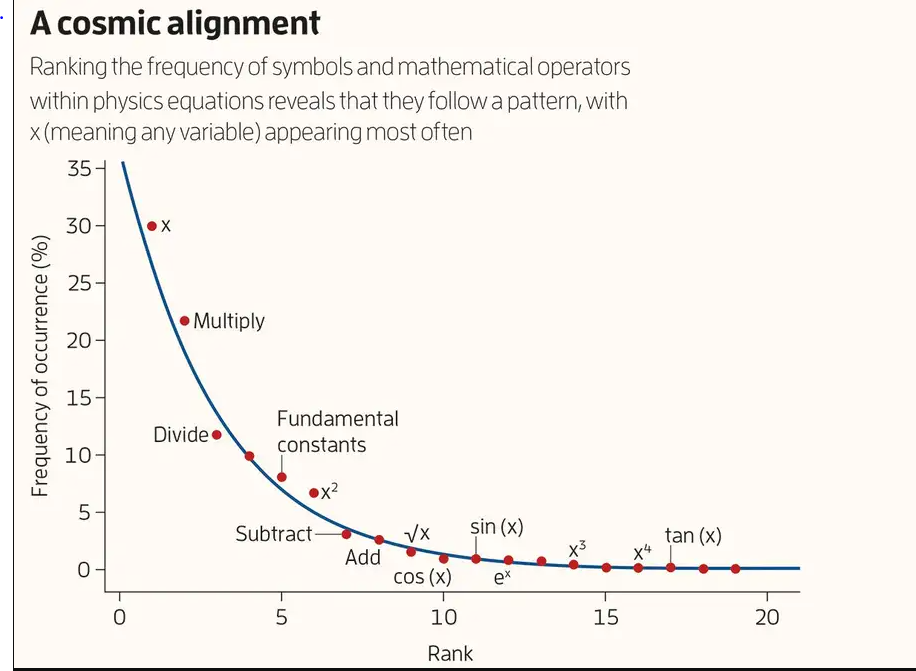
ZIPF Law “A strange pattern running through the equations of physics may reveal something fundamental about the universe or could be a sign that human brains are biased to ignore more complex explanations of reality – or both.” If it is the former, what is this fundamental aspect of our universe? Order in disorder? An underlying template to the apparent chaos? Or, if it is the latter, can it just be human brains doing what human brains do; paint-in a picture of reality based on an unintentionally biased interpretation of facts. https://institutions.newscientist.com/article/2452341-the-laws-of-physics-appear-to-follow-a-mysterious-mathematical-pattern/
-
If trust always has conditions, then it is a better word than faith for science. As Ronald Reagan used to say, "trust but verify". And I wil add, never take it a 100% full face value, because it's not!
-
We should have faith in the methodology, but not unconditional faith. Unconditional agreement to all of your statements. Agree!
-
"us", including myself to try and keep it polite Natural and social sciiences is large segment of science.
-
Correction - With all of this being said, should we maintain our unconditional faith in science as some of us do?
-
Replication is a major pilar of science. However, some say that there is a replication crisis in natural and social sciences. In a 2016 Nature survey more that 70% of researchers tried, but failed to reproduce another scientist’s experiment results https://en.wikipedia.org/wiki/Replication_crisis. And there is more to the confidence in science story. Even with all of the measures taken to reduce it as much as possible, bias in science remains an issue. You can reduce it, but not remove it as it is “baked into” us from early childhood and plays a predominant role in all of our undertakings. https://biasinsideus.si.edu/online-exhibition/the-science-of-bias. Continuing in the same vein, false positives and false negatives also unintentionally inject false results in science False positives and false negatives - Wikipedia. Data dredging is an issue Data dredging - Wikipedia, and misconduct prevalent in science https://en.wikipedia.org/wiki/Scientific_misconduct. With all of this being said, should we maintain our absolute faith in science as some of us do?
-
A meaningless expanse of mostly nothing, yet we stand, breathe and think.
-
Life’s complexity making the step from molecules to life that much more difficult to contend. Conditions required to transition doing the same it is not proof of concept, but might be an indication of a need to recalibrate
-
I am aware of these findings. Some even consider this matter to be post biotic rather than prebiotic. Your count is too high No, I am too stupid. How about NDE’s; there’s a lot to learn even if they may not be what they intend to be Doing the best that I can but guess that I am not smart enough for you. attack ideas, not people.
-
There is evidence that life is much more complex than anticipated. There is mounting evidence that the conditions required to make it happen were exceptional. And not wanting to upset Zapatos again, but we still have not figured out how to do it.
-
You cannot prove this. I cannot disprove it. But you have a theoretical framework for it and I have no such framework if it is not as you describe it. So you are one up on me. Assumptions yes. Agenda no. Evidence will lead where it shall.
-
MAN is an amalgamation of cells and they replicate. Do they have no or low metabolism-respiration? I thought that it was the latter not the former. Nonetheless, you are starting to convince me that there may be exceptions to the rule. Then, might we be entertaining core attributes with others being secondary? If the cells are still alive, then it is not even partway. take dead cells and reanimate them and then I will admit that we are partway. But they have to really be dead before reanimation.