
Genady
Senior Members
-
Joined
Everything posted by Genady
-
I'm looking where exactly, during a construction of the Feynman propagator \(D_F(x_1,x_2)\), a particle goes off-shell. It is on-shell all the way until before the last step: \(D_F(x_1,x_2)=\frac i {(2 \pi)^4}\int d^3 k \int d \omega \, e^{-i \vec k (\vec x_1 - \vec x_2)} \frac 1 {\omega^2 - \omega_k^2 + i \epsilon} e^{i \omega (t_1-t_2)}\) The particle is on-shell here because its 4-momentum is \((\omega_k, \vec k) \), where \(\omega_k^2 = \vec k^2+m^2\). Integration variable of the first integral is 3-momentum \(\vec k\), where each one of the three component varies from \(- \infty\) to \(\infty\). Integration variable of the second integral is energy \(\omega\), which also varies from \(- \infty\) to \(\infty\). Now, we combine these integration variables into a new 4-vector \(k=(\omega,\vec k)\), where each component varies independently from \(- \infty\) to \(\infty\). This 4-vector is not a 4-momentum of anything and thus is off-shell for a simple reason that there is no shell for it to be on. It is just an integration variable: \(D_F(x_1,x_2)=\frac i {(2 \pi)^4}\int d^4 k \, e^{-i \vec k (\vec x_1 - \vec x_2)} \frac 1 {\omega^2 - \omega_k^2 + i \epsilon} e^{i \omega (t_1-t_2)} = \frac i {(2 \pi)^4}\int d^4 k \frac {e^{k (x_1 - x_2)}} {\omega^2 - \omega_k^2 + i \epsilon}\) Being a generic 4-vector, \(k\) satisfies \(\omega^2=k^2+ \vec k^2\). Being an on-shell 4-momentum, \((\omega_k, \vec k) \) satisfies \(\omega_k^2 = \vec k^2+m^2\). Substituting these above, we get the final form of the Feynman propagator: \(D_F(x_1,x_2)= \frac i {(2 \pi)^4}\int d^4 k \frac {e^{k (x_1 - x_2)}} {k^2 - m^2 + i \epsilon}\) The particle, which is on-shell, is not explicit in this form. Instead, we have a generic variable \(k\), which is a Lorentz invariant way to package the four integration variables, and which is not a 4-momentum of any particle. Evidently, there are no off-shell particles here.
-
Unfortunately, I can't read this post: and I don't know how his result is different from mine, but it seems that his EL equation is the same as mine, <<<<< which is different from <<<<<<< I disagree with the latter. We need to use the generalized EL equation, which I have already derived in this exercise: and got the answer compatible with this: (Euler–Lagrange equation - Wikipedia)



-
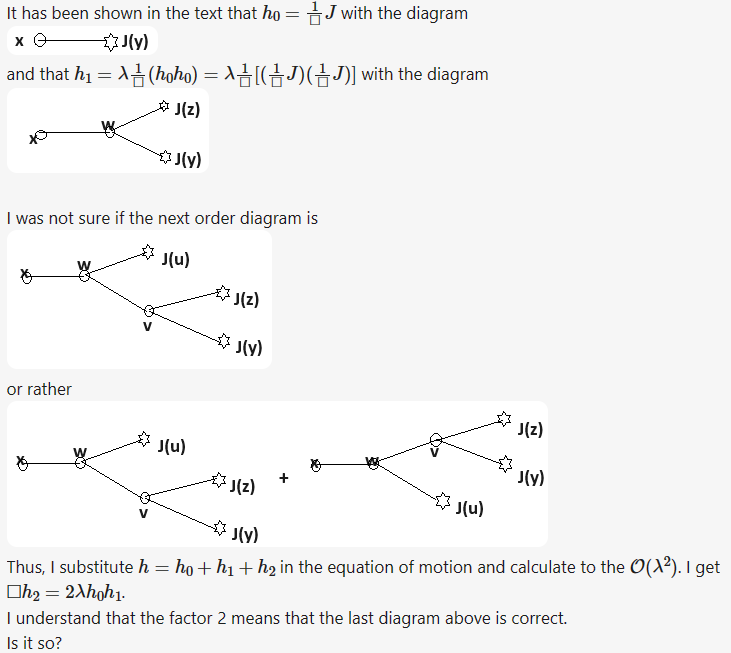
Write down the next-order diagrams for the equation of motion \(\Box h - \lambda h^2 -J =0\). Check the answer using Green's function method.
-
Q: How many constants \(c\) are there so that \(\phi(x)=c\) is a solution to the equation of motion? A: Three. \(c=0\) and two solutions for \(c^2= \frac {3!} {\lambda} m^2\) Q: Which solution has the lowest energy (the ground state)? A: The potential energy from the Lagrangian is \[\frac {\lambda} {4!} \phi^4 - \frac 1 2 m^2 \phi^2\]It is the lowest for the non-zero \(c\): \(- \frac{3!m^4} {4 \lambda}\).
-
This is a multi-step exercise. It would be very helpful if somebody could check my step(s) as I go. @joigus, I'm sure it is a child play for you. I'd like to make sure that I've derived correctly the equation of motion for this Lagrangian: \[\mathcal L=- \frac 1 2 \phi \Box \phi + \frac 1 2 m^2 \phi^2 - \frac {\lambda} {4!} \phi^4\] The EL equation: \[\frac {\partial \mathcal L} {\partial \phi} + \Box \frac {\partial \mathcal L} {\partial (\Box \phi)} = 0\] The equation of motion: \[\Box \phi - \frac 1 2 m^2 + \frac {\lambda} {3!} \phi^3 = 0\] How is it? P.S. As edit LaTex does not work, I add a typo correction here. The equation of motion is rather \[\Box \phi - m^2 \phi + \frac {\lambda} {3!} \phi^3 = 0\]
-
The advantage is, no deadlines.
-
I think, I got it. The symmetry validates the equation (3), because this equation makes the variation of Lagrangian a total derivative, and this makes the variation of action vanish: IOW, without the symmetry, we can't go from (4) to (5).

-
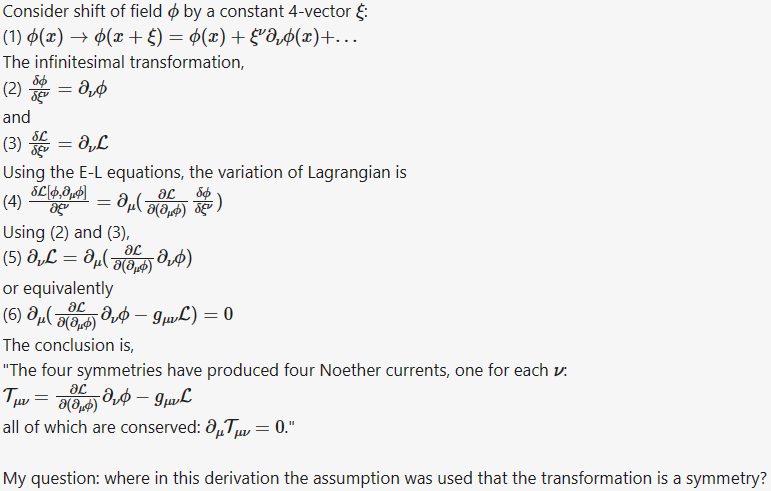
Rather than trying to fix the OP, I've prepared the text elsewhere and just post its image: A minor correction: the equation (4) above should rather be

-
Here are steps of derivation of energy-momentum conservation: Consider a shift of the field ϕ by a constant 4-vector ξ : (1) ϕ(x)→ϕ(x+ξ)=ϕ(x)+ξν∂νϕ(x)+... The infinitesimal transformation makes (2) δϕδξν=∂νϕ and (3) δLδξν=∂νL Using the E-L equations, the variation of Lagrangian is (4) δL[ϕ,∂μϕ]∂ξν=∂μ(∂L∂(∂μϕ)δϕδξν) Using (2) and (3), (5) ∂νL=∂μ(∂L∂(∂μϕ)∂νϕ) or equivalently (6) ∂μ(∂L∂(∂μϕ)∂νϕ−gμνL)=0 The conclusion is, "The four symmetries have produced four Noether currents, one for each ν : (7) Tμν=∂L∂(∂μϕ)∂νϕ−gμνL all of which are conserved: ∂μTμν=0 ." My question: where in this derivation the assumption was used that the transformation is a symmetry? P.S. I am sorry that LaTex is so buggy here. I don't have a willing power to do this again. Ignore. Bye.
-
\[\phi(x) \rightarrow \phi(x+\xi)=\phi(x)+\xi^{\nu} \partial_{\nu} \phi(x) + ...\] \[\frac {\delta \phi} {\delta \xi^{nu}} = \partial_{\nu} \phi\] \[\frac {\delta \mathcal L} {\delta \xi^{nu}} = \partial_{\nu} \mathcal L\] \[\frac {\delta \mathcal L[\phi, \partial_{mu} \phi]} {\partial \xi^{\nu}}=\partial_{mu} (\frac {\partial \mathcal L}{\partial (\partial_{mu} \phi)} \frac {\delta \phi} {\delta \xi^{nu}})\]
-
Thank you. All's well. Yes, I like the book otherwise, but it would be so much easier to follow if the indices were where they should be.
-
Please, I really, really know this. I know this index gymnastics, lowering and raising indices, tensors vs. basis representations, etc. I appreciate your time, but there is no need to teach basics here. Let's focus. Back to my question. Let's take \(\nu=1\). If \(\partial_{\nu} \mathcal L = \partial_{\mu} (g_{\mu \nu} \mathcal L)\), then \(\partial_1 \mathcal L = \partial_{\mu} (g_{\mu 1} \mathcal L) = -\partial_1 \mathcal L \). Where is my mistake?
-
They are different: \[\delta=\begin{pmatrix} 1 & 0 & 0 & 0 \\ 0 & 1 & 0 & 0 \\ 0 & 0 & 1 & 0 \\ 0 & 0 & 0 & 1 \end{pmatrix}\] \[g=\begin{pmatrix} 1 & 0 & 0 & 0 \\ 0 & -1 & 0 & 0 \\ 0 & 0 & -1 & 0 \\ 0 & 0 & 0 & -1 \end{pmatrix}\]
-
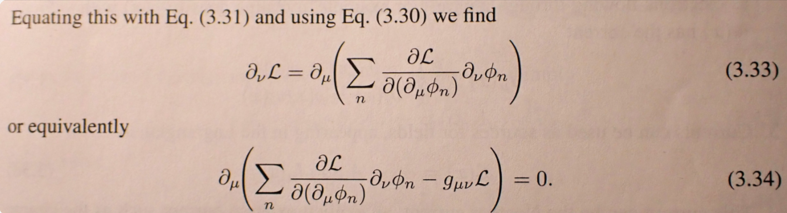
I understand this but I don't think it answers my question. This is what I mean: I can rewrite (3.34) so: \[ \partial_{\mu} (\sum_n \frac {\partial \mathcal L} {\partial (\partial_{\mu} \phi_n)} \partial_{\nu} \phi_n) = \partial_{\mu} (g_{\mu \nu} \mathcal L)\] Then, from this and (3.33), we get \[\partial_{\nu} \mathcal L = \partial_{\mu} (g_{\mu \nu} \mathcal L)\] I think, it is incorrect. It rather should be \[\partial_{\nu} \mathcal L = \partial_{\mu} (\delta^{\mu}_{\nu} \mathcal L)\] P.S. Ignore positions of indices; Schwartz does not follow upper/lower standard. The difference is between \(g\) and \(\delta\).
-
My question is about the following step in a derivation of energy-momentum tensor: When the ∂νL in (3.33) moves under the ∂μ in (3.34) and gets contracted, I'd expect it to become \(\delta^{\mu}_{\nu} \mathcal L\). Why is it rather gμνL ? Typo? (In this text, gμν=ημν )
-
It is not technically homework, but it could've been if I were technically student. Just a new textbook to work on. I don't anymore read books that don't have equations. 🙃
-
Just to answer the OP question, It would not. Without the step function it would be \[\int dk^0 \delta (k^2-m^2) =\frac 1 {\omega_k} \] rather than \(\frac 1 {2 \omega_k}\).
-
A light that is produced by hot infalling matter between the photon sphere and the event horizon can still escape radially, right?
-
Thank you. I got it. My mistake was that when I replaced \(k^0\) with \(\omega_k\) I've missed that it can be + or - \(\omega_k\). The step function is needed to kill one of them.
-
The question: Show that \[\int_{-\infty}^{\infty} dk^0 \delta (k^2-m^2) \theta (k^0)=\frac 1 {2 \omega_k}\] where \(\theta(x)\) is the unit step function and \(\omega_k \equiv \sqrt {\vec k^2 +m^2}\). My solution: \(k^2={k^0}^2 - \vec k ^2\) \(\omega _k ^2 = \vec k^2 +m^2\) \(k^2 - m^2 = {k^0}^2 - \omega_k^2\) \(dk^0= \frac {d{k^0}^2} {2k^0}\) \(\int_{-\infty}^{\infty} dk^0 \delta (k^2-m^2) \theta (k^0) = \int_{-\infty}^{\infty} \frac {d{k^0}^2} {2k^0} \delta ({k^0}^2 - \omega_k^2) \theta (k^0) = \frac 1 {2 \omega_k} \theta (\omega_k) = \frac 1 {2 \omega_k}\) However, the point of the unit step function there is unclear to me. Wouldn't the result be the same without it?
-
I agree, the vagueness of such statements is an issue. Next time somebody says, "Hawking radiation is generated just outside the event horizon", I will ask first, how far is "just".
-
Yes, for an audience that thinks that Event Horizon is an actual physical structure, there is no difference between an approximation and a myth.
-
I've arrived to an expected answer, but I am not sure at all that the process was what the problem statement wants. First, I considered \(0=(t+\delta t)^2-(x+vt)^2-(t^2-x^2) \approx 2t \delta t - 2xvt - v^2t^2\). Ignoring \(O(v^2)\) gives \(\delta t=vx\), i.e., \(t \rightarrow t+vx\). Keeping \(O(v^2)\) gives \(t \rightarrow t+vx+\frac 1 2 v^2t\), which is the correct expansion of the full transformation to the second order. Now, taking \(x \rightarrow x+ \delta x, t \rightarrow t+vx\) gives by the similar calculation \(x \rightarrow x+vt+\frac 1 2 v^2x\). Is it what the exercise means?

-
No, I don't call approximations, myths. They are different things. Is it an approximation to say that all life forms were created at once from scratch?
-
Checking with the physicists here: On the p.17 it says, Shouldn't it say force rather than potential? Isn't any potential rather quadratic close to equilibrium?