Genady
Senior Members
-
Joined
Everything posted by Genady
-
A bit OT here: @joigus I also wish experts would contribute, but I didn't have a good experience with them. I emailed a few when this was fresh. Two replied. One just said, they never noticed such a pattern. The other said, they think I am wrong and the corals turn either way. They even attached a few pictures. Guess what? On all the pictures the corals were right-handed! This expert perhaps is a good biologist, but there is some issue with 3D geometry there In fact, they don't cluster thickly - there is half-meter or more between the loops and they don't bend easily. When there is some current, the entire thing just bends the other way, like a windsock.
-
That is what they can't do. They are radially symmetrical miniature upside-down jellyfish.
-
I got an idea. Firstly, we can assume that the polyps can chemically sense their neighbors. This thing is quite common and I think such an assumption is safe. Let's call it, Assumption 1.0. Secondly, let's assume that they are programmed by their genes to grow in such a way as to minimize interference with their neighbors in a given neighborhood. This is good for filter feeding. Let's call this, Assumption 2.0. Such a program will lead them to make a linearly arranged colony. This seems like a promising beginning. Now, how do we modify these assumption and add to them to get eventually to the right-handed helix?
-
I think, my main point of curiosity in this phenomenon is, how these small organisms, each a few mm across and apparently radially symmetrical, genetic clones of each other, determine uniquely a global morphology of the structure 1000 times larger than themselves. Perhaps, it is an emergent feature, but how?
-
One more piece of information. I've tried to compare my local findings with a global "data" by googling "wire black coral" images. As far as I could identify Cirrhipathes leutkeni in random pictures, I've found all of them right-handed as well. Thank you. I took time to read about them about 10 years ago. Yes, building up of an organism is programmed by genes and their is a strange correspondence between the linear order of these genes on DNA and linear order of body parts of bilateral organisms. However, as far as I remember, in didn't have anything to do with chirality. Plus, coral we discussing is not an organism but a colony of organisms. Plus, it is not bilateral.
-
It is hard for me to see a chain of causal connections between chirality on molecular level and chirality of a large scale morphology not even of organism but of a colony of organisms. The water here and specifically on that depth is practically still - the movement of about 1 cm/s or less. "Black corals" belong to so-called soft corals. They don't have calcium carbonate skeletons. Their "housing" is made of hardened mix of minerals and proteins. Coriolis effect doesn't appear on such a small scale. Here I have a story to tell. Six years ago I was in Ecuador and visited the Middle of the World, where they have equator line marked on the ground. The guides there gave a bunch of various presentations including the famous one with a water rotating opposite ways while being flashed. They had a tab with a hole, put it on one side of the equator, poured water from a backet and it rotated clockwise. They then relocated the tab to the other side of the equator, poured water - and it rotated counterclockwise. 'Coriolis,' they said. After the presentation I took one of the guides aside and tell her that I know that Coriolis has nothing to do with this and asked her to tell me the secret. She did. The sense of rotation is determined by which side of the hole they pour water to.
-
Here is a description including its distribution. Not in Kiribati. Correct, the reproduction is not an issue for corals. A few dozens of them are all I could find where I dive. Marine Species Identification Portal : Wire coral - Cirrhipathes leutkeni (species-identification.org)
-
Happy to answer all specific questions: The size of the locale is a couple of dozens mi/km. Depth about 100+ft /30+m. No strong currents, mostly no currents at all, certainly no prevailing currents. Orientation varies - around the island and along a curved shoreline. The location is practically on equator, about 12N, between the hemispheres
-
More specific situation, for example: if a satellite is held at rest with respect to Earth, it will certainly experience acceleration. While if it free falls toward Earth, the Earth free falls toward it, and both feel nothing. I'm sure your opinion will change after learning GR. Here is how Penrose - who knows something about gravity - describes the situation: Previously, an inertial motion was distinguished as the kind of motion that occurs when a particle is subject to a zero total external force. But with gravity we have a difficulty. Because of the principle of equivalence, there is no local way of telling whether a gravitational force is acting or whether what ‘feels’ like a gravitational force may just be the effect of an acceleration. Moreover, as with our insect on Galileo’s rock or our astronaut in orbit, the gravitational force can be eliminated by simply falling freely with it. And since we can eliminate the gravitational force this way, we must take a different attitude to it. This was Einstein’s profoundly novel view: regard the inertial motions as being those motions that particles take when the total of non-gravitational forces acting upon them is zero, so they must be falling freely with the gravitational field (so the effective gravitational force is also reduced to zero). Thus, our insect’s falling trajectory and our astronauts’ motion in orbit about the Earth must both count as inertial motions. On the other hand, someone just standing on the ground is not executing an inertial motion, in the Einsteinian scheme, because standing still in a gravitational field is not a free-fall motion. To Newton, that would have counted as inertial, because ‘the state of rest’ must always count as ‘inertial’ in the Newtonian scheme. The gravitational force acting on the person is compensated by the upward force exerted by the ground, but they are not separately zero as Einstein requires. On the other hand, the Einstein inertial motions of the insect or astronaut are, according to Newton, not inertial. Penrose, Roger. The Road to Reality (pp. 393-394). Knopf Doubleday Publishing Group.
-
Gravitational acceleration is. As per equivalence principle.
-
The answer depends on your frame of reference, i.e. an observer. In the first scenario, as we consider an orbit around the Sun, yes it will get tighter. In the second scenario, wherever you put an observer, the Earth will be free falling toward it (plus the initial velocity.) There is no absolute frame of reference to give an absolute answer.
-
Thank you. I know about chirality - in the Standard Model, in chemistry, in biochemistry (e.g. DNA), in biology, too. Most examples in biology I know of have explanations, e.g. chirality of snails. Those are not applicable to corals. Looking for new ideas ...
-
Yes, the actual calculation should be done from the Friedman equations. The result is the same - a uniform infinite mass density causes deceleration. It is one of the components. The total result - positive, negative, or zero - depends on other components, specifically, on the current rate of expansion and on cosmological constant (or, dark energy, if you prefer.)
-
The acceleration is relative to an observer. If an observer is attached to the mass, it does not accelerate anywhere. To any other observer, it accelerates - free falls - toward them with G*M/(R^2), where R is the distance from the observer and M is the mass of the stuff inside a ball of radius R.
-
With all due respect, we are going circles for some time already. The answers to all these objections are in the Susskind lecture 1, I've linked earlier. The math is simple and the result is calculable. The outcome is that the uniform infinite distribution of mass causes it to shrink. All points toward all points. If it started with expansion, this distribution causes the expansion to decelerate.
-
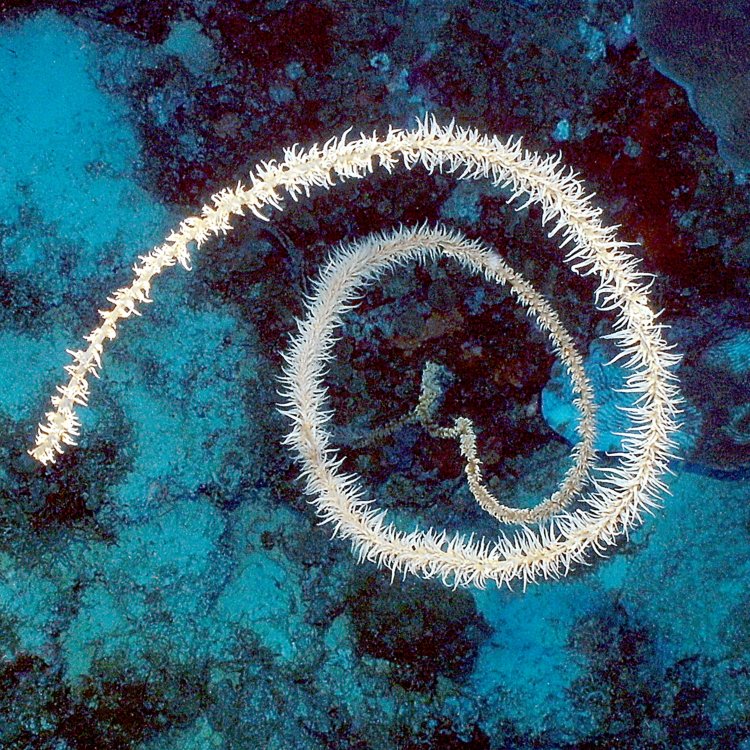
Some years ago while diving around the island where I live I've noticed that this coral always makes a right-handed helix. I wonder if it might be an adaptive feature or, more generally, what could cause it. I mean, I saw dozens of them and never one turning left...
-
I hope you will enjoy this video as well. Susskind presents an example of dark matter mass calculation starting at about 31st minute. (Only stuff inside an orbit has gravitational effect on the orbit.)
-
R in this calculation stands for distance from origin. Which of course is arbitrary. As Susskind has shown in his derivation, the final result does not depend on R. No, that calculation doesn't have such flexibility. The observable effects of dark matter lead to calculation of not only it's mass - positive - but also of its amount and distribution. The only observable effect of dark energy is acceleration of the universe expansion.
-
Correct again. All effect for the smaller R's add up. All effect s for the larger R's cancel.
-
Right, it doesn't have an effect inside the sphere, it does have the effect outside it.
-
Dark matter and dark energy are separable in a variety of ways. Dark matter attracts, dark energy repulses. Dark matter density falls off with a cube of expansion, dark energy density doesn't change with expansion. Dark matter non-uniformities accelerate clamping of regular matter, dark energy doesn't have such effect. ...
-
By the Newton's theorem, a particle inside an empty massive sphere doesn't feel any gravity from the sphere. It holds the same for positive and for negative gravity. Neither positive nor negative mass homogeneously distributed outside galaxy have any gravitational effect on the galaxy.
-
Sorry for the misunderstanding. I was kidding. Such headlines, I guess, are just click baits. Thought about it because the thread topic mentions impressing scientists. I don't enjoy claiming that scientists are easily shocked but rather enjoy making fun of popular science reports.
-
Evidently, scientists are easily shocked: Scientists Shocked by Discovery of Enormous, Healthy Coral (futurism.com) Climate scientists shocked by scale of floods in Germany | Flooding | The Guardian Scientists 'shocked' by high levels of microplastic pollution in London's Thames (nbcnews.com) Scientists shocked by Arctic permafrost thawing 70 years sooner than predicted | Climate crisis | The Guardian Scientists shocked by mysterious deaths of ancient trees - BBC News Scientists shocked to discover how much lightning may clean the atmosphere | CBC Radio Scientists Shocked By Rare, Giant Sunfish Washed Up On California Beach : NPR Italian scientists shocked by earthquake devastation | Nature Scientists ‘shocked’ to find life in extreme depths under Antarctic ice - National | Globalnews.ca Scientists 'shocked' after second coral bleaching at Great Barrier Reef in two years - CNN ... the list goes on and on.
-
A friend has sent this question to me. I have it solved with linear algebra (and some hand waving). Can you find a shorter way to the answer? (It's not a homework, not mine anyway. My homework times long gone.) A gardener collected 17 apples. He finds that each time he removes an apple from his harvest, he can share the remaining fruit in two piles of equal weight, each containing 8 apples. Show that all apples are the same weight.