
Genady
-
Joined
Posts posted by Genady
-
-
22 minutes ago, geordief said:
I was wondering whether the direction of the resultant wave differs from the other 2 waves and if that might cause a slow down.
The direction of the resultant wave is different. Why the speed would be different, though?
22 minutes ago, geordief said:And what about the interactions with particles .Do they slow down the wave ?
I don't see how they could.
22 minutes ago, geordief said:Is what I though,too but the waves from the electron are not moving in the same direction as the light wave ,are they?
They are not. They are moving in all directions, I think.
Another questions in relation to this. Let's assume for simplicity that the primary wave is monochromatic. Is the resultant wave monochromatic? If so, what is different about it, i.e., wavelength, frequency, or both?
-
1 minute ago, Boltzmannbrain said:
Go to 7:10 in the video. You simply add the amplitudes of the waves. For example, you see when the crests and a troughs align; you get 0 amplitude, or just a flat line, and so on. So it is just what happens when slow and fast waves combine mathematically.
Right, it shows that the amplitude changes. It does not explain why the speed changes, though, does it?
Also, there are no slow and fast waves there, as both waves are electromagnetic and thus both move with the speed of light. Right?
-
-
-
40 minutes ago, dimreepr said:
Therefore
This is how your logic goes:
It's a genuine paradox:
Atheist/"arelionist", whatever, state's as a matter of fact, there is no such thing as Santa. (Edit let's not get into semantics here.)
So therefore, in a world without Santa, the children's books and the idea's therein have to be written by man and accepted by their fellow man.
So therefore, if a lot of people, even in the face of cultural difference, say "that's an idea worth following".
No Santa needed.
Therefore, Santa has become a weapon for atheism/<insert word>.
-
2 minutes ago, martillo said:
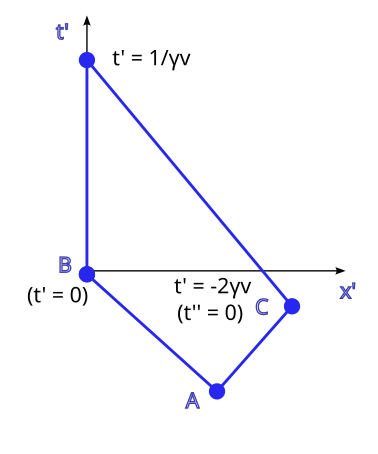
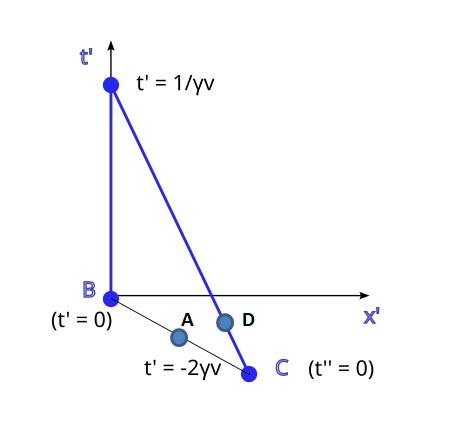
The good thing of this is that calculations can be made with the space-time diagrams just with geometrical considerations. I think that was intuitively the approach in my calculations although making some things wrongly of course. I will try to remake them some day and if I find something to discuss may be I post a new thread about.
Please, do. I'd prefer a fresh thread for this.
-
3 minutes ago, martillo said:
I edited the post above:
I looked for that on google and found that if the frame is inertial then the length between two points on the lines represent the elapsed time between the events in the frame.
The above is right then because the travelers are moving at constant velocity v, not experimenting accelerations and so their frames would be inertial.
Yes. The interval between two events on B's timeline is the B's elapsed time between these two events. Likewise, the interval between two events on C's timeline is the C's elapsed time between these two events.
-
33 minutes ago, martillo said:
can the elapsed times in each frame be obtained geometrically with the length on the lines of the travelers?
Generally, not. The metric of the diagram is not Euclidean. It has Minkowski metric. IOW, the "length" squared between two events on the diagram is not dt2+dx2. It is dt2-dx2. For example, the "length", called "interval", between any two events on a light line (450 line) is 0. IOW, the units on the lines belonging to different frames are not equal.
-
-
-
-
-
-
-
-
6 hours ago, martillo said:
Sorry, I'm a bit tired and got confused again with an old bad concept. I need to have a rest now...
While you're resting, may I recommend these free and fun online presentations, which give good explanation for and practice in spacetime diagrams and Lorentz transformations (with Spanish subtitles available):
Understanding Einstein: The Special Theory of Relativity | Coursera
-
-
-
-
3 minutes ago, Lorentz Jr said:
More confusion.
The spacetime diagrams are good for qualitative comparisons between events and frames, but to get quantitative comparisons you will have to calculate Lorentz transformations.
-
-
-
54 minutes ago, martillo said:
I'm assuming initially (time when the signals are emitted) and in B frame dist(B,A) = dist (A,C) = L.
If you are assuming this, then B and C are not symmetrical, and I can prove it.
Since they are not symmetrical, when they meet their clocks and beards will not be equal.
-
Just now, Lorentz Jr said:
the problem is that @martillokeeps trying to apply the simultaneity in A's frame to the analysis in B's frame.
Yes, this is the problem. But we keep trying not to let him do this
 .
.
PS. I have to go now. We'll be back in about an hour, I think. Otherwise, good night to all.
The speed of light and causality
in Relativity
I don't believe it. I'd love to see that math.
The Fermilab video linked above says that this explanation is wrong. Do you think they are wrong?