
AbstractDreamer
-
Joined
-
Last visited
Posts posted by AbstractDreamer
-
-
Where I said calculus contradicts HUP, was in the context of GR and observables, NOT as a mathematical tool in itself.
Whether I gave reason for other readers to think I have no idea what I'm talking about is again irrelevant. Lets say I factually had no idea what I'm talking about, not just readers thinking that I don't. How does that change anything?
Does that justify your responses in COMPETELY failing to acknowledge the most important point and focus SOLEY on my "extraordinarily silly statements"?
I have just shown GR metric tensor contains conjugate variables in it's differential equations, in direct violation of HUP. Why didn't you just tell me this - IN ADDITION to correcting all my silly statements? Why focus on the silly statements? -
47 minutes ago, swansont said: When you first mentioned this you said things that were flat-out wrong, and it’s hard to answer a question based on such misconceptions unless those misconceptions are first cleared up. They were fundamental, rather than being irrelevancies.
You're going to have to quote me where is said things were "flat-out wrong".
I still maintain the overall gist of what I was trying to say is valid - that GR violates HUP - despite having to talk about irrelevancies like what x and y represent, what isn't superposition, whether infinitesimals are irrelevant.
I left the conversation 4 months ago with a sense that I was entirely wrong. A sense that you and others contributed towards. A sense that was entirely false.
I had to go and find proof that conjugate pairs existed in the metric tensor because no-one here was willing to overtly support my suspicion of HUP violation. Your silence on that point is louder than all the minor mistakes I may have made. -
1 minute ago, joigus said: Classical GR (or any other non-quantised theory) obviously violates HUP, as coordinates and their canonical momenta commute.
You need coordinates, a Lagrangian, and canonically-conjugate momenta that do not commute with the former, for the HUP to be satisfied. There is no Planck's constant, nor non-commuting operators in GR.
I wouldn't say it was "obvious". When I first mentioned this, most of the response were not in agreement. Instead, most of the responses were trying to nit pick irrelevances and mistakes that I made, instead of getting straight to the point.
Going back to the OP. Here is a "flaw". -
Edited by AbstractDreamer
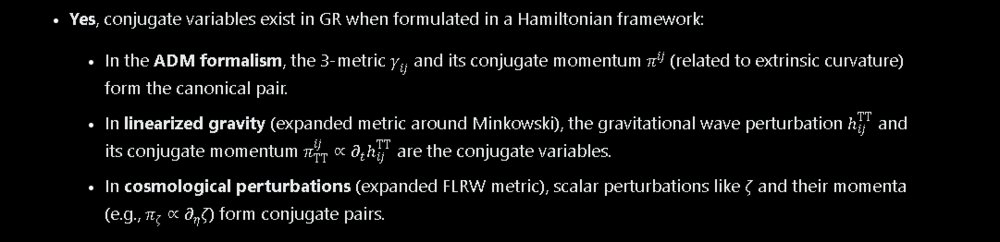
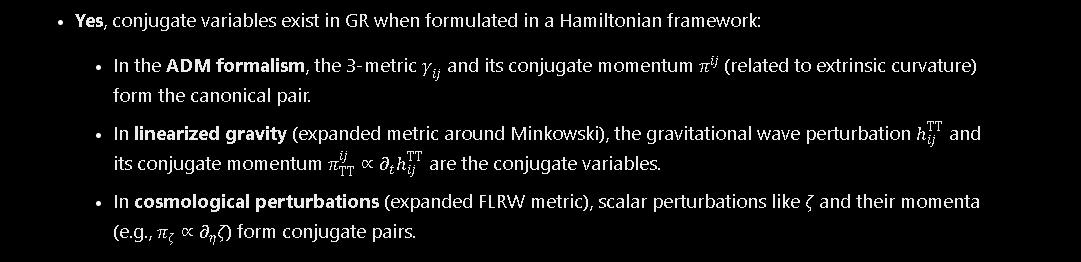
Can anyone verify this information? Does this then corroborate my claim about GR violating HUP? Specifically, but not isolated to, the metric tensor within GR and its application of calculus to conjugate pairs, which are linked by HUP.
We have conjugate pairs in the metric tensor.
-
-
42 minutes ago, studiot said:
If you are saying that I did claim that GR is flawed pleased post the quote .
Otherwise reread what I actually said about about GR and apologise.
It is as irrelevant if GR is flawed as it is if GR is limited. I am sorry if you want to talk about what you claimed or not. You did not claim GR is flawed I agree.
My first point was about GR's premise on a differentiable manifold. I've made my case. OP asked about flaws, where it breaks down. Everyone here doesn't think its a flaw, because they prefer to call it a defining limitations. Semantics. Limitations are the boundaries where it breaks down. So OP was really asking what are the limitations and why are they the way they are.
And differentiable manifolds is one such limitation - my case - as are singularities20 minutes ago, swansont said:The HUP only restricts you from simultaneously measuring one other, specific variable to arbitrary precision at the same time.
Including simultaneously measuring Space and one other specific variable say, Time? to arbitrary precision at the same time?
26 minutes ago, swansont said:It defines the limit of their applicability.
Well there you go. it defines the limit of their applicability. The boundary where it breaks down. What the OP intended to mean when he said "flaw".
-
1 minute ago, studiot said:
Go on ?
And what about your misreading of my previous posting ?
I dont know what else im expected to say. I've already made my position very very clear.
GR is a model of Space and Time founded upon Calculus. Space and Time are conjugate variables. Calculus with conjugate variables break the Uncertainty Principle. Therefore GR breaks the Uncertainty Principle.
Call it a flaw, limitation, incompleteness, whatever you like. Refute me, instead of arguing over irrelevances (not you) or calling me an idiot (also not you).
-
1 minute ago, studiot said:
Instead of shouting everybody else down how about you try listening?
In particular I didn't make this an argument.
That is most definitely not what I said.
I will ignore the first sentence as you clearly do not know what conugate means in the context of QM.
But I do agree that you can labe the axes any way you like.
If you lable them as you describe in the underlined sentence, it becomes impossible to plot any points at all using those axes.
That is a direct result of the uncertainty principle.On the other hand if you prefer to hold a civilized discussion then I am quite happy to expand on my explanations further.
Honestly, I'm just reciprocating the attitude shown to me. I'm not shouting, and its not at everybody. I'm reciprocating the attitude that SwansonT showed me, when saying to me that I need to speak the language of physics or nobody would understand me, with the demeaning implication I couldn't speak the language. When in actual fact, what I said was perfectly understandable.
Lets talk about Calculus, conjugate variables, Space and Time, and General Relativity.
-
Just now, exchemist said:
I think you may be confusing abstract mathematics with physics. Calculus is used all the time in QM. The uncertainty principle arises from pairs of non-commuting operators for certain observable properties. This concept is quite compatible with calculus. In fact some of the operators concerned contain things like derivatives.
Pairs of non-commuting operators...
Like position and momentum
Like pressure and volume
Like space and time?
-
1 minute ago, swansont said:
Momentum is p.
If you want to discuss physics and be understood you need to speak the language. Otherwise nobody knows what you mean.
The larger point is that only a very limited set of variables are constrained in this way. It doesn’t apply to most. And calculus isn’t the limitation.
Nah. Y can be anything I choose the axes to be. This is basic algebra, where symbols replace variables - INCLUDING momentum, and IRRESPECTIVE of whether momentum is p.
So in this case I'm calling my y-axis Momentum. Is that ok with you? Do I get your approval? You said nobody would understand me, do you think they would understand this? Shall we waste more time arguing over irrelevances?
Lets talk about the "very limited set of variables" then. Calculus of course is independent of what its variables are, that goes without saying. But if calculus is used on conjugate variables, then it contradicts Uncertainty Principle. So instead of blanket claiming Calculus isn't the limitation, SHOW ME!
Show me that Calculus is not performed on conjugate variables in General Relativity
-
-
-
The most obvious "flaw" in GR is that its model of reality is premised on a differentiable manifold.
Calculus assumes and necessarily requires the logical leap-of-faith that if you break a curve into infinitesimally small parts, then each part is a straight line. An infinitesimal change in y with respect to an infinitesimal change in x. Calculus claims it knows the value of both x and y, at infinitesimality.
Quantum uncertainty principle claims that at infinitesimality, observables are in superposition. You cannot know fully and simultaneously both the values of y and x. -
Thank you all for being really specific and pedantic in your wordings. I genuinely need this to help understand with more clarity as I know words are a poor substitute for maths. I will take some time to absorb all this so I can pose questions that make more sense in terms of real physics and mathematics.
-
Edited by AbstractDreamer
5 hours ago, Markus Hanke said:It’s not flat because when solving the EFE, you start with a universe filled with energy-momentum, which necessarily has a gravitational effect.
The scale factor arises as part of the solution; it’s not a source term that appears in the initial setup.
If you remove all gravitational sources, you no longer get an FLRW solution - you’d be in a different spacetime.
Right. But if you had an FLRW universe devoid of energy momentum, it would still be a valid solution for that universe, if energy momentum could exist. It just has zero value at the start and at least until the moment of observation. Sure, that universe would look different to their observers than our universe looks to us. And sure it probably wouldn't be a solution their would come up with as there is nothing in their universe that would cause curvature, so why would they have a solution that permits it. But then they could go looking for signs of energy momentum to validate their FLRW solution of a universe that started and still has zero energy momentum.
I don't understand how the cause of spacetime expansion is dependent on energy momentum. If anything, they are opposing "forces". I understand how observationally the measurement of spacetime expansion, and the evolution of OUR universe under FLRW is modulated by energy momentum, but the actual mechanic of spacetime expansion - dark energy - does not depend on energy momentum as far as I can understand.
And I accept that even light has energy momentum, so the very presence of redshfted light means energy momentum is present and some degree of non-flat geometry.
Going back to the thought experiment,On 5/24/2024 at 3:29 PM, AbstractDreamer said:Say we observe two redshift galaxies at z=5. Let's say one galaxy is only spatially expanding away from us, and the other is both spatially and temporally expanding away from us, and all three locations (two galaxies and the observer) are on a spacetime plane that has observably flat geometry. Could you distinguish which is which?
If dark energy could cause both spatial and temporal expansion, then, in a spacetime geometry of net zero energy-momentum (Minkowski spacetime?) and over a short period of constant scale factor, could you distinguish how much of the redshift in the wavelength of photons is due to spatial expansion and how much is due to temporal expansion?
-
Edited by AbstractDreamer
On 5/25/2024 at 4:10 PM, Markus Hanke said:FLRW spacetime is not flat, so I don’t quite understand what you’re trying to ask…?
Is FLRW spacetime not flat because of curvature caused by mass, and the scale factor of expansion that changes over time?
If we zero the non-flatness effect of gravity AND zero the non-flatness effect of the scale factor, is FLRW spacetime otherwise flat?
In other words, if we take a period of time that is very small cosmologically, say 1 day, where the scale factor of expansion is constant; and if we remove all gravity from the universe. Would then the FLRW and the spatial expansion it describes be over a flat geometry?
-
-
17 hours ago, Mordred said:
It seems your confusion is thinking the FLRW metric for flat spacetime only includes the 3d portion for spatial components. It also includes the time component for 4d spacetime. However for flat spacetime you don't require the Gamma correction between coordinate time and proper time.
It's literally no different Than GR for flat spacetime or Euclidean geometry the only difference is the commoving coordinates which is equated via the scale factor "a".
The FLRW metric is literally a GR solution.
I do accept that the FLRW does include a time component. Perhaps I'm using the wrong words when I accuse the FLRW of having no temporal component. What I mean to say is FLRW has a temporal component that has a net zero value, and consequently all observed expansion must be spatial according to EFE.
But where is the direct evidence that Cosmological spacetime is absolutely flat in the absence of a gravitational field, even if there is no evidence of local spacetime expansion, neither spatial nor temporal?
The logical fallacy here is: Because gravity curves spacetime, local spacetime is not flat, therefore (fallacy) in the absence of gravity, non-local spacetime is also flat.
If gravity can curve spacetime locally, why must spacetime be flat cosmologically?
-
Edited by AbstractDreamer
On 4/29/2024 at 10:02 PM, KJW said:My most recent post in this thread demonstrated that there are limits to what coordinate transformations can do. By showing that an expanding time only metric can be transformed to a flat spacetime metric by a coordinate transformation, I established that it cannot be obtained from an expanding space only metric, which is not flat, by a coordinate transformation.
I have been trying to understand this for some time but still fail. A flat spacetime metric cannot be obtained by coordinate transformation from an non-flat expanding space-only metric?
How does this refute an expanding time-only metric?On 4/29/2024 at 6:56 AM, Mordred said:The simple reason you only really need the spatial component is that observational evidence shows a flat spacetime geometry. That's not some arbitrary choice of the metric. That the findings of all observational evidence.
But if there was a temporal component, could it be observed as distinct from the spatial component? If you cant observe a distinction, then just as you can argue that all observational evidence says you only need a spatial component, the position that none of the observational evidence refute a temporally expanding component is equally as strong.
And the important thing is that EFE suggests BOTH components form a single manifold. There's no observational reason why the temporal component is zero in the case of expansion. The only reason, as far as I can tell, is simplicity of calculations - which is a good reason but not one based on observation.
Thought experiment:
Say we observe two redshift galaxies at z=5. Let's say one galaxy is only spatially expanding away from us, and the other is both spatially and temporally expanding away from us, and all three locations (two galaxies and the observer) are on a spacetime plane that has observably flat geometry. Could you distinguish which is which?
On 4/29/2024 at 5:32 AM, Markus Hanke said:you could “distribute” the expansion across both time and space parts of the metric by a suitable coordinate transformation, which has no physical consequences. It’s the same spacetime, you’d just label events in it differently. The question is why you would want to do this - it would greatly complicate most calculations relevant to us, since such coordinates wouldn’t straightforwardly correspond to our own clocks and rulers. But of course you can do this, if you really wanted to.
I accept the argument why we would want to complicate the calculations. Like the geocentric theory of the solar system is valid if you choose that coordinate system, but it makes the calculations impossibly complicated, versus the Copernican model which simplifies things a lot.
My question is what might we be missing when we simplify them.
Just like the equivalence principle, there's no difference between being in a gravitational field or in a rocket that is being accelerated. For local calculation purposes they are physically equivalent. But there is a materialistic difference. An accelerated rocket is a far less stable environment than a gravitational field. Maybe locally there is no physical consequence of calculations that assume zero temporal expansion. But maybe in the bigger picture, or some grander theory there is a difference.
Could the Crisis in Cosmology be partly due to the lamba-CDM modelling both spacetime geometry as too "flat" and expansion as spatial-only?
-
21 hours ago, Markus Hanke said:
Well, the fundamental assumptions underlying this solution are homogeneity and isotropy - if you feed this kind of energy-momentum distribution into the field equations, you get as solution a spacetime that expands. You are free to choose yourself what kind of coordinate system you wish to use to describe this, but obviously it is smart to use a system where your intended calculations are easy.
I understand what you are trying to say. The FLRW metric does rely on the cosmological principle, that’s an assumption we make - that on large scales the universe is homogenous and the same in all directions. Since there’s an observational horizon past which we can’t see, it’s possible at least in principle that perhaps one of these doesn’t actually hold.But homogeneity and isotropy in the cosmological principle is an assumption of spatial distribution of energy momentum. Choosing time coordinates for a solution to EFE such as FLRW, is an assumption of temporal distribution. Isotropy of time would mean there is no preferred direction of time, but all our observations of time show it does have a preferred direction - time goes forwards. Observationally, the universe is temporally anisotropic. Homogeneity of time would mean there is no preferred moment in time. The universe looks different at different coordinates in time - it was pure plasma very early on, and now it isn't. Similarly, observationally, the universe is temporally inhomogeneous.
21 hours ago, Markus Hanke said:The underlying premise is really the laws of gravity, meaning Einstein’s equations. If you start off with a distribution of energy-momentum that interacts (approx) only gravitationally, then it’s actually difficult to avoid solutions that metrically expand in some way. FLRW is by no means a unique thing, it’s just a particular example of a large number of such solutions. This is not just due to coordinate choices.
Right, but FLRW is a particular solution that inherently forbids temporal expansion because of the choice of coordinates. Therefore it cannot be used to justify why all expansion is spatial.
On 4/27/2024 at 3:24 PM, Mordred said:As far as sampling range is concerned, redshift is only one of many pieces of evidence of an expanding universe. In point of detail its not even close to the strongest evidence. Its the one most ppl are familiar with but the real evidence comes from our thermodynamic laws in regards to temperature and how it influences the SM model of particles via processes such as BB nucleosynthesis in regards to the CMB.
My position is NOT that the universe is NOT expanding. My position is why all the expansion is attributed to spatial expansion and not temporal expansion. I suspect all the other evidence that supports metric expansion does not directly refute temporal expansion. Cosmological redshift does not refute temporal expansion. But if we use the same FLRW solution to interpret the evidence, then our conclusion will be constrained to the assumptions of the solution we chose. It is the solution that assumes all expansion is spatial, not the evidence.
On 4/27/2024 at 3:24 PM, Mordred said:I am really interested in distance measures in cosmology. In particular the margins of error, models and assumptions when interpreting observations. But will ask those questions another day.
On 4/27/2024 at 11:07 AM, KJW said:No, it is not possible to coordinate-transform a metric of the form:
(ds)² = c² (dt)² – a(t)² ((dx)² + (dy)² + (dz)²)
to a metric of the form:
(ds)² = α(t)² c² (dt)² – ((dx)² + (dy)² + (dz)²)
This is piqued my interest. No transformation that allows time to expand and not space. Why does expansion have to be at least in part spatial? Why can expansion have no temporal component? What does this physically mean?
-
31 minutes ago, Mordred said:
No there is no assumptions due to coordinate choice.
I don't know the maths at all. But it seems fundamental to me that if you make a choice, you instantiate something. When something is instanced, things are set and other settings are rejected. When you reject other settings, there are fundamental consequences. These consequences are the assumptions.
If time coordinates are chosen such that earth-bound clocks are comoving with the cosmological medium, that has consequences. The very choosing of those coordinate forbids a non-relative (non-gravitational) time dilation effect. That is why FLRW metric forbids temporal redshift, because it was chosen to be orientated that way. Am I wrong?
33 minutes ago, Mordred said:The math and observational evidence shows us that there is no curvature term k=0. So where would you get time dilation ? This has already previously been mentioned. As massless particles travel at c we can ignore the inertial gamma factor.
The observational evidence in this case is dubious solely because of the narrow range of observation relative to the field of study. We've never made an observation of cosmological redshift from outside of our solar solar system, let alone from a distance where space-expansion or temporal-expansion is significant. We've never made an observation of cosmological redshift from a time in the past or the future, where spatial or temporal expansion is significant. I'm not saying any of this is possible. I'm just saying our sample range of observations is far too narrow to be confident to say our evidence is significant.
We've taken a handful of stones from a beach, and assumed all beaches must be stoney.
As for where would we get time dilation? Where do we get space-expansion? Dark energy? We can make up anything to fit the narrative.36 minutes ago, Mordred said:A higher density past the answer either. To go into greater detail if you take 3 time slices say time now, time at the CMB say z=1100. And a slice at say universe age 7 billion years old. If you describe the geometry of each slice. Each slice has a uniform mass distribution so no slice has a non uniform mass distribution to have a curvature term.
Hint this is the real advantage of the scale factor a. No time slice has any change in geometry or curvature it's simply volume change between slices and density changes as a result of the ideal gas laws
Advantage for what purpose? Simplicity and accuracy to fit other observations are similarly limited in their scope? This again falls foul of confirmation bias.
BTW, someone anonymous is downvoting all my threads. Not that I care about reputation, but being anonymous and not saying why I'm wrong feels like im being victimised and rather abusive. -
7 hours ago, Markus Hanke said:
In the standard FLRW metric, the time coordinate is chosen such that it corresponds to a clock that is co-moving with the cosmological medium, meaning it fits well with our own physical clocks here on Earth, and thus the “phenomenology” of the metric corresponds to what we actually observe, without any need for complicated transformations.
So by choosing such time coordinates, it also inherits the assumption that the cosmological medium of time is moving uniformly, everywhere and always (an Earth bound clock must tick at the same rate as the rest of the universe now and in the past and in the future). And yet, our observations are bounded to a infinitesimally small location of the universe (observations from our solar system compared to the size of the universe), and a very small period of time (150/13billion years).
There is a problem here I cant quite put into words, so I will use bad analogies. Its like everyone being colour-blind and believing the universe is shades of grey. You can observe light wavelengths, but you cant observe the colour blue. It has no physical meaning. Its like believing gravity is a force before GR modelled spacetime curvature.
Everything must fit what we observe (of course, to be empirically tested), but we don't acknowledge enough how severe our observations are restricted/limited. In many areas of science, where and when you perform an observation has no bearing on what is being tested. In THIS particular case of redshift, when and where you perform an observation is of paramount significance... and we are straight-jacketed into observations from our solar system location (where ever it is in the universe), and observations from our moment in time (a few hundred years). The limitations of our observations are significant relative to the field of study.7 hours ago, Markus Hanke said:These aren’t different “theories”, but simply coordinate choices. You’re describing the same spacetime in different coordinates. KJW has given an example how a “time-only” expansion metric could look like. Ultimately you want to choose coordinates that make your calculations as simple as possible, and that’s often ones based on the cosmological medium. But in principle, the choice is yours, so long as they’re related by valid transformations.
But space-expansion IS a theory, as is the more absurd temporal-expansion. The premise for the theories is from choice of coordinates.
2 hours ago, KJW said:No, it is not possible to coordinate-transform a metric of the form:
(ds)² = c² (dt)² – a(t)² ((dx)² + (dy)² + (dz)²)
to a metric of the form:
(ds)² = α(t)² c² (dt)² – ((dx)² + (dy)² + (dz)²)
Is this saying there is no transformation that will allow only time to expand and not space? What is the meaningful consequence of this?
-
-
I not going to pretend to follow the math. Neither do I want to interrupt where the thread has gone, but I want to bring it back layman speak on my level.
On 11/24/2023 at 6:48 PM, KJW said:The OP enquired as to why it is only space that expands and not time. The answer is that the difference between time expanding with space and time not expanding with space is just a coordinate transformation, which means that there is no physical difference. However, as you correctly point out, the time coordinate of the time-expanding metric doesn't correspond to anything, in particular, not a co-moving clock, whereas the spatial coordinates actually do correspond to the co-moving cosmological fluid.
Earlier in this thread I did already mention that the FLRW metric is "orientated" where time does not expand with space. I had suspected that a transformation could orientate it differently such that time does expand with space. And I suspected at the other extreme we can have a solution where space does not expand at all and only time does.
In another thread I asked about a variable "metric of time", and the "rate of flow of time", which was very difficult to conceptualise and it sort of ended there.
My position is that l still maintain the validity of the interpretation that: non-relative time expansion/contraction is indistinguishable from space expansion/contraction.
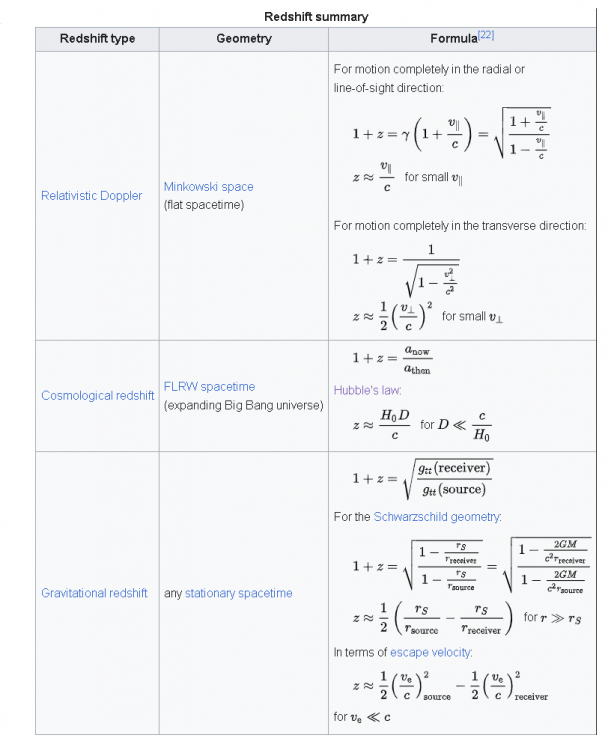
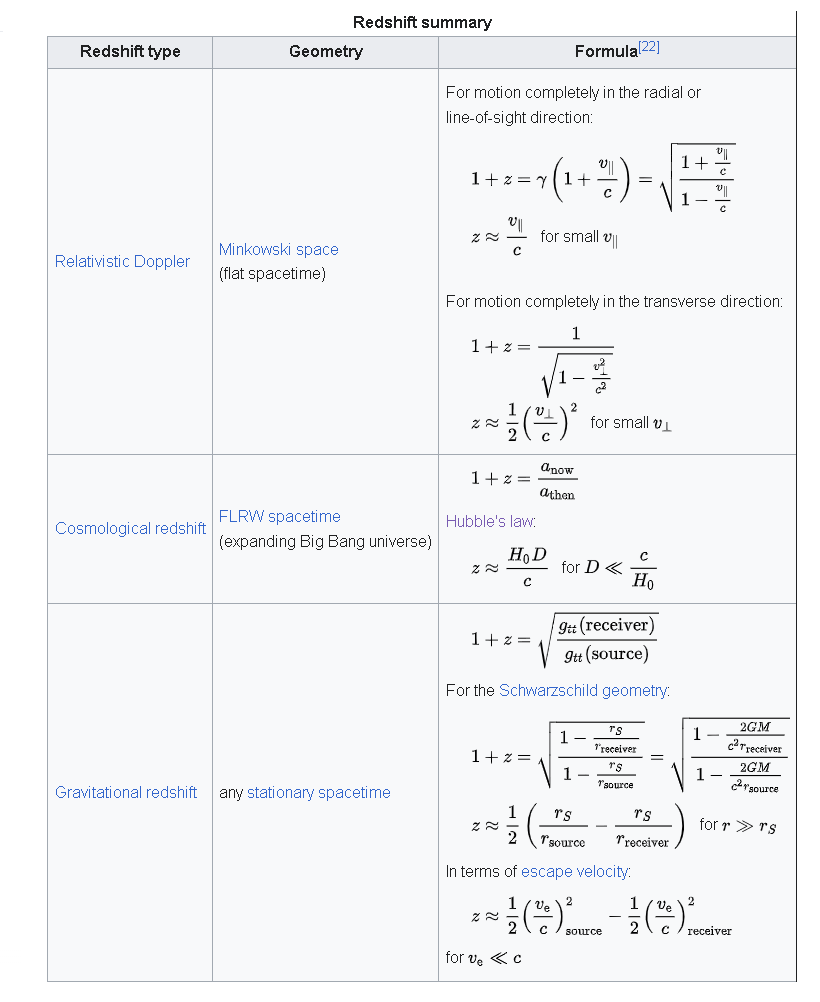
When you look up cosmological redshift in wiki there is no "Temporal Redshift" type. That is, redshift caused by an expanding temporal metric. It doesn't exist. Not a single reference, no studies, no papers.
Why? Just because its too complex and abstract compared to space-expansion-only theory? I don't believe complexity is a reason for the entire physics community to shy away from such an interpretation. If it is valid, and no-one has researched into temporal redshift, it can only be because "space expansion" and its universal acceptance has blinded us to the truth that is only one alternative of other interpretations.
Is such a flaw conceivable in GR?
in Relativity
Thank you for all your corrections. I've had a eureka moment on the theory of everything.

GR models the past. QM models the future. It was so obvious. They are theories of time.