qsa
Senior Members
-
Joined
-
Last visited
Everything posted by qsa
-
It is in the same sense as you flip a dice, we know the law that controls it but it would be cumbersome to calculate how it will end up. But that does not diminish the classical law.
-
The main idea in all present theories is to have a unified principle to describe particles and forces, and from that to explain the cosmic problem. My theory seems to do the former well in a natural way, but it is to early for the later. I doubt if you will have a realistic equation for the universe, since in QM we have a hard time tracking individual particles (even in principle) let alone the universe.
-
What is meant in the first sentence is that if reality is not math then what is it. We can also say water is water and air is air, so what. Yes, math is the pattern that we observe reality with, that is the whole point. This is how we do science, we say the only thing that we can know are these patterns. But I say from my theory it appears that these patterns look very much like the patterns that we notice in mathematical objects (like circle and triagles for simplicity) which have no underlying cause and they stand on their own. Hence, nature IS a mathematical structure ( or object, albiet with complexity but which arises from realtively simple relations).
-
Of course we know how well that math works to describe reality that is not new, but it is more correct to say that we don't know what nature is made of, mathematics or otherwise. But because our understanding of nature has grown tremendously in the past hundred years or so, it was the scientists in the field who got to consider that nature looks like it has more than this casual relation with mathematics. It was not just the suggestion of that casual relation but also the deeper understanding of how nature seems to be constructed. While we don't understand a lot of things about nature, it was this comprehendible thing about it that made many scientists make that connection. The quote of Wigner's "Unreasonable Effectiveness of Mathematics in the Natural Sciences" is very well known and pointed to as one of the first hints. Another hint you can see in the classic textbook by Wheeler , Misner and Thorne GRAVITATION where the first attempts were made to drive the law of physics by logic which they called pre-calculus. As our knowledge increased more people got to consider it like Wolfram in New Kind of Science, Conaway's game of life, all kinds of automata ideas, Fractals and not the least as we got hints from how computers generate virtual realities. But the grand slam belonged to Dr. Tegmark with his MUH. So this idea did not happen in one go but in a continuous fashion. But the man who put that in words that I think is most beautiful is wheeler. Behind it all is surely an idea so simple, so beautiful, that when we grasp it - in a decade, a century, or a millennium - we will all say to each other, how could it have been otherwise? How could we have been so stupid? you can also get some idea from http://www.fqxi.org/...kles_fqxi_2.pdf I did not say that reality is a mathematical structure and stopped. I show some evidence. maybe you can say that your evidence is not good enough because ....so and so. Mathematics has a lot of philosophical issues. like is there anything deeper as to the reason of their compelling truth, to my knowledge most agree that no reason is there or needed. as to where those numbers exist, I take a guess and say WE are the living proof, derived from my theory.
-
Thanks for the reply much appreciated. Of course I am well aware of all the short comings you listed. As you well know docummantation is both boring and seems tediuos when many changes occur while I am actively developing it. But it is prudent to do it good if others have to invest their time in it. So I promise to clean it up and show you the essential feature with minimum effort and time on your part. I will do my best to get you interested again, mind you my theory only deals with the basic of QM and QFT. BTW, which OS and C++ version are you using.
-
md65536, will you help me in confirming the results of the simulations at least, since you seem to be a good programmer. you can PM your answer if you like. sorry I can't pay you for that ,because that will raise my Baez crackpot index. I have a reputation to keep, you know.
-
Thanks for the reply. While it is true that there is a controversy of math being "invented" vs "discovered", but I would say the vast majority agree that reality and math is outside of our minds and objective. And in science they are treated as so. Our mind does not make up the concept of circle. My system uses a computer program to prove the point, but I suspect someday an equivalent mathematical system can be produced. It just seems so much easier to do it with a computer program, say, just like CDT(casual dynamic triangulation)-google-. So it is not about a computer program it is the mathematical structure that is important. Here is the most important first result from the three results that I will show. The results confirm that the classical Bohr Model falls out from QSA model which encompasses QM and QFT. It is generated using the same program listed in post # 11 Please always refer to these wiki http://en.wikipedia....iki/Bohr_radius http://en.wikipedia....wiki/Bohr_model this is the result of simulating two particles with a width of 1823 which is close to 1822.8885 for electron compton wavelength (just simplification)interacting at a seperation of around Bohr radius which is 1/(m*alpha)=1/(.00054858*.007297352569) = 249801.3 the raw data is below from the program with int=50. also make this change in the program to get these results for (mk = 2475; mk <= 500000000; mk++) also d0 =1823; // Particle 1 size d1 = 1823; // Particle 2 size long long kj =20000000000; // # of random throws (approx 30 min for each distance) but next I give the important data that we will discuss distance energy (P.E.) charge^2(e^2) Expectation value(Ex) 249323 0.0000120326 3.000003457 2.219640631 249423 0.0000120278 2.999998876 2.219325817 249523 0.0000120229 3.000000804 2.217591031 249623 0.0000120181 3.000000809 2.217731633 249723 0.0000120133 2.999998829 2.215744702 249823 0.0000120085 3.000006682 2.215434488 249923 0.0000120037 2.999998356 2.214921159 because I have the 1/r law I interpret the energy as e^2/r , e=charge so if you multiply distance *energy(P.E.)= e^2=3 as shown, the average of above e^2= 3.000001, but we will take 3 to simplify. then because we know alpha I deduce that ( from alpha=e ^2/(h*c)) h*c=e^2/alpha= 3/ .007297352569= 411.108 from other arguments I have h=c= sqrt(411.108)= 20.2758 Now, the important part which Expectation value(Ex for short) after inspection I find it to be related to the classical bohr model variables Ex=v^2/(2*m*e^4) ---------- eq 1 solving for v^2=(2*m*e^4)*Ex --------------- eq 2 from above simulation the average of Ex= 2.2172 almost hence v^2= (2*.0005485*9)*2.2172= 0.0218936 v= sqrt(0.0218936)= 0.14797 now we compute v/c=0.14797/20.2758= 0.0072976 v/c should be alpha we have a very good match with some error mostly because of Ex which we can simulate with higher j thows to get more accuracy and also due to the approxomation of 1823 and 1822.8885 Great we proved that Ex is what it is and h=c next from eq 1 we can compute the kinetic energy K.E.= (m^2*e^4)*Ex=(1/2)*m*v^2=.5*.00054858*0.0218936 = 0.000006005195544 2*K.E.= 0.000012010 That is Bohr Model P.E.= 2*K.E. So the energy has the interpretation of potential energy and Ex is related to K.E. , that makes perfect sense also if we take 1/(2*Ex)=1/(2*2.2172)=0.22551 almost m*c^2 m*c^2=.00054858*411.108= 0.225526 errors should be taken into account as mentioned earlier Q.E.D 2475 249323 1.2032598102434993e-005 5.9941919763095141e-006 3.0000034566933995 1.823 2.2196406306904919 -2.1562643940237649 2476 249423 1.2027755561853412e-005 5.9917972737823617e-006 2.9999988755041636 1.823 2.2193258174578432 -2.1564566940604664 2477 249523 1.202294299276971e-005 5.9894015680537819e-006 3.0000008043848765 1.823 2.2175910306876858 -2.1541575969249607 2478 249623 1.2018126569310113e-005 5.9870183764102081e-006 3.0000008086108982 1.823 2.2177316327685048 -2.1541184268552342 2479 249723 1.2013306059579073e-005 5.9846252913626688e-006 2.9999988291162647 1.823 2.2157447018220182 -2.1534291553698495 2480 249823 1.2008528765272037e-005 5.9822392351484673e-006 3.000006681726556 1.823 2.2154344880241297 -2.1517840085696207 2481 249923 1.2003690562073311e-005 5.9798542464554e-006 2.9999983563450483 1.823 2.2149211586316824 -2.1521569239379232
-
This is just a write up on the background of the theory Reality exists hence we say it is true. But what is really true besides that more than anything else which we can really trust, it is mathematical facts. So, to my mind I connect both since both seem to be a statement of truth. So I took a guess that reality is something akin to a circle (truth). The relations between the points give you a mathematical structure whereby you get PI which defines the structure of the circle. So I was thinking the relation(s) between what entity(s) could give a rise to a universe (truth). To come up with a structure with some entities, the easiest way was to see if I could draw two entities and define some kind a rule for their interaction. At that time I was familiar with fractals and vaguely heard of Conaways idea, but I said let me see maybe I will be smarter than Conaway and get some really fancy rule between some triangle or circles or lines or whatever. But as soon as I put a blank sheet in front of me ,for a short while I thought to myself this sounds very enigmatic, first by what criteria I am going to choose my entity, and which characteristic of that entity I was going to interrelate them and what expression. Choosing by trial and error was not very natural. My intuition was telling me I needed something more natural. Being an engineer and a programmer we learn to be efficient in our designs. So I opted first for the simplest configuration and that was point and to start simple and not to draw points all over the paper, I restricted myself to a line. Now, if I iterate on an artificial formula I will just get fractals which has already been tried which gives you beautiful suggestive pictures but that's all. Also the different formulas I could use were most unnatural. So I thought the only way out is to throw random numbers on the line and see what happens. Off course, after a bit more than few seconds it was obvious I am going to get a uniformly distributed points on the line, I don't have to tell you that I was sad at that point( although I should have been happy as hell, you will see why). How I was to get out of this conundrum, other than mangling that paper, throwing it in the garbage can and go to a party. The only other thing to do was to throw random lines that did not exceed an original line of length L. One more choice was necessary is to choose where those lines started, the obvious choice was random position on that line L. Simulating this concept with simple BASIC program and using the simplest constraint , to eliminate the lines that went out of the L bound I plotted the probability of hitting the positions on the line L. And WOW sin^2 the solution to Schrodinger equation(actually psi square) in an infinite potential well. The rest of the story of multi axis, general potential, and interaction and so on you can read about it in the website.
-
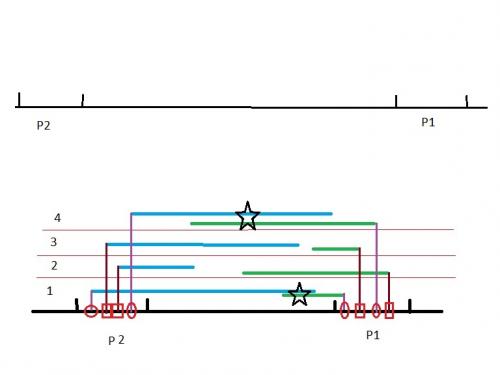
I would like to ask you (or anybody else) for a favour to run the program that reproduces above results to check that i have not made any silly mistakes. I thank you whether you can help or not. But first let me explain a bit about the program. the thumbnail shows 1D implementation. 1,2,3,4,.... are the number of loops. in each loop I throw two numbers for each particle denoting their position and length. if the lines cross (star) I ignore I don't register the position( the round marks) or don't do anything with the lines. But if they don't cross then I have a counter that updates the number of times a hit happened in the particular position (the squared marks). then for each particle I have a counter that simply adds the lengths of this line to the previous total for each particle. I do that(loops) a million, sometimes a 100 trillion times. then I normalize to the number of throws. the totals of the lines(normalized) are the energy. the numbers of hits for each positions is operated on to get the expectation values. normalized position hits are the probabilities that are similar to the ones we get from the "squaring" of the wavefunction. Without interaction the expectation value is the midpoint of the particle. But when interaction happens the expectation value moves. lets say to left in the left particle and right in the right particle. That denotes a repulsion. you can also get attraction with different logic. But more on the logic part later. then the particles are moved to a different distance and the operation is repeated. Now I explain the code in more detail. see attached file. The code that you see is the cleaned up version of the one in the website. 1. define variables/types 2. set the particle widths (d0,d1) , which I interpret as the compton wavelength, I assume lamda= h/mc the model shows (I will show why) that h=c , so lamda =1/m ,then I choose m to be in au hence if m=.0005485 then lamda=1822.8885 units of length on the axis/line . more on scale later. 3. set the interval (intr), that is used as a quantity to increas the distance between the particles after the calculation finished for certain distance. 4. start the mk loop that will increase the distance between the particle after each iteration. 5. based on mk value set the positions of the particles,zero out some of the variables need be. f1 is the number of hits for crossing f for not crossing. Zero out the arrays (S[],Sy[]),that hold the hits for each position on the axis/line. 6. next is the j loop the heart of the program, it iterates on the random throws 7. don't worry about these lines, not important long r= rand(); double rndm=(double)r/((double)RAND_MAX); 8. calculate the start of the lines from inside of the particles and the length of the lines shooting to the other particl all based on random numbers. 9. use if ( st1+p1 + li1 > st0+ p - li) to check if lines crossed or not. 10. if not crossed update the position hit by incrementing the counter S[] for that position. add the random line to an acummulation counter (en). I do that for one of the particles only. the other will be similar. While I said I don't do anything when lines crossed but in this program I do the same using Sy[], en1 just for information. I will talk more about it later. 11.go to 6 12. when done with j loop normalize the energy en to the numbers of throws accepted frf = (double)f/en; //energy of the particle 13. calculate the expectation value for the position array S[] -over the width of the particles. edx = edx + (( n) * S[n]); calculate how much exectation is offset from center of the particle ex[mk] = (double)edx / ((double)f)- (0.5 * int(w*d1))+.5 ; 14. update all data in file for that seperation. 15 . go to mk loop for new seperation distance 16. done To get the said graph you have to run it several times with these parameters. d0=d1= 5,50,200,500,1500,1647,1966 what ever you like up 2000 is ok. just plot distance vs frf(energy)[second and third output columns] for the different runs of particle sizes. but make mk start=0 and intr =50 and kj= 500000000 for 150 points run for each particle will take 2 hours. for 5 particles 10 hours and you are done. you can also run it for only 3 runs for d0=d1=5,200,1500 to get a rough idea. Take the data to a spreadsheet(excel) and plot. you can also change to for (kk = 0; kk <= 10000000; kk++) just to be on the safe side.also change to following long long w =1; qsaclean.txt
-
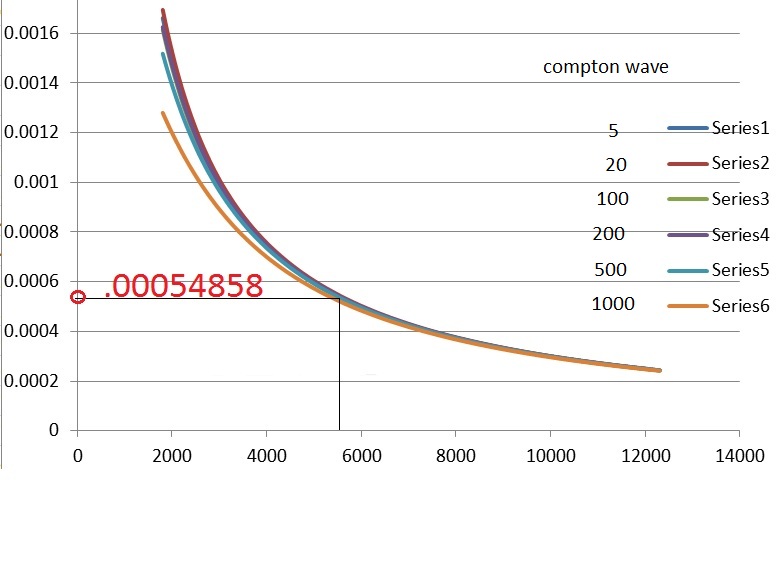
Here it is, what I call the most beautiful graph ever, I simulate two particles interacting, with different compton wave lengths for each run. they all converge on the .00054858 the mass of the electron. also check out this formula (compare with QED derivation) electron g-factor=(4m_e/3eh)*(2/(3*m_e*alpha) - 2*e^2 -1) =2.00231934... e=3(charge square),h actually h_bar=(e/alpha)^.5=20.2758.. m_e=.00054858
-
Thank you for reply again. I basically agree with everything that you have said. I have explicitly and implicitly admitted to what I have been able to make sense of and how much. The sad thing is that I have not gotten much attention because that was the whole purpose of the exercise is to see what other people make of it and what mistakes I have made since like I said it is in my interest. I replied to your post in less than two minutes when you pointed my error, that was really nice. Because I saw the behaviour that I show in the thumbnail before but did not pay attention to it that much and it was not clear because of the error that you pointed out. So when that cleared up the new picture became much more clear and I caught it, thanks to you. That is why I said I am sad, because people here demand some real math in the theory and I show it with simulation, yet people who wrote prose got much more attention, not that there is anything wrong with that. The physical picture is building up very slowly. but even the formulas I show I have hard time fiquring out what is going on. Still I am having a very vague idea what is going on since I have not shown you many other results and I also know what I need to do to have a better picture. and I don't blame the reader because my website writeup is a disaster of its own. But basically the equivalence to standard physics is coming from the fourier wave analysis. As to the whole of physics I agree it is a quite bit strong, but not entirely untrue from the large amount of evidence of both the shown and the unshown. But since this is not a publication it is only in the debug stage so I thought of doing clever advertizing! I do hope to publish soon in My link after more solid results are worked out. I will post the X axis soon, it is probably the most clear and interesting result. Thank you again. P.S. how did you find the links that I have posted in my last post. Speaking of coincidence. I calculate alpha (FSC) in my program with few terms that are an output of the simulation. the difference was something like .000004, it drove me nuts for months. Until I found out that it was pure concidence becaus of the closeness of 4/alpha*m to 1000000 , how much honesty do you want. untile I found the reasonable formula for alpha which I have shown.
-
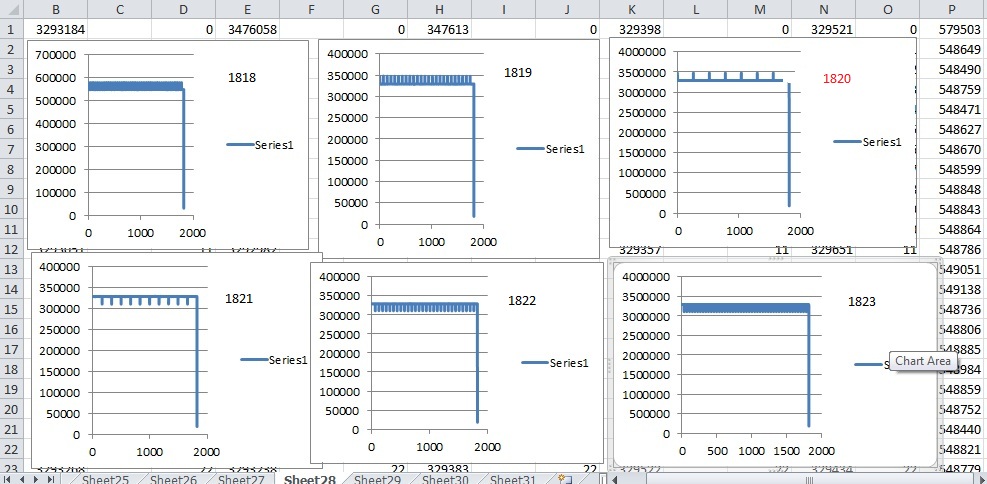
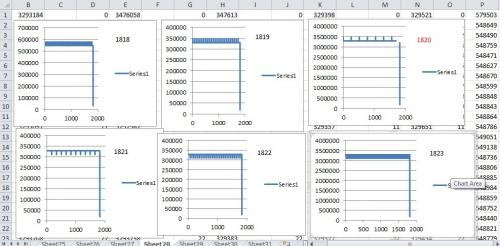
Ok, here is the the electron mass and spin relation. if you look at the attachment you will see as the particle size approches 1823,1822,1821 then at 1820 you get a flip in those notches and the frequency becomes minimum. I interpret that there is a relation such as 1820+3(charge square)=1823 which is almost electron mass. also the same behaviuor appears at 1820*5, 1820*3,1820*2,1820*2,1820*1,1820/2,1820/3,1820/4 ... I am not sure at all what is going on, but the simulation don't lie. If it is some kind of coincidence , well that will be strange to say the least. but there is also some support form the X axis simulation also. but again I have to put it in a presentable form. attached mass.txt has the code just plug the the particle size (1823 ....) into d0 and d1 in the code. take the data from "y5a.txt" and put it in excel sheet and plot. Please erase "y5a.txt". before you run again for different particle number. change code to prevent from repeated runs from for (mk = 1; mk <= 100; mk++) to for (mk = 1; mk <= 1; mk++) mass.txt
-
Thank you for the reply,much appreciated. As for that programing error took me less that 3 seconds to realize it when you pointed it out. But otherwise I have checked for the possible errors that you have mentioned. As for Mermin paper ,which I have seen before, its points are well taken. It remains to be seen how my theory is to be interpreted in its context. As for the cult thing, it simply does not apply to me. I am a very well to do person with a history of many success on my side and also I have a patent. Like I have explained a bit in my website I have a Masters in EE from University of Sussex , and I keep my mind sharp by reading about complicated stuff with physics and other things. Although, I cannot claim to be a high end physicist but I have read a lot in the area ,up to the latest QG theories, and I do have the basics albiet far from full. I guess what I mean is that I know very well how science works and I am very well aware of the cult example pitfalls. I tinker with ideas for fun. like I also mentioned in my web the result that I got was a COMPLETE surprise to me, I had a gut feeling about the idea , but NEVER expected those results. As you may know, which I came to know much later, that people like Wolfram (New kind of science-google-) and Conaway game of life have consciously persued such ideas righlty from their experience with physics. But fortunatly I did not, and I did not even know about them at the time. Nor, I knew of Dr. Tegmark's conjecture which I think my theory proves, somewhat at least. I arrived at it from a very different prespective. Now, you could look at it as if it is a fourth method of doing QM ( the others,schrodinger,matrix,path integral), but from a very diffrent prespective. Whether that adds something very new or not is to be seen. My first impression is that it seems to justify my claim, but I cannot be very sure. That is the whole purpose of these discussions. BTW, I have again connected electron mass to spin, I think there are no errors this time. I will post that when I put the material in a presentable form. it involves few graphs. As to your knowledge of quantum physics I hope somebody with experience can help, maybe somebody you know. But thank you very much anyway. Mathematical Universe theory,wiki A new kind of science, Wolfram
-
Thank you for catching the 1823, error. I just simulated that few days back, I guess doing a ton of simulations with code makes you do a lot of mistakes, which I have done plenty of. But still that is a good start. Anyway, I appreciate your help a lot, and if it turns out that the theory is just a mathematical illusion then that will be a relief eventually. And if it has any value no matter how small then I will be just glad, either way I win. I do hope you stay with me until it is resolved. But for your first question the output sine^2 wave simulates the shrodinger equation solution for particle in a box, ie with infinite potential. The constraint is just not to allow the random lines to go out of bound. particle in a box just corrected the link, I am new here.
-
I derive the whole of physics from a simple postulate " Reality is a Mathematical structure". It is the only dynamic structure possible using fundamental entity which is a random line. Particles are modelled as end of lines, one end is confined to a small region and the other to other particles in the universe. I simulate , with a simple C++ program,two particles interacting in 2D by counting the lengths of the random lines that cross each other from the two particles. In the X-axis I get the 1/r law for coulomb potential.The system automatically reproduces the hydrogen 1s energy. The secret is that in my system the Hamiltonian is an output and not an input. when lines meet that is gravity. NOW for the big surprise. In the Y-axis the particles can only interact on a region set only by their width and it is NOT dependant on the distance between them. so each on can be at the other side of the universe. and the expectation value are always the opposite of each other, one is negative the other is positive. Please click new developments in my website and be sure to go where I show the relation between spin and mass. You can verify the results for yourself by running the simple C++ program. QSA theory check out these formulas that I deduce from my theory, these are NOT a guessed formulas. alpha=α = 7.297352533(27) × 10−3 let m= 27*(1/(2*alpha) -(.5*alpha) -1) + (alpha/(2*PI)) m=1822.888474(approx)..... the term (alpha/(2*PI)) it is related to spin .................................................. .................................................. .............. Also first term 27*(1/(2*alpha) )=1849.98599... Two terms 27*(1/(2*alpha) -1 )= 1822.98599 average (1849.98599+1822.98599)/2 -1/3= 1836.15266 electron-proton ratio, strange ha !!! Actually 27=3^3, 3 is equal to e^2(charge squared!!) in my system, the long term not the running phase. Also reversing the relation I find 1/alpha= (2/3)(1/m*e^4) +2 +(3/2)(m*e^4) Approx.(m=1/1822.8885) (e^2=3), e^4=9 beautiful symmetry. all these equation can also be written in a form that uses the golden and silver ratios (google) α