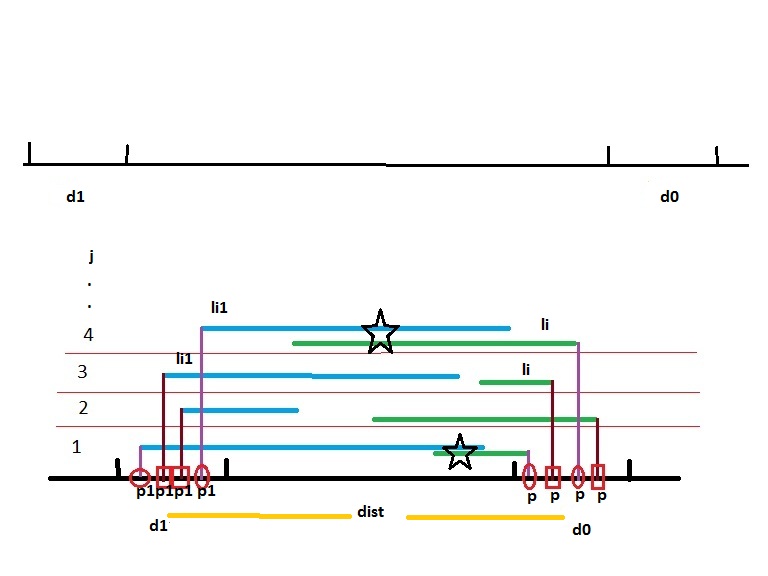
qsa
Senior Members
-
Joined
-
Last visited
-
Dear mentor, 1. I did not mean to advertise since the thread already had a lot of information. I just mentioned the extra results and I intend to answer any questions that might come up regarding the new programs. 2. their were not a lot of "outstanding" issues. the main issue was that bignose was not able to understand my point i.e. the mass of the electron appeared in an area just after the curves converged strongly. And we discussed it at length, so I thought there was no point on dwelling and I was waiting for other peoples opinions , that is the whole point of posting on speculation. Thanks
-
New JavaScript programs were added. also bump up for new members. url deleted
-
Thanks for the reply. If you have browsed through the thread you would have seen that my system is based on computer simulation. This technique is similar to what was attempted by Wolfram in his New Kind Of science, however, my system directly derives QM and gravity laws including particles and space and time in one coherent go. My future plan is to convert the system into the familiar mathematical formalism which is related to Buffon's needle and it is closely related to this concept(and the related references therein) http://arxiv.org/pdf/quant-ph/0608251.pdf However the important point is to read section two of the contest article and run the gravity and the Bohr model program to quickly familiarize yourself with the concept. All that should not take more that 10 min or 15 min max. Sometimes people expect to skim for a couple of minutes to understand, which is unreasonable. As for Newton law I rewrite my first sentence in my post to add the latest discovery which I derive gravity from the same system that reproduces Quantum Mechanics.
-
Ok Thanks.(sorry that was copied from Dr. Tegmark Facebook posting) Here are the direct links FQXI contest article http://fqxi.org/community/forum/topic/2451 Gravity simulation producing Newtonian law at large distances. http://www.reality-theory.net/gravity.html Other interesting simulations especially the Fine Structure Constant http://www.reality-theory.net/a.htm ABSTRACT In This essay I shall derive the laws of nature from a simple mathematical system from a postulate that reality is indeed a mathematical structure. The system can be simulated by a computer program to generate many results that agree with Quantum mechanics. Also I will show that the system can be put in regular more familiar mathematical formalism. The postulate lead to assume particles are made of random lines were one end originates in a small region representing the particle and it extends to all other points in space and some ending on other particles. The points are really nothing but random numbers, hence reality is nothing but some relation between random numbers. Moreover, the lines are responsible for the interaction by a process of crossing or not crossing or meeting.The start point and the end point of these lines define space and the length of the line is interpreted as energy, time is just a change of state. The system unifies space, time, matter, energy and interaction, all in one coherent picture, so particles and the laws of nature governing them appear naturally. The simulations generate some basic Quantum Mechanics results and the 1/r law as in quantum field Theory. There are other results such as the hydrogen 1s level where the universal constants like c, h, e and their relation that lead to Fine Structure constant automatically fall out of the simulation. Two simulations are done; one is Bohr like model and the other Schrodinger like equations solution and show the equivalency. Also, the mass of the electron appear naturally using a simulation which is an extension of the Bohr model which in turn leads to the predicting the size of the proton. The system displays the non-local behavior and explains the EPR in simple terms and shows spin. The coulomb potential is produced by line crossing, Gravity appears for certain constraint as shown in the program. P.S. the information in the FQXI contest about gravity is outdated but the program does produce Newtonian gravity.
-
This thread is four years old. This is a follow up post to add the latest discovery which I derive gravity from the same system that reproduces Quantum Mechanics. Moreover, some better and more compact writing of the concept is introduced with some more results from new simulations. TO RECAP Seven years ago I came up with an idea that proves DR. Tegmark's conjecture that "reality is nothing but a mathematical structure". The mathematical structure agreed with many of QM features and explained some of its mysteries. However, during all these years gravity was incomplete, while I was getting a tiny tiny force( from the same structure that produced QM) but no Newton's gravity law appeared. That is until one month ago, now I have the correct constraint to generate Newton's law at large distances (of course you can calculate it at any distance). here is the simulation for gravity Other simulations for QM Contest paper about the idea LINKS REMOVED BY MOD
-
Thank you for your reply. What I was trying to ask you is to confirm that the program is simple in its structure, the variables are few literally. But of course it might be hard to understand what the system actually represents. That is why I wanted to go step by step, starting with the program in post #49. So what did you think of the result, did you recognize the number? Yes, as you go further away from 1 and get closer to two particles with a width of 1500 or more the numbers start to become less and less although still staying close to 00054858. There is a very specific behavior, that is why I needed to show why in a step by step. I repeat the two particle interaction explanation(although it is for c++, and step 13 is not implemented in javascript yet) here for ease of reference from section 3 in the website. 1. define variables/types 2. set the particle widths (d0,d1) , which I interpret as the Compton wavelength, I assume lambda= h/mc the model shows (I will show why) that h=c , so lambda =1/m ,then I choose m to be in amu hence if m=.0005485 then lambda=1822.8885 units of length on the axis/line . more on scale later. 3. set the interval (intr), that is used as a quantity to increase the distance between the particles after the calculation finished for certain distance. 4. start the mk loop that will increase the distance between the particle after each iteration. 5. based on mk value set the positions of the particles, zero out some of the variables need be. f1 is the number of hits for crossing f for not crossing. Zero out the arrays (S[],Sy[]),that hold the hits for each position on the axis/line. 6. next is the j loop the heart of the program, it iterates on the random throws 7. don't worry about these lines, not important long r= rand(); double rndm=(double)r/((double)RAND_MAX); 8. calculate the start of the lines from inside of the particles and the length of the lines shooting to the other particl all based on random numbers. 9. use if ( st1+p1 + li1 > st0+ p - li) to check if lines crossed or not. 10. if not crossed update the position hit by incrementing the counter S[] for that position. add the random line to an accumulation counter (en). I do that for one of the particles only. the other will be similar. While I said I don't do anything when lines crossed but in this program I do the same using Sy[], en1 just for information. I will talk more about it later. 11.go to 6 12. when done with j loop normalize the energy en to the numbers of throws accepted frf = (double)f/en; //energy of the particle 13. calculate the expectation value for the position array S[] -over the width of the particles. edx = edx + (( n) * S[n]); calculate how much expectation is offset from center of the particle ex[mk] = (double)edx / ((double)f)- (0.5 * int(w*d1))+.5 ; 14. update all data in file for that separation. 15 . go to mk loop for new separation distance 16. done
-
Checking your profile I knew that you have a mathematical background. But since you asked me for equations and your other comments about programming I assumed that programming might not be something you like to do. So far you have been my main customer and the adage is "customer is king", so no insult was intended. And I tried to explain that I can only try to clarify the results by showing a step by step some of the results that I have , but only using the simulations. In my last post I tried to explain why I must use simulation. Thanks for your detail reply. I was not asking you to back me up on the idea, only that the program is relatively simple as you seem to be good at programming. I have no magic numbers. you could use 100 and 700 or 500 and 1234 or such and you get essentially the same result. All other variables are counters and such and I can change any of them with no consequence on the results.
-
I agree with you that programming for the uninitiated can be daunting. However, this system is really very simple, even md65536 can confirm this for you. I am not sure if you are aware of Wolfram's NKS and Conway they tried to generate the laws of physics through a simple automata. As you know they are very heavy duty mathematicians(and physicists) yet they believed in such a simple system such that ordinary mathematics will be very hard to emulate if not impossible. So, unfortunately at this time I have not tried to convert to ordinary physics techniques, yet I have been more successful than Wolfram(and others) by obtaining direct results in such a simple and powerful way. That does not mean that I have no plans, I do have three routes to convert to standard mathematics but it is too early, they are all complicated as far as I can see at this point. I need to understand and extract more results from the system as is, which is surprisingly able to do.
-
I could chit chat about the philosophy or the techniques of what would be considered significant or not in a scientific activity, however, at this point I just want to show some basic results. It is up to you to decide if it is significant or not. this new program and two or three more will hopefully let me illustrate my results.
-
The whole point of discussing my theory on forums is to "debug" my idea, so I am very much interested in any opinion particularly the negative ones. I am planning to publish it in some open journal so I need to be prepared for any criticism. As a matter of fact I spent several days trying to see how to make the issues more clear and I spend at least three hours rewriting the new program since it was written in C++. actually it was more like for checking the output, C++ PRNG is much better than JavaScript. I am trying to take you a step by step through the system hoping to make it much easier to understand. So you cannot accuse me of ignoring your feedback. However, I cannot answer purely on your terms I have to put my own arguments in my own way. Now, if you don't accept them after reviewing them that is all together another matter, I could be wrong or you might not understand them. So, please take your time and run the new program, it only takes a minute to setup. you can run it and then go about your business and then come back to check the results so we may discuss it. Please note that the javascript screen might go blank(if you switch to another tab) but it will come back after it finishes the results. Yes, I understand the problem. The discussion is all about that. the prediction is not given a clear point but of a general area. I am trying to explain that. Please see my reply to Bignose.
-
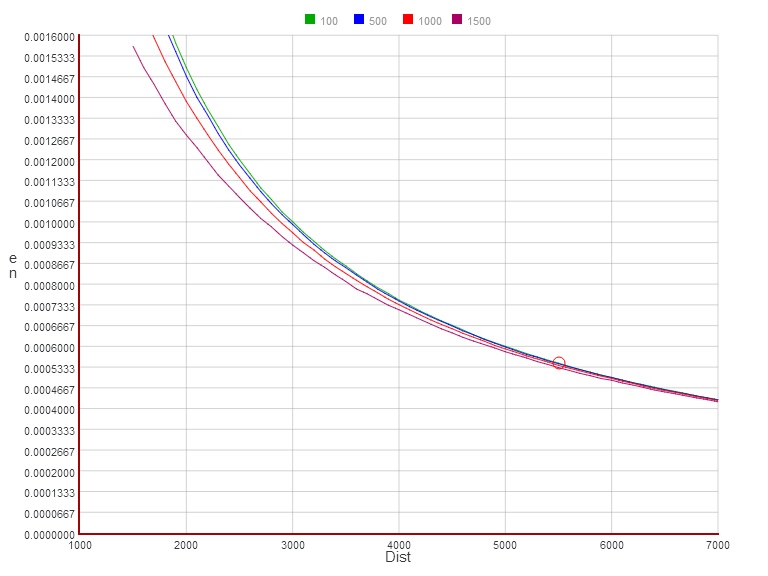
I am now on vacation, but I will do my best if you want to continue the discussion which I appreciate a lot. Irritation is a natural human reaction, I also get irritated from your comment, but I will not get it into my head. You can always opt out if you get too annoyed! That is your right of course. Now, I don't think it is wise to go into this cycle of yes it meets , no it doesn't. It does look like the numbers you picked seem to be the general area, however, you are right that there is no specific point, and there seems to be a good reason. I would like to analyse this fact a bit more later, but I want to go through several points before that. But before that I would like to emphasize a point relating to your comment that you can write a program to do such and such. That is why I emphasized in a previous post that all my results are done using one and only one system, I don't get to pick and choose. I only do what is possible as to the system allows me to do, which is relatively very small set of actions. To see my point about the system please cut out the code in my website and replace it with a copy of the code appearing in the thread. run it to see the results in the textbox and see what number comes up. it might take few minutes(10-15). . run it few times and average for even more accuracy. the two particle interacting have a Compton wave of 1822.8885 and sitting at a distance of Bohr radius. 1/(m*alpha). Alpha seems to be nothing more than a probability ratio of hitting the particles directly to kj or f(unaccepted throws). The program is exactly as the previous one with a condition shown. Once confirmed we take more. //insert code here function GraphIt() { var newElement = document.createElement('p'); var L = 1000000; var w=1; var f = 0; var q = 0; var en = 0; var en1 = 0; var edx = 0; var edx1 = 0; var kj = 1000000000; // increase for accuracy var m = 0; var km = 1; var d0 = 1822.888; var d1 = 1822.888; var intr = 1 ; var eqt=0; var rand = new Random(); // create an array 's' and 'l' and initialize all elements to 0 var fr = new Array(); // KM or w*d0 !!!!!! for (var i = 0; i <= km;i++) { fr.push([0,0]); } for ( var m = 0; m <km; m++) { var dist = d0*137.036-0+2*m*intr ; var st1 =(L/2)-(d0*137.036)/2+ -d0 - m*intr; var st0 =(L/2) +(d0*137.036)/2+ 0 + m*intr ; f = 0; f1 = 0; edx = 0; edx1 = 0; en = 0.0; en1=0; ent=0;q=0; for ( var i = 1; i <kj; i++) { // throw random lines var p = d0 * rand.random(); var li = (dist + d0) *rand.random(); var p1 = d1 *rand.random(); var li1 = (dist +d1)* rand.random(); if ((st1 + p1 + li1 > st0 + 0) && (st1 + p1 + li1 < st0 + d0) ) { // if ( st1+p1 + li1 > st0+ p - li) { eqt=eqt+li q=q+1; } } // put random lines through conditions if ( st1+p1 + li1 > st0+ p - li) { // do nothing } else { en = en+(li); f++; en1=en1+li1; } } en = f/en; en1 = f/en1; fr[m][0] = dist; fr[m][1] = en; document.lf.log.value += 1/(q/f)-1+"\n"; } var myChart = new JSChart('chartId', 'line'); myChart.setSize(750,600); myChart.setDataArray(fr, '100' ); myChart.setLineColor('#00AA00', '100'); myChart.setDataArray(fr1, '500'); myChart.setLineColor('#0000ff', '500'); myChart.setDataArray(fr2, '1000'); myChart.setLineColor('#ff0000', '1000'); myChart.setDataArray(fr3, '1500'); myChart.setLineColor('#AA0066', '1500'); myChart.setLineWidth(1); myChart.setTitleColor('#7D7D7D'); myChart.setAxisColor('#9F0505'); myChart.setGridColor('#a4a4a4'); myChart.setAxisValuesColor('#333639'); myChart.setAxisNameColor('#333639'); myChart.setTextPaddingLeft(10); myChart.setAxisPaddingLeft(80) myChart.setAxisNameFontSize(12); myChart.setAxisNameX("Dist"); myChart.setAxisNameY("en"); myChart.setLabelFontSize(8); myChart.setAxisValuesDecimalsY(7); myChart.setIntervalStartX(1500); myChart.setIntervalEndX(7000); myChart.setIntervalEndY(.0016); myChart.setAxisValuesNumberY(100); myChart.setLegendShow(true); myChart.setFlagRadius(6); myChart.setTooltip([5500,'','100']); myChart.draw(); }
-
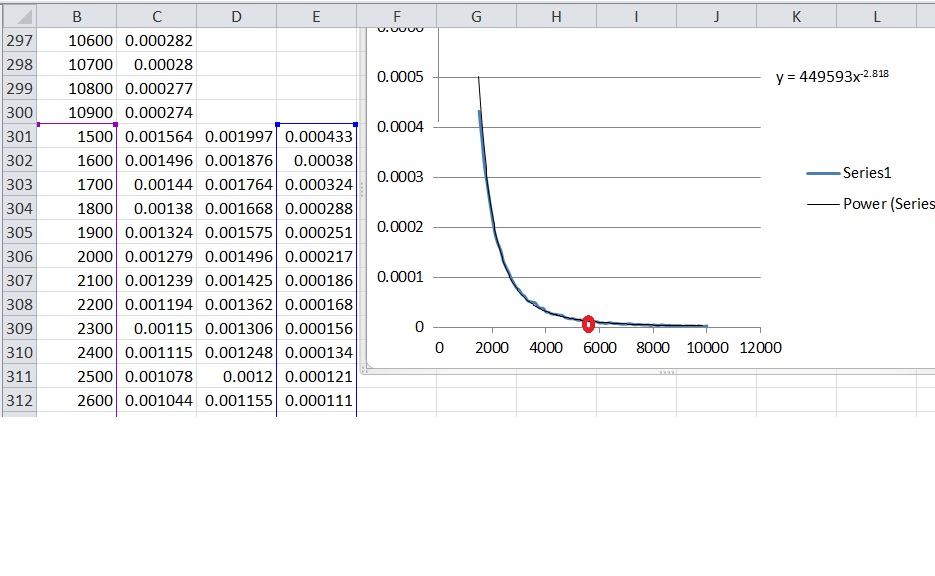
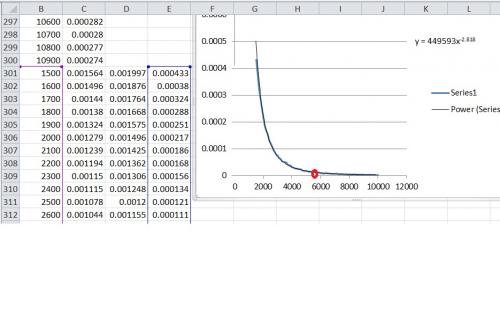
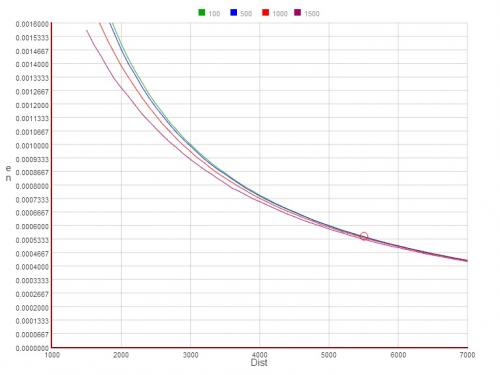
Thank you for the long reply and your good observation, That shows that you are carefully examining the results. Of course I say that because I also wrestled with this issue, I was not getting a clear point of intersection. As a matter of fact the curves never meet even at large distances although very close there was no clear criteria as to what the difference should be taken as. Nevertheless, it is also clear that the area we are talking about is significant in the general sense. What I mean is that it is a standard practice to approximate functions for instance by cutting off the higher terms. We do many such approximations when solving engineering or physics problems. Also don't forget that here we are talking about the mass of the electron which has been the untouchable of the standard physics. So any hint of it showing up is very significant, Moreover, it is showing up in a theory in a natural way i.e. without making too many assumptions, just extension of the basic system. To convince you that the area mentioned is significant I show a plot(in the image shown) for the difference in the values for 100 and 1500 for each of the distance of the separation. You can see how the values quickly went down by 97% at the vicinity of the area marked by the red circle. from there on the difference takes a much much more gradual poster. the curve was fitted with a power function using EXCEL and you can see it is almost 1/X^3, a very fast decay before the end of bent. I post the image of the typical curves that is being talked about for the benefits of those who don't what to go and run the program.
-
I am not sure why I got -1, I just thought I would be courteous by informing that I will not be able to reply soon( 4 AM local time). I could have simply waited, I pass that as a misunderstanding. I don't want to make a big issue out of side issues like the derivation of SE, but if you Google for it you will see a lot of papers claiming such a thing, They usually start with criticizing previous work and then offer their "right" explanation. There is no standard acceptable theory. Now to the issue at hand. But before proceeding further, I would like to emphasize couple of points. First, do you agree that I am not doing anything on purpose to produce those curves. I.e. I use the same algorithms that I use in getting the basic results that I mentioned to swansont in post # 40. Second, the curves are fully divergent to the left and almost fully convergent on the right. So there is an area where they start converging. Can you please estimate the range of this area approximately and tell me what it is in YOUR opinion. Thank you. In this post I want to address your specific suggestion that the system with random lines and point represent some physical activity. If some Gods were running a computer with a program that would be a possibility, however it sounds remote. It could also be some children in some God universe playing with their fancy needles, that even sounds even more remote. Since the design looks unique and natural, my first guess is that mathematical facts are real and reality is a by product of that via this mathematical structure.
-
I will respond later . It is very late our local time. Thank you for your interest.
-
Very good question, thank you. Yes you are right, That is why I have said previously in the "vicinity" of the electron mass. To clarify maybe I should have said just at the "beginning" of the curves convergence. Obviously, that vicinity looks like an interesting or unique place not like when the curves are separated or fully(almost) converged. and it is a wonder why this unique place is in the vicinity of the electron mass. I will diverge with a story to clarify a point. It is said that Feynman commented about Schrodinger equation by saying "Where did we get that (equation) from? Nowhere. It is not possible to derive it from anything you know. It came out of the mind of Schrödinger." So Schrodinger just made an educated guess and it worked(hydrogen). Even the correct interpretation for PSI came one year later. So, in the same sense the system works, especially combined with all the other results. However, I cannot claim I understand FULLY what is going on, all I can see at this point is that I do get some surprising results(some which I have not documented yet). Some agree with standard physics others like electron mass have no standard equivalent. And it seems that we might have the origin of Schrodinger equation. Also these separated curves seem to have something in common with renormalization as in standard theories, more work is needed to see if there is any relation. The electron mass that I get seem to agree with non-standard theories like this one http://arxiv.org/abs/1312.4204 with the electron having "structure". My tentative conclusion( too early to be sure) is that the interpretation of Yakawa potential as m standing for the particle that carries force does not seem to be correct. Yakawa potential is just that a potential. I have much more to say later about how the system exhibits scale invariance and maybe even mc^2 origin!! and other things. Hi md65536, Thanks for coming back, you know how much I appreciated your participation in the past. As you know as soon as you pointed out some mistakes in my program it took me seconds to acknowledge them and I was very glad that you found them. As a matter of fact I had another error which I discovered myself, the results of post #6 in this thread which I have promptly removed from my website. So as you can see I have no interest whatsoever in fooling myself, I have much better things to do in life. In this program there is no any number close to 1822.8885, only 100,500, 1000, 1500. You could change those numbers to 251,654,1234, 1456 and you will get the same results. I am really looking for any reason as to why I am getting these results, like by chance or some hidden assumption or whatever other than that the system is showing real physics. I hope people will help me with that. As to Buffon's needle, I have posted in many forums and blogs to say that QSA seems to have some links to it. As a matter of fact, in the FQXI contest I chat with Torsten here http://www.fqxi.org/community/forum/topic/1877 and I mention this "Also one important link that I found is that my system seems to be a generalization of Buffon's needle in the sense that both the needle and the lines become random in size. And that leads a series of connections to : http://en.wikipedia.org/wiki/Buffon's_needle http://en.wikipedia.org/wiki/Integral_geometry http://en.wikipedia.org/wiki/Radon_transform http://en.wikipedia.org/wiki/Penrose_transform http://en.wikipedia.org/wiki/Twistor_theory