Jacek
Senior Members
-
Joined
Everything posted by Jacek
-
@Mordred When I asked you about conformal time as the age of the universe, I meant conformal age of the universe, even if I didn't specify it.
-
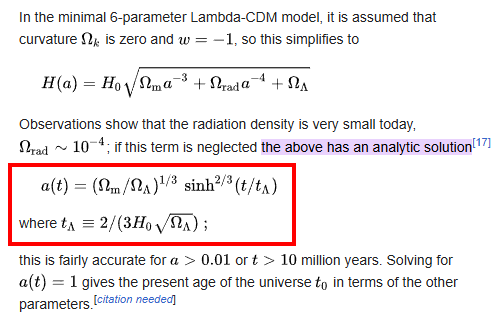
This one https://en.wikipedia.org/wiki/Lambda-CDM_model#:~:text=the%20above%20has%20an%20analytic%20solution If you also know the explict function which doesn't neglect the radiation density, I'll be grateful if you share it. The radiation density is so negligible (even if it wasn't in the very early universe), that the integrated inverse of the scale factor function without it also gives 47 Gy and 47 Gly.
-
@Mordred conformal age is on the LHS, and the upper limit of the integral on the RHS is the proper age.
-
I did, because 13.8 Gy is the proper time of matter.
-
@Mordred η=∫dη=∫dt/a(t) If you do this integration with bottom limit equal to zero and upper limit equal to 13.8 billion years, you'll get 47 billion years. If you multiply this result by c, you'll get 47 billion light years.
-
@Phi for All Jesus... I think you forgot to add all the banned users to this list to make it more impressive. It's not infinite though. Why haven't you banned me yet?
-
Now the funniest thing. If cosmic time actually is the conformal time according to @Mordred and my physical definition for this time, is 47 Gy a present, cosmic time of the universe? What's your answer, Science Forums?
-
That's a good one :) I really like it, seriously. In a sick world you have be a psycho to be normal.
-
Thank god for that @Mordred .
-
@Phi for All I wasn't banned on Reddit's r/Astronomy for evading a ban, arguing with them or insulting anyone. I was banned for telling them they created a cancel culture, and I gave the explanation. They couldn't handle it. I couldn't even argue with them afterwards, because they muted me right away. You know exactly why I'm calling @Mordred a liar. Go ahead, ban me, you're great at it giving 40 pages of banned users. I don't care. I'm insulting you now because you actually are a nasty, indecent bunch of people. And @Mordred is the worst of you. You told me not to be a COMPLETE DICK about my post and my points. Go ahead, be a COMPLETE CUNT about me and ban me.
-
OMG, you're all so kind to me. Thank You!
-
@Mordred ... Conformal time η=∫dη=∫dt/a(t) includes the whole expansion history, because the scale factor function of time a(t) IS the expansion history. You're worse than a liar at this point. Much worse. @Mordred EVERYTHING you wrote indicated that COSMIC or COSMOLOGICAL time IS THE CONFORMAL TIME. Try to deny it, please, make my day. You know exactly what I was banned for. https://www.scienceforums.net/topic/140238-cancel-culture-in-major-astronomy-communities/ You shouldn't defend a liar, you know? Just a thought.
-
@swansont @Phi for All Can you see now what I'm dealing with on your forum regarding the fact that @Mordred is Resident Expert, Super Nerd and Glorious Leader?
-
@Mordred ... I asked you whether 13.8 billion years is the age of the universe in the conformal time, and you confirmed. I asked you whether you don't have a problem with calling 13.8 billion years a conformal time, and you denied. And you insinuated yourself earlier multiple times, that it's the conformal time, so now your evasiveness reached its peak and you're practically a liar at this point. More than that. At the very end you asked me if I'm sure that you're wrong. Yes @Mordred you were wrong, and now you're trying to act like you weren't. That's very, very low, and I totally disrespect you for it.
-
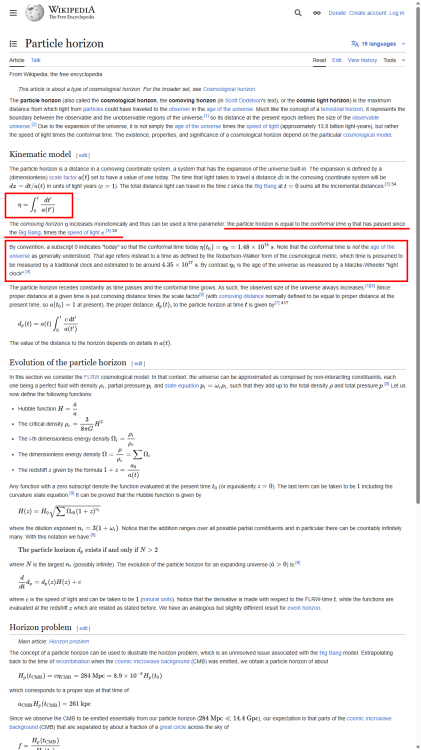
@Mordred yes, I am. Read the underlined text and text in the red frame. https://www.scienceforums.net/topic/140204-physical-conformal-age-of-the-universe/page/5/#findComment-1305391 And find the same text in the wikipedia - there is a link.
-
@Mordred you shouldn't try to teach anyone anything anymore, because 13.8 billion years is not the age of the universe in the conformal time.
-
https://en.wikipedia.org/wiki/Particle_horizon And now I think I really need to read about Marzke-Wheeler "light clock". Marzke, R. F.; Wheeler, J. A. (1964). Chiu, H. Y. (ed.). Gravitation and relativity. Benjamin. pp. 40–64.
-
Unbelievable. If the universe age equal to 13.8 billion years is already in the conformal time, then I can die happily. Thank you @Mordred
-
Don't you have a problem with calling 13.8 billion years a conformal time?
-
It would be a miracle if we came to mutual understanding after all we wrote, but you gave me a tiny spark of hope. You're asking me "is commoving coordinate independent of its geometry ? Or is that now a coordinate time ?" I assume that geometry you mention is given by the metric, so coordinate time differential dt is independent of this metric and proper time differential dτ is not. For null geodesic used to calculate the proper distance equal to the radius of the observable universe we have: dτ = 0 ∫dr = ∫cdt/a(t) dt is the differential of cosmological time t. Now I'm asking you: Is t the comoving, coordinate time of the comoving observer? I'm asking, because in integration over this time we use limits corresponding both to the universe age, as well as the proper time of the observer resting in the CMB reference frame since its emission, if we neglect the fact that it was emmited some time after the BB, because his proper time is equal to the universe age (13.8 billion years). Ps. Not that the Christoffel symbols were needed and you said it yourself, but you couldn't help yourself... Now I get it - you're promoting your own thread.
-
Proper time squared is on the left hand side of the equation I gave.
-
Finally, something I can deal with. In case of the FLRW metric the proper time squared is dτ²=dt²−a(t)²dr²/c² and coordinate time is dt.
-
You say that I "refuse to acknowledge that conformal time is specific to commoving coordinates not proper distance for proper time." Where? Quote me. Sure @Mordred write the Christ-awful symbols equation, we need it so much at this point of our conversation... I'm also sure that all the readers would love to see it. No @Mordred please, explain as extensively as you can the overdot notation, I'd love to know what first and second order time derivatives are.
-
Do you have a problem with superluminal recession velocity? Are you sure that's the right thread to post about it? No @Mordred the FLRW metric is not a solution to the Einstein Field Equations. The Friedmann equations are a solution to EFE for this metric.
-
You can't be THAT silly... The FLRW metric on wikipedia: https://en.wikipedia.org/wiki/Friedmann%E2%80%93Lema%C3%AEtre%E2%80%93Robertson%E2%80%93Walker_metric If you write this metric in form of the metric tensor, substitute it into the Einstein field equations and solve them, you will get the Friedmann equations. And there is a scale factor in both the FLRW metric tensor and the FLRW metric equation, not to mention the Friedmann equations. And check out the Ricci tensor with the scale factor and its derivatives: https://en.wikipedia.org/wiki/Friedmann%E2%80%93Lema%C3%AEtre%E2%80%93Robertson%E2%80%93Walker_metric#Curvature "Resident Expert" - unbelievable...