
OlegMarchenkov
Members
-
Joined
-
Last visited
-
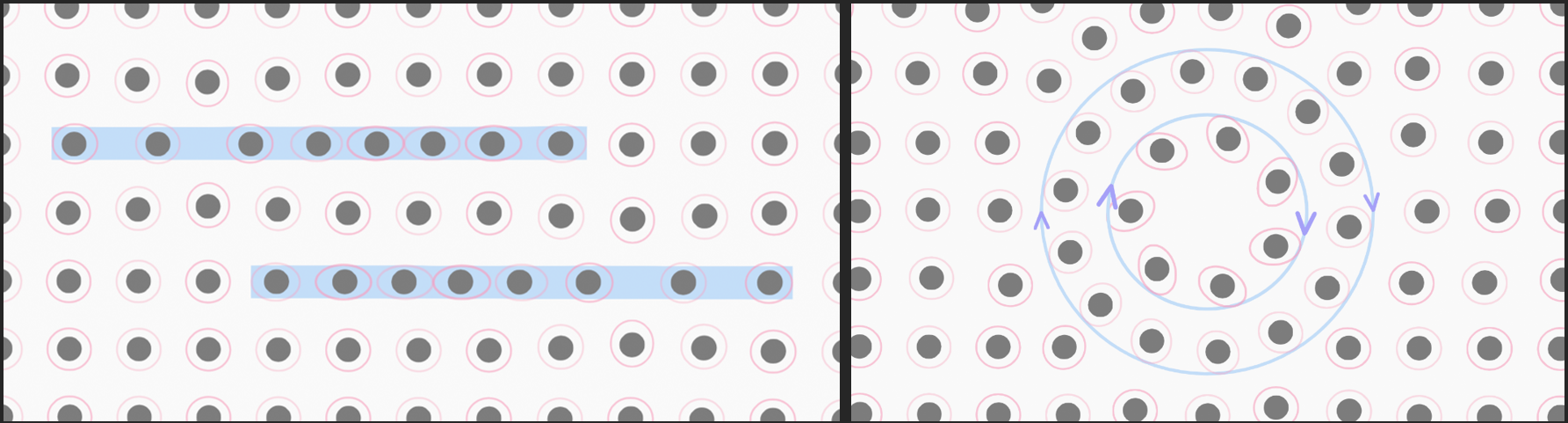
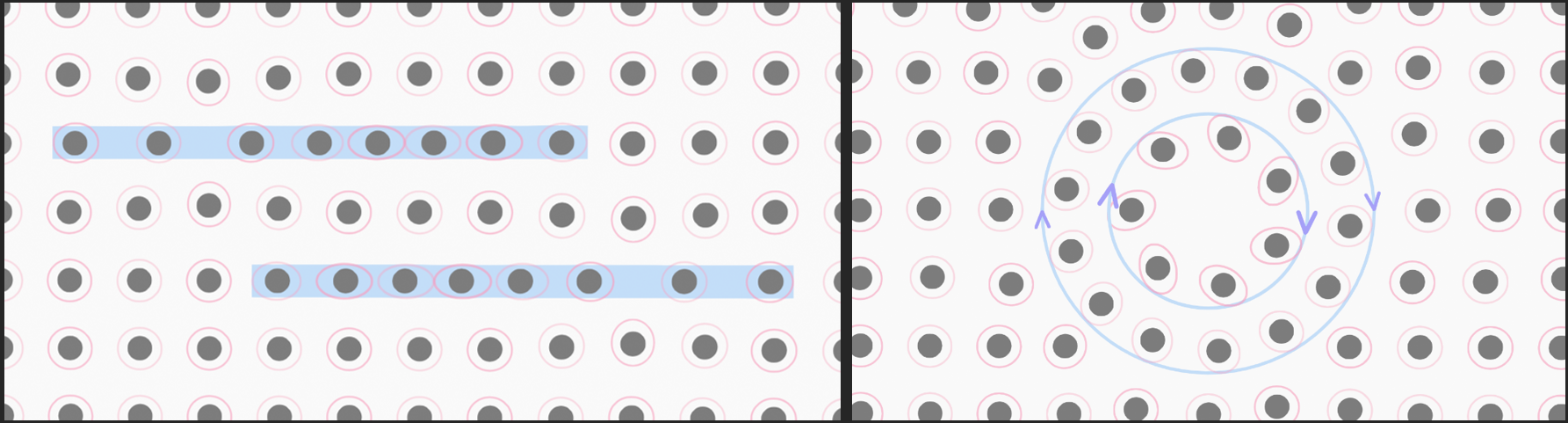
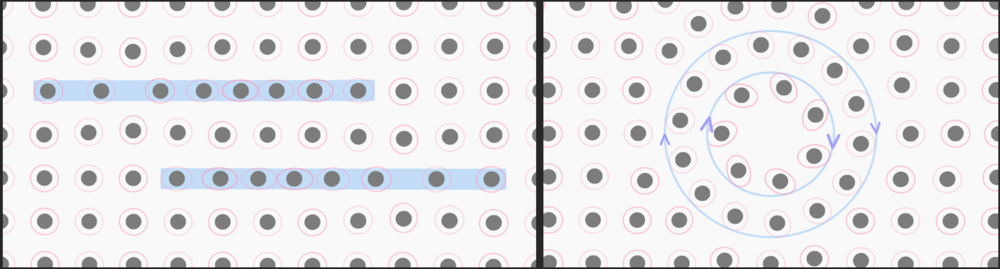
2. Nature of lightOk. This post about dark matter was an overview. Now we need to make sense of it and understand the implications of replacing vacuum with microparticles. Microparticles continuously move around their positions, transferring momentum to each other. They move in a specific formation (Figure 1). A microparticle with momentum pushes the next microparticle in the line and bounces back to its previous position after transferring momentum. The two highlighted lines (two momentum transfers) contain disturbed microparticles. We will call these formations microphotons. The microphotons are directed oppositely. Naturally, microparticles from the compressed region (microphoton head) of one microphoton are pushed into the rarefied region (microphoton tail) of another microphoton. The microphotons are turning their directions of propagation. At least partially, they loop on themselves. Such formation of microphotons moving in circle will be called a microparticle. Most microparticles have a similar simple structure of rotating smaller microparticles. Not all structures of microparticles are stable or metastable. Thus, for example, on this layer (Figure 1), most microparticles have the same size, having the most stable structure. On the lower layers (if we zoom in on the space between microparticles) we will see a similar view (Figure 1). The number of layers and possible sizes of microparticles are infinite. Figure 1. Formation of a particle from two photons Let us apply this model to atoms. When a photon head reaches a stable atom, the repulsed electron cloud is slightly lengthened and shifted away from the nucleus (Figure 1, the ellipses around the particles are orbits). If the photon is suitable for the atom, the cloud is locked in the new position by electromagnetic forces. The photon is absorbed. In the new position, one electron inside the cloud and one outside do not have an electron pair. We can return the electron cloud to its original position by elongating and displacing it in the other direction with an identical photon (stimulated emission). Although in most cases, background microphotons return the atom to its stable state (spontaneous emission). The electron outside must return to its stable orbit through the electron barrier. Background microphotons cause deviations from orbits and help the displaced electron find its way back between deviated electrons. If an electron falls from a high orbit due to spontaneous emission, it pushes the electron cloud, producing a photon. A stronger photon corresponds to a stronger push of the next atom by the electron cloud in the propagation line. A pushed atom can immediately rebound to its previous position if the photon is strong enough. But in reality, photons produced by electron clouds are often weak. While the first atom slowly pushes (transfers momentum), the second atom runs away from it. Thus, by the time the first atom returns to its previous position, the millionth atom in the line starts receiving momentum. For this reason, such a weak photon has a large length. We call this length the wavelength and associate it with the effect called interference. This description is simplified, we will come back to it later. It seems unlikely that we can do any useful analysis of this disordered sea of microphotons (Figure 1), but there are some things we can do. Photon heads (compressed regions) are repulsive, which leads to emergence of some structure in the sea. A flow of photons quickly arranges in a rhombus pattern (Figure 2, left). They can also overlap, but the overlapping pattern remains the same. Other patterns (such as photons moving in columns) are not stable. In this rhombus pattern, the upper and lower photon heads on the left are attracted to the rarefied region (photon tail) between them and cannot move away. At the same time, they are repulsive and cannot move to each other. Figure 2. Diffraction of light. A good illustration, although exaggerated in the displacement of atoms All microphotons are forced to form the same rhombus patterns with themselves. From the moment a photon is created, its head repels the heads of less strong but always present background photons and microphotons. If the background photon was traveling not exactly parallel to the photon, its course is corrected so that the photon heads become parallel. In the first moments after creation, the photon acquires its own escort of photons around itself (in front, behind and on the sides). Background microphotons and photons immediately flank it, striving to form compressed regions around it, as in the rhombus pattern. Why do we show photons moving along the grid (Figure 1)? In Figure 1 we have shown a stable configuration in which the grid is symmetrical to the right and left of the photon. If there is no lateral symmetry, the frontal escort jostles particles until lateral symmetry and stability appear. Therefore, photons simply cannot travel not along the grid in a stable state, which allows them to propagate straight in uniform medium.
-
Whenever I leave no reply, I agree with you (not always absolutely). Right now, I'm reading your links in an attempt to get my concepts lined up Photons align their directions of propagation. In any case, we'll need my next post to make any sense of it.
-
It is just an illustration. The scale is wrong. I intend to move back to the beginning of the story in the next post. What we discussed so far (dark matter, the central plane, etc) is not the basis.
-
The direction changes due to a gradual change in the refractive index near the central plane. There is an underlying layer of complexity I don't want to go into right now. Let me start with the basics in the next post because I'm afraid these questions will never end. Yeah, It looks that way. I remembered why I discarded the vacuum. It is not needed in the model. There are small and large microparticles in this broth. When a region is rarefied with large microparticles, it is not necessarily rarefied with small microparticles. Small microparticles still occupy space. Please, excuse me. I can't remember everything. It works with vacuum or without.
-
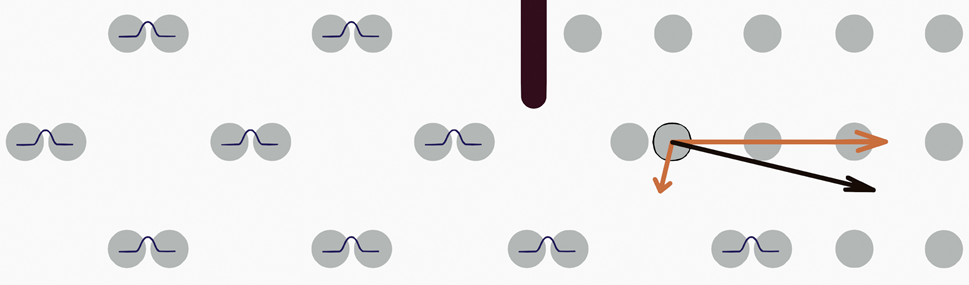
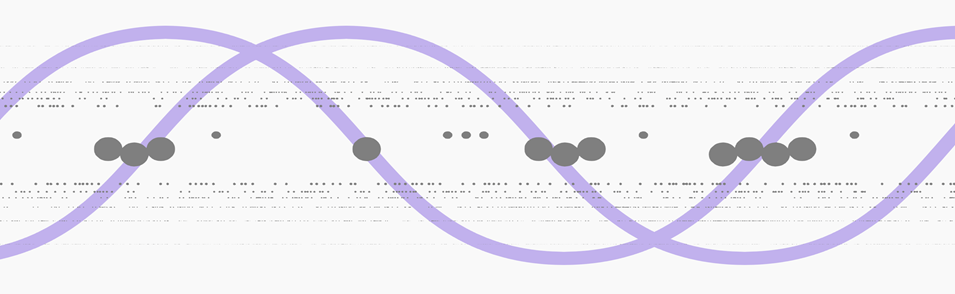
I derived that gravity varies 1/r^2. Once we there, I would be able to show you the derivation. It is quite simple. If we take two dimensions from our space (any plane in our view) and add to them the fourth dimension instead of the third, we will see something similar to this Figure: The oscillating trajectories are photon paths. I don't want to go too far now, let us just say microparticles are pressed to the central plane, ie central line in the Figure. The density gradually increases closer to the plane. Photons are forced to oscillate along the plane (along 3D space in our 4D universe), as in a waveguide with a gradual distribution of refractive index. The fourth dimension is vertical in the Figure, it is quite special as we see. In this case, the property (momentum) is passed from microparticle to microparticle. I try to explain this as clearly as possible. I think I understood you at last. Microparticles just oscillate around their positions because of the microphotons. But if gravity acts on them, they do move in certain direction. Yes. Momentum is p=mv (we all know what it is). A photon is a propagating configuration of compressed and rarefied regions. I certainly need to learn how to explain it better. I'll look into it. Good question. I was thinking about it yesterday. Apparently, some vacuum exists in the model between microparticles. I don't know why I decided to discard vacuum earlier. I'll take a look out of curiosity.
-
All I want to say is that a photon is a formation of microparticles, ie compressed and rarefied propagating regions. Microparticles do not propagate. Momentum propagates through these microparticles (one microparticle pushes the next and so on).
-
I clarified what I've written. I'm a bit confused. What is the problem?
-
Not much math really (plenty of tests though). Actually, I was hoping you could give me a nudge in the right direction with math. It is certainly possible to derive any constant and formula with this. But so far I have only derived relativistic formulas, the Schrodinger equation and some other well-known expressions (not exactly derived, more like proved their applicability to this model). The fourth dimension is a spatial dimension. The thing is, light propagates only in three dimensions of our space (it does not spread in all four dimensions). Gravitational interactions rely on light, as I will show later. I did not mean that microparticles make up a photon. Photon is a propagating interaction, ie propagating momentum. The same way momentum can pass through a microparticle
-
The black discs are microparticles (actually, all microparticles are still particles). The white spaces between them are filled with microparticles (not vacuum). The red circles are used to show how electron orbitals might be deformed if we imagine these microparticles as atoms. Microphotons pass through them.
-
This is what I call all particles that cannot be detected. The model of 3D universe (one dimension lower to make it comprehensible for us) is a space filled with them. As incredible as it may seem, I managed to build a universe out of it. I'd love to walk you through this process, but I don't want to dump it all on you today. Although, I feel obliged to tell you about the structure of microparticles. This paragraph from my article should help: Particles are the fundamental building blocks. It seems reasonable to fill all space with moving particles and see what happens next. Perhaps, there is no need for electromagnetic waves and other numerous concepts. If one particle moves toward another, it transfers part of its momentum. Since nothing (even vacuum) exists except particles, we must consider what happens to lined up particles. The particles move in a specific formation (see the Figure). A particle with momentum pushes the next particle in the line and bounces back to its previous position after transferring momentum. The two highlighted lines (two momentum transfers) contain disturbed particles. We will call these formations photons. The photons are directed oppositely. Naturally, particles from the compressed region (photon head) of one photon are pushed into the rarefied region (photon tail) of another photon. The photons are turning their directions of propagation. At least partially, they loop on themselves. Such formation of photons moving in circle will be called a particle. We must keep in mind that between other particles there are always particles, not emptiness. The background in the Figure is made of smaller particles, which will be called microparticles. If you ponder about it and the structure of hydrogen atom long enough, you will see why de Broigle assumption and therefore Schrodinger equation were correct. Leptons are all made of rotating microparticles, as shown in the Figure.
-
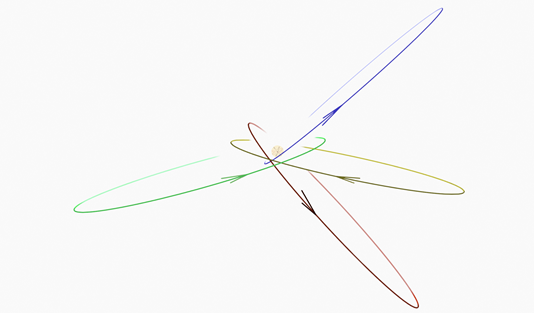
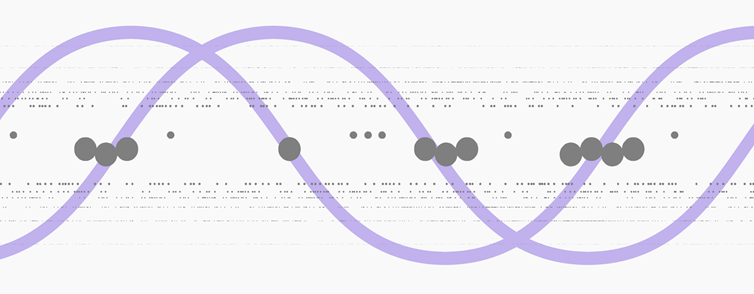
Dark matterWelcome to my theoretical model! You and every particle around you are made up of photons here. Nothing else exists (even a vacuum). Microparticles (far too small to be detected) fill all space. They also experience gravity and orbit every massive object (we will talk about gravity later). This is how they orbit the Sun: All microparticles in the vicinity form a stable configuration of highly eccentric orbits during their fall toward the Sun. The same configuration applies to Earth, galaxies, or any other celestial body. In this way, microparticles move faster in the center, which ensures their uniform density throughout the universe. We expect to detect ether flow in the Michelson-Morley experiment. These attempts are futile because the only streams of microparticles near Earth are too thin to be detected. Any photon (regardless of whether it is directed along the Earth motion or not) passes through millions of thin streams of microparticles directed almost perpendicular to the Earth surface (their elliptical orbits curve in the Earth core). As a result, photons do not appear to be accelerated or decelerated, especially when we lengthen the photon path in an attempt to improve precision. Furthermore, negatively and positively charged microparticles have separate streams shifted in the fourth dimension (which are mostly opposite, since otherwise they will annihilate). So photons oscillating in the fourth dimension often move in opposite streams without gaining speed in them, which gives a zero result in the Michelson-Morley experiment. Highly eccentric orbits of microparticle flows (of Earth or other massive body) are formed from stationary distant microparticles. Not all microparticles are stationary in the universe (for example, some of them are accelerated by supernova explosions). These accelerated microparticles form their mostly circular flows around a massive object, which increases the gravity near it. How does this increase gravity? Consider the gravitational force exerted by a microparticle in a highly eccentric orbit that extends far from a massive body. This force is practically zero. However, if we place this microparticle in a close circular orbit, the gravity caused by it will be noticeable. These microparticles in circular orbits are dark matter. Old galaxies lived through many supernova explosions. Therefore, they contain a lot of accelerated microparticles, a lot of dark matter. Note: Charged particles are shifted in the fourth dimension. Negative particles are slightly above our space, positive are slightly below. If we take two dimensions from our space (any plane in our view) and add to them the fourth dimension instead of the third, we will see something similar to this figure (not to scale, trajectories of oscillating photons are also shown). Keep in mind that photons in the model are not exactly what QM tells you.
-
Now I understand. There may be some gaps in a tessellated volume that can never be covered by spheres. Fortunately, I don't have to prove it. In my model, protoparticles are not ideal spheres. They can be stretched a bit by repulsive forces (protoparticles are repulsive to each other, which leads to filling of all empty spaces).
-
Yes, experiments showed that we cannot understand wave-particle duality deeper with current theories. Unfortunately for me, I must obey your demands. After all, I came to you with this model, not you to me. Perhaps, I can briefly explain dark matter in the next post. But don't be surprised that I may answer your questions with "Explanation requires basic understanding of the model". In other words, I will do what you asked, please remove your downvotes.
-
When I disagree with you, I also present my arguments. The question of spheres is important for me because you criticized my model with it. Read almost everything you sent. Did not find anything related to infinities or the question I asked. If you find this offensive, I will not touch on this topic again.
-
Progress of theoretical physics is not measured by how fast it changes. It is measured by how well observational data is explained, ie the number of paradoxes and unanswered questions. I don't see how it precludes. We can always fit a tiny sphere between other spheres. We have an infinite number of spheres of arbitrary sizes. These two true statements must ensure that we can completely fill a volume with spheres. Isn't it correct?