windsurfingphd
Members
-
Joined
-
Last visited
Everything posted by windsurfingphd
-
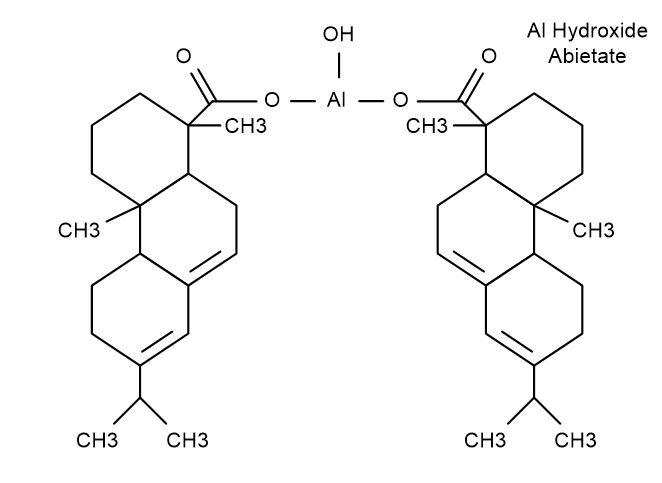
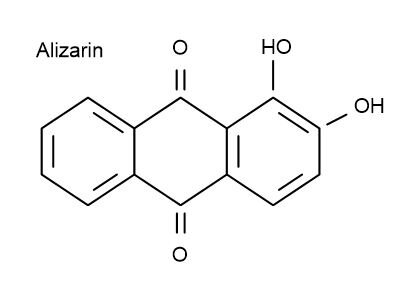
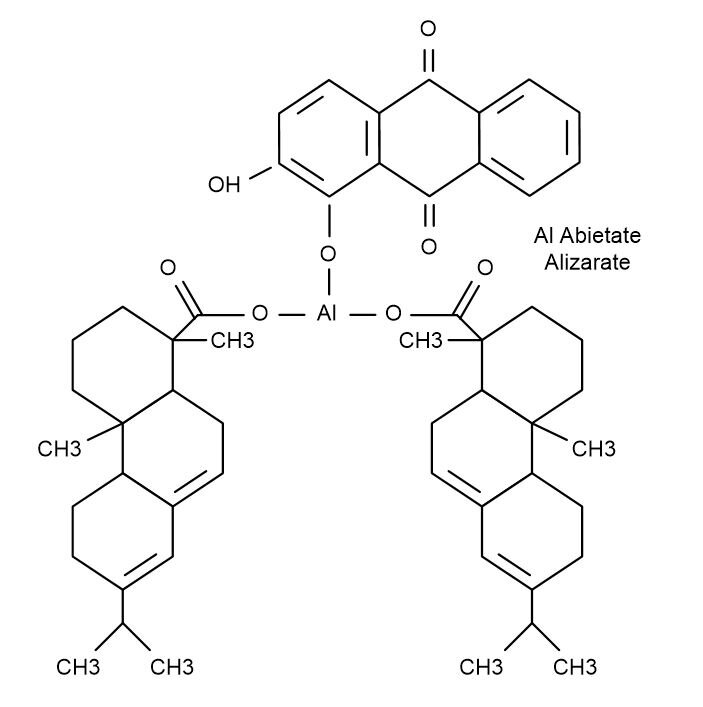
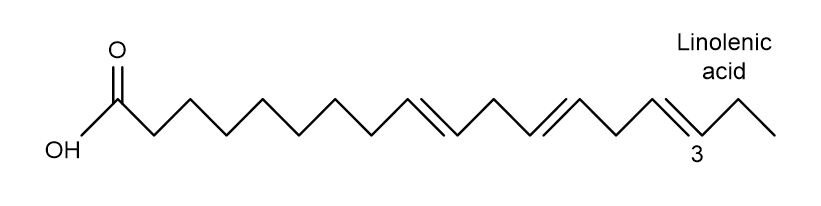
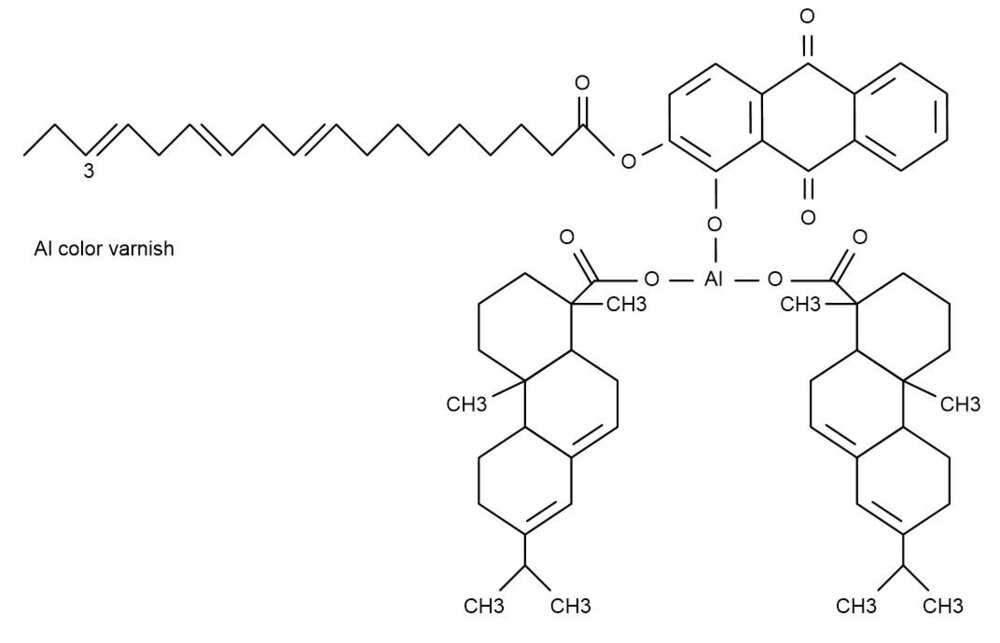
I am including the open formulas of the end products after each reaction below to be able to follow through reactions a bit better. I used linoletic acid and Al in formulations. Please let me know your thoughts.
-
There was a paper (w/o chemical reactions) published by Michelman long ago to incorporate Al into alizarin (Modified Michelman Recipe). In this article, he explained how metal rosinates are formed to produce color in a varnish. I penciled in the equations based on his explanations in the article :-) The first reaction incorporates K2CO3 in abietic acid, C19H29COOH. K2CO3 + C19H29COOH = KHCO3 + C19H29COOK In the next two reactions, he uses Al and Ca chlorides to react with abietic acid to form Al and Ca rosinates, but with an OH-bond attached to the molecule. AlCl3 + KHCO3 + 2C19H29COOK = Al(OH)(C19H29COO)2 + 3KCl + CO2 CaCl2 + KHCO3 + C19H29COOK = Ca(OH)(C19H29COO) + 2KCl + CO2 The last two equations he combines alizarin with the metal rosinates above to create Ca and Al rosinate alizarates. Here, C14H8O4 is alizarin, and in the reactions below alizarin loses one H-atom to be able to combine with Ca and Al rosinates. I speculated these equations. Ca(OH)(C19H29COO) + C14H8O4 = Ca(C19H29COO)(C14H7O4) + H2O Al(OH)(C19H29COO)2 + C14H8O4 = Al(C19H29COO)2(C14H7O4) + H2O Now, my biggest issue here is to be able to incorporate oil with metal rosinate alizarates to produce a color varnish. And the question is how is this reaction going to take place? Will it happen between the OH-bond in an oil molecule pictured above (linoletic, oleic, linoetic, steridonic and stearic) and the H-atom of the "second OH-bond" in alizarin (the H-atom of the first OH-bond was used by the metal ion to form rosinate alizarate above)? Do I need any catalyst(s)? I apologize for the closed formulations of these molecules above. I can rewrite these equations in open molecular form to send it to you if there is a difficulty. Take care.
-
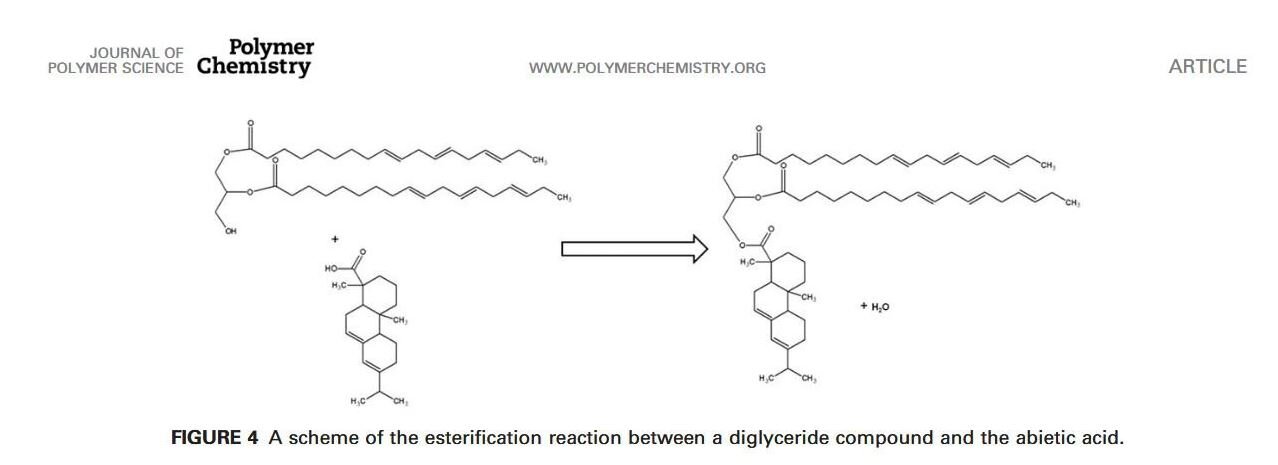
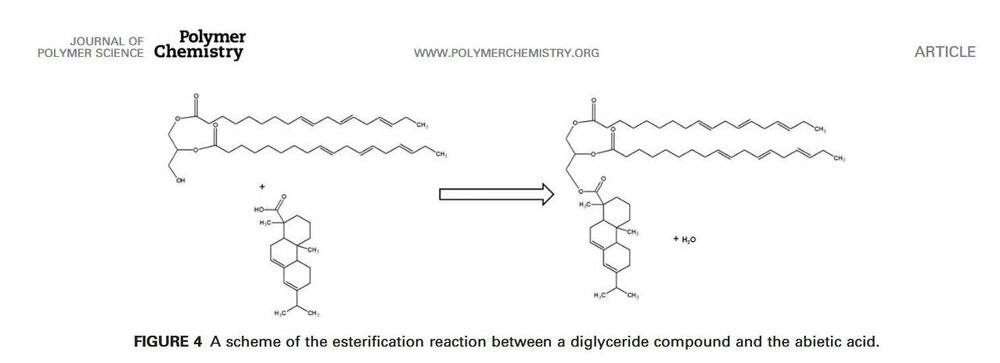
I am so glad you answered. I want to add alizarin, C14H8O4, to this reaction (please see the suggested esterification by a 2017 article in Polymer Science) to provide color to the varnish. Is it possible because the end product seems neutral? What catalyst(s) should be added?
-
I read two articles published in 2017 about how abietic acid in resins may react with oil acids in linseed oil to make varnish. Is anyone in this forum familiar with the chemical reactions and catalysts? Thank you.