Lara_Colon
Members
-
Joined
-
Last visited
Everything posted by Lara_Colon
-
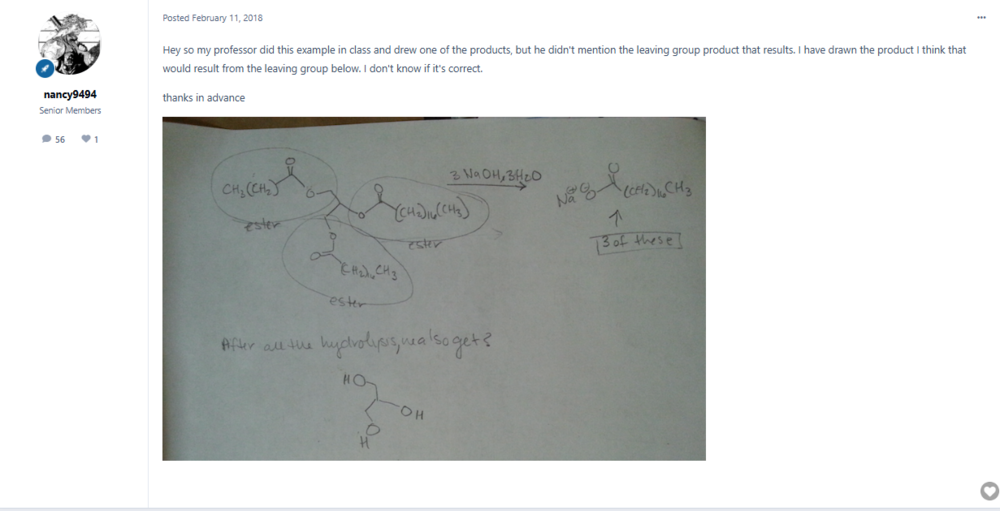
To answer the question asked on the previous blog post. In the base-catalyzed hydrolysis (saponification) of a triglyceride, each ester group reacts with hydroxide ions. The hydroxide attacks the carbonyl carbon, forming a tetrahedral intermediate that collapses to give a carboxylate ion (RCOO⁻) and a glyceroxide leaving group. The glyceroxide is then protonated by water, producing glycerol (HO–CH₂–CH(OH)–CH₂–OH). The overall reaction is: Triacylglycerol + 3 NaOH → Glycerol + 3 Sodium carboxylates (soap molecules). These sodium salts of fatty acids are the “soap” products, while glycerol remains as a neutral, water-soluble by-product. If the mixture is acidified afterward, the sodium carboxylates convert to free fatty acids (RCOOH). So, the correct products after complete base hydrolysis are three sodium carboxylate salts and glycerol, not a cyclic structure.
-
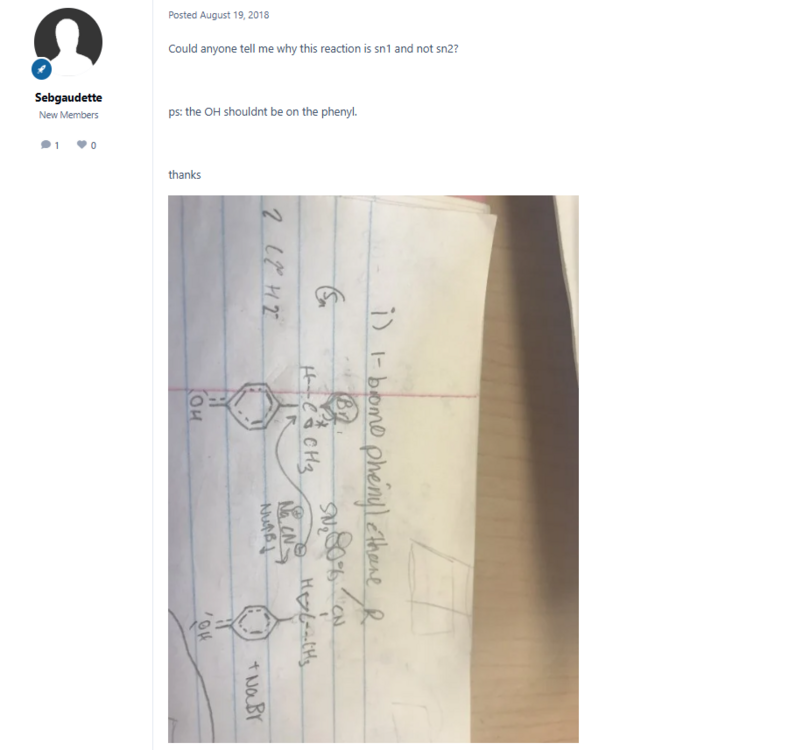
This reaction goes through an SN1 mechanism because when the bromine leaves, it forms a really stable benzylic carbocation. That positive charge can spread into the benzene ring through resonance, which makes the intermediate much more stable. An SN2 reaction would not work well here since the carbon attached to bromine is too crowded for a nucleophile to attack directly. Because of that, the reaction naturally follows the SN1 path, where the bond to bromine breaks first and the nucleophile comes in afterward to form the final product.
-
This is saponification. Sodium methoxide and water. The methoxide ion is the nucleophile and attacks the carbonyl carbon and the water works as the solvent supporting the reaction environment and maintaining the ionic species. So yes, you are right. Adding water is necessary because the medium would be too dry to allow proper ion stabilization. As for the mild acid, it protonates the salt formed in the first step.