jv1
Senior Members
-
Joined
-
Last visited
Everything posted by jv1
-
Hi halc and Thevat I was hoping to explain that movement of pedestrian 1 is just reference frequency f=1 . This vertical movement is not related at all to horizontal movement of road . What it does it gives us reference distance travelled in time period. In pedestrian 1 case , this frequency f=1 d1 =1 m is travelled in t1=1sec. f=1/t If we do not know the horizontal speed v2=? We can observe - measure the distances Between points ABCEF… These are real distances - nothing relative about them. From triangles made of distances AB,CD…. we can calculate the speed v2. This is the point of having reference frequency(pedestrian 1). Now if we substitute pedestrian 1 for light clock - the reference frequency is not f=1 the reference frequency couod be f=1 for light clock L=3x10e8m All the way to f=3x10e8 for light clock with L=1 m And we calculate the v2 of object in real world - using reference points ABCD…. or (t xyz) from the observer (reference frame). I was hoping somebody will see this ,without me pointing this out. The light clock ,same as pedestrian 1 has nothing to do with horizontal speed v2 - the speed of objects in real world. We measure distance in light years . The biggest light clock with L=3x10e8m is actually reference distance of One light second the light travels 3x10e8 in one second . Inside the distance of 3x10e8m from the light clock we can use this reference distance - one light second. For the wast universe we use light years . Could you please spare few more minutes and let me explain caesium atomic clock A bit more. Atomic clock in the oven heats caesium And creates beam of atoms traveling Through the resonator. Inside resonator the atoms are excited and spectated . Than excited atoms hit the metal wire. They release photon - micro wave photon with wave length l=3.6 cm The distance this photon travels from metal wire to counter is equivalent to d1 in light clock. When photon reaches the optical optical counter it does not deflect- it goes through it. This is very modern version of light clock. And as I said above - it he distance d1 increases to distance d3 when horizontal speed is applied to light clock This is the real increase in length- nothing relative or imaginary about this In atomic clock processor unit which counts the number of 3.6 cm photons is pre calibrated to work at v2=0m/s(horizotal speed). Any increase in horizontal speed v2 from 0 to c will literally increase the distance of photon 3.6cm(the wave length). So the display on the atomic clock will show WRONG time . Now there is only one thing left to do let’s revisit Hafele- Keting experiment. Or even better ,can you guys try to tell me what really happened on those flights? May be just may be we can answer why chicken cross the road - for no reason . The same way why was increase in distance travelled by photons in light clock called TIME DILATION- for no reason
-
To explain more closely my thought train I will use two light clocks : First : Light clock 1 with distance between magnets L=3x10e8m The vertical speed v1 (of system one- pedestrian 1)is v1=c The light clock mirrors (road)are moving at horizontal-speed of v2=0.5c This is observed by pedestrian2(jv). The angle of chevron trajectory created(observed) by these two speed systems is: tan Alfa=0.5c/c=0.5 Angle Alfa =26.5 degrees The second : Light clock with L=3.6cm distance between mirrors. The speed v1=c The speed v2=0.5c The angle Alfa is the same Alfa=26.5 degrees. The “small “ light clock vertical distance d1=3.6cm the time t1=0.036/3x10e8=0.012x10e-8m For the same time the hirizontal distance d2=0.5x3x10e8x0.012x10e-8 d2=0.018m(1.8cm) The chevron trajectory distance will be d3^2=12.96+3.24 d3=4.02cm The time difference delta t Delta t=d3/c=0.0402/3x10e8=0.0134x10e-8s Why is this relevant? I am going to try to explain how the cesium nuclear clock is working - with a twist. The frequency of radiation of ceasing inside the nuclear clock is f=9.1922633177GHz the wave length l=3.26cm the speed of this microwave range photon is v1=c Now let’s put two polished copper plates at distance L=3.6 cm Between these two plates When caesium atom passes between them, it will emit photon and this photon will be “trapped “ and continue to move vertically up and down between copper plates. What do we got? Ceasium version of light clock. Now let’s put this ceasium light clock on the space ship. The space ship speed is v2=0.5 c (horizontal speed) If you have a look at the small light clock2 from above ,what do we get? If jv is on the space ship with the cesium light clock- the dial will show the time 1 sec. But the signal - microwave photon traveling between copper plates will travel longer trajectory and the time on dial will be wrong. To compensate for this - we have to readjust trajectory we are traveling on (GPS satellites come to mind) Conclusion: the time is imaginary phenomena. The light will travel distance 3x10e8 m For period of time we call 1 second . If there is change on the measuring instrument - clock- it is because the distance light signal,or microwave signal, or laser signal is changed. Tx
-
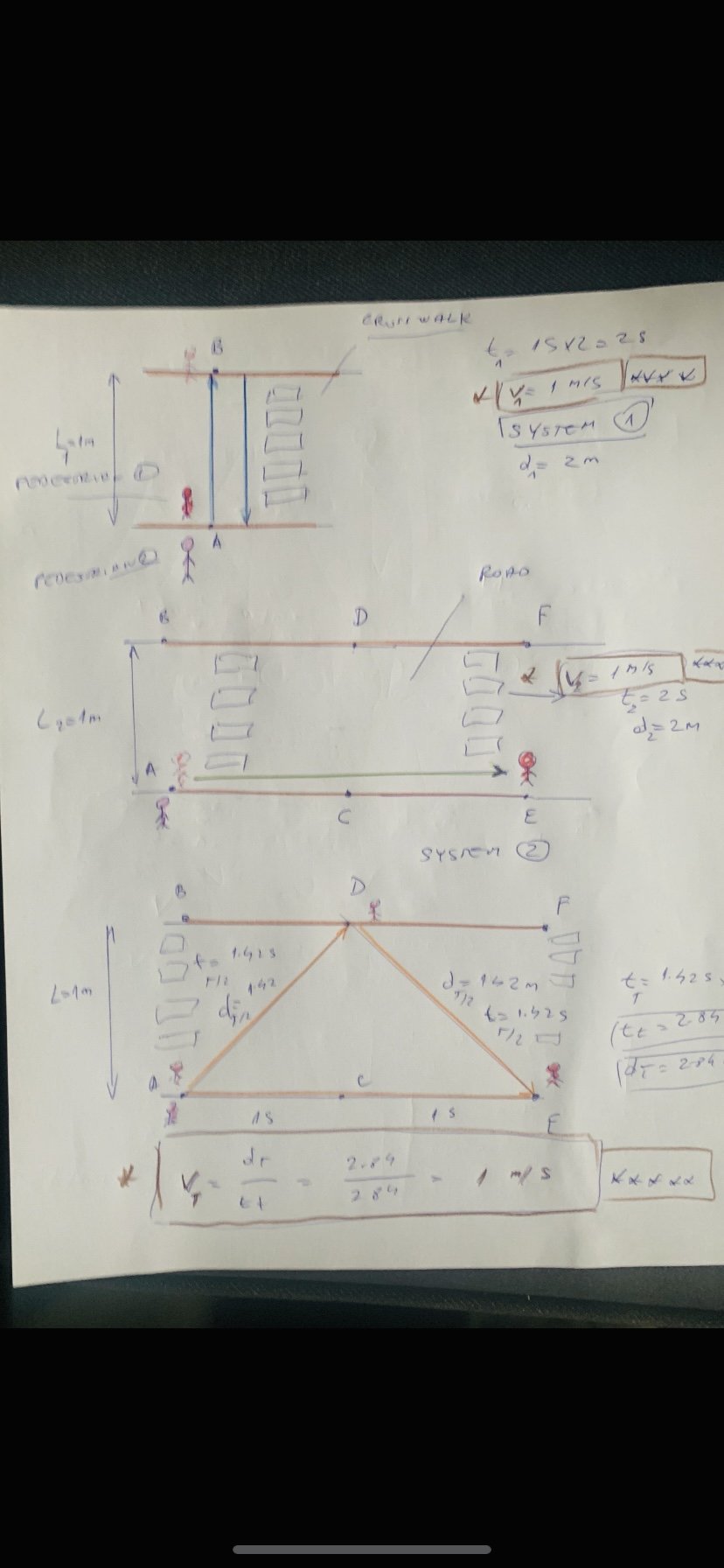
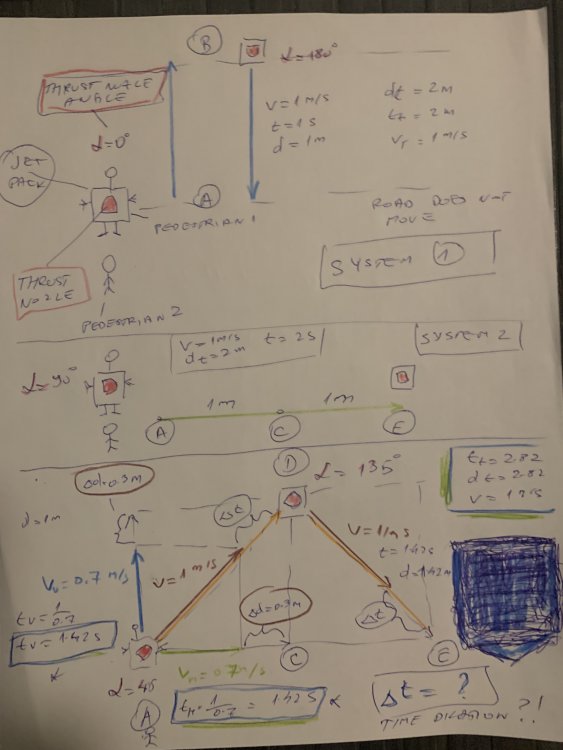
Halc ,thank you so much for your time and good points. You are correct airport moving walkway is inspiration. I tried to explain this : The pedestrian 1 moving up down on non moving road is system 1 . pedestrian 1 is moving relative to pedestrian 2( non moving observer - reference point) Speed v1=1m/s has only vertical component - horizontal component of speed is zero. system 2 Is movement of road relative to pedestrian 2. The road moves horizontally at speed v2=1 m/s I mentioned non moving pedestrian 1 - relative to road. Pedestrian 1 movement (together with road)observed by pedestrian 2 is 2 m horizontally. The same pedestrian 1 we can put in non moving position at any position between A,B . The observed horizontal distance would be 2 m That is movement of road - relative to pedestrian 2 Conclusion : There is two simultaneous movements in the same reference frame (pedestrian 2) vertical movement of pedestrian 1 and horizontal movement of road Again ,both observed by pedestrian 2 at the same time . For system 3 I used jet pack and nozzle to emphasize the importance of nozzle angle Alfa. When two speeds vertical and horizontal Acting at the same time they create observed trajectory to be seen by pedestrian 2 as a diagonal . Diagonal which is 1.42 m long. This diagonal angle rotation is equal to angle Alfa of nozzle 45 degrees . The tan angle alfa =dv/dh dv=d1 =vertical distance of 1m dh=d2=horizontal distance 1 m The road moving horizontally and the pedestrian moving vertically on the road(picture at the top of thread ) at the same time will create the same trajectory as a trajectory cretaed by nozzle on the jet pack moved CW (picture at the bottom of the thread ). When we now the length of trajectory (1.42m) this is only one half of total distance ,this half goes up at 45 degrees - the other half is 1.42 going down at 45 degrees . So total length is 2.84 m . This is length observed by pedestrian 2 - observing only pedestrian 1. Now the most important part speed vector v3 on the chevron trajectory of 2.84 m is v3=1 m/s. This v3 speed vector is created by vertical component v3 v=0.7 m(originates from vertical v1 - system 1) and horizontal component v3h=0.7 m(originates from v2 - system 2). The total length d3/v3=t3=1.42 Times 2 is total time t3=2.84s. And now the vertical component v3 v =0.7m is the observed vertical speed of pedestrian 1 (by pedestrian 2) It will take exactly d1 /v3v =t3v=1.42 sec for pedestrian 1 to travel distance d1 =1 m. This is slowing down of the clock. Here is explanation: If instead of speed v1=1 m/s as a fastest speed in universe we use c-speed of ligh=v1 And instead of pedestrian 1 we use light clock 1 with L=3x10e8 m(distance between mirrors). Instead of road let’s use train. Theoreticaly(it is impossible ) If train moves at speed v2=c The total time t3 will be t3=2.84s - the same as for pedestrian 1 . The slowest tick will be 0.7 s Not 0 - like we think - at speed of light (hypothetically) . in my humble opinion , time dilation does not happen . actually overlooked increase in observed trajectory length (chevron system 3) d3 Is the reason for observed time increase . The original tile dilation experiment used light clocks with L=1m Distance between mirrors L. Light travels that distance in one second 3x10e8 times. It is very hard to observe that chevron d3 trajectory length d 3 only increased to d3=1.00000001 m from original d1=1 m But it is calculated - as a time dilation . I would like to say again - what we call time dilation is mislabeled increase in observed chevron trajectory length.
-
Here is very rough drawing of pedestrian 1 with jet pack . I hope it is visible that with changing thrust nozzle angle we change the direction of speed v=1 m/s There is no simultaneous movement of road and pedestrian. Pedestrian 2 observes only the motion of pedestrian 1 / Both vertical and horizontal components of v have value of 0.7 m/s
-
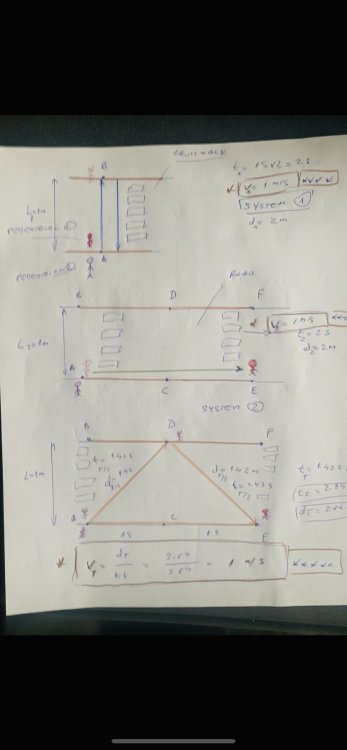
Hi again I was trying to say that : Two systems (objects) are observed at the same time by pedestrian 2. Object one : pedestrian 1 moving up and down on road. Object two: road moving in direction to the right (pedestrian 1 is located on the road and he is not moving relative to the road) The road is transporting pedestrian 1 to the right direction and away from pedestrian2 So pedestrian 2 observes in case 1 (system 1) only movement of pedestrian 1 (up / down) In system 2 pedestrian 2 observes movement of road- and the pedestrian 1 is stationary only to demonstrate that pedestrian 2 is not observing road - he is only observing pedestrian 1 . He is not aware that road is moving. system 3 Both road moving to the right away from pedestrian 2 for 2 seconds and pedestrian 1 moving on the road (first second away in vertical direction and back for another second) The pedestrian 2 is not aware that road is moving. These two separate movements are cratering chevron like trajectory. The length of trajectory is 1.42m- this is hypothenuses of triangle with sides of 1 m each. d total =2.84m The time is is the same triangle and t total =1.42 s x2=2.84m These are scalar quantities and we can do these calculations. The observed speed is vtotal=dt/tt=1 m/s Triangle with vertical speed v1 and horizontal v2 can not be cretaed because These are vectors of two separate - not related systems (or phenomena ) the pedestrian 2 is not aware of this . He just sees the movement of pedestrian 1. If pedestrian 1 has a jet pack and his thrusters are pushing him at the same time at horizontal and vertical direction with speed v1=v2 =1 m/s than we would be able to say that speed is v3=1.42m/s This is the most important thing. If the speed v=1 m/s is the maximum speed than the speed v1=v/3x10e8 =0.3x10e-8m is the speed of road . so vertical speed of pedestrian 1 is huge compared to the movement of road . This movement is insignificant.The pedestrian one is 0.7 m wide. If the road speed is 0.1m and up - all the way to 1 m/s we will see effects of speed on observed distance and time . This was supposed to make you think speed of light vertical ,up 2 down movement ,of light dot in light clock and movement of train at speed of 1 m/s away from observer beside the train tracks in original tile dilation experiment . I hope that those other things look a bit less silly now. Again the biggest confusion is that trajectory of pedestrian 1 , light dot in the train,baseball in the car, astronaut in space shuttle , observed by not moving onserver (or pedestrian 2 ) Is created by two movements of two different objects. So again for time dilation (Lorentz transformation) to apply to all of these objects , these objects need “Jett pack “ to push only the observed object at vertical and horizontal speed vectors v1 and v2 That is so easy to overlook and so hard to see after 120 years. Cheers
-
Hi Halc may I first explain situation 2 The pedestrian 1 is positioned on the road. Pedestrian 2 is positioned beside the road. The pedestrian 1 is not moving at all. The road is moving to the right at speed v2=1m/s. And road is transporting pedestrian 1 from A to E(marks on the non moving part beside the moving road). In all three systems we can observe(measure ) ditance and time . And from these two values we calculate the speed . Pedestrian 2 has coordinates (t,x,yz)=(0,0,0,0) in all systems. in system one pedestrain 2 observes movement of pedestrian 1. Only pedestrian one is moving. pedestrian one has coordinates A(0,0,0,0) B(1,1,0,0) d1=1 m in on x t1=1 sec on x v1=d1/t1=1 m/s System 2 Pedestrian 1(was stationary in the road- the road moves- pedestrian 2 is observing movement of pedestrian 1) A(0,0,0,0) B((1,0,1,0) E(2,0,2,0) d2=2m t2=2s v2=1m/s Both systems moving at the same time . Pedestrian 2 is observing movement of pedestrian 1 pedestrian 1 has coordinates A(0,0,0,0) D(1,1,1,0) E(2,0,2,0) From these value we calculate observed distance to be d3=1.402x2=2.84m t3=1.42x2 =2.84m v3=1 m/s And these are all Galilean transformations. And the time will be the same 2.83 for any observer . The distance is only thing changing. (Speed is d/t). Now let’s try to say that speed v=1 m/s is maximum speed in universe . And let’s try to do the same experiment for speed v2=1/3x10e8=0.3x10e-8m What would be distance and time increase ? And one more time we have to movements Observed - movement of pedestrian on axis x (vertical up and down) and movement of road (from left to right) Transporting pedestrian on y axis . Now let’s compare this thought experiment with baseball thrown up and down by the driver in the car traveling at 100km/s. Base ball moves up/down car is perpendicular transpiring the ball and the driver. Or train with light clock on it. Light dot is moving up and down -vertically and train moves light clock horizontally. Is there any similarities? tx
-
Observing pedestrian crossing the street - thought experiment. The experiment is split in three systems: System 1 There is two pedestrians at position A. Pedestrian 1 is moving at speed of v1=1m/s and goes to position B and return backwards to position A. The distance d1=2m time t1=2sec speed v1 is constant. This is all observed by non moving pedestrian 2. System 2 The pedestrian 1 is not moving. The road is moving at speed of v2=1 m/s The pedestrian 1 moves from point A to point E. the distance d2=2 m Time t2=2s The speed v2 =1 m/s is constant This is observed by pedestrian 2. The third system is system 1 and system 2 taking place simultaneously. The trajectory of movement of pedestrian 1 has zig zag pattern - this is observed by pedestrian 2. The total length dt=2.84m The total time travelled is tt=2.84sec the total observed speed is vt=dt/tt=1 m/s The speed of pedestrian 1 is 1 m/s - constant - in all three systems . The observed distance was increased because system 1 and system 2 are applied simultaneously. It will take longer time for pedestrians 1 ,traveling at constant speed to move on Bigger distance of observed trajectory 2.84 m. There is difference in observed time and length but the observed speed is constant. Opinions?
-
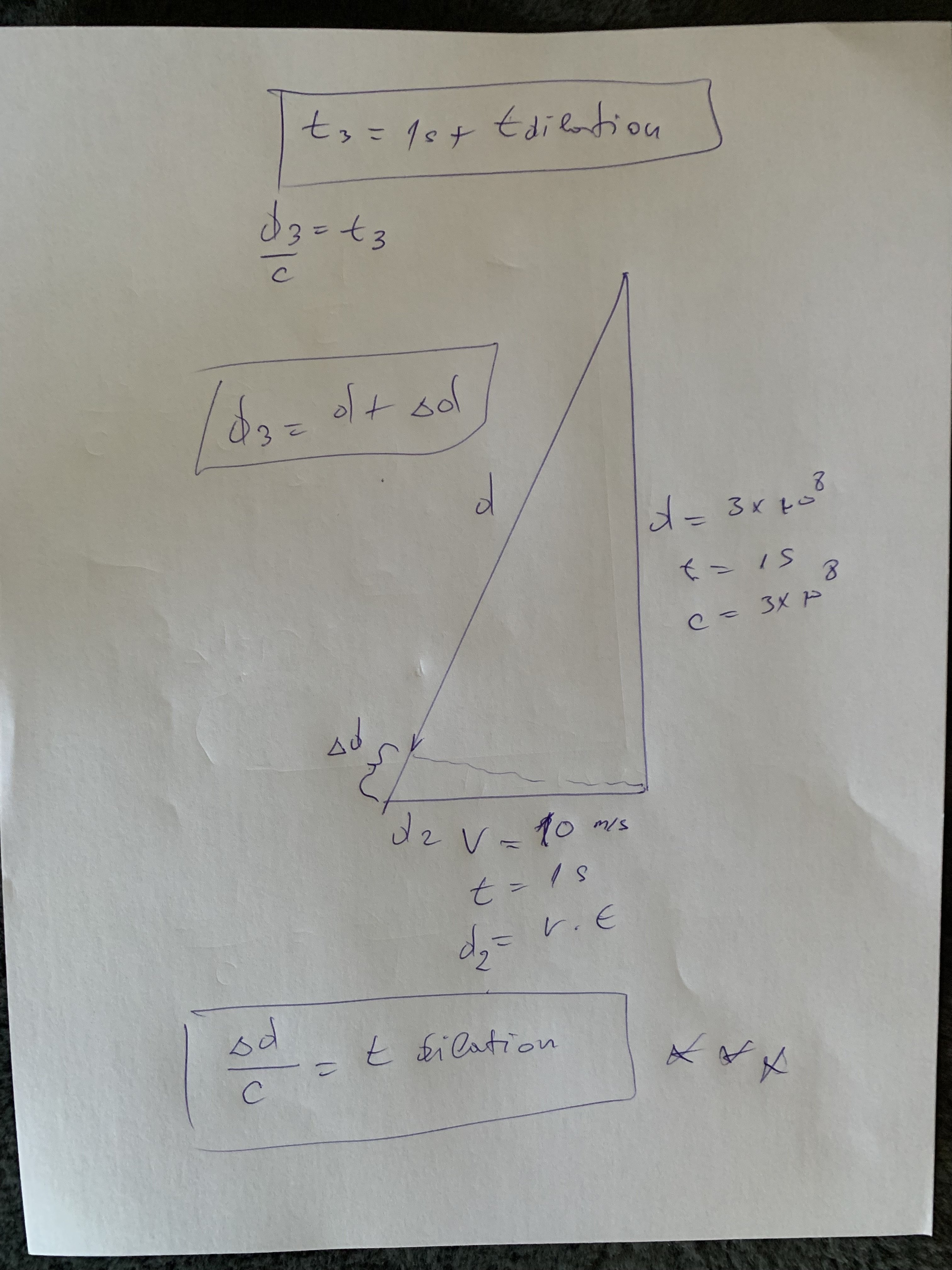
I am talking about the original experiment with two observers,light clock and train car. SR is very well explained with this experiment . I would like to ask: has anybody ever tried to calculate time dilation for above mentioned experiment when the light clock distance L=1.5 x10e8m? For this distance time t=delta t =2x0.5 sec=1 sec. In 1 sec time 1) for speed v=1 m/s the train will be away from static observer For distance dv =1m this is the real distance - nothing relative about this dv distance . ***from the point of view of non moving observer relative distance dv relative to moving observer (with light) clock will be dv relative =1 the speed v=1 m/s DIRECTION OF SPEED VECTOR is from static observer to moving observer. *** from point of view of moving observer the distance dv relative =1m/s the speed is v=1 m/s BUT THE DIRECTION OF SPEED VECTOR IS 180 degrees (opposite ) from the other relative speed. the value of time and distance is the same for both relative positions And the both realize times and distances are equal to real time and distance . what make big difference is the direction of speed vector. for any speed from 1 m/s to speed c=3x10e8 m/s the time will be 1 sec the distances will change - for different speeds in one second - the distance is v x 1 s =dv The speed v is not going to affect the time t=1 s what is changing is distance dv. when train is leaving static observer - going a way - for any speed from 0 to c speed vector will be constant. The speed of the light beam inside the light clock first 0.5 sec is moving from railway tracks to height of 1.5x10e8m The speed c vector is UP. For the second 0.5 sec the beam goes from 1.5x10e8 to train tracks . The speed c vector is DOWN. If one wants to calculate the time t=delta t’ There is two ways: 1) to use distances traveled in time t=delta t=1 second the train travelled for speed 1 m/s distance eV=1 m the distance travelled by light beam inside the light clock is 2L =1.5x10e8 up +1.5 x10e8=3x10e8 m THESE ARE SCALAR VALUES AND DIRECTION OF MOTION IS NOTBA FACTOR. we can use Pythagoras rules and calculate the distance of hypotenuses. The distance h/c=time delta t’ Angle ALFA=tan (dv/2L) is the same as in Lorentz factor v^2/c^2 how? for time period of 1 sec the v=dv and speed c =3x10e8 m ONLY IN SCALAR QUANTITY. Now 2) to use speed v and speed c to calculate the time : SPEED VECTOR DIRECTION is crucial. The first 0.5 sec the vector of speed v is going away from static observer. at the same time the light beam inside the clock for the first 0.5 sec is going up and away relative to static observer. Observer in the first 0.5 seconds see the light moving at the slower speed than speed of light - but very close to speed of light. (1m/3x10e8=0.3x10e-8) thisnis the change in distance at L =1.5x10e-8m There is no time dilation,the distance becomes longer . If the light clock test is done with light clock L=1 m The elongation of distance will be in 10e-8 s x speed c Time in 10^-9 s - time dilation ? does this look familiar ?
-
I will try to explain the logic behind this simple way to calculate time delta t’ Time and distance are scalar quantities The speed v multiplied by 1 second is distance dv. Distance dv is real distance between observer in rest frame and observer/light clock on the train. To travel this distance dv- any distance from 0m to 3x10e8 will take 1 second. Time t=delta t does not depend on speed of light . it depends on distance L- distance between mirrors inside the light clock. The direction of distance dv is perpendicular to the distance L. This two DISTANCES create triangle and the hypothenuses of triangle is time t=delta t’ that is pretty simple . What was logic of using speeds v and c to calculate time t=delta t’ at the first place ?
-
I am thankful to anybody who finds time to read and comment.
-
Thank you so much externo This helps a lot
-
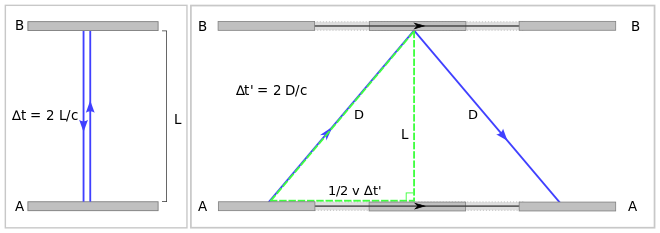
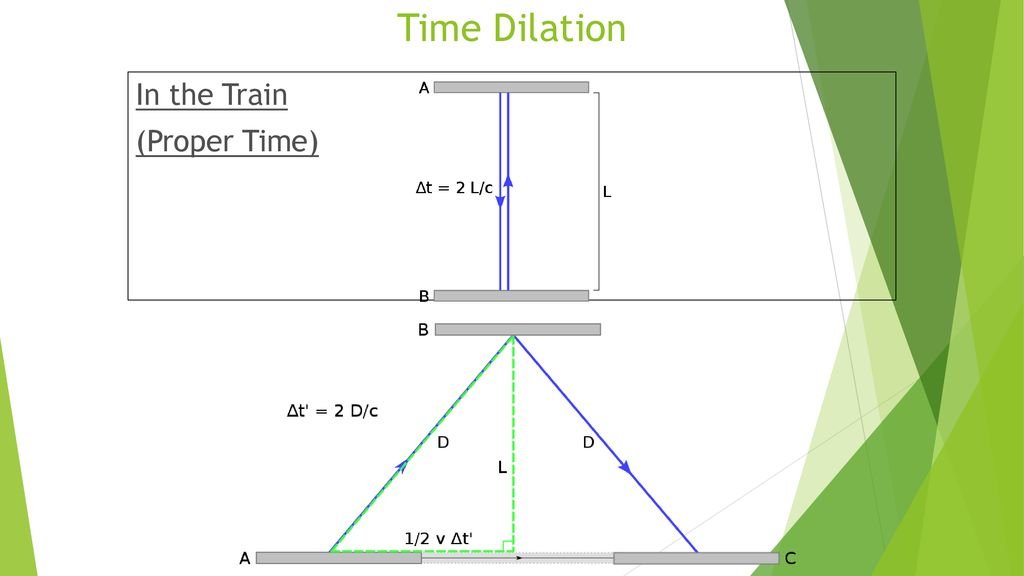
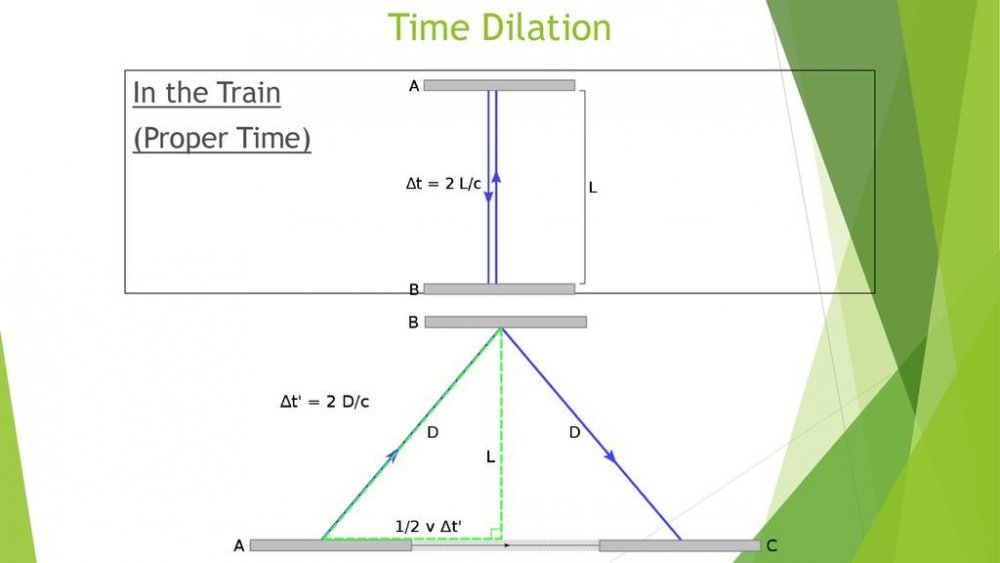
Hi could this be a more simple way to calculate time in light clock time dilation experiment? On the lower picture the side of triangle 1/2xvxdelta t’ is actually 0.5 sec time - for spweed v=0 to c I will repeat this - the time tv =0.5 sec for any speed from 0 to 3x10e8 . for side L of left triangle at the bottom picture file is equal to delta t this time is easy to calculate delta t=2L/c to calculate delta t’ (Delta t’)^2=(0.5 sec)^2 + (delta t)^2 is this more simple way to calculate time dilation for light clock experiment ? And is there time dilation at all?
-
Here is very simple way to explain this in original experiment with flash light And train cars the flashlight was switched on. than when signal came back from the mirror it was switched of. the light went out not as beam it went out as a hollow sphere. When this hollow sphere hit the mirror Part of it was deflected and came back to flash light. to make a experiment for time dilation From set up above - proton is observer Lightbulb Mirror is positioned at the 3x10e8 perpendicular from the direction proton Center. Time flash light is on ,as per original experiment will be 2 s We will end up with two reference frames of 1 sec. The time is imaginary term. it describes what is going on. the phenomena in nature changed in this time. Just a quick example Radar mapping screen show what is in front of aircraft . to the details . the signal is sent in front of aircraft and time is measured for signal to come back . from time sequence we mapped the real terrain surphace mid we go west we take in consideration the difference in speed (aircraft to ground ) which is different from east bound flight. Did time dilate ? yes did the dilation of time affect how the ground looks like ? no it described it if we think that changing the parameters on map will change the surface of the earth - no The prospective how surface looks like from diferent angle is changing - Or if the speed is changing - perspective is changing but the real surface is not changing. curvature of space is happening with or without of time dilation time dilation records the dilation of curvature
-
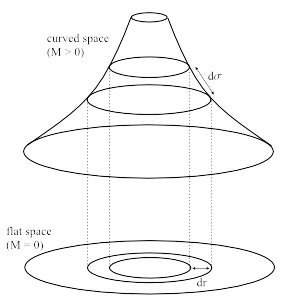
Mordred what I am saying is not main stream I am not reinventing the physics I do not have to do any calculation - all data needed is done and available easily/ I apologize for my wording velocity and distance in period of one second Can be compared with power and energy Or like mass flow per one second and mass I say there is no time dilation time is point there is nothing to dilate. when I say waves are dilating I meant this Light has frequency of 400 THz That is wave length of 2x10^-14 every oscillation will create circular ripple (bubble) and every bubble will have dilation- it will increase in size within time. there is going to be be bubble inside the bubble …. dilating at the same rate - following lorentz transformation law. at speed close or at speed c the outer bubble will hit obstacles (particle) and it will stop dilating (k factor infinity or Lorentz factor ) will be infinity. the rest of the bubbles are still dilating and collecting up in front of the particle . these are for example gravitational ripples/ compressed bubbles (waves) do not have mass but they carry the momentum. and they will push back. the gravitational waves have wave length in range of 10^16 that is a lots of momentum to push back. The waves have dilation not time. I would like to thank you all for allowing me to share this idea with you. This has been crush corse of how to get from laser range finder to there is no time dilation in a very short time . Here is final step: Part1 Frame of reference: The sphere with radius r=c(speed of light) Time 1 second Speed c=distance c=acceleration c Part 2 In the center of reference frame light bulb is positioned . Light bulb has a 2 cm diameter . The light switch will be pressed for duration of 4x10^-9 seconds. The light signal created will be hollow sphere wiht diameter of 2 cm and thickness of 4x10^-14m This is the original shape and it has Dilation coefficient k=1 The speed is v=0 In one second time the same light circle will dilate and reach maximum Radius r=3x10^8 m Thickness is unchanged . The dilation factor K=infinity The light propagate by Lotentz transformations . The coefficient of Lotentz transformation is Gama =1 at 0 speed Gama =infinity at speed light. We can say that light dilation is described by K=gama The light wave is real phenomenon. It happens in real time This works for all waves including gravity. Part 3 Proton at the edge of frame reference goes to center The time dilation calculated by theory of relativity confirmed that time dilation change happs according to Lotentz factor gama. Time is imaginary term . It is point which can not dilate Part 4 Conclusion: Based on above , dilation of signal was seen as time dilation . This is overlook Tx
-
Mordred what I am saying is not main stream I am not reinventing the physics I do not have to do any calculation - all data needed is done and available easily/ I apologize for my wording velocity and distance in period of one second Can be compared with power and energy Or like mass flow per one second and mass I say there is no time dilation time is point there is nothing to dilate. when I say waves are dilating I meant this Light has frequency of 400 THz That is wave length of 2x10^-14 every oscillation will create circular ripple (bubble) and every bubble will have dilation- it will increase in size within time. there is going to be be bubble inside the bubble …. dilating at the same rate - following lorentz transformation law. at speed close or at speed c the outer bubble will hit obstacles (particle) and it will stop dilating (k factor infinity or Lorentz factor ) will be infinity. the rest of the bubbles are still dilating and collecting up in front of the particle . these are for example gravitational ripples/ compressed bubbles (waves) do not have mass but they carry the momentum. and they will push back. the gravitational waves have wave length in range of 10^16 that is a lots of momentum to push back. The waves have dilation not time.
-
Thanks again A bit more about K when dilation factor K is infinity the body can not dilate (getting more big) at speed of light Lorentz factor is infinity that means that ripple if met with a obstacle (particle/ proton) at speed of light it can not expand (dilate ) the next ripple piles up and the next the electromagnetic waves do not have mass but they carry the moment. and a lots of little moments act like a bigger mass and they will push back at bigger bodies bigger the push back That is what theory of relativity is showing the best part it does not know that yet
-
Hi thanks for the coment it looks a bit unusual but it is hard to explain a lot in a short period of time here is the thing the v^2 /c^2 padtbif gama of Lorentz factor v- is distance c - is speed and speed (ratio ) changing distance is time now speed(ratio) of changing dilation of object is called K What theroy big relativity calls time dilation is actually Koeficient K for dialtion of electromagnetic waves this is the final thing. To repeat this is posible becouse in time of one second velocity c -m/s distance c -m acceleration c-m/s^2 it is constant and it has value 3x10e8 i hope this all make sense now cheers

-
I am claiming that time is point and it cannot have dilation Mathematically we calculated time dialtion but it actually dilation of electromagnetic wave - light in one second electromagnetic light from sphere with diameter 4x10e-12 is dilating to sphere of size with diameter 3x10e8 When both observers do not move there is no time dilation if signal is sent (light bulb) it will travel at speed of ligjy And time needed to racy is 1 second time dialtion - or dilation of wave will be infinity. at distance of radius infinity is circle or in 3D sphere with diameter of 3x10e8 In this set up theory of realty is the original electromagnetic range finder. when objects move they BEND the buble (electromagnetic wave everything else in theory of relativity is perfect This is the overlook I am talking about . The infinify for circle with radius r=3x10e8 is infinity
-
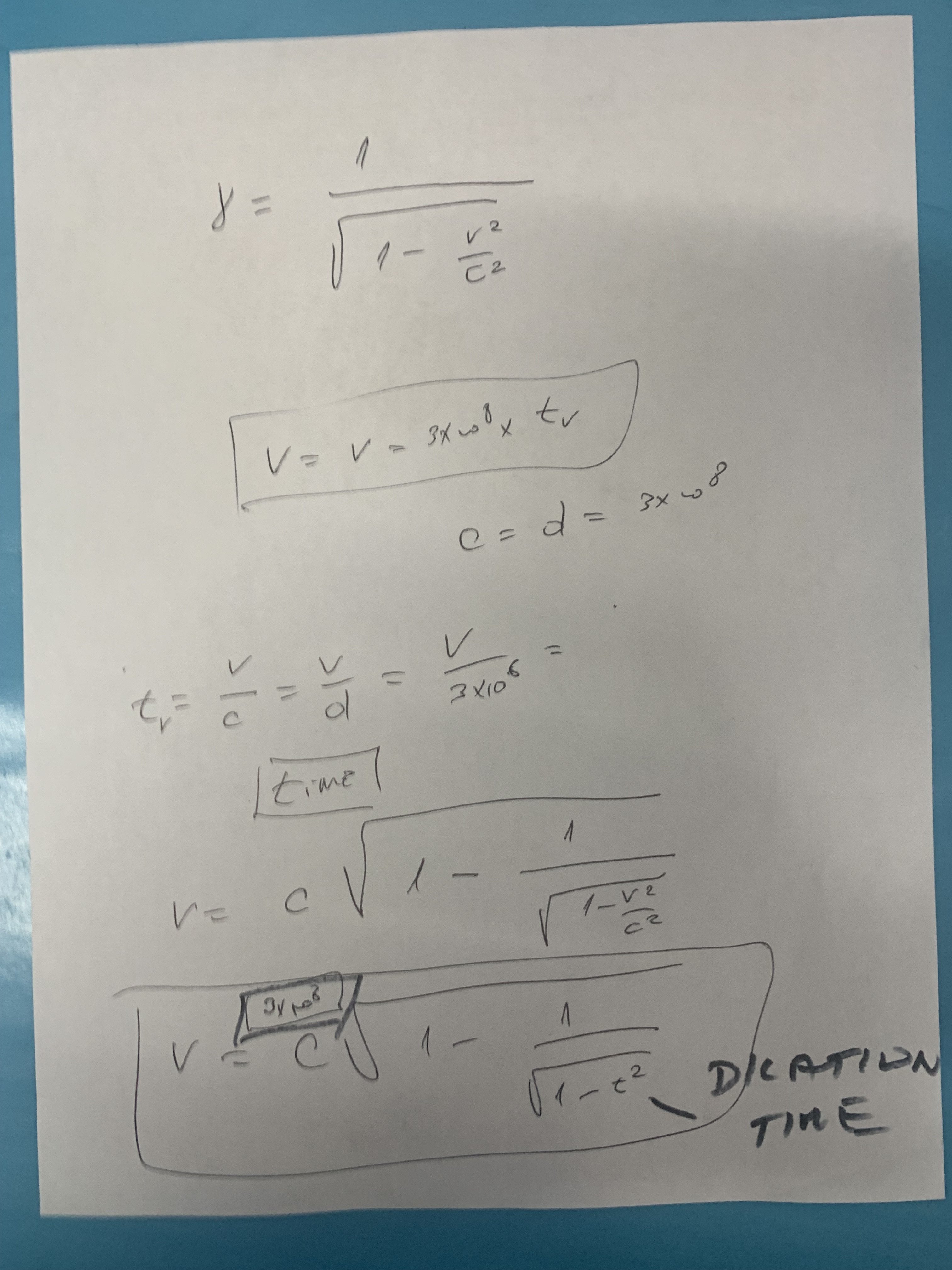
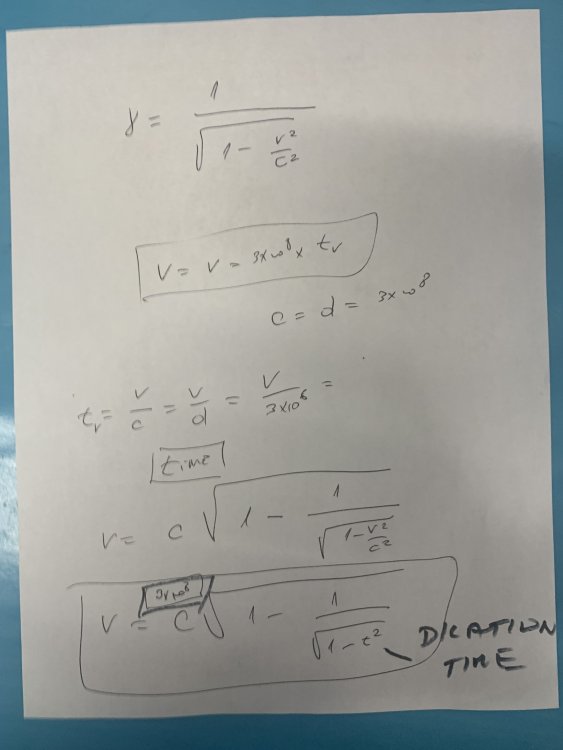
Ok I just would like to add one more formula for time dilation in period of 1 sec when distance =velocity t’=t/ √(1-1/t^2)
-
Thank you so much for finding time to look over and comment. I would like to point out one thing nobody is asking about and I would like to have your attention to it at time frame of 1 second velocity and distance have the same value. the way gama(Lorentz ) is derived from relationship between the vectors of speed. the vectors of speed have the same value as scalar distances. ANY speed in any set up to calculate time dilation is not changing . c is constant v we are using is constant I repeat in time frame if 1 sec the speed of C is equal 3x10e8m/s the distance dc=3x10e8m the speed v =dv This is constant in eny experiment for time dialtion - at any speed Alfa angle will have same value for speed vectors and for scalar d distances Tan Alfa=c/v For both velocity and distance Time t c=dc/c or tv=c/c=1s Time tv=dv/c At speeds close to c the angle Alfa will be about 45 degrees what is the tangent of angle 45 it is one does anybody see that all calculations do not have to be done with speed you just measure the time and multiple by speed of light If one has a closer look the at distance of 3x10e8 observer is not going to see the light in one second of observer is stationary if observer moves at speed of light he will see the light beam in 0 seconds the distances in experimental set up are extremely important and in every experiment - nobody even mentions distance . again the distance and speed are the same at 1 second time frame Thank you so much for finding time to look over and comment. I would like to point out one thing nobody is asking about and I would like to have your attention to it at time frame of 1 second velocity and distance have the same value. the way gama(Lorentz ) is derived from relationship between the vectors of speed. the vectors of speed have the same value as scalar distances. ANY speed in any set up to calculate time dilation is not changing . c is constant v we are using is constant I repeat in time frame if 1 sec the speed of C is equal 3x10e8m/s the distance dc=3x10e8m the speed v =dv This is constant in eny experiment for time dialtion - at any speed Alfa angle will have same value for speed vectors and for scalar d distances Tan Alfa=c/v For both velocity and distance Time t c=dc/c or tv=c/c=1s Time tv=dv/c At speeds close to c the angle Alfa will be about 45 degrees what is the tangent of angle 45 it is one does anybody see that all calculations do not have to be done with speed you just measure the time and multiple by speed of light If one has a closer look the at distance of 3x10e8 observer is not going to see the light in one second of observer is stationary if observer moves at speed of light he will see the light beam in 0 seconds the distances in experimental set up are extremely important and in every experiment - nobody even mentions distance . again the distance and speed are the same at 1 second time frame I am really hoping that somebody will see that here os something very different thatbis formula for time dilation when velocity =distance Opinions ?
-
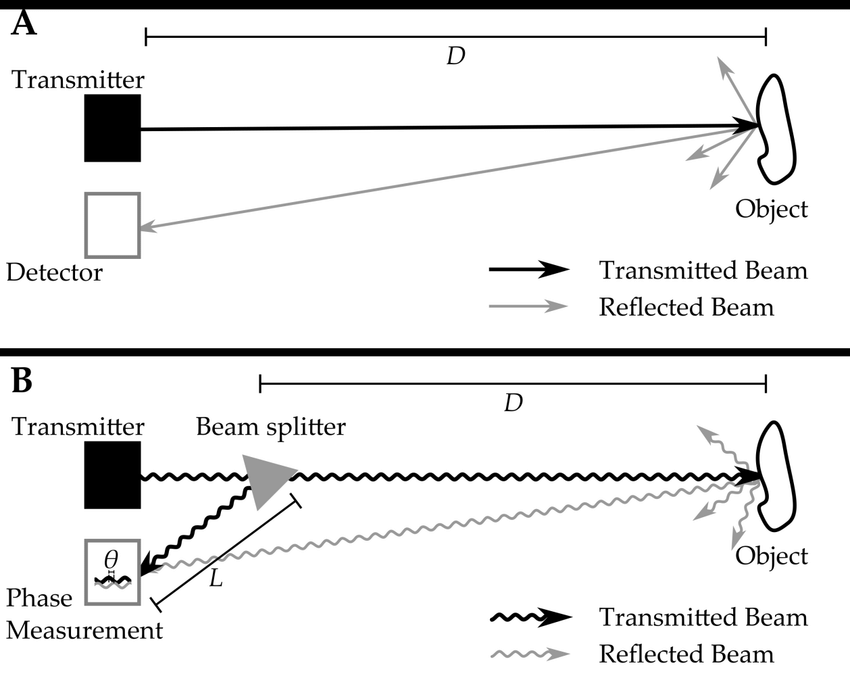
Here is a bit better explanation what is connection between theeiy of relativity and laser range finder . Range finder emited and receiver are not on the same line there is a small angle we are going to call angle alfa between sent and return signals. in one second signal travels distance of 3x10e8 this angle is so small that we ignore it. now if the distances become bigger it can not be ignored. for example height radio altimeters on the aircraft. Let’s see flash light ,vaginitis and observer in this set up instead of flesh light we will use light bulb. and both observer and mirror will be disco balls and one is positioned at distance 3x10e8 (mirror) and the other disco ball distance changes from 0 to 3x10e8m . the distances are perpendicular to each other (mimicking flash light,mirror observer). the light wave leaving the light bulb is circular wave and it spreads 360 degrees in xyz directions from light bulb. now we are pressing the stop watch button and we are going to follow only one light wave - signal signal reaching the disco ball at 3x10r8 distance is constant and it will be our comparative signal. in our case the distance is 3x10e8 and Time is 1 s the same signal travels to observer disco ball at distance d=0to 3x10e8 The time the signal reaches the observer is t=d(from to 3x10e8)/ c These two distance are sides of triangle with 90 degrees angle Between them.sides a and b The distance from observer (disco ball) to mirror disco ball can be calculated as hypotenuse. the angle between distance to observer and distance to mirror Tangent function is tan Alfa=d mirror /d observer OVERLOOK In quadrant 3x10e8 x3x10e8 in time of one second velocity and distance have the same value. If the sides of signal triangle length (abC) where a=v b=3x10e8 C^2=v^2x9x10^16 are seen as distance (m) the tan Alfa =c/v if the abC are seen as velocity (m/s) the tan Alfa =gama(lorentz factor) if the distance observer is bigger than 3x10e 8 only clasic physics approach will work. now please,go back to the beginning of this thread and you will see that theroy of relativity is original electromagnetic range Finder.
-
The first thing about train and flash light I said that it can be explained with both Newtonian and theory of relativity approach- before that everybody says that time dilation can not be explained with classical physics - correct? I hope I showed that using the distance not speed it is posible to describe time dilation calculating the distance . if time is measured from moment the light left the object A and reached object B if both objects are moving the most important thing is velocity V between them . the speed of light is just measure - comparator for distance (like light years)just opposite. like lessor beam directed to golf flag- in one second the distance will be time divided with 3x10 e 8 meters(distance) the l speed v is tangential speed on trayectory at which moving object moves relative to stationary object. the time and is the same . in one second from tangent function from v/c which is constant for hole universe - proven by theory if realtivity- will show us Tan v/c = 0 v= 0 both objects are moving in the same line - in linear direction - light signal can be a beam or edited in 360 directions dies not matter. one object is in front of the other The distance between them is constant - time is constant- but the velocity is constant . the red shift and blue shift just tell us is object A in front or back. All tangential velocity is spent on linear motion. Tangent v/c=0 to one infinity the objects are helix trajectory the tangential velocity is spent on rotational motion (angular component ) and linear motion (linear component) If A object is observer the helix will have bigger linear component and smaller angular components If b object is observer helix velocity components are reversed. tan v/c is infinity It does not meant that the mass is infinity it means that object is rotating around each other in circular trayectory the earth is rotating around sun in reality becouse if different mass but for us sun looks like it rotates in circle around us . theory of relativity explained and experimentally confirmed much more than classic physics. so the theory of relativity with this overlook properly remedied will be as I joked at part three borderline acceptable even for the worst critics Cheers
-
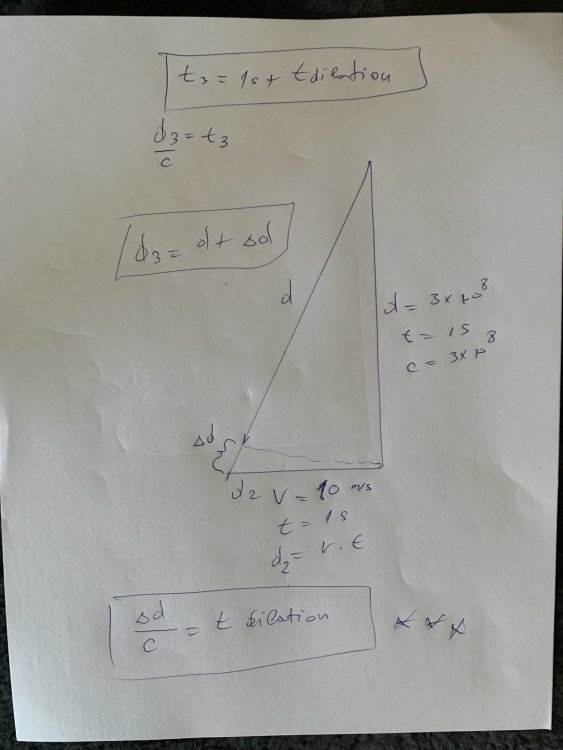
Thank you for the input Here is my point of view. The gamma factor at v=c is infinity. Here is drawing of set up to measure time dilation using Newtonian physics . from this we can see that this is actually one turn of helix trayectory this mass is moving on shown in 2D we do not have to use lotentz transformation. From angle Alfa -angle where tan angle Alfa =v/c from this we can find components for length of helix for 360 degrees - one turn of trayectory. The v tangent velocity of mass moving around observer . From angle Alfa we can find components of linear and angular speed of velocity v from these two components we can calculate the angular and linear momentum of mass moving relative to the observer If you do that you will se that relativistic mass is actually not increase of mass - it is the increase of angular momentum overlooked . Newtonian physics will do this part faster . but theory of relativity does everything else better . That is why I said that theory of relativity will be borderline acceptable (it was joke) If this idea is looked over by somebody competent .
-
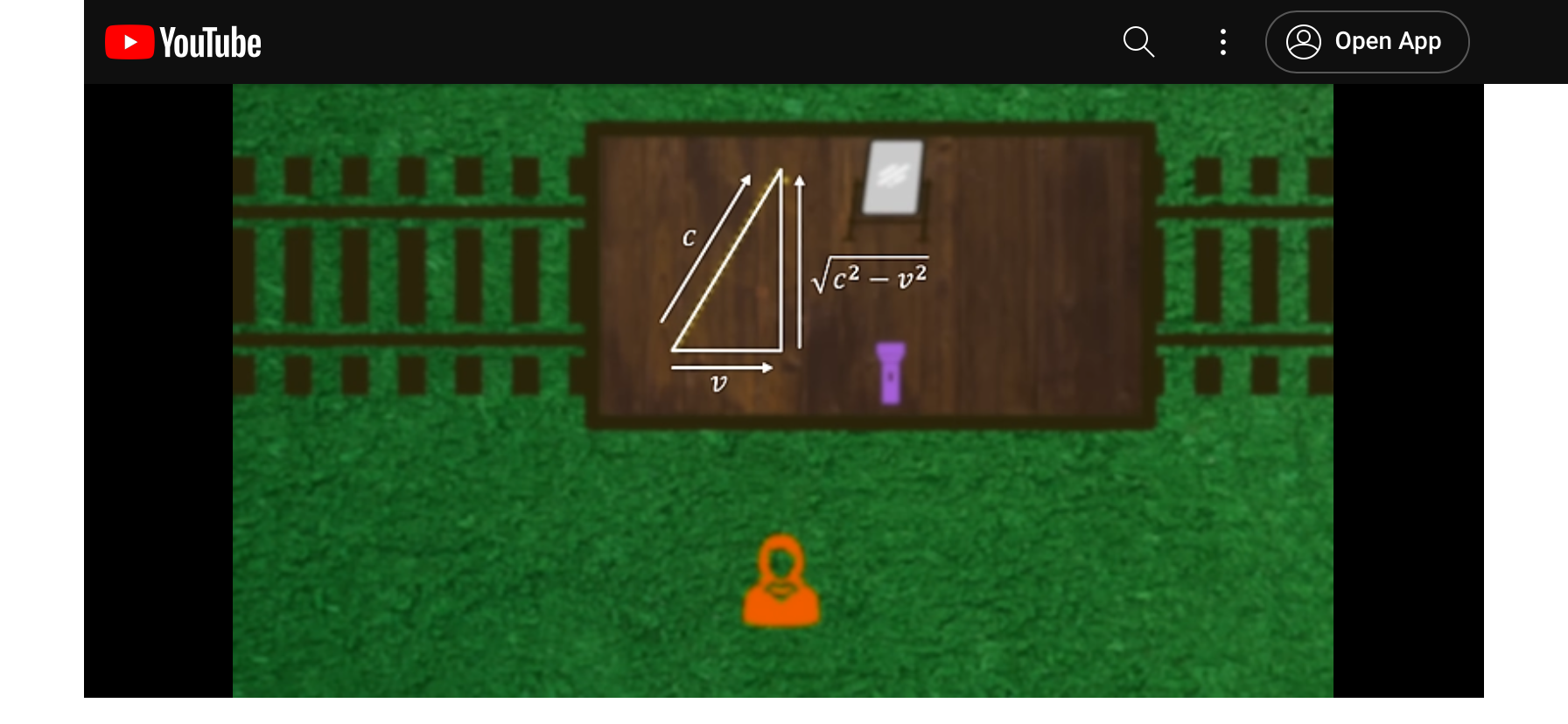
Thank you so much for finding time to answer. here are two pictures from dr Don Lincoln you tube episode about Lorentz factor time dilation . for the time period of one second the velocity = distance in bottom picture the theory of relativity is used and time dilation is calculated . and it is proven milion time over. the value of velocity in time if one second is used. the top picture is Newtonian classical physics way ti do it . if DISTANCE value per time if one second is used the real daily if time dilation calculated will be the same . The time dilation can be calculated using both theory of relativity and Newtonian classical physics. the diference is distance us scalar and velocity is vector quantity. Fir time dilation - or time delay calculation one can get away with this but to calculating mass - vector is very very important part . This is the only overlook in theory of relativity- but the most important one. in the early twentieth century there was no laser range finders and I understand that scientists were not able to see that in one second velocity and distance have the same value. But in 1960 or so laser range finding device was patented. What is our excuse?


-
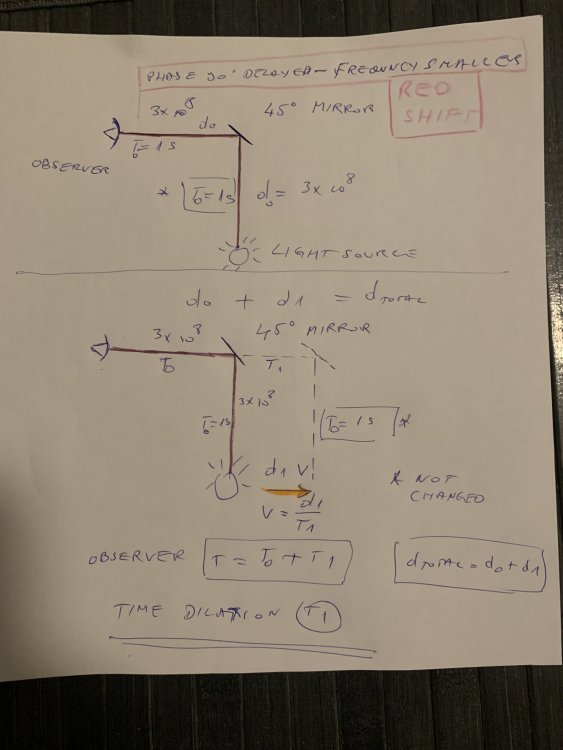
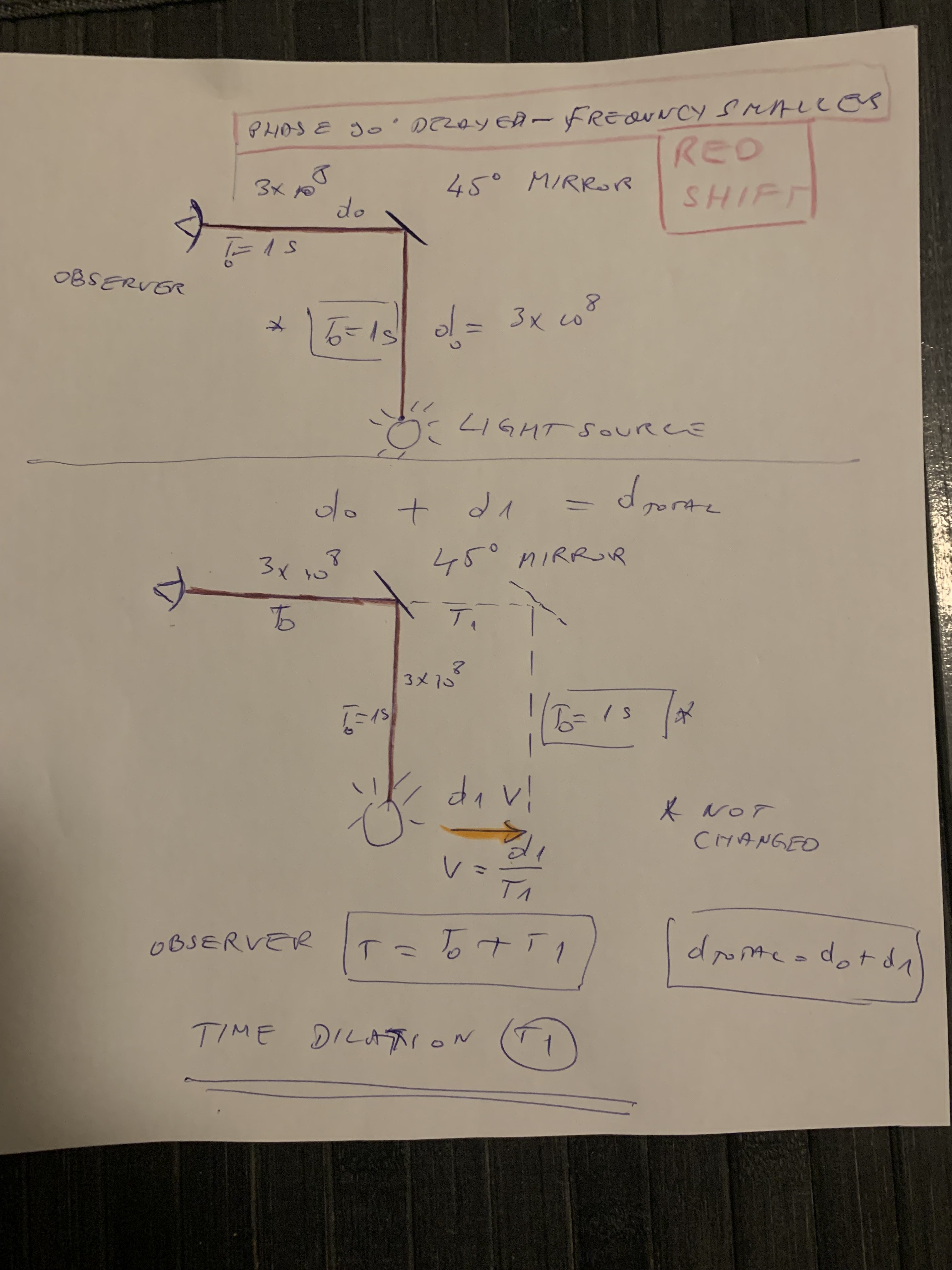
Hi thank you so much for finding time to answer . Here is closer explanation of part 1 part 1 Theory of relativity is the first system in history which can be described as range finding device using electromagnetic waves. Dilation of time is the easiest to explain if beside the speed value of distance is put in calculation . The distance between light source (emiter) to mirror (target ) positioned at angle of 45 degrees is d=3d10e8m Distance from mirror to observer (receiver ) is d=3x10e8m Case 1 At rest time of 1 second is needed to travel from emiter to target and 1 second to travel from target to receiver. Hete is a overlook : when light beam deflect from mirror it delays the the phase for 90 degrees . Case 2 when emiter and target start moving at speed v away from The receiver the distance between receiver and target is increased in one second by distance of d delay =v x 1 second Time dilation for light to reach the observer will be d delay/ c=T dilation The light beam phase shift will cause what we call today red shift effect. Conclusion there is no relativistic time or I owe Mr Einstein a big apology. In radius distance of 3x10r8 the angle Alfa between light waves is 45 degrees When angle Alfa is 0 degrees we have standard set up for time dilation only diference is that angle of mirror(target ) will be 0 the targeting laser pods in aviation work on this 360 degree principle .