jv1
Senior Members
-
Joined
-
Last visited
Everything posted by jv1
-
Michealson - Morley experiment revisited Visible light is electromagnetic wave. Light traveling from air than through the glass and back in to the air gets refracted . Light refraction, the bending of light as it passes from one medium to another, is explained by the interaction between photons and electrons in the material. Photons, the particles of light, are absorbed by electrons in the material, which then emit new photons, effectively delaying the passage of the light. This process contributes to the change in light speed and direction observed during refraction. The mirror is usually made of glass with thin layer of aluminum applied to surface of the glass. This happens because the frequency of the light waves does not match the natural vibration frequencies of the object's electrons, causing them to vibrate and re-emit the energy as reflected light. In both cases light(electromagnetic wave ) interact with the electrons. The baryonic components of glass (protons and neutrons including quarks ) are not interacting with light . The Michelson-Morley experiment aimed to detect the hypothetical "luminiferous aether," a medium thought to carry light waves. The experiment compared the speed of light in different directions, expecting it to vary due to the Earth's movement through the aether. However, the results were null, meaning no such aether drift was detected, leading to significant implications for understanding light and space. In 1887 science did not know anything about quarks and gluons. From above we can see that interaction between light(electromagnetic waves ) and baryonic matter does not happen at all. The direction of earth traveling through the “aether “ even if it existed will not affect the speed of light. Conclusion : This experiment sparked the creation of theory of relativity. Today,144 years later ,thanks to the exploits of the theory of relativity we can see that Michealson - Morley experiment had nothing to do with interaction between aether and baryonic matter. Einstein's theory of relativity, both special and general, is heavily influenced by Maxwell's equations of electromagnetism. Special relativity, in particular, is built upon the idea that the speed of light is constant for all observers, a direct consequence of Maxwell's equations, and this led to the formulation of the Lorentz transformation. Maxwell's original equations are based on the idea that light travels through a sea of molecular vortices known as the "luminiferous aether", and that the speed of light has to be respective to the reference frame of this aether. For speed of light ,If reference frame is aether ,it does not matter where observer ,or how many observers and their proton is in space - the speed of light will be constant .
-
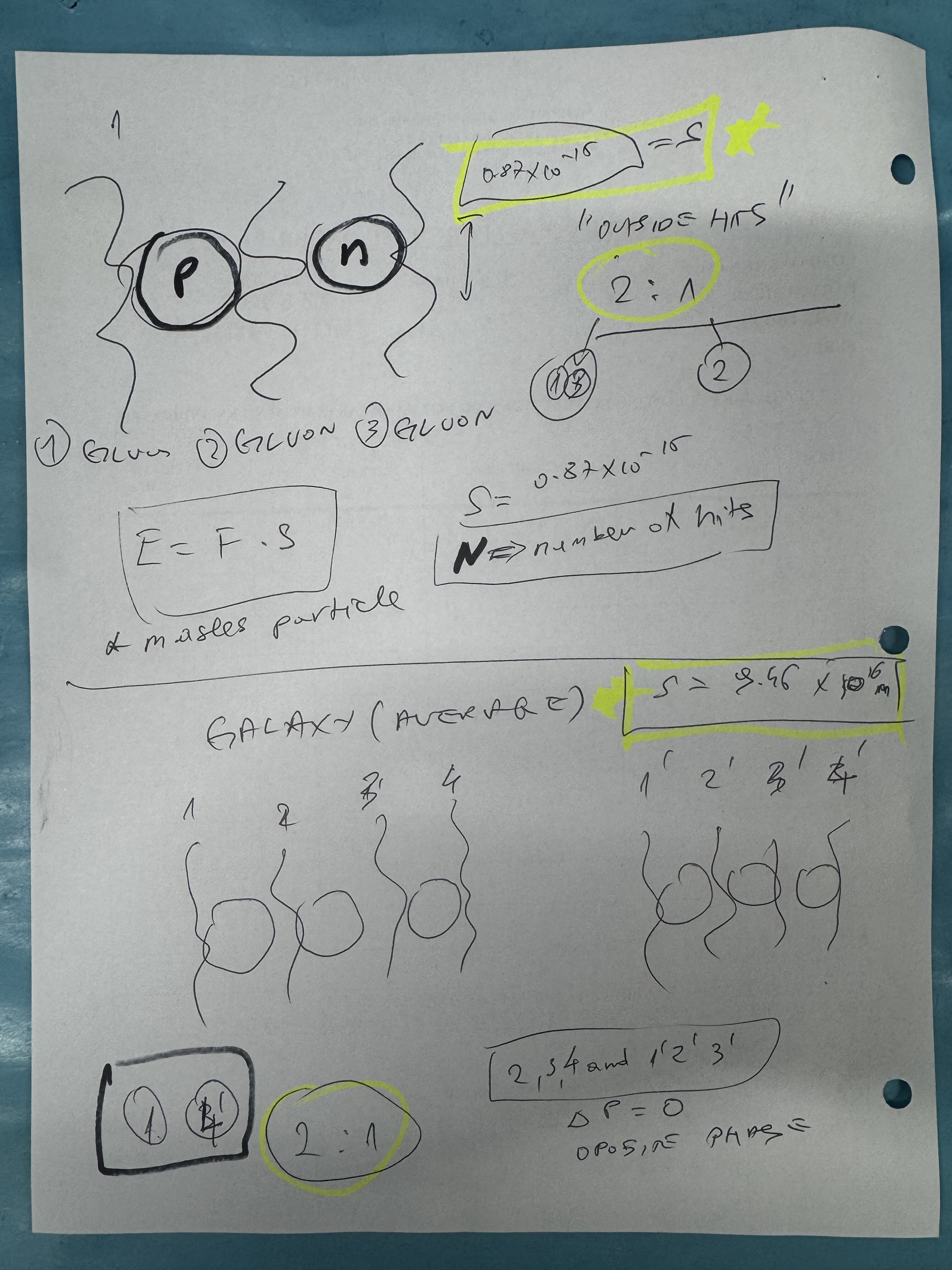
To paint closer picture : Here is again very rough drawing. This rough drawing us shown in 2D.The quarks are shown as a sphere just for explanation - they are more like “spindle” shaped. Single gluon travels around single quark in 3D, so impulses transfer momentum from all sides XYZ ,360 degrees around. When two gluons travel on opposite directions - one up and one down- the impulses in area between gluons are transferring momentum (by impulses ) nit only on the quarks . They transfer impulse between themselves- and the energy of massless gluons in area between gluon has a smaller force “ pushing out” than the gluons “ pushing in”. Fir proton neutron - the six gluons are involved - the N= 10e27 impulses creating strong force are the difference between number of impulses (for six gluons) which are “ pushing in “ from outside and impulses of the same 6 gluons “pushing out” from area in between quarks. That is strong force . Th et e is 10e 68 proton neutron pairs in galaxy - the same pushing in and out difference in number of impulses will create gravitational force . Only difference will be the distance between two galaxies. Fir the liquid drop model of visible universe from above this is obvious.Becouse that is static perfect 2D picture . In real life- galaxies are made of different number of different atoms, molecules . They come in different shapes and sizes - and most importantly they MOVE. That is the reason why the gravitational force is acting from center if the mass.

-
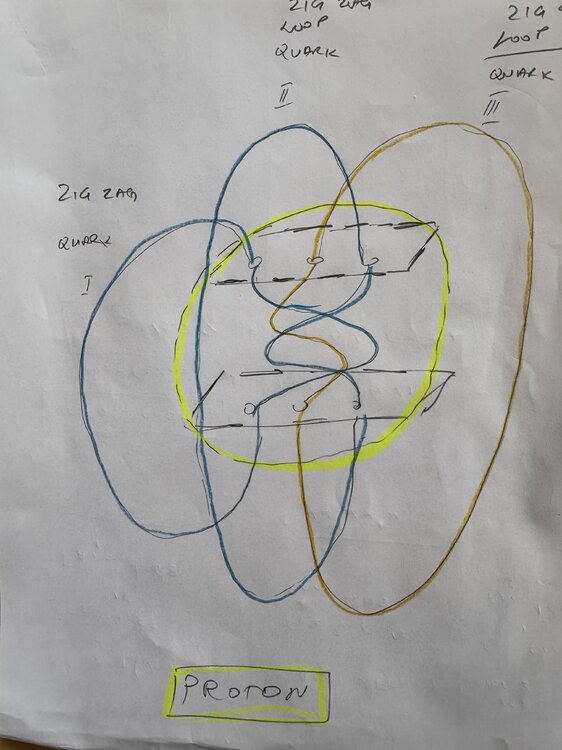
MigL First : from the bottom of my heart thank you and the other guys for finding time to look ,read ,try to understand and comment. Second : BIG YES you got it. I wish I had heard about this gluon things a decade or more ago. The gluons do not recognize the type of quark- they create - or better they decide what type of quark is involved in system . The gluon is massless particle which travels the universe in big numbers in big thick loop like trajectories . The diameter of these loops is 10e26m The direction of rotation of these loops could be CW or CCW . The quark is chunk of baryonic matter - like elastic” blob”. It is not up,or down or any of 8 flavours . It is just a blob. The gluon stream loop , traveling at CW or CW direction, will decide what quark flavour is quark going to be. Here is very rough picture - it shows three gluon streams : Blue Green Red Blue and green loops are traveling for example in CW direction . The red loop is turning in CCW direction . Green and blue loop are traveling upwards inside the proton . The red loop is traveling in down words (opposite ) direction . This direction of movement of the gluon loop Decides is the quark going to be up or down. Inside the proton - each loop wraps around single quark (blob) . The wrap direction can be in CW or CCW direction . This decides what spin the quark will have . In neutron the direction of loops will be opposite . This is the simple explanation of quark gluon interaction The massless gluon interaction by 10 e7 impulses per second with baryonic blob ,creating the strong force and not only strong force but gravitational force too, this is the most important point of this idea . This is a connection between gravity and strong force - they do not have the same nature ,they are the same force.
-
I just calculated it : Gluons The speed of gluons is C(3x10e8m/s) Distance gluing travels is s=0.89x10e-15m s/C=t t=0.3x10e-23s Impulse P=Fxt=10e4x0.3x10e-23=0.3x10e-19 N- number of impulse per second N=E binding / P N=3x10e13/0.3x10e-19 N=10e7 This is the number of impulses per second where gluon is transferring energy (strong interaction ) between proton and neutron . For this ,the gluons have to travel in between and on the outside of protons and neutron . The impulses from outside will be bigger than impulse form within. That is how strong force is crated. And gravity For first scenario of liquid drop model 10e68 of deuterium only gluon actin on the nucleuses at the outside (on the surface e of half bubble ) will create gravitational force . The fluids “inside the galaxy “ will neutralize each other - the resistant force will be zero And Massless particles, like photons, can indeed transfer momentum through an impulse, even though they have no mass. This is because their energy and momentum are related by E = pc, where E is energy, p is momentum, and c is the speed of light. The impulse imparted by a massless particle is the change in momentum of the object it interacts with.
-
In real life 10e7 impulses per second created by gluons when traveling at speed of light is what makes momentum transfer and Ceres strong nuclear force . And the same impulses only 10e7 c10e n n- number of proton neutron pair in “surface “ of each galaxy in real world. Hahaha Sorry about mistakes : Impulses create strong force - 10e7x10en=number of gluon crated impulses - create real gravitational force between two galaxies s. Or any objects with mass in real world
-
Now Gluons The speed of gluons is C(3x10e8m/s) Distance gluing travels is s=0.89x10e-15m s/C=t t=0.3x10e-23s Impulse P=Fxt=10e4x0.3x10e-23=0.3x10e-19 N- number of impulse per second N=E binding / P N=3x10e13/0.3x10e-19 N=10e7 This is the number of impulses per second where gluon is transferring energy (strong interaction ) between proton and neutron . For this ,the gluons have to travel in between and on the outside of protons and neutron . The impulses from outside will be bigger than impulse form within. That is how strong force is crated. And gravity For first scenario of liquid drop model 10e68 of deuterium only gluon actin on the nucleuses at the outside (on the surface e of half bubble ) will create gravitational force . The fluids “inside the galaxy “ will neutralize each other - the resistant force will be zero
-
Thank you for pointing that out In visual universe bubble the time period should be in light years . In deuterium / the time period should be in Plancks time I went with one second so there is no confusion . Both systems have the same energy,and in one second transfer of energy (Work) will be equal For both and amount of energy transferred in one second (power ) will be equal for both The scale of light years 31.5x10e6 and Planck time to 10e-43 s Are both based per 1second. In the liquid drop model of visible universe there is 10e12 average size galaxies . Each galaxy is made of 10e68 deuterium The average distance between distance galaxies is 2x10e22m The gravitational potential energy is 10e50. Now: The liquid droP model states that nucleons are the same size and they are at the same distances inside the bubble (drop). If deuterium nucleus is used at average distance inside the bubble (without ) being positioned in average galaxies (10e68 in one) The 10e79 deuterium atoms are positioned At 10e78m3(volume of visible universe ) bubble At distances of roughly 1 mm(10e-3m) The gravitational energy(potential ) between two neighbouring nucleus’s will be 6.9x10e-11x4x1.6x19e-54/10e-3=8.39×10⁻⁶⁰ this energy times 10e79 (total number of deuterium ) is 10e18J So separation energy for this system would be 10e42 times smaller than energy of strong interaction - this is what standard model is saying us . But when deuterium is positioned in average galaxies - we have confirmation that gravity could be strong interaction - or have the same Nature .
-
Yes And again system has bonding energy it is constant . To brake apart proton neutron - work in one second is equal to energy inside the system . E/t=W In one second Energy E=W Work done in one second by any energy which is equal to bonding energy (2.2x1.6x10e-13J) Is equal to separating energy needed to take a part deuterium. So two works done in 1 second (by any energy- collision for example ): 1)Bonding energy of deuterium =work of separation (in one second) 2)potential gravitational energy = work of separation (in one second) Ergo: In liquid drop model of visible universe , In period of time of one second - The bonding energy of deuterium for the hole visible universe is equal to gravitational potential energy of galaxies shown as nucleon. Again for time if one second work and energy are calculated E=W=Fxs In any other case work and energy systems are incomparable
-
GravitationalPotential Energy beyond Earth Potential energy is particularly useful for forces that change with position , as the gravitational force does over large distances. And The strong force, also known as the strong nuclear force, is responsible for holding together the protons and neutrons within the nucleus of an atom, and it also binds quarks together within these particles. The energy associated with this force is referred to as the nuclear binding energy. This binding energy is the energy released when nucleons (protons and neutrons) combine to form a nucleus, or the energy required to separate them. The stronger the binding energy, the more stable the nucleus. Gravitational potential energy is minimum energy needed to separate - pull away two average galaxies from average distance . The same for strong interaction binding energy- is minimum energy to pull apart proton and neutron . I said that in time frame of 1second - as an example - becouse in one second Energy of separation =Work of separation J/s=W Joul per second is wat
-
I see what you do not get - every galaxy insert the attracting force to all galaxies . The biggest attractive force is to closest one . Instead of calculating each individual galaxy acting on the real life neighbours,the visible can be seen as N number of average galaxies . This simplified view of visible universe and galaxies inside is very similar to liquid drop model of nucleus. Every second the force is acting between galaxies - work is done - in one second the work done is equal to energy . The energy spent in one second to produce gravitational forces is the total energy of gravity I am talking about . The galaxy is made of stars ,planets - they are made of molecules and atoms. Atoms of all visible universe are seen as deuterium to simplify calculation . The same way the average pair of galaxies are used above. Deuterium - proton neutron pair is constantly bound by strong force and in one second work is done to produce the force between the two. This was done by constant exchange of gluons. Gluons carry the 2 mev of energy per second . 10e79pairs of proton neutron in one second has the same energy as the gravitational energy of pair of average galaxies spent on gravitational force between them. If we use average energy per second gravitational force between proton and neutron 6.9x10e-11x 1.6x10e-27 x1.6x10e-27 / 086 x10e-15=10e-40 10e-40 x10e79 for number of pairs Total gravitational energy produced to keep atractive gravitational force between proton neutrons of hole universe is 10e39J If we take in consideration that distance between pair Averge galaxies is 3x10e22 The total energy is going to be 10e17J That is 10e60 value for strong force energy(per second gravitational) / 10e17 That is 10e43 diference in amplitude d. The conventional thought is that 10e38 is diference in amplitude between strong force and gravity. Gravitational energy from average galaxies - made of the same proton neutron pairs Is 10e58.this should be 10e17 too - but it is not .
-
Nuclons (proton neutron ) are very stable systems. When i say strong force energy I meant energy needed to provide the strong force for 1 second. For period of one second the energy and work are the same thing. The Planck force Approximate Value: The Planck force is approximately 1.21 x 10^44 Newtons. Significance: The Planck force is a fundamental quantity that arises when considering the limits of our current understanding of physics at the Planck scale (the smallest meaningful length, time, etc.). It's thought to play a role in the potential unification of all fundamental forces (gravity, electromagnetism, weak force, and strong force) at the Planck energy. It just happens to be equal to hypothetical surface force of bubble created by liquid drip model of visible universe . As mentioned above ,it is thought to play role in. Potential unification of forces …. About my neurological reference frame - every new idea is considered lunacy until proven to be true. Let me use this opportunity while I am still excused for what ever I do or say 😜 To ask one more unusual question : Has anybody here b this forum found the idea anytime in history - that baryonic matter was made of aether ?
-
One more thing Gluon - it is disturbance of the quantum field ,which is responsible for 98 % of 988MeV binding energy of proton . We say that gluons are exchanged between quarks - in this speculative story of mine - gluon is not exchanged between quarks - it travels around the quarks . The quarks are pushed by big number of massless gluons and the number of gluons from outside is bigger and has bigger energy than number of gluons which are traveling in between quarks . It does not matter are the quarks particles or waves - they will be affected . Gluon travels at the speed of light. And it travels in loop with diameter of 10e26m(size of visible universe ) or probably more . The gravitational force is crated by the same gluons - gluon is what we call graviton .
-
Liquid drop model of visible universe is used to explain how gravitational atractive force (which are long range force ) can be seen the same way as a strong Force acting in the short range. The proton neutron binding energy is 2.2 MeV(for deuterium).Energy needed to hold deuterium together - and they are held together by strong force (this force is product of binding energy). Instead of calculating every atom in the universe , for simplicity we can There qre 6-7 protons for each neutron in visible universe . The same goes for 2 average size galaxies at average distance in visible universe . Gravitational force between two galaxies is product of gravitational energy created by proton neutron pairs inside the galaxy Now 10e38 is magnitude difference between gravity and strong force inside the nucleon - It would be logical that sum of all energies of proton neutron pair would be 10e38 times bigger than sum of average gravitational energies in visible universe? Correct?
-
I wanted to hear your opinion about trying to prove that graviton and strong force beside on the quantum mechamics(Planck scale ) can be connected in a very unusual way. Energy . Here is an simple example how to connect strong force and gravitational force. Let’s compare energy needed to create these forces. Hypothesis: The energy needed to create both of these forces are equal - for visible universe . This idea is - visible universe is seen as a liquid drop (nucleus) and the galaxies are seen as nucleons. The gravity (gravitational energy) is used as an equivalent to strong force . The galaxies are acting strongest to the neighbour galaxy and there is surface tension cretaed on the “outside “ surface of visible universe . Very interesting thing - the gravitational energy cretaed by all galaxies inside the visible universe is equal (very close ) to energy crated by All nucleons (protons and neutrons ) strong force which planets ,stars (galaxies ) are created of. The distance these fundamental forces are acting in are very different and the strength of forces are very different- but interesting thing is - Energies are the same . Hypothetically- could this be the same force ? Here is a bit closer calculation. Cheers Liquid drop model revisited The liquid drop model explains forces in atomic nucleus as they were created by tiny liquid drops. It is based partially on theory and partially on empirical measurements. In this revisited model The visible universe is seen as bubble/nucleus of liquid with diameter of 8.8x10e26m.In the further text big bubble. The galaxies inside the bubble are seen as a nucleons.In further text small bubbles. For simplicity of calculation we are going to use average size of galaxies. The number of galaxies inside the visible universe is Ng=2x10e12. The mass of galaxies is found to be 10e7 to 10e12 solar mases. Mass of average size of galaxy is calculated to be ma=2 x10e39kg. The sizes of galaxies are in the range of few to 100 kiloparsecs. The size of average galaxy is Da=4.89x10e20 m. The average distance between two galaxies is 1x10e6 light years or 9x10e21 The force acting on surface area of big bubble is F=PoxAbb F=246.10e52 x 1.3x10e-13 F=0.316x10e44N Po=1.3x10e-13 Pa(pressure in deep space ) The force acting on the outside surface area of big bubble is very similar to Planck's force. Binding energy between two closest average galaxies(small bubbles)can be calculated from Formula for gravitational energy. U=Gx(ma)e2/da U=6.6x10e-11 x (2x10e39)e2 /9x10e21 U=8.8x10e46J There is 1x10e12 pairs of nucleons (small bubbles) creating this energy) Total binding energy of big bubble is Et=8.8x10e46 x 10e12 Et=8.8x10e58J*********** The binding energy calculated by Weizsäcker formula : E=15.75 x A - 17.8 x A e1/3 (Columb and Pauli term are negligible) E= 15.75 x5.71 x 10 e67 - 17.8x(5.71x 10e67)e2/3 E=89.9x10e67-14.7x10e44 E= 89.9x10e67 mev One ev=1.6x10e-13J E=89.9x10e67x 1.6x10e-7 E=142.4x10e60********** The total binding gravitational energie Produced by little bubbles - seen as nuclons is very similar (close) to total energy produces by total number of protons inside the big bubble (weizsaecker formula ).
-
All quantum particles can be particles or waves. Gluons are massless particles traveling at speed of light. They are carrying the sting force between quarks and they can be transformed to quarks and vice versa. In this idea where the gravitational force mimics the strong force - the stream of light speed traveling gluons can be a seen as a solid barrier between quarks . The thickness of this stream is 0.04 x10e-35 m Are they coming from one quark and travel to another - maybe. Or they are traveling from “outside “ of hadron- maybe. The quarks have mass - they will create gravitational force between each other. At distance of 0.04 x10e-35m the gravitational force will be 10e4 or very similar,for two up quarks,two down quarks or one up one down quark. Inside the proton the quarks masses are stable . Idea- the strong force is gravitational force,or in one specific set of conditions can mimic strong force. The connection between gravity and strong force - is all we need to connect all fundamental forces to electromagnetic nature . We are in speculations - is there anybody out there who can see the way for this to work? Or help for this to work? Tx Moderator could you please close the thread Tx
-
In this isolated system we have only : up quark(charge +2/3) down quark (charge -1/3) gluon the total charge of system is +1/3 but the electromagnetic force between up and down quark is attractive. The gluon in this system is massless particle - there is no gravitational force between up or down quark and gluon . The gluon maximum size is calcite to be 10e-19 m and the smallest size could be 0m(massless point particle has no dimensions )but it is there and it is proven that it carries the strong force. Gluon in this I isolated system is just”space filler” between quarks - kind a like elastic band . When gravitational force is acting from the masses of up and down quarks (3.5 and 8.9 x10e-30) for the gravitational force to be crated by these masses to be equal to the strong nuclear force - the distance between up and down quark has to be 0.04x10e-35m The gluon is “squished “ between quarks by quarks. In this isolated system there is two forces gravitational force created by the up and down quark masses And the atractive electromagnetic force crated by up and down quark electrical charges . In this isolated system two of these forces are crating the force or bigger equal to strong force . now inside the proton there is 2 up and one down quarks . Let’s apply logic from isolated system in to this real life application There is going to be 3 gravitational force swishing gluon Beside this 2 attractive and one repulsive electromagnetic forces Are squishing the gluon. Beside this ,two up quarks are pushed away one from another in circular motion around rain quark(spinning angular momentum)by repelling electromagnetic force. So - what we perceive as strong force is 3 gravitational forces Equilibrium between masses of 3quarks. what we perceive as color or flavour is the spinning momentum created by repulsive electromagnetic force of 2 up protons. The distance we observe quarks inside the hydron (10e-15n) Is correct but center mass of all three quarks are ate distance of 0.04 x10e-35 m in the center of proton .
-
Here is the key point behind this idea. Strong force between quarks is provided by gluons. Gluon is massless point particle. Interaction between quarks through gluons is very well explained and confirmed by experiments. The biggest size of gluon is 10e-19m The smallest size of gluon could theoretically be 0m Lets observe quark and down quark and gluon between them as a single system. Quarks have mass- and gravitational force will be acting between them. the gravitational attractive force will position quarks as close to each other depending on strength of atractive force. Using Newtonian formula for force ,or general relativity or observing gravity as geometry or force will not change the fact that gluon is “squished “ between quarks . For up and down quarks the gluon “thickness” or size will be below Planck length and force acting on gluon will be 10e4N Beside gravitational force there is going to be atractive electromagnetic force becouse both quarks are charged particles with different spin. the gravitational force at Planck scale is way bigger than electromagnetic force . There is no strong force needed to explain interaction . Now in real life - there is always three quarks : 2 ups 1 down …. Gluon (or gluons)in between What we observed and measured in experiments is the strong force . We can see that in real life there is three system from above . There is three particles (quarks)acting on gluon (quizzing or streching them) Three forces are atractive gravitational forces and three Forces are electromagnetic- 2 atractive and 1 repulsive . All these forces are at equilibrium and we perceive it as strong force. Here is physics with now numbers needed,we can call it thought experiment
-
The gravitational Force obeys inverse square law from 0m to infinity For The Planck scale distances gravitational force would be the strongest in nature . Mechanism of how gravitational force works (gravitons or not) I assume is electromagnetic . The strong force has atractive and repulsive components. Let assume that gravitation is attractive component(made by mass attraction of quarks) of what we perceive as strong force . The repulsive component of what we perceive as strong force is repulsive electromagnetic force created by near by positions preons,quarks and nucleons) This mix of gravitational and electromagnetic forces is there aim that strong force does not follow the inverse square law
-
Quarks are bound together by strong nuclear force Fs=10e4N The up quark has a mass of 3.56 x10e-30And down quark has a mass of 8.9x10e-30kg. The size of quarks is calculated to be 10e-19m. Average distance between quarks is 0.8x10e-15 m. The minimum and maximum distance between two quarks quarks is created by gluons . Now: At what distance between quarks the gravitational force Fg=Fs strong force ? Gravitational force formula Fg=Gxm1xm2/re2 From this formula we can calculate that distance between up and down quark is r=4.6x10e-33m and gravitational force Fg =Fs If two forces have the same value in the same distance - could it be that both forces have the same origin? Could we call this starting point to find connection between gravity and other fundamental forces?
-
Exchemist That is a good one. Joking a side ,i would strongly recommend to all of physicists to take a course or two in fluid mechanics. i would like to ask moderator to lock this thread . tx
-
Hi again I would like to thanks to science forums for giving me opportunity to share a very different and more simply view on physics I promise I will not come to speculations thread ever again. I have learned a lot from science forums and I will try to learn more. I would like to finish this speculation threads of mine with two words super symmetry. cheers
-
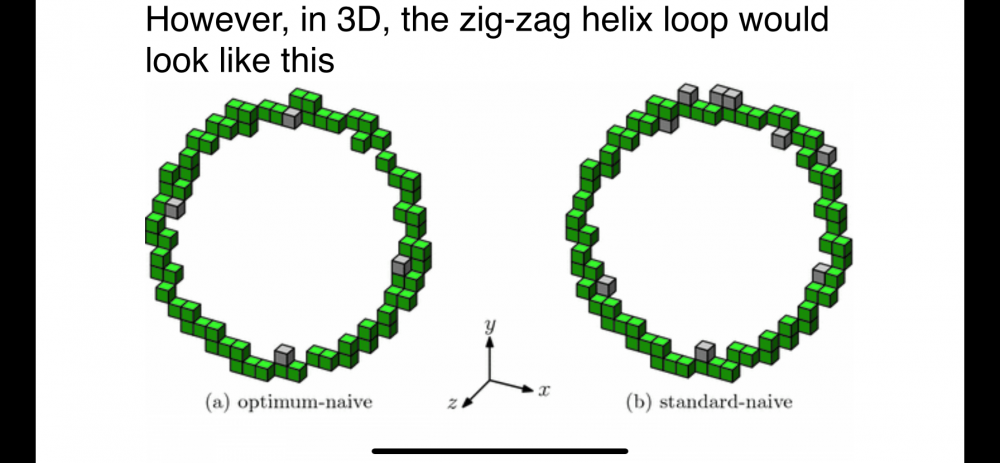
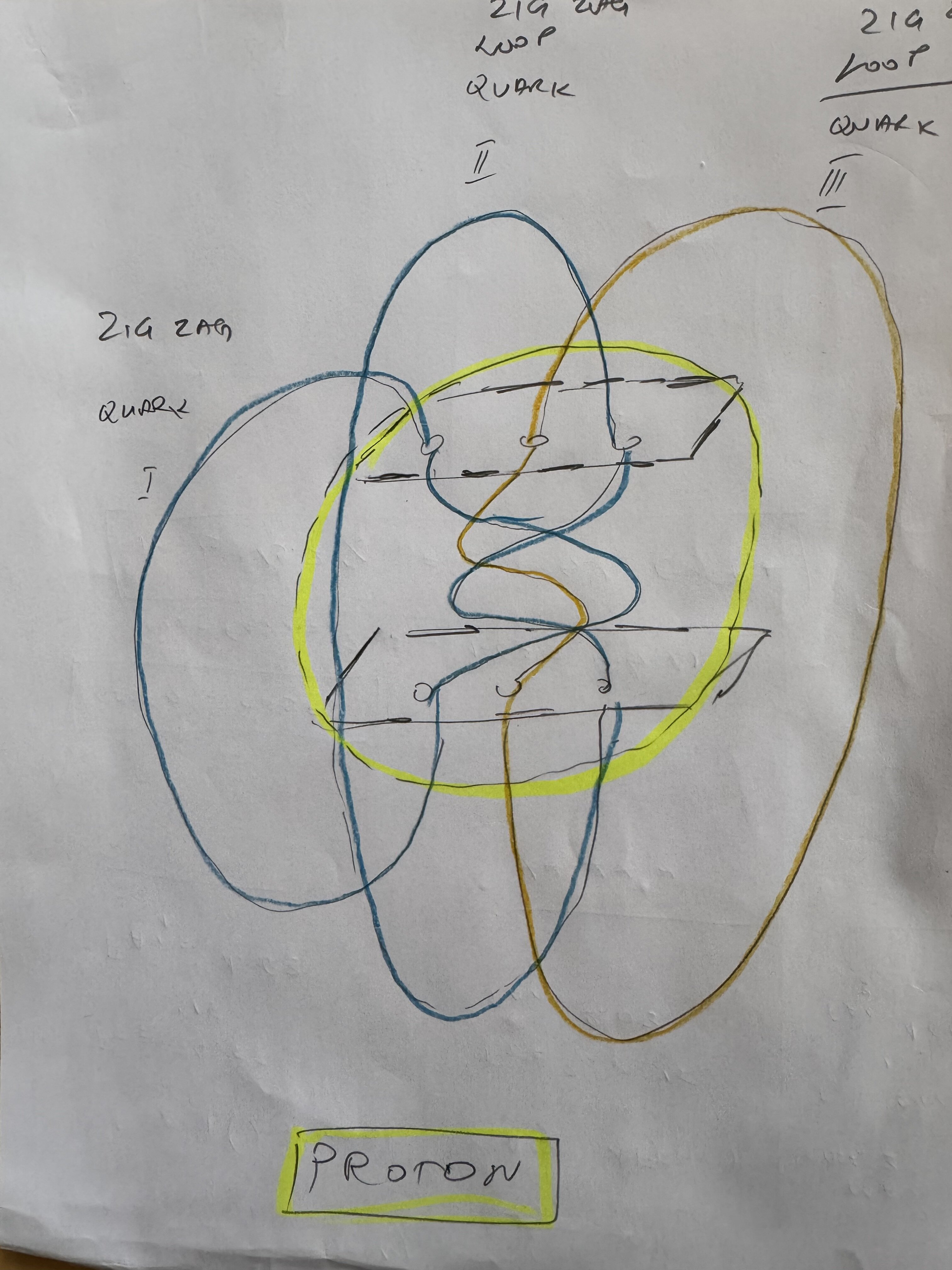
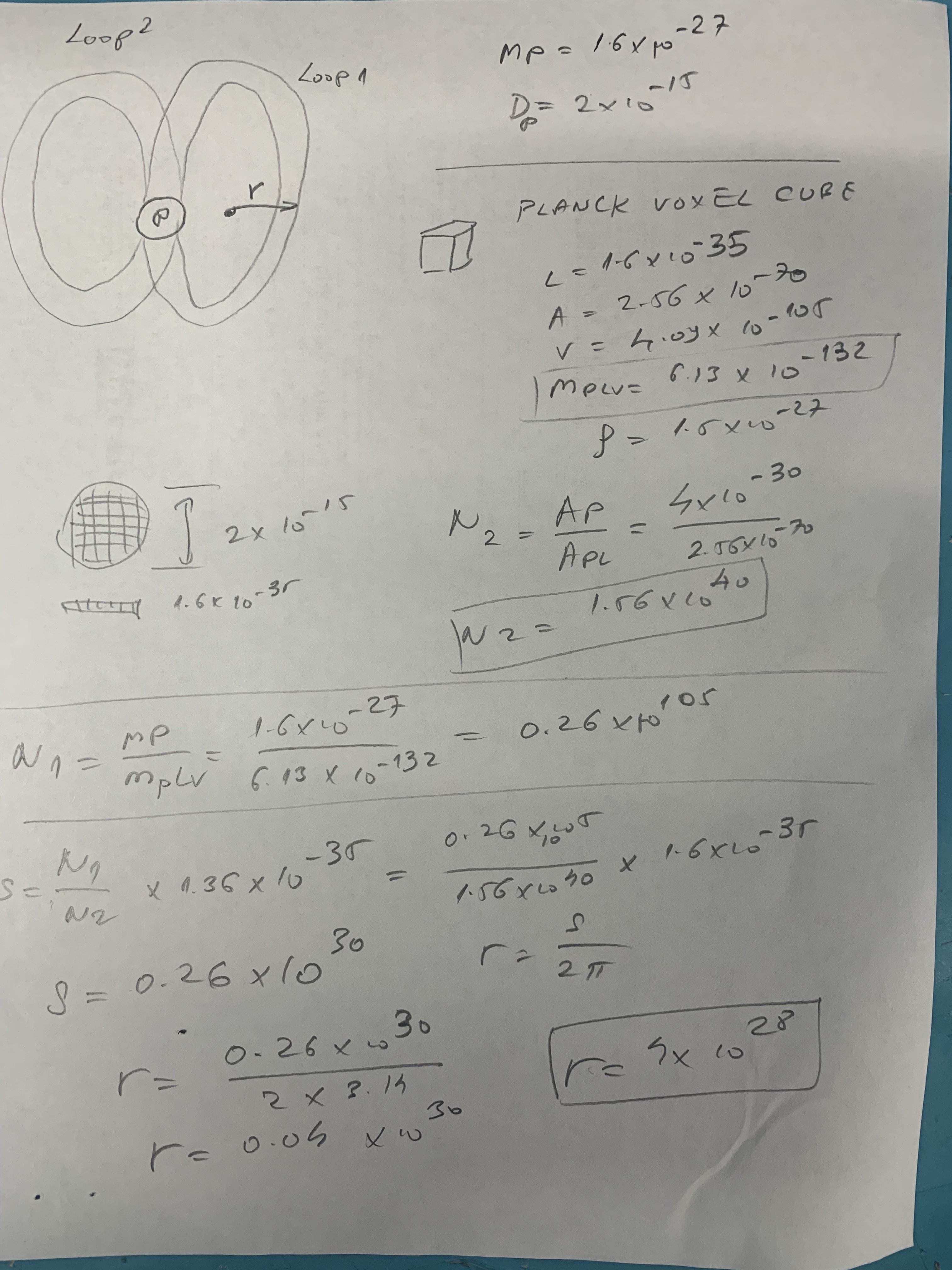
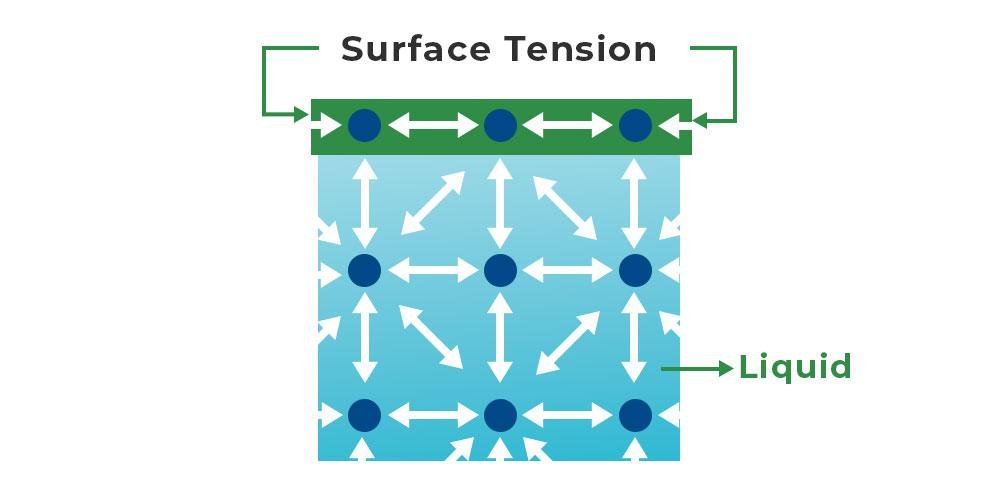
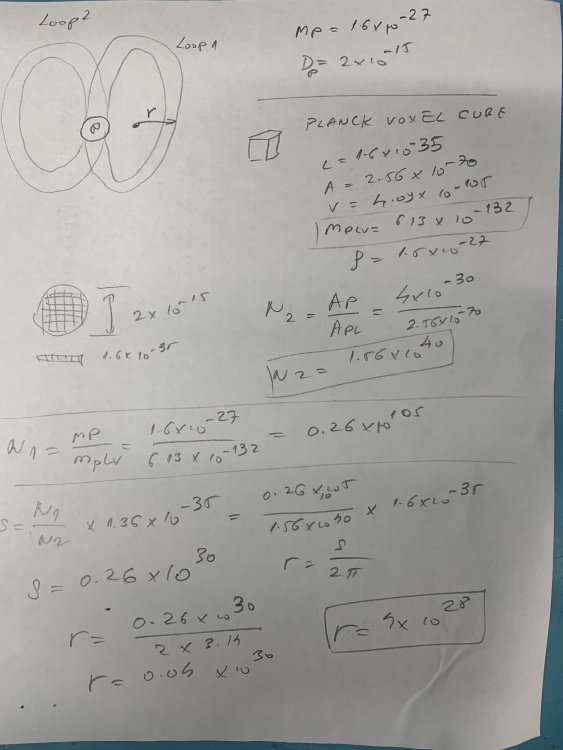
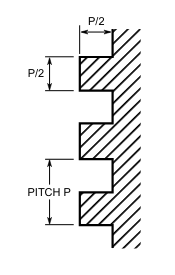
I would like to add couple of more things. The average sized galaxies (small bubbles) inside the visible universe (big bubble) are acting on each other with gravitational force. The surface tension T=F/L F=Fg=0.97x10e25 L=27.63x10e26(half of circumference of big bubble) T=0.0035 Pi-Po=4T/r Po=(1.3x10e-11)-(3x10e-29) The outside pressure Po acting on bubble is very close Pi pressure acting inside of the big bubble. If the proton is made of two zig zag helix loop and loops are made of Plancks size cubes here is very rough picture : To calculate the size of loops for proton the mass and diameter of proton is starting point. The Planck cube mass and diameter are used too. N1 is number of Plancks cube masses inside the proton mass. N2 is number of Planck cubes inside the area of cross section of proton diameter . S=N1/N2 S is length of loop 1 and 2 . S is circumference of loop. The r=4 x10e28m This is very close to 4.4x10e26 m diameter of big bubble. The cross section are of proton Shown as a circle (N2)of Planck cubes (single layer) is area where half of cubes are moving CW with loops 1 and CCW with loop2 .This is main spin . At the same time cubes have zig zag motion they go perpendicular to the main spin and create intrinsic spin. The number of cubes in “vertical “part of zig zag motion will moving at the same time will create pitch- the spin number .Two loops are going to be “pushing “against each other and creating spinning motion - the main spin around proton. The cubes moving perpendicular will create Pauli/ pairing - intrinsic spin. Just one more thing- any change we afflict to proton ,if we alter number of cubes flowing through the proton ,will automatically change number of cubes or flow of cubes on both loops .On both loops at the same time at very big distance - there is nothing “spooky “ about that .
-
Hi swansont I am not reinventing the wheel. Everything in standard mode is accurate to the letter . I just want to point out few overlooks and point out few directions where the standard mode can be better understood. If you connect this and my previous threads this “model “points out few things: 1)the fractal nature of universe 2)the total binding energy between all protons in visible universe is equal to gravitational energy between all galaxies in the visible universe 3)the Planck force - pure theoretical term is equal to force created by pressure Po acting on outside surface of visible universe 4) the average density of visible universe is equal to pure theoreticaly calculated density of dark matter. 5)it connect liquid drop and shell model 6) it explains what happens on Planck scale ,sun atomic scale,atomic scale ,molecule scale All the way to interaction between galaxies. 7)it explains in 3D the spin of particles 8)connection between electromagnetic properties of particles with fluid nature of particles 9)change of pressure Po acting on outside of visible universe create vibration which produces motion of particles inside . 10) fundamental forces have all the same nature - electromagnetic nature . The gravitational force is crated the same way as the other forces- by change in pressure Po acting in the outside of “big bubble”. 11) the smallest particle in universe is Planck sized cube
-
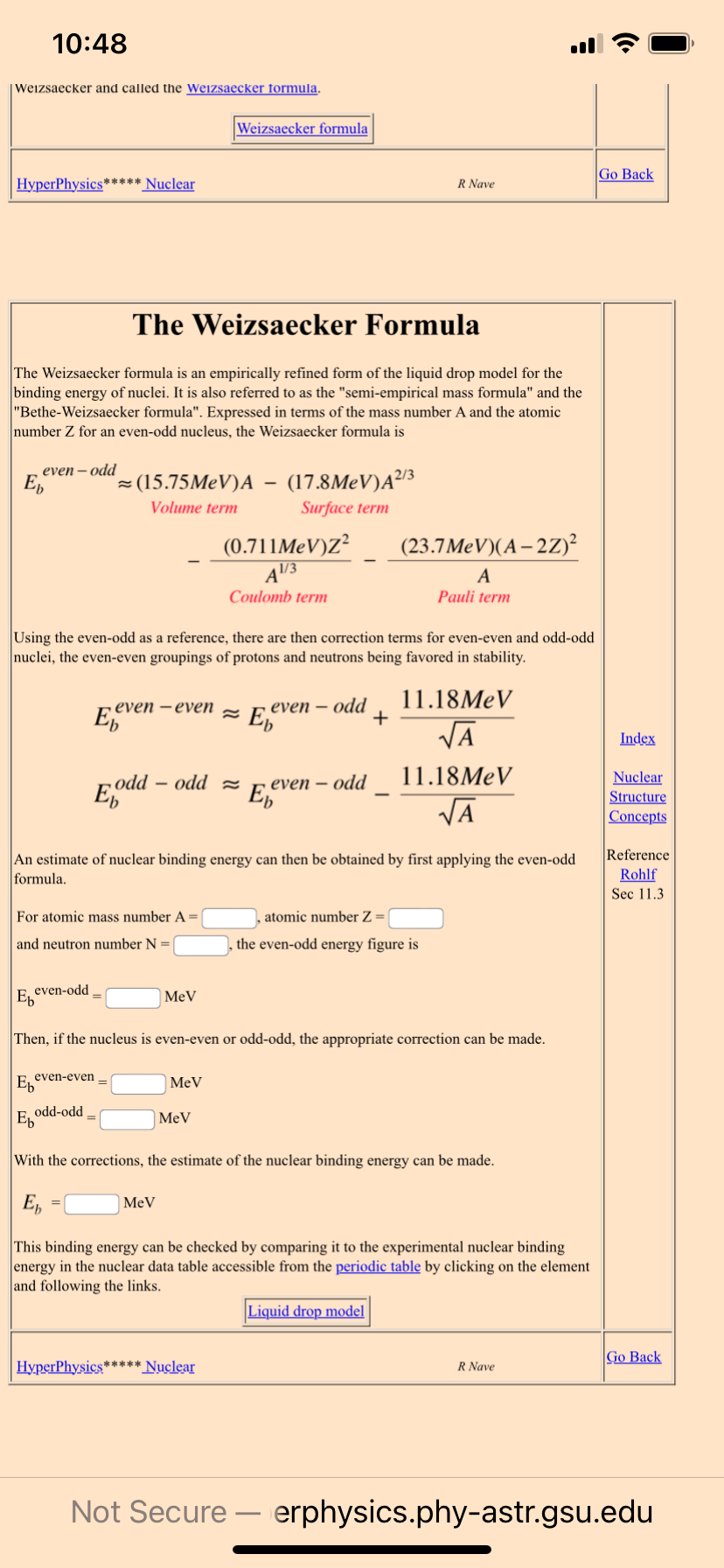
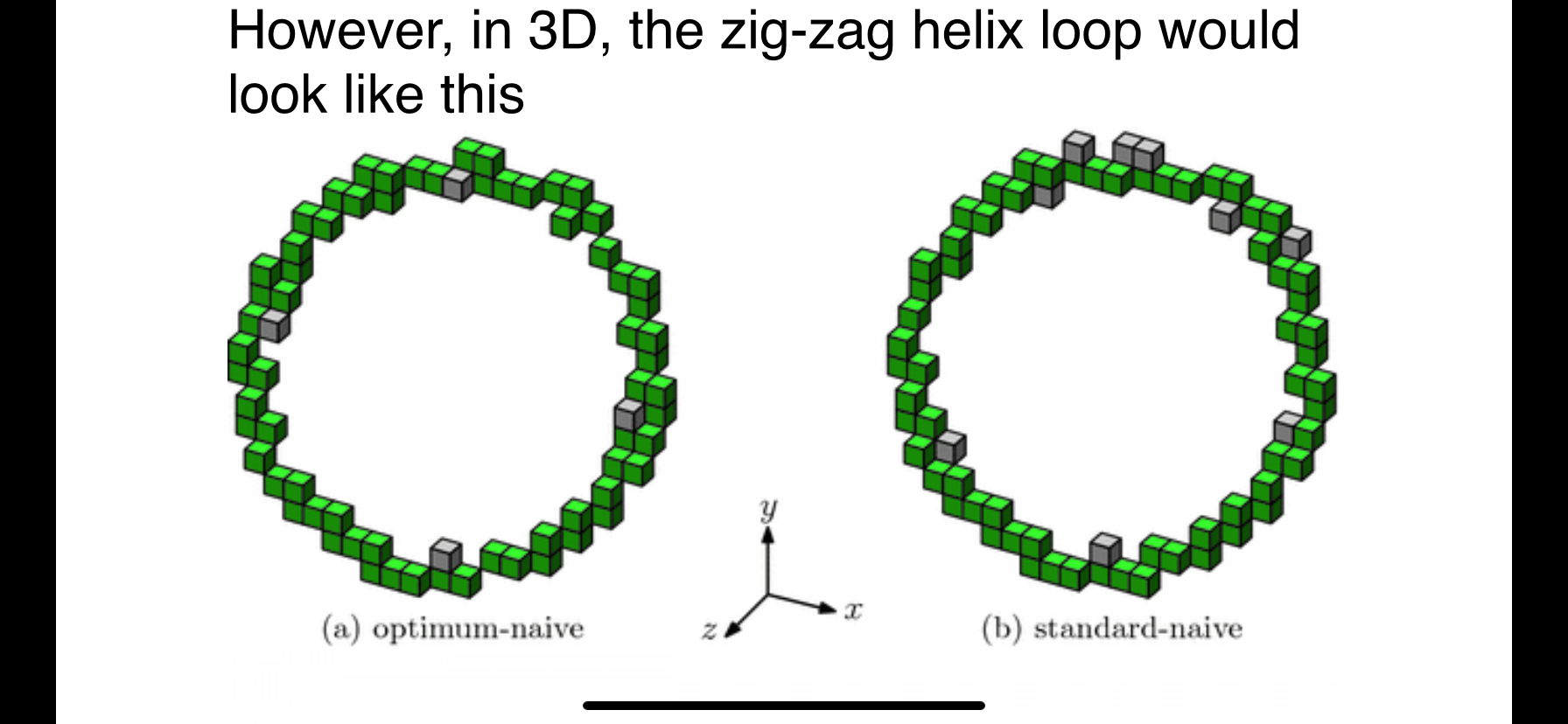
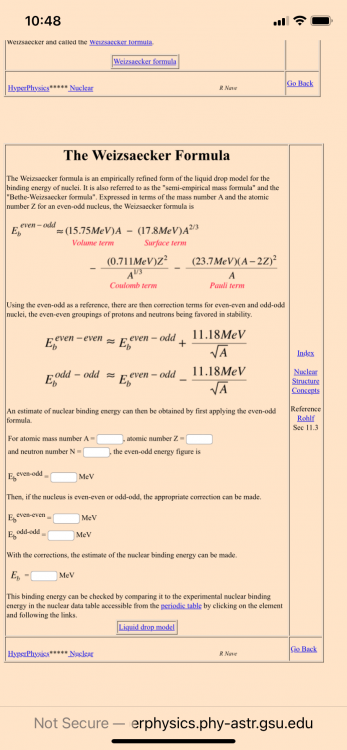
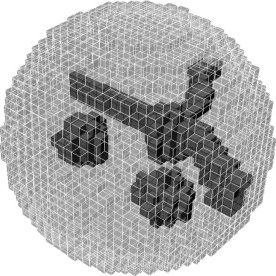
Liquid drop model revisited The liquid drop model explains forces in atomic nucleus as they were created by tiny liquid drops. It is based partially on theory and partially on empirical measurements. In this revisited model The visible universe is seen as bubble/nucleus of liquid with diameter of 8.8x10e26m.In the further text big bubble. The galaxies inside the bubble are seen as a nucleons.In further text small bubbles. For simplicity of calculation we are going to use average size of galaxies. The number of galaxies inside the visible universe is Ng=2x10e12. The mass of galaxies is found to be 10e7 to 10e12 solar mases. Mass of average size of galaxy is calculated to be ma=2 x10e39kg. The sizes of galaxies are in the range of few to 100 kiloparsecs. The size of average galaxy is Da=4.89x10e20 m.We do not know the average "height" of galaxy. The average distance between two galaxies is 1x10e6 light years da=9x10e21m In visible universe there is about 10E80 protons . There is about 7 protons for one neutron in universe. Z=10x 10e79 N=10e80/7=1.4X10e79 A=11.4x10e79 The average galaxy has Za=10x10e79/2x10e12 Za=5x10e67 Na=5x10e67 /7 Na=0.71x10e67 The Aa=5.71x10e67 From formula R=Ro/A1/3 Ro=R/A1/3 Ro=4.4x10e26/(2x10e12)e1/3 Ro=5.5x10e30m Ro= height of galaxy. We already know one size of average galaxy is Da= 4.89x10e20 Foer approximation the volume of average galaxy is Va=Rox Pi x( Da)e2 Va=(4.89x10e20)e2 x3.14x 5.5x10e30 Va=412x10e70 The density od average galaxy is D=ma/Va D=2x10e39/412x10e70 D=0.0048x10e-31 D=48x10e-27kg/m3 The average density of big bubble(visible universe) is very close to average density of dark matter inside the visible uni. The force acting on surface area of big bubble is F=PoxAbb F=246.10e52 x 1.3x10e-13 F=0.316x10e44N The force acting on the outside surface area of big bubble is very similar to Planck's force. Binding energy between two closest average galaxies(small bubbles)can be calculated from Formula for gravitational energy. U=Gx(ma)e2/da U=6.6x10e-11 x (2x10e39)e2 /9x10e21 U=8.8x10e46J There is 1x10e12 pairs of nucleons (small bubbles) creating this energy) Total binding energy of big bubble is Et=8.8x10e46 x 10e12 Et=8.8x10e58J*********** The binding energy calculated by Weizsäcker formula : E=15.75 x A - 17.8 x A e1/3 (Columb and Pauli term are negligible) E= 15.75 x5.71 x 10 e67 - 17.8x(5.71x 10e67)e2/3 E=89.9x10e67-14.7x10e44 E= 89.9x10e67 mev One ev=1.6x10e-13J E=89.9x10e67x 1.6x10e-7 E=142.4x10e60********** The total binding gravitational energie Produced by little bubbles - seen as nuclons is very similar (close) to total energy produces by total number of protons inside the big bubble (weizsaecker formula ). In fractal cosmology is stated that distribution of matter in the universe or structure of universe itself is fractal across wide range of scales. On sub atomic level all terms(volume,surface,columb and pauli) play important contribution to binding energy. On Plancks scale the terms (volume,surface,columb and pauli) can be used to visualize and explain : Volume term: The volume of liquid in the nucleon multiplied by density of liquid is mass.The mass traveling at speed Is what create binding energy. Arae term: At Planck diameter, there is no smaller diameter so there has to be 2 nucleons creating nucleus. One moving and the other stationary , or moving in the opposite direction. Columb term: The spin of stationary and moving nucleon is can be seen as a pitch of a thread, If the spins are opposite and have the same pitch, the nucleons (moving and stationary)will be bound or attracted to each other. If the spins are same or the pitch is different the nucleons are going to repel each other. The spin number 0,1,2,3. Or 1/2,3/2 .... Can be seen as a "pitch" angle of thread(spin) Pauli term: The magic numbers 2,8,20,28,50,82 and 126 are the numbers of stationary and movable nucleons which can be combined to create nucleons in Planck's scale. To fulfil all terms from above the nucleon has to be created by particles with diameter length of Planck. To fulfil Columb term the particle has to be square-cube shaped. The Planck size cube . The big bubble or visible universe should look something like this . Conclusion: The preplanned (or calculated)change of pressure Po acting on outside surface of big bubble will cause harmonized oscillations inside the big bubble which will cause Planck cubes to move in zig zag helix pattern to create forces we actions inside the big bubble.
-
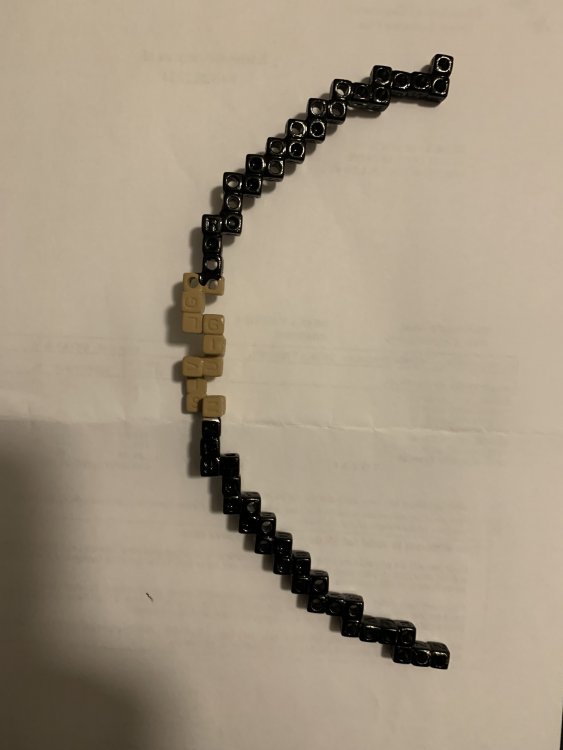
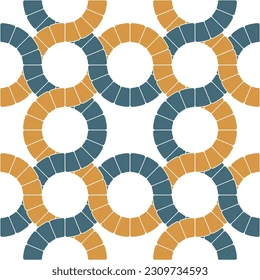
Thank you so much for being so patient with me. This thought experiment- Plancks voxel grid purpose is to show 3D picture of Planck scale world. I have talked about interlocking segment on zig zag helix loop here is 3D picture of segment The brown coloured cubes are the interlocking segment. They have intrinsic spin . The rest of half loop is black and they are shown without untrusting spin(it would take to much glue all the way around the loop). The segment - brown voxel cubes can be rotating CW or CCW . The segment cloud make one turn in 720,or 360 degrees . The loop is not circle it is helix- spiral and I call it zig zag becouse brown cubes are moving (all cubes ,black should too)are moving in zig zag intrinsic spin around the spiral. The interlocking happens when two loops are engaging each other for the length Of brown cubes . In the picture above the loops are green When both loops a and b are rotating CW or CCW the intrinsic spins rotate are in opposite directions . Brown segment of a loop has a CW intrinsic spin and brown segment of b loop has CCW spin. If the segments are mashed together - by outside force - the brown segments of a and b loop will create one solid rotating system- particle. This is the basic building block in Planck voxel grid. We have a perception that this particle is one cube rotating - having spin up or down ,0,1 or 1/2 spin and it does . But, it is not the same Plancks voxel cubes moving inside - it is flow of voxels cubes from the two loops.To confirm this we have to follow the movement of two red voxel cubes of each loop. Any voxel cube can be a red cube - frame of reference. Very important fact: The magnetic North south bearing and direction is constant throughout the Plancks grid. Another constant is plancks speed. Particles connect by loops and create bigger particle s the area between loops and particles is not empty space . That area is filled with not moving Plancks voxel cubes . All particles inside the grid from Plancks scale to galaxies have loops coming “out “ of them . The bigger the particle bigger the loop. For example proton is 10e20 bigger particle than Planck particle - brown segment from above . Big bang made proton and neutron insife the nucleus ti ride on the same loops through the voxel grid . The strong force which holds them together is created is the strength of loops They are riding on. The speed of loops and the mass of the loops is what creates strong force inside the Plancks grid.