
jv1
Senior Members
-
Joined
-
Last visited
Everything posted by jv1
-
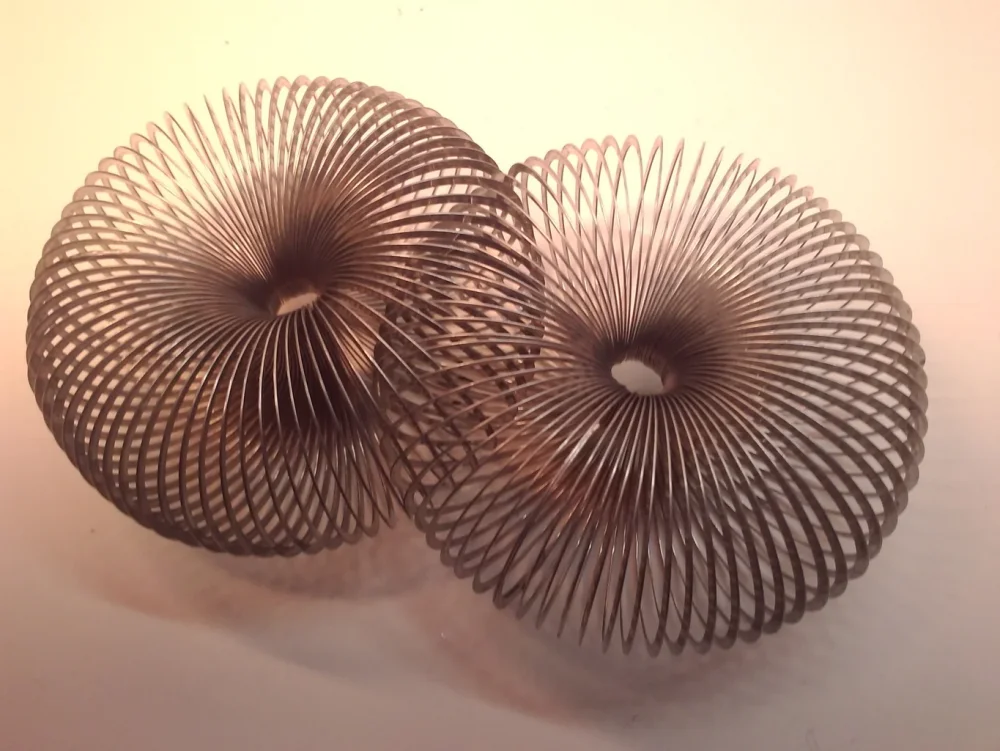
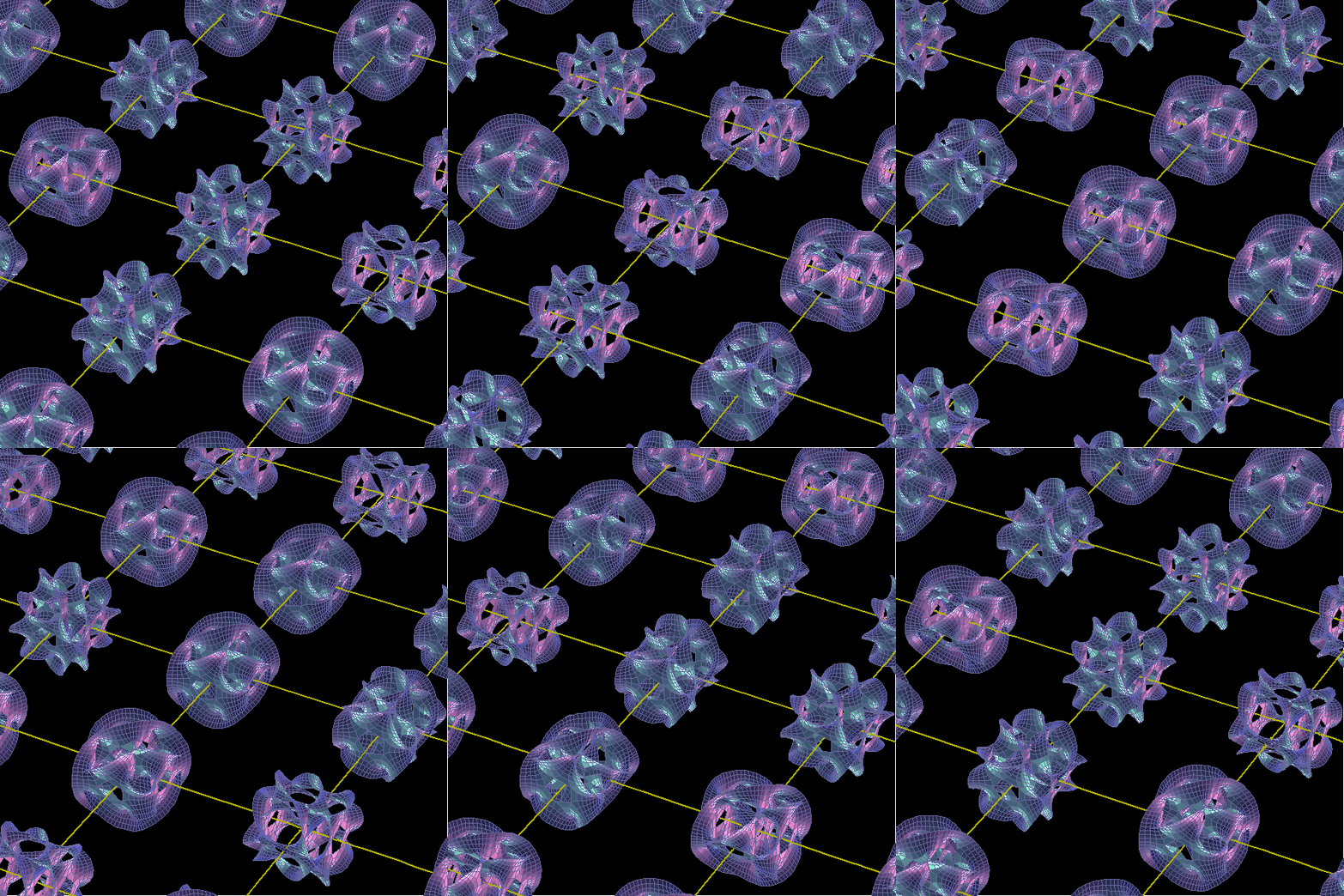
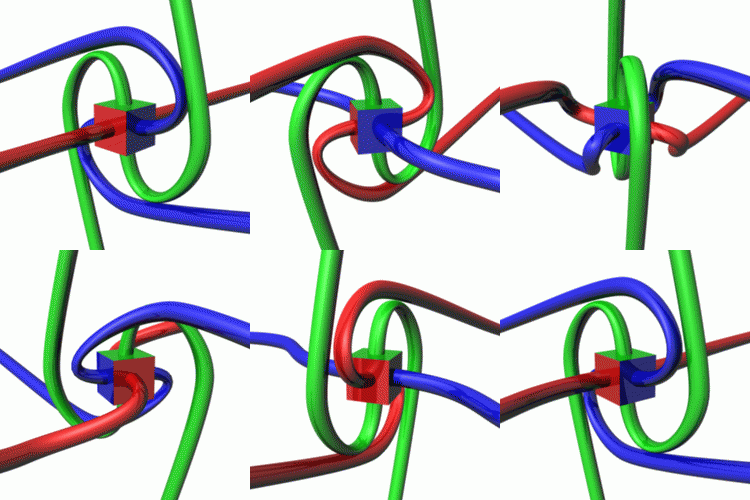
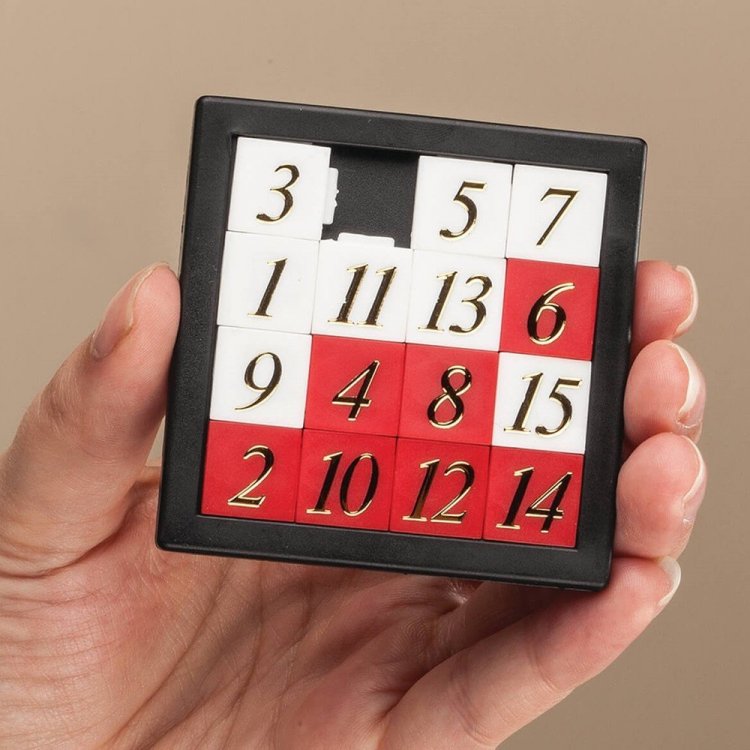
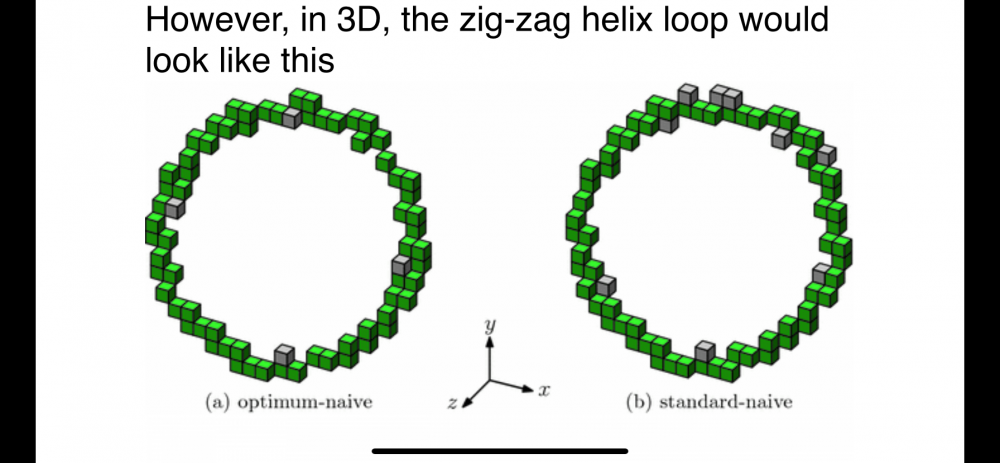
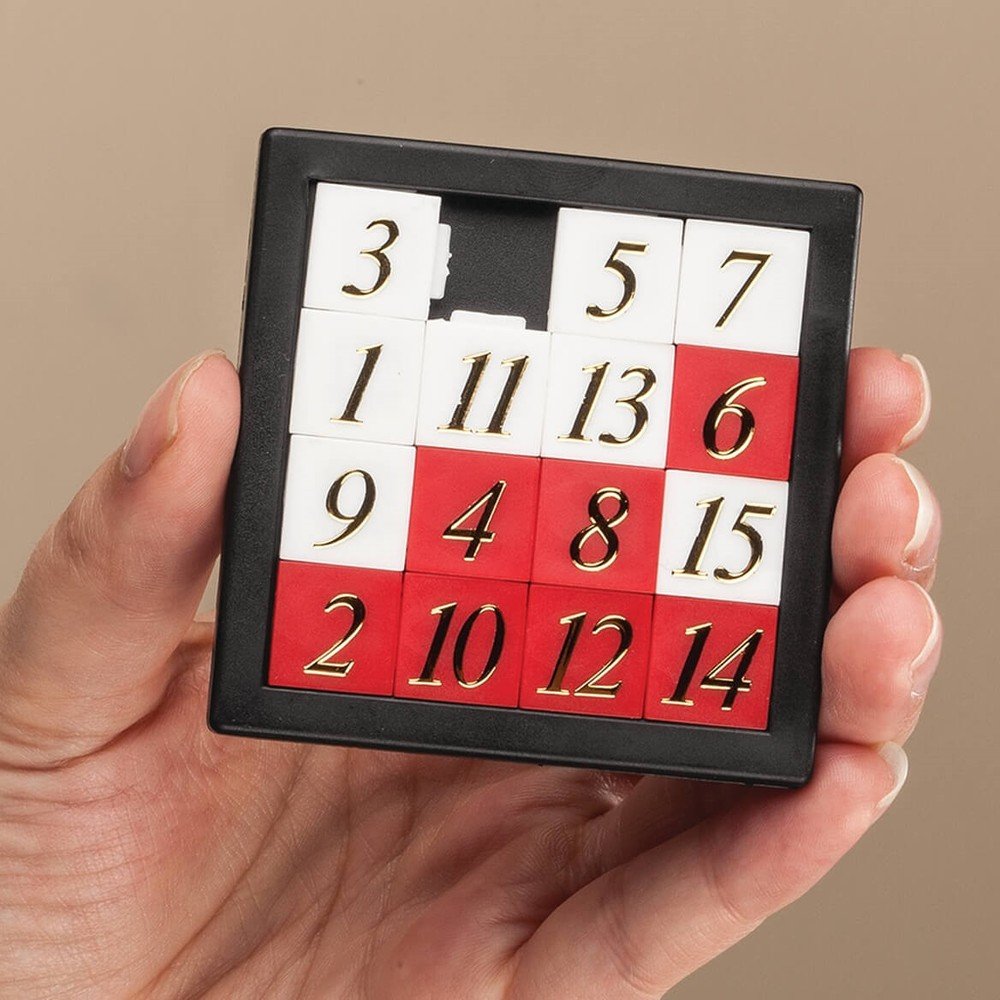
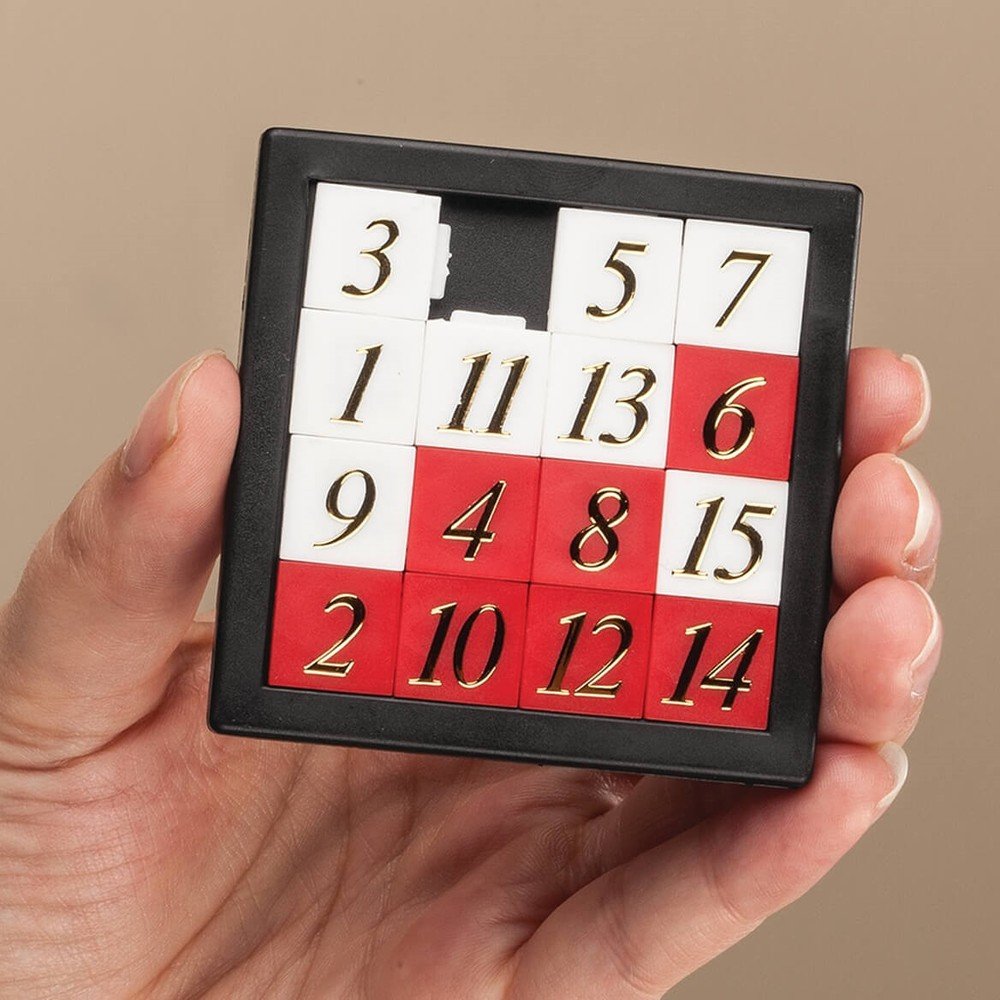
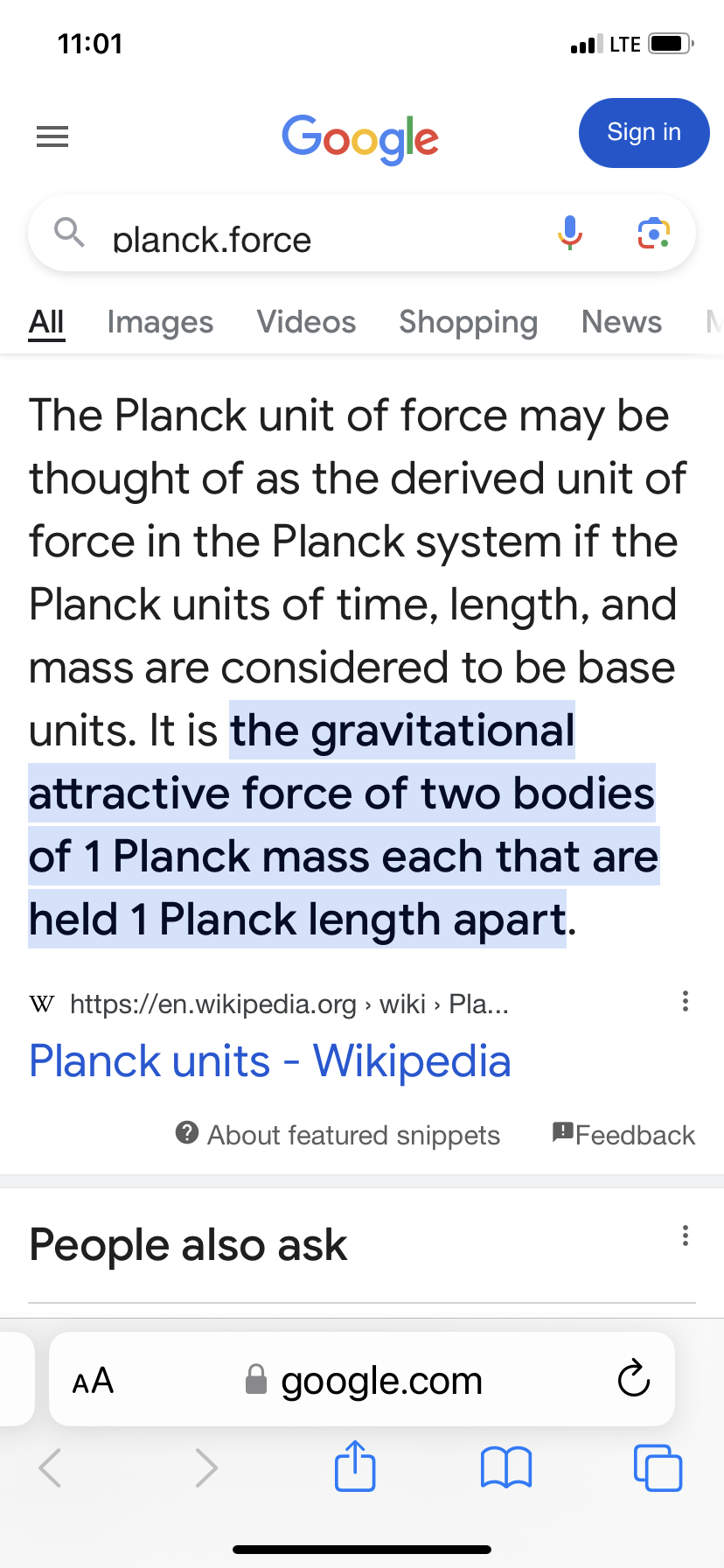
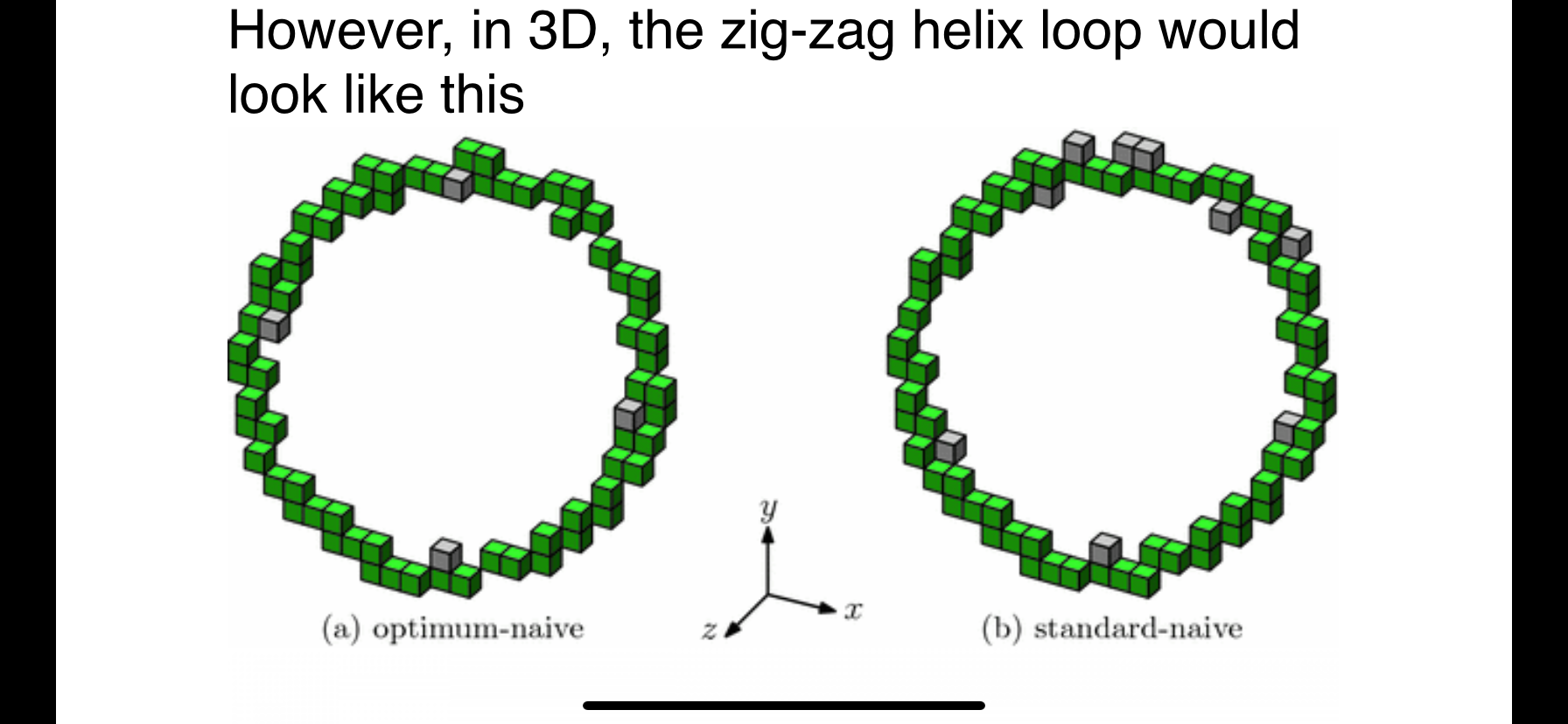
Planck force is gravitational force between two Planck masses . Yes it is theoreticall term ,but if theory is applied to experiment- Plancks voxel grid it is force with which all 4 fundamental forces can be simulated. The particle - the interlock between loops should look something like this The closest thing to zig zag helix loops is strung theory The zig zag loops of Planck voxel grid can be seen as a strings. They are created by vibration In Planck voxel grid these pretty flowers are shown as a Planck mass very thin squares . And to use very simple example - when Planck mass planes vibrate (in xyz) direction the Planck size voxels are pushed in circular motion inside the grid . Two dimensional example of lateral movement of mass(matter ) by vibration is this The particles (interlocking knots between loops) are the Center of “propeller “ created by two zig zag loops. This” propeller “ is drilling its way through the Planck voxel grid. To move one red voxel to the next plane every voxel in the both loops hav sto be moved at the same time . The grid is tightly packed - there is no free spot to use it,like in puzzle Please try to solve the puzzle above with three frames (puzzles) and no free space . One has to move frames of puzzles one at time to move red or white blocks inside the puzzle . That is why quantum mechanics is hard to understand. Once you guys figure this out -it is not that complicated . cheers


-
I really do not like that soapboxing expression.I will answer question directly. We follow red voxel cube traveling in helix through the Plancks grid. Beside moving in circle trayectory ,red voxel has intristic spin around the helix. It takes red voxel 720 degrees to finish one full circle around main helix trayectory . That is intrusive 1/2 spin. When another loop with red voxel 2 is close to the loop 1 , segment of both helixes interlock for the length of 720 degrees (one intrinsic spin turn). For loops ti interlock it takes energy (big bang,hemical etc) if the smaller loop with the red voxel having 320 degrees spin for one turn comes to contact with loop with 720 spin(1-2) it can have spin 1 or spin 0 The interlocking segment in 360 loop is as twice as small as interlocking segment of loop 720. The spin can be up or down - it depends which way helix (big loop is turning). This is simulation and simple 3 D explanation what the particle spin actually is. Particle is segment of two or more loops where intrinsic spins mash together. The voxels inside the locking area are always flowing - traveling in the loop- but we have perception that it is the same stationary voxel. To change the particle (interlocking segment)trajectory the force is acting not mass of particle - it is acting on mass of loops too. This is the reason why we think gravitational force is small for sun atomic particles . With usw of Plancks voxel grid it can be proved that all forces in nature are one force - Plancks force .
-
I am thankful to all of you guys who find the time to look over and answer. Mayb I please explain a bit more about zig zag helix loops interlocking. The inartistic spin ( red /blue) lines of one loop turn CW and the other loop has CCW spin. These two spins are acting like a lock and they can have different values (360 degrees / 1turn, or 720 degrees for one full turn…,) This is very important when three or more loops are interlocking The most important thing I have said so far is that the density of Planck mass simulated as a plane made of Planck size voxel cubes - is equal to density of dark matter. The point of voxel grid simulation with Planck size cubes as an 0 particle is that the energy ,forces , particles (from gluon soup to galaxies ) inside the grid are made of dark matter. Energy inside the grid is flow of particles (planck size voxel cubes ) traveling at Planck speed . The cube particles created by interlocking zig zag loops (gluon to galaxies )are moving at speeds between 0 and Plancks speed. The voxels not moving at all are what we call dark matter .

-
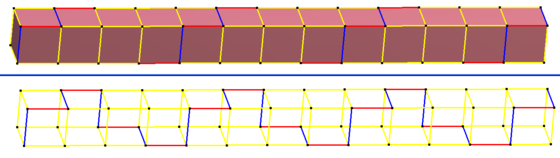
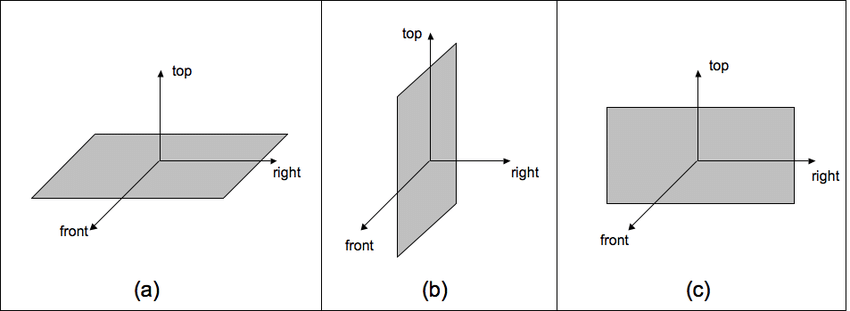
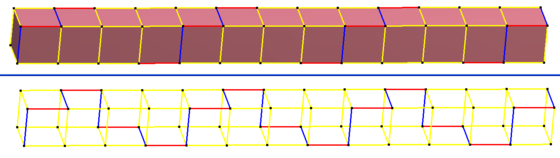
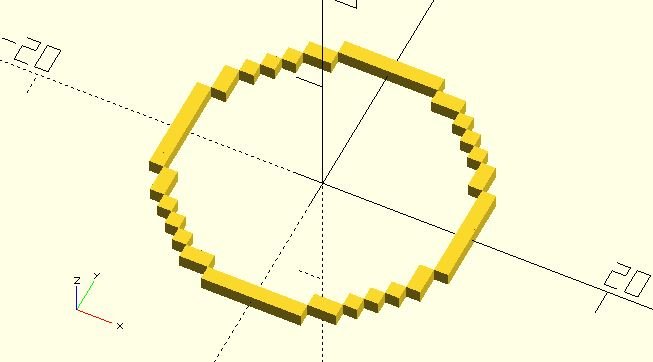
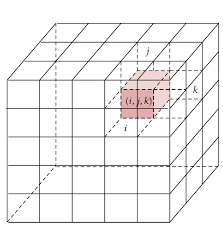
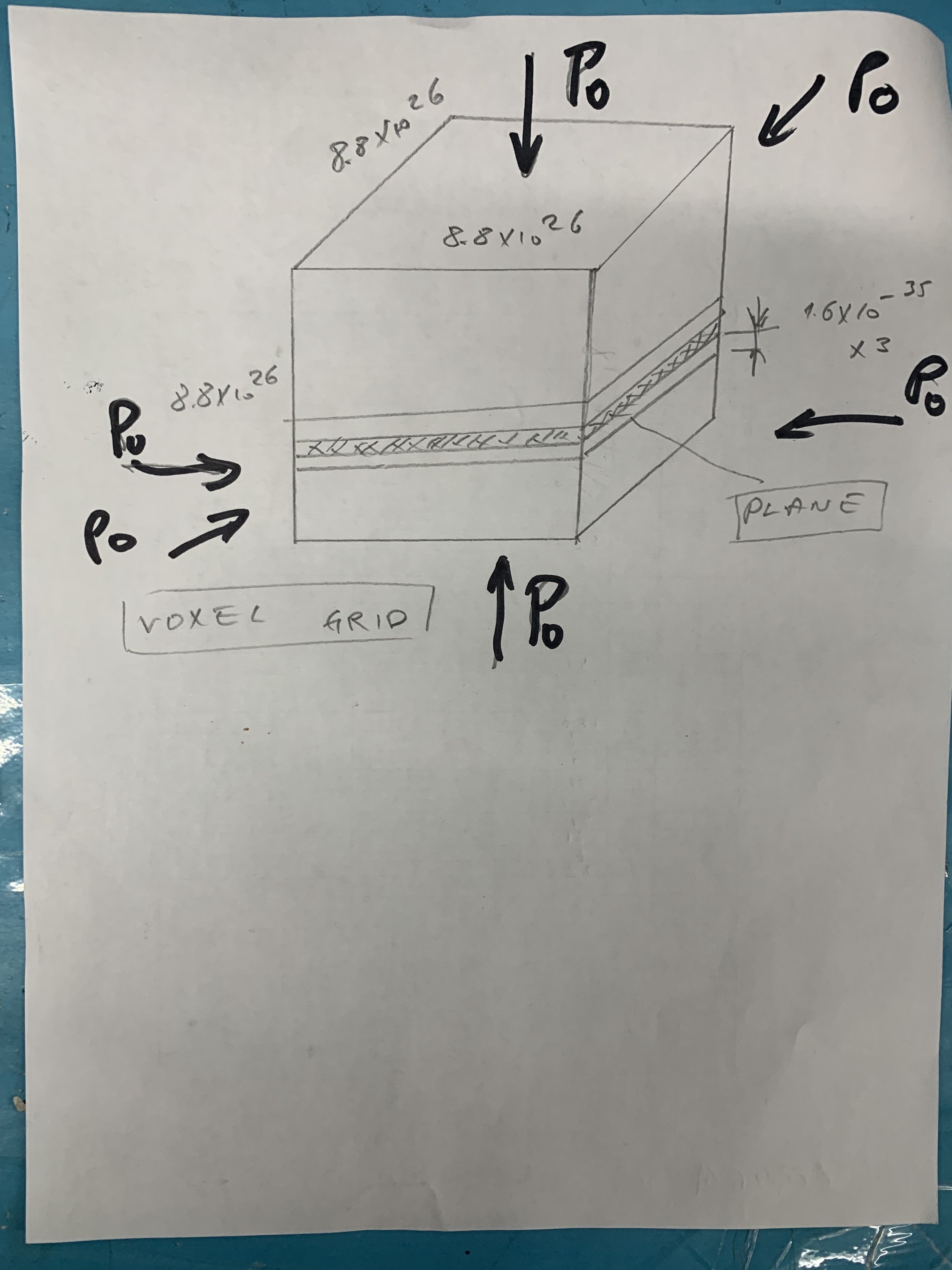
The Plancks voxel grid is an attempt to simulate universe and interactions inside . The three planes are shown in stationary position . There is 8.8x10e26 of these planes held together by pressure Po acting on all sides . As long as pressure Po is constant nothing happens inside the grid . The force acting between each layer is Planck force - gravitational force. As you can see that force is outside force holding the grid together. From inside the grid ,it may look like planes are attracting each other - but they do not . They are held together from outside . Nothing will collapse - no black holes ,yet. The density of each Planck cube/ voxel is D=1.5x10e-27- this means that density is constant throughout the grid. To move single voxel for distance 1.6x10e-35m in any direction,the hole plane has to be moved for that distance . Single voxel is 000 position on drawing above . The North South magnetic bearing is “top” direction on outside above . To move voxel for a distance longer than plancks length ,the planes have to vibrates in sequence and push single voxel in desired direction. zig zag trayectory will be created On the picture above black dot is the voxel and red and blue lines are 1.6 x10e-35m long. This picture is just a part of zig zag helix loop. Harmonized (sequenced ) movement of many planes inside the grid create zig zag movement of many voxel and 000 voxel will finish the loop in time t. This zig zag loop can be seen as a wave . When two waves (zig zag loops are ) touching and one rotate CW and the other CCW they interlock- the zig zag parts are engaging like a threads This point looks like few voxels are together and not moving is what we call particle . This is the smallest particle in Plancks voxel grid. The diameter of loop will depend on what we call frequency.
-
This forum is called speculations, and I am extremely happy and thankful I was given the opportunity to say something different. If the hole visible universe is seen as voxel grid - grid made of Planck size cubes /voxels, every known particle in the universe can be shown as a volume made of the voxels. Planck mass included. And the trayectory of movement of each particle from gluons to galaxies can be simulated . The Planck units are the base - the building blocks of universe. But I have few questions for you guys : nobody is saying anything about the values of density of Planck mass calculated from formula for gravity ? it is equal to dark matter density ? The simulation of force created by pressure in deep Space acting on area (Planck mass)with sides which are equal to size of known universe-Is equal to planks force ? The 10e44N force can be simulated in universe - Planck voxel grid. The force 10e40 times stronger than strong force can be achieved in universe - and it is gravitational force? The gravitational force is 10e39 times smaller than strong force ? Is this just coincidence?
-
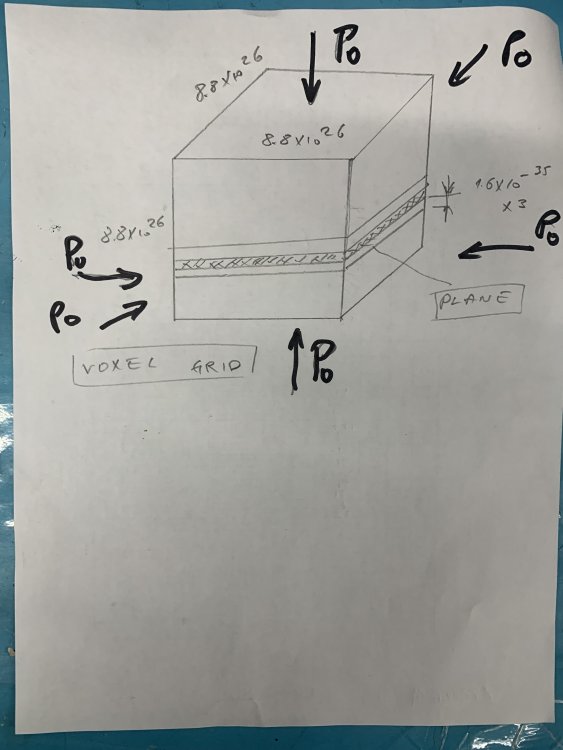
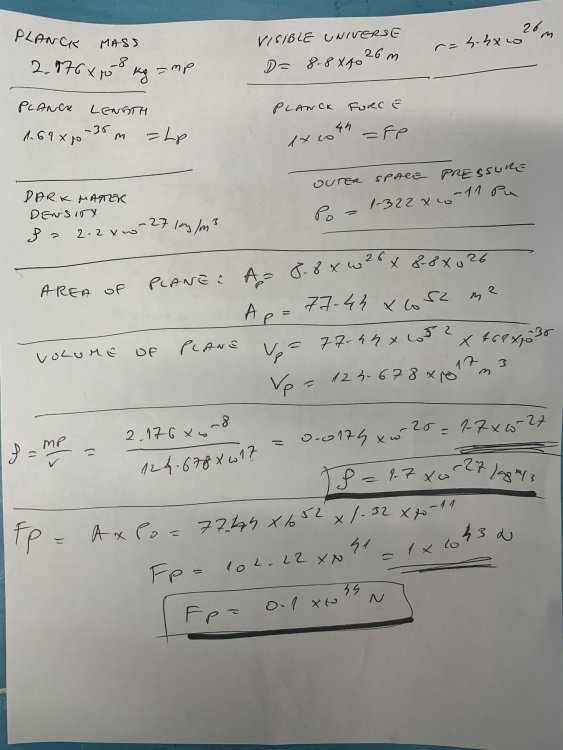
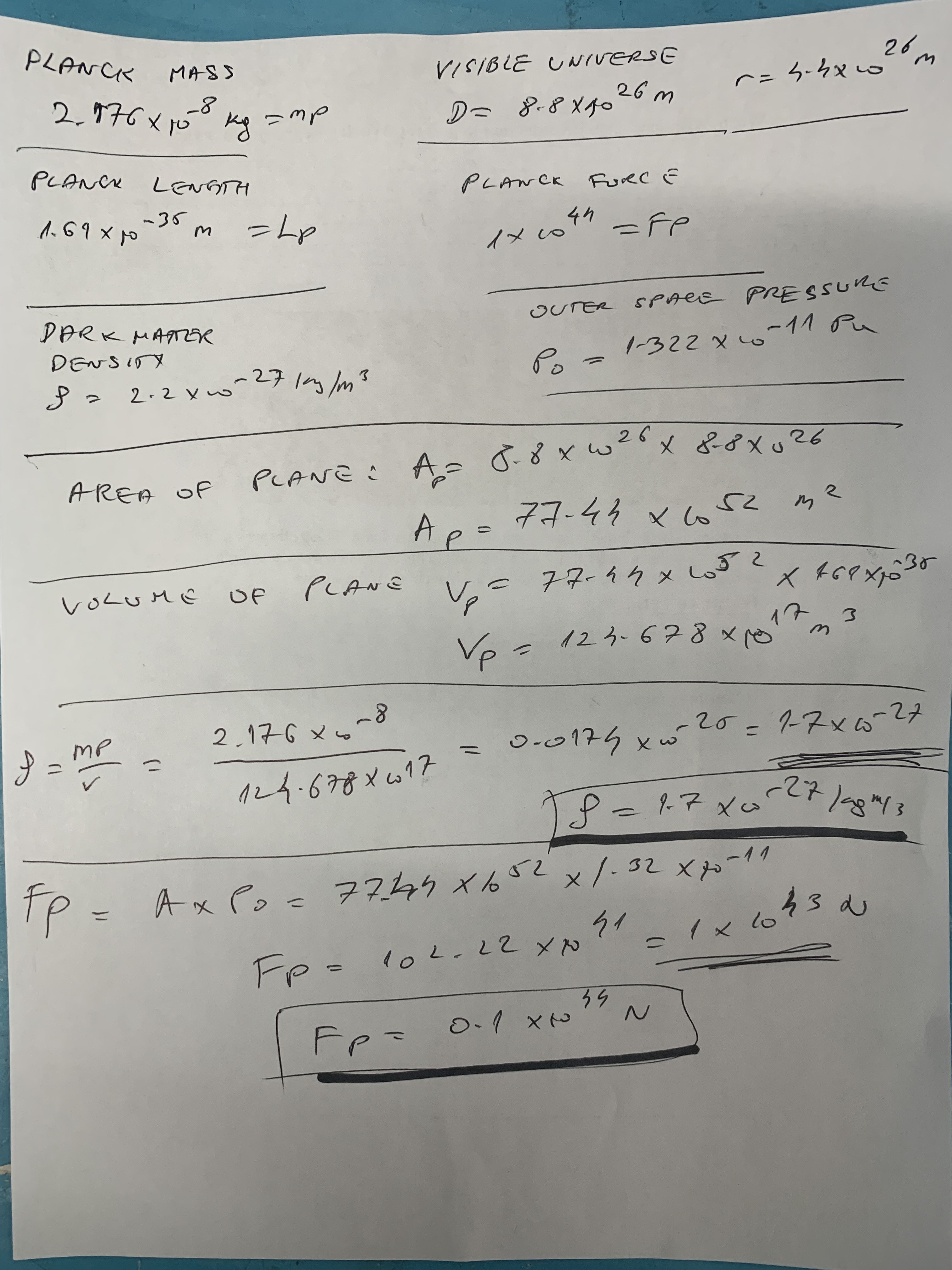
Here is very rough drawing of voxel grid . Planes are very large and thin squares - no diameters involved . The mass is spread in very thin square - and all three squares have the same thickness- 1.6x10e-35m i hope this answer the question about distance between Planck masses . I do not invent physics - I have used so far Planck force (and description of what this force is- gravitational force between two PLANCK’s masses acting between them at Planck distance ) planck length planck mass Pressure in deep space density of dark matter Size of visible universe in m My question to you all is : Is it posible that gravitational force is created by pressure Po acting on area A of PLANCK’s mass is creating gravitational force? And from calculating density of the space from Planck mass divided with volum of this very thin square - we get dansity of very close to density if dark matter. Coud this be - pressure acting on dark matter be the mechanism of interaction between dark matter and gravity? From formulas F=Po x A and F=Gx m1xm2/re2( formula for gravity) we can calculate exactly the Po and Density if dark matter. Po=10e44/77.44x10e52 Po=77.44x10e-12=7.7x10e-11pa For two Planck masses : Po x A=G x me2 / re2 PoxA=Gx (AxDxLp)e2/Lpe2 Po x A=GxAe2 x De2 xLpe2/Lpe2 Po=G x A x De2 De2=Po/GxA D=1.58x10e-27kg/m3 D -density of dark matter A area of thin square Po pressure deep space Lp- Planck a length Again ,I did not invent anything To move voxels inside the grid would be sliding cubes ,like puzzle above - with no free space .
-
Here is very rough drawing of voxel grid . Planes are very large and thin squares - no diameters involved . The mass is spread in very thin square - and all three squares have the same thickness- 1.6x10e-35m i hope this answer the question about distance between Planck masses . I do not invent physics - I have used so far Planck force (and description of what this force is- gravitational force between two PLANCK’s masses acting between them at Planck distance ) planck length planck mass Pressure in deep space density of dark matter Size of visible universe in m My question to you all is : Is it posible that gravitational force is created by pressure Po acting on area A of PLANCK’s mass is creating gravitational force? And from calculating density of the space from Planck mass divided with volum of this very thin square - we get dansity of very close to density if dark matter. Coud this be - pressure acting on dark matter be the mechanism of interaction between dark matter and gravity? From formulas F=Po x A and F=Gx m1xm2/re2( formula for gravity) we can calculate exactly the Po and Density if dark matter. Po=10e44/77.44x10e52 Po=77.44x10e-12=7.7x10e-11pa For two Planck masses : Po x A=G x me2 / re2 PoxA=Gx (AxDxLp)e2/Lpe2 Po x A=GxAe2 x De2 xLpe2/Lpe2 Po=G x A x De2 De2=Po/GxA D=1.58x10e-27kg/m3 D -density of dark matter A area of thin square Po pressure deep space Lp- Planck a length Again ,I did not invent anything
-
Hi Swansont The voxel cube grid can have any size of cubes and outside dimensions . The pressure acting on the outside of grid is deep space pressure (10e-11). Voxel grid with outside sizes (8.8x8.8x8.8 ) x 10e28 m and cube size (1.6x1.6x1.6)d 10e-35m is easily split in to the “layer” with sizes( 8.8x8.8)x 10e26 and thickness of 1.6x10e-35 m- let’s call this plane . This plane has Plancks mass,plane has Very big area with small thickness. When three of these planes are positioned together ,two outside planes are “squishing “the plane in between. The distance between these 2 planes is Planck length and each plane has Plancks mass.
-
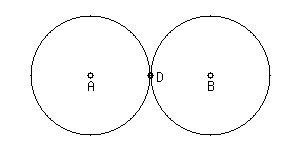
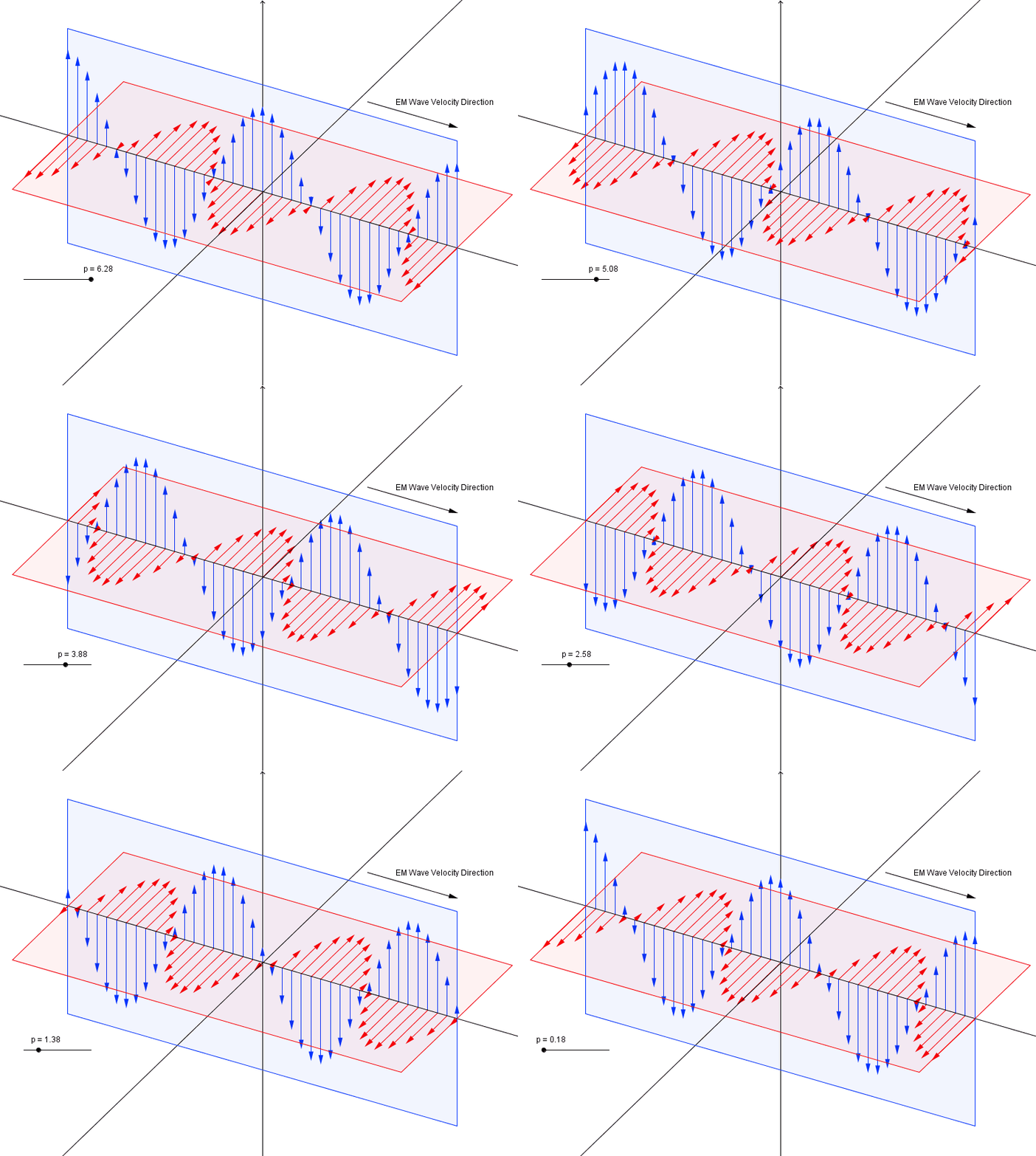
A voxel grid — or stack of cubes — has one red voxel inside. The vibration movement of the planes will be used to move this voxel through the tightly packed voxels. The planes’ center is the red cube. Movement of red cube in 3D,wouod create the zig-zag helix loop: Loops can move in a CW or CCW rotation throughout the vowel grid. Let’s call this zig-zag helix loops WAVES . The points where the zig-zag helix loops interlock—(D)one spinning CW and the other CCW— would create spinners (green, red, and blue).If three zig-zag helix loops were interlocked,the interlocking points would look like this: Let’s call these interlocking points PARTICLES. To connect voxel grid with quantum physics Planck force will be used as a starting point. The Planck force is extremely high (10e44) Let’s try to simulate force of gravity of 10e44 working on layers in the shape of squares (planes) with gap between them of Plancks length. Let’s put two planes at distance of Planck length. The thickness of each disk is 1.6x10e-35 and size is D=8.8x10e26m This gives us area of the disc to be A disc=77.44x10e52m2 Pressure Po=1.3x10^-11 is pressure of calm deep space . If Po is Acting on surface of disc A Is going to produce force very close to Plancks Force. The Planck mass over volume of single plane create density very similar do density of dark matter. Vibrational vertical movement of planes will create a flow - which we perceive as wave For visual effect blue and red planes are created of planck size cubes and create voxel grid. And both blue and red plane are made of three layers of cubes - two stationary and one moving . The vibrational movement will crate waves . If the distance of movement is Planck time / per Planck length(size of cubes ) Then speed of wave movement will be speed of light . Couple of more srawings

-
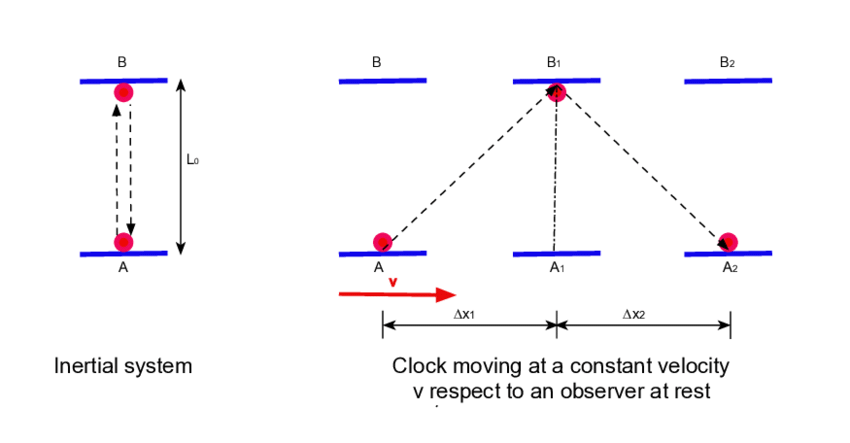
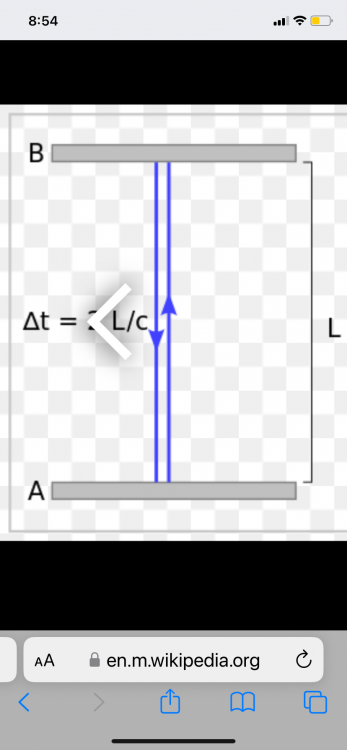
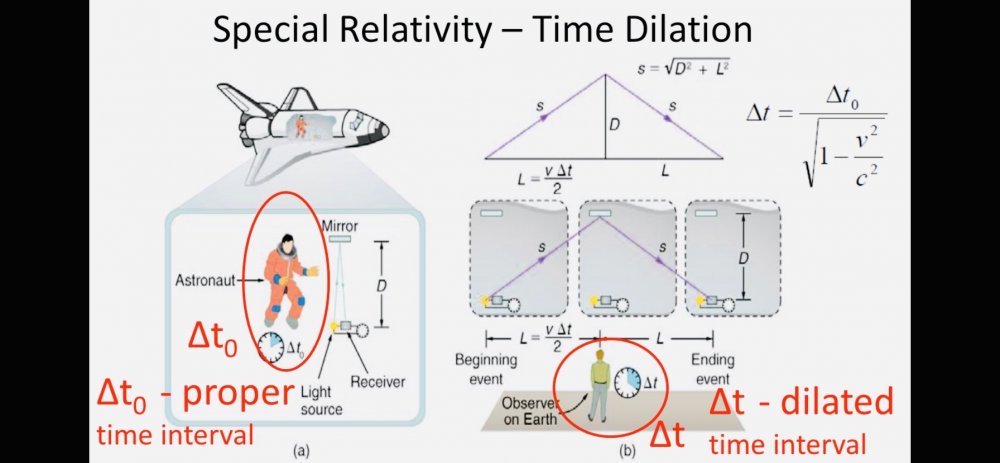
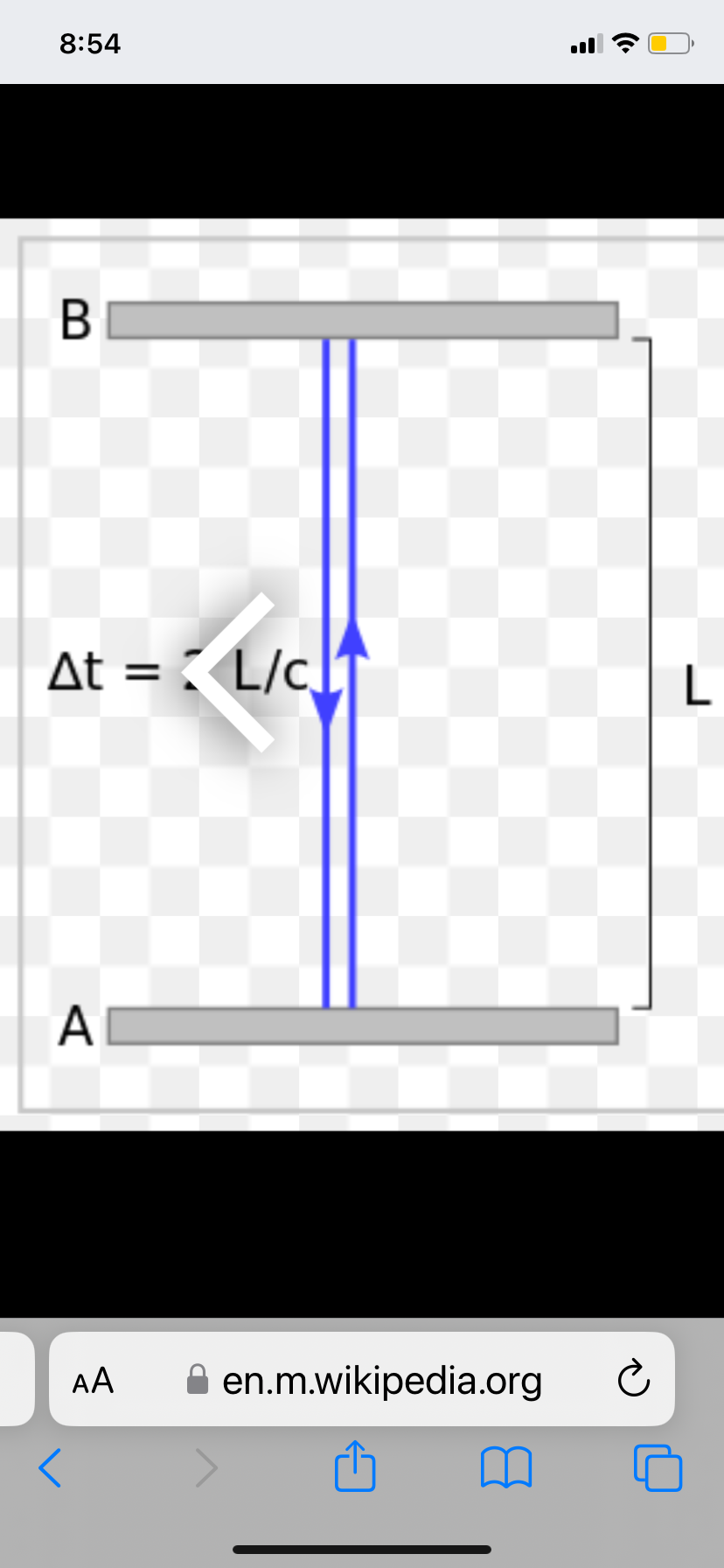
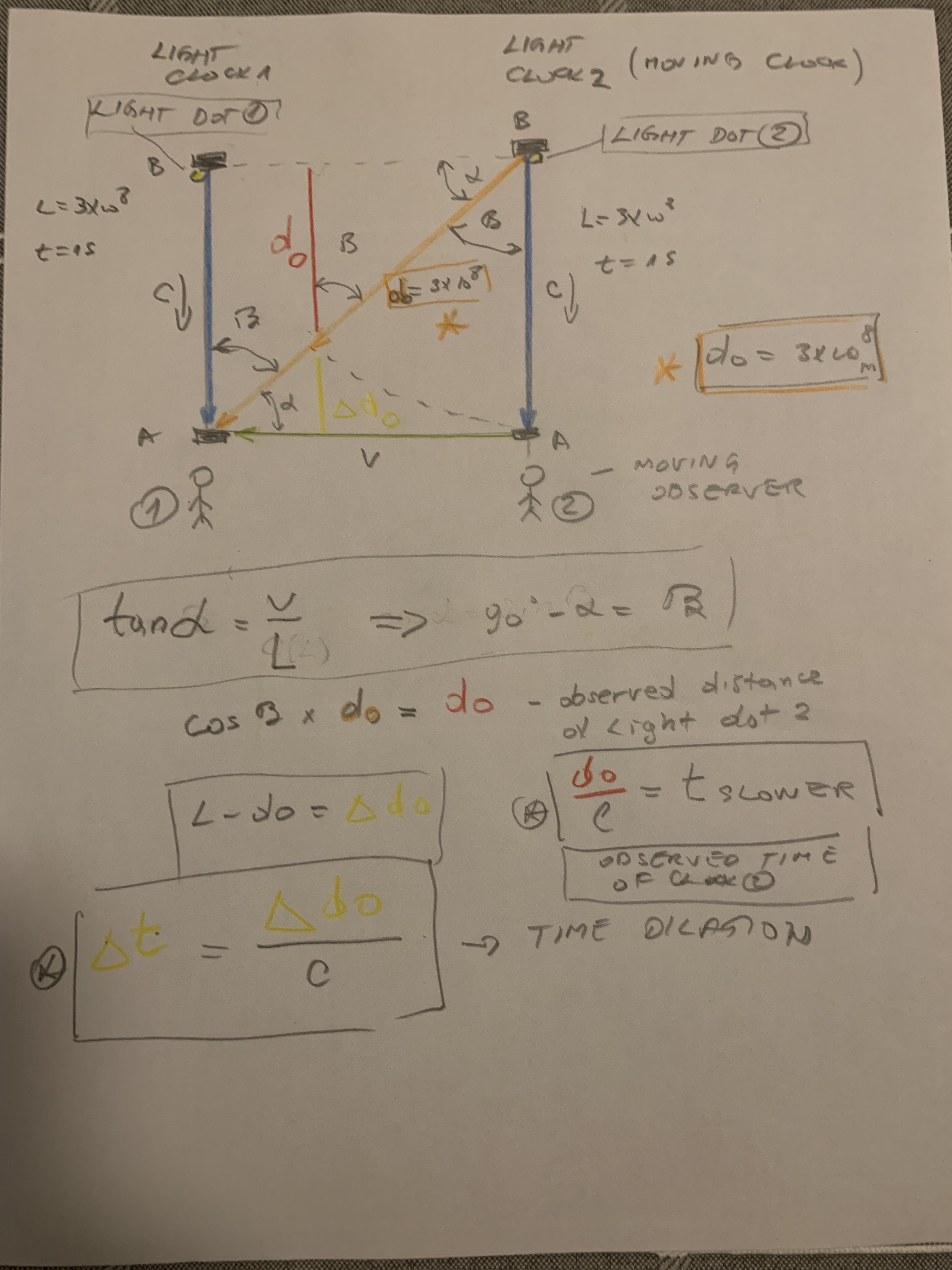
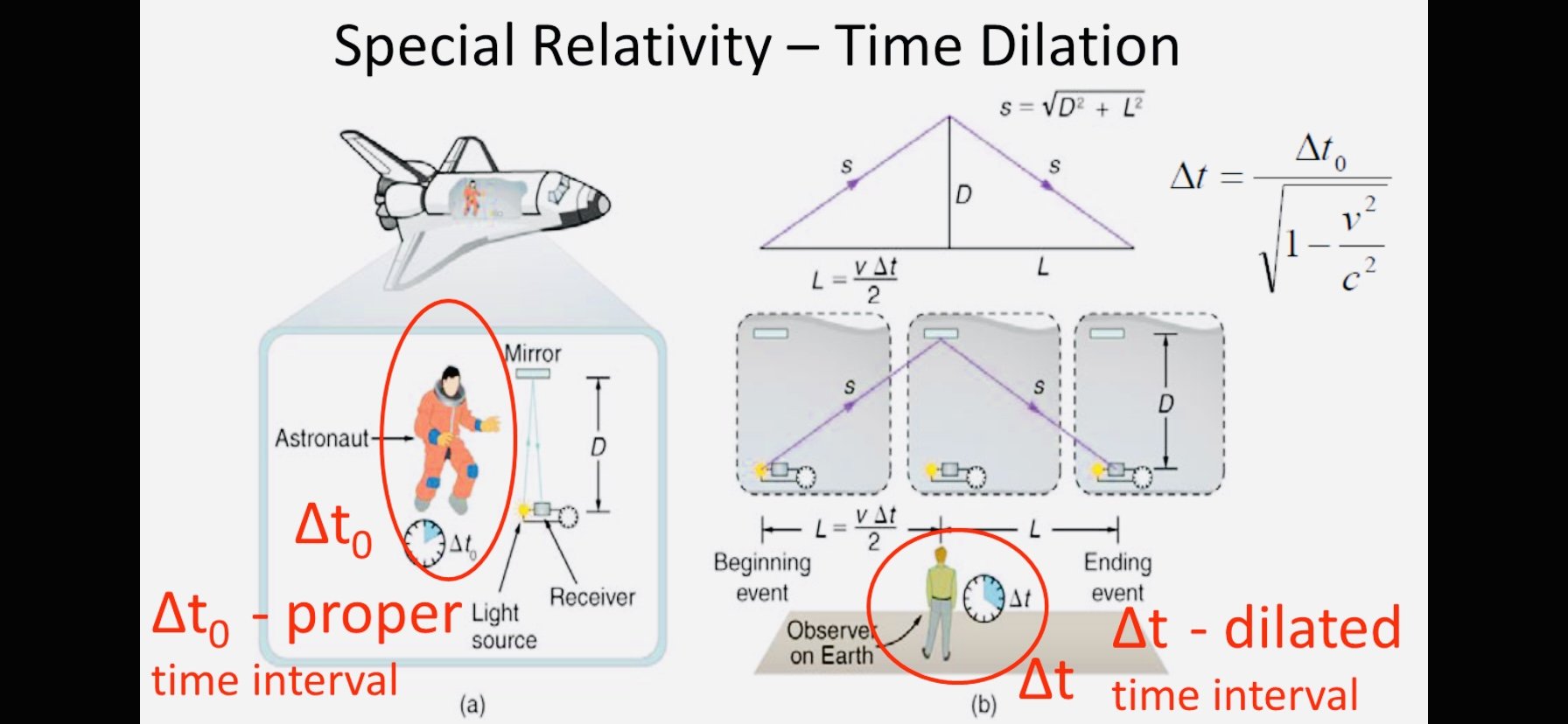
Hi have finally wrote the essay for science paper . Your thoughts would be appreciated a lot. This is thought experiment in which light clocks - stationary and moving will have very unusual feature-adjustable length between mirrors A and B. Light clock with adjustable distance between mirrors will provide better look at understanding Of time dilation. Picture 1 The distance Lo(picture 1) is distance between mirrors.The distance Lo will be calculated and adjusted from two components : Speed of light C and distance of L= 3x10e8m and time t=1sec Speed V- in m/s (speed v is speed of moving light clock)It will be shown as percentage of C V=0.1C to 0.95 C The different approach to this time dilation thought experiment is : The diagonal distance (picture 1) between AB1(dotted line )will be L’=3x10e8m. Distance Dv =x1 +x2=Vx t (t=1 sec) From Pythagoras theorem the distance between mirrors Lo is Lo^2=L^2-Dv^2 Here are few practical examples: For speed V1=0.1C the distance Lo=0.994 x 3x10e8m For speed V2=0.5C the distance Lo=0.86 x 3x10e8m For speed V3=0.95C the distance L0=0.31x 3x10e8m From this very simple thought experiment is easy to see that In moving reference and in Non moving reference frame the distance L=3x10m is travelled in time t=1 sec . The distance L(3x10e8m) and time t (t=1 sec) are measuring reference signal to calculate the Distance Lo. By adjusting the distance Lo for different speeds V ,the time dilation calculation using Lorentz Factor formula is not needed. The construction of time measuring device ,in our case light clock , is what creates difference In time shown on moving and not moving light clock. The light dot of light clock is quanta of light-photon with frequency f=400-800Thz. The difference in direction and distance of movements of light dot in stationary clock and moving clock is observed as different number of clicks per second(photon travels from mirror A B).This number of ticks per second is can be seen as frequency of photon been emitted from mirror A to mirror B. The atomic clock use photon created by caesium atom changing energy state . The moving atomic clock photon will travel longer trajectory than static atomic clock. The different time will be shown on the display of moving clock.The atomic clock Can be seen as a modern version of light clock. The creation of Particles inside the accelerators is observed by specific frequency photon released. If the particle moves the trajectory of photon will increased and measured time By moving observer will be longer. Conclusion: From this very simple thought experiment we can see that time difference shown by stationary And moving clocks is caused by increase in distance and direction of photons used to measure time. The theory of relativity time dilation is just overlooked change in distance and direction of Speed of electromagnet photons.
-
I can see that shock still did not wear off. Mathematicians are extremely good at what they do ,but in my humble opinion they do need to take extra courses in geometry ,vectors and a fluid mechanics . Here is something funny,I hope not that offensive for mathematicians

-
What would be the values of: v=? do-red=? do-yellow=? for angle Beta=0 degrees
-
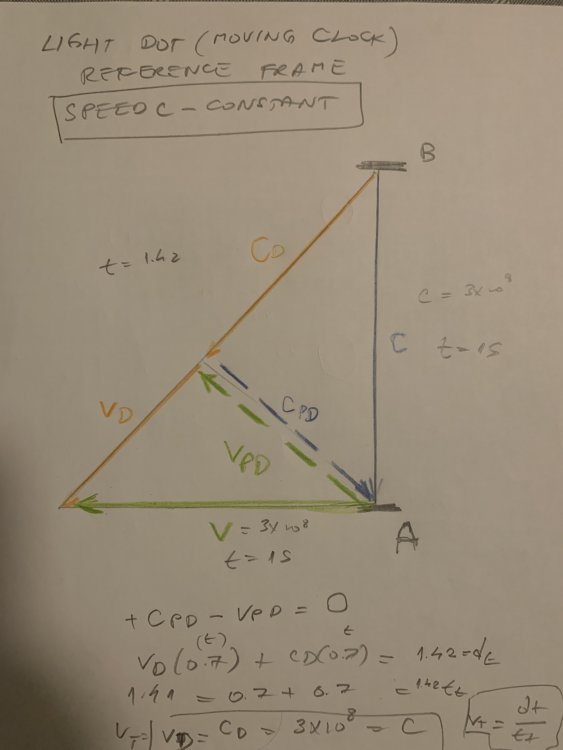
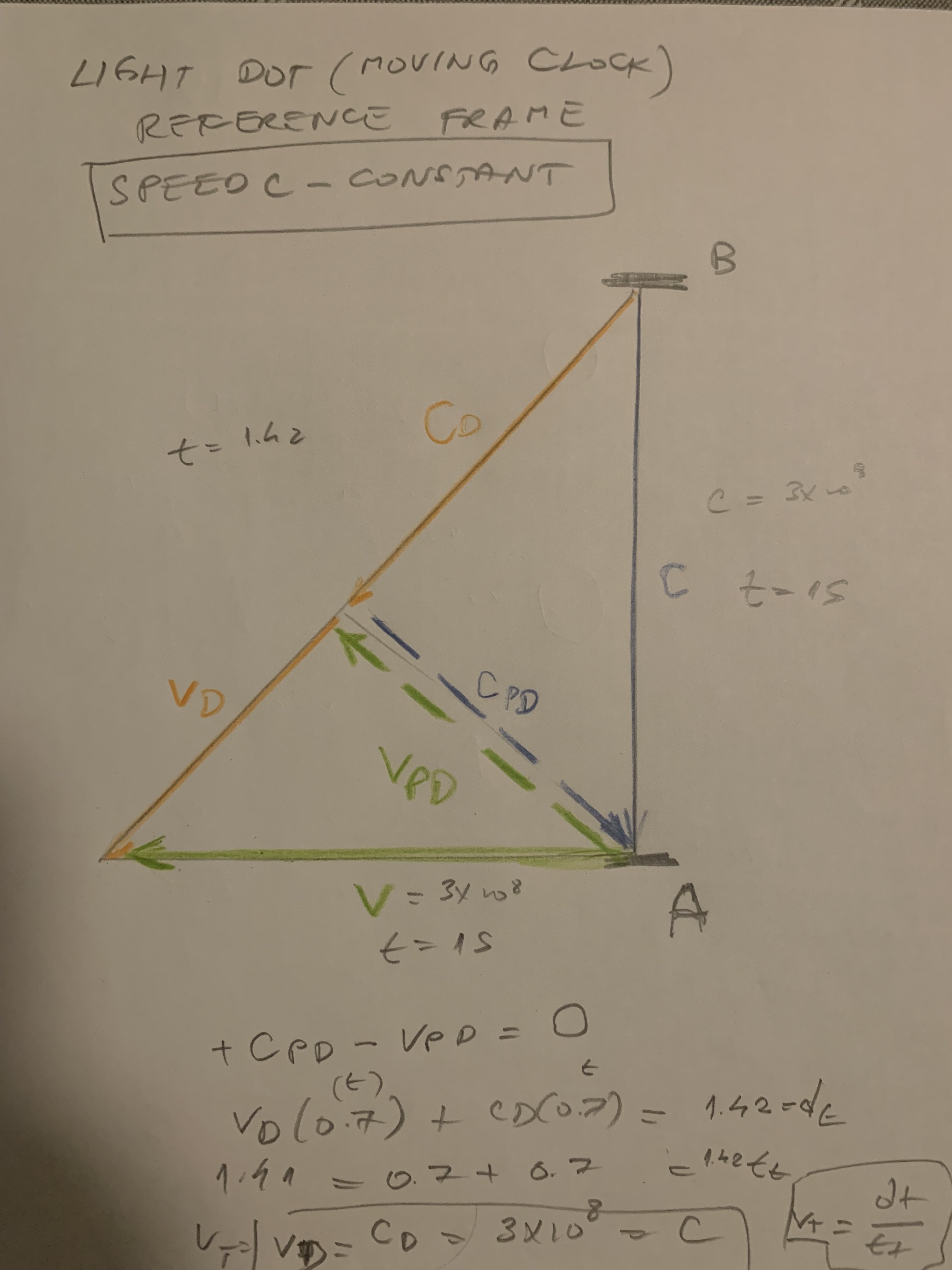
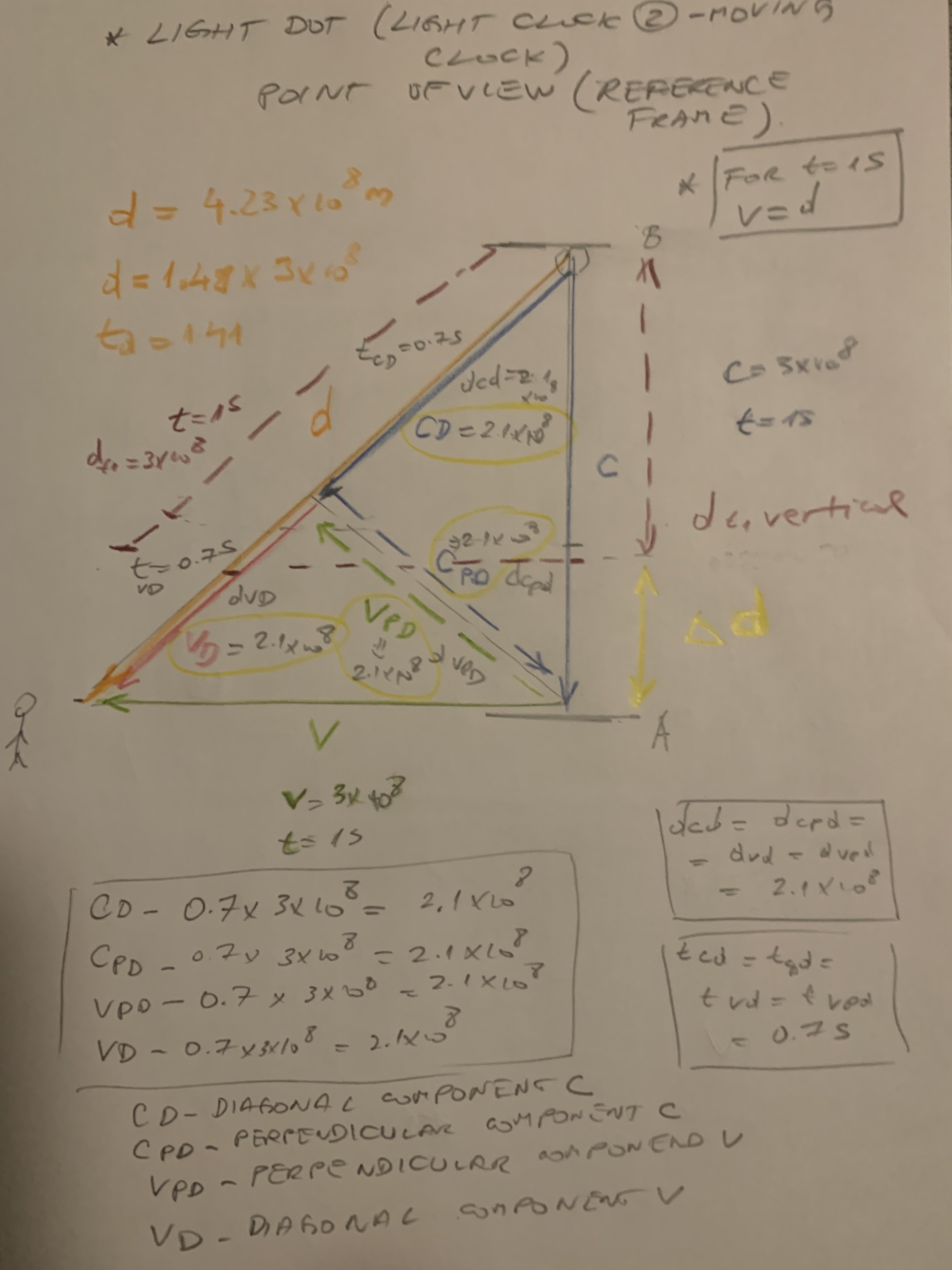
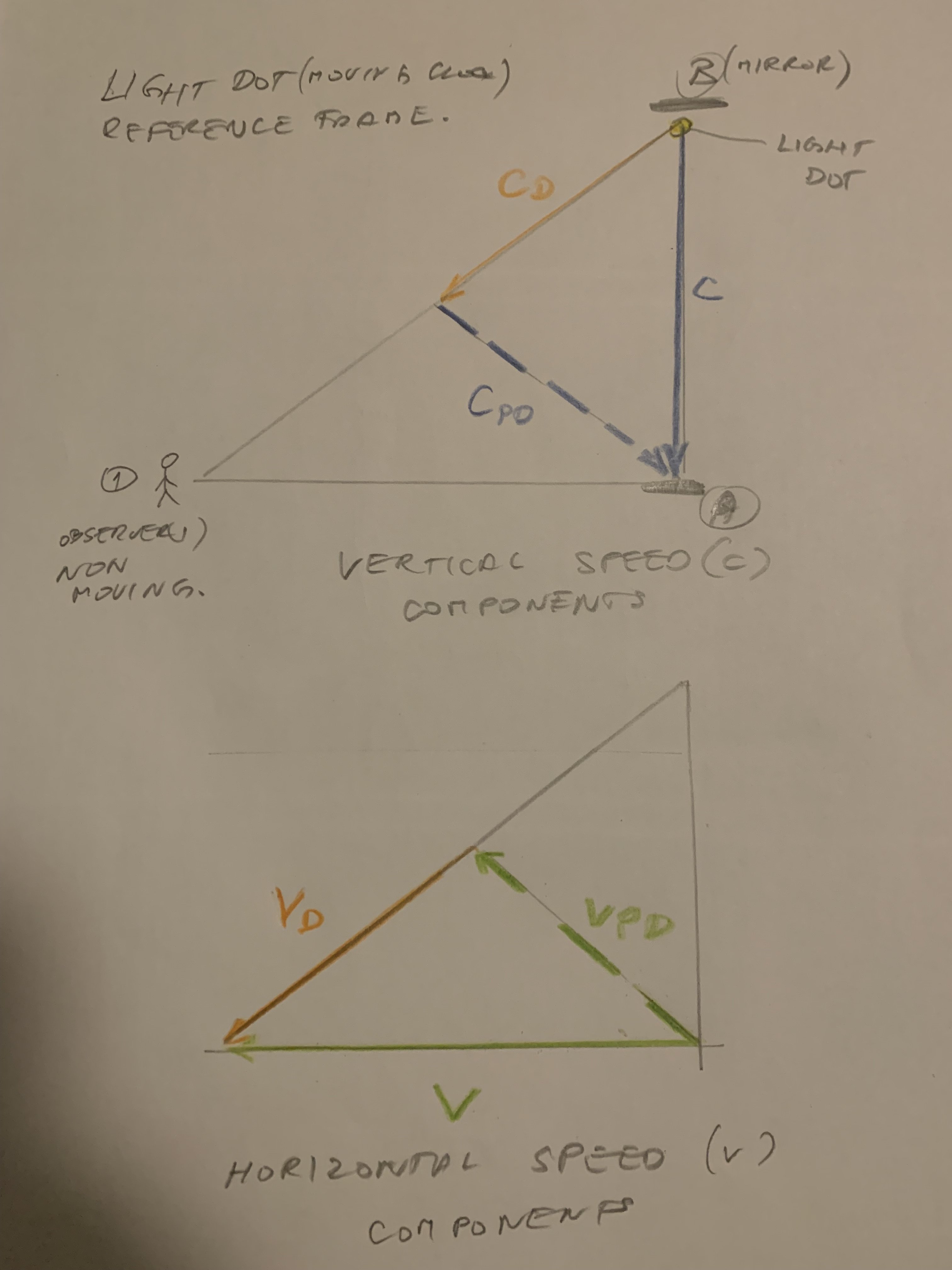
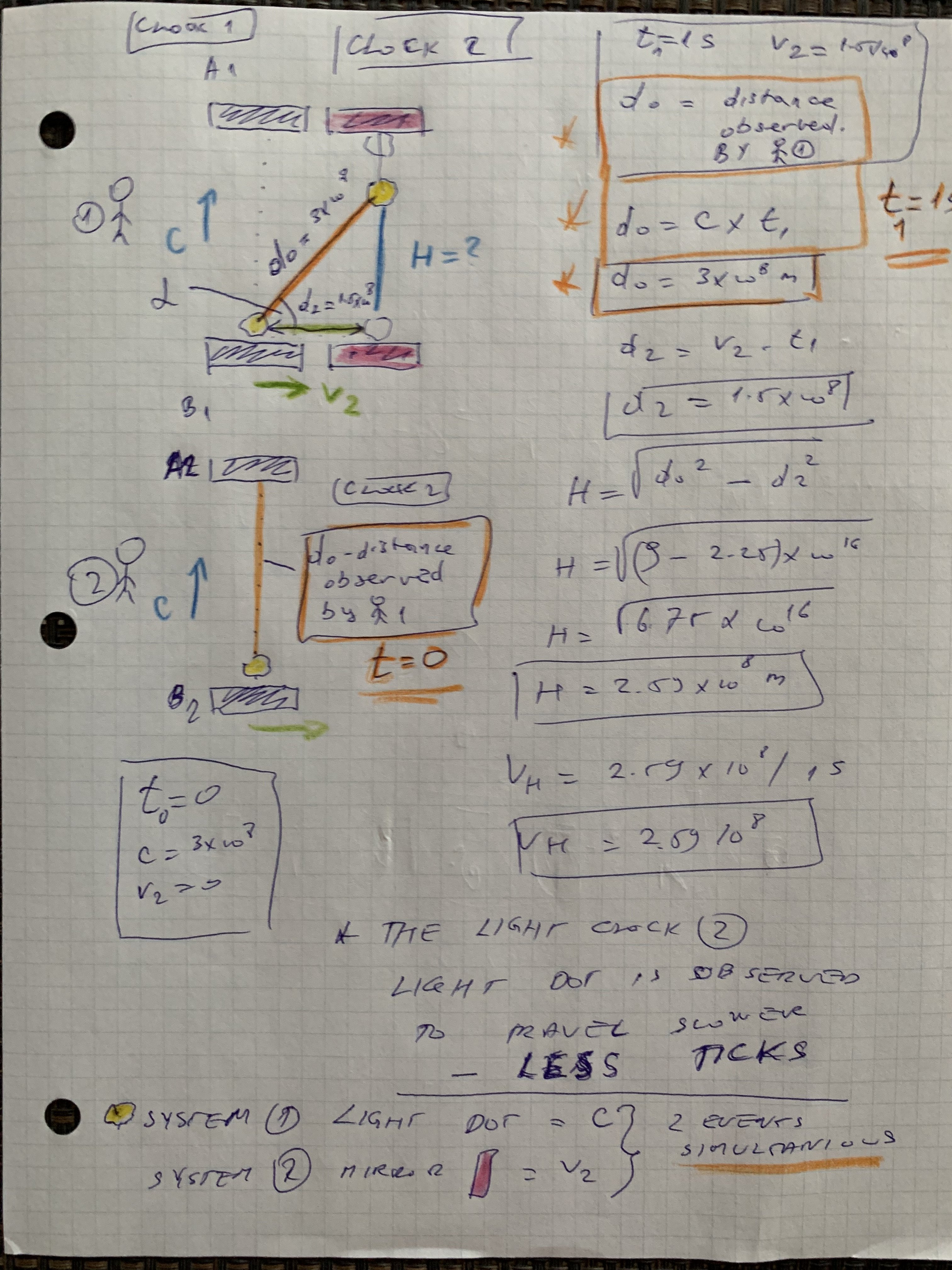
Here is a light dot point of view (reference frame) if two separate events: Movement of mirror A in vertical direction at speed c. And movement of observer 1(non moving observer ) at speed v=c These two events are completely not related They just happen at the same time - they are simultaneous events. The components of vectors blue and green are the result of simultaneous vector (velocities) action . the blue Cod and green Vpd components act in the opposite direction and they are the reason speed orange - Vd and Cd are 2.1x10e8 . The speed of light is constant in all directions . This is time dilation explained using Galilean transformations. The increase in distance - is the reason why time is longer . This is the overlook which led to Lorentz transformations been invented . Here is a light dot point of view (reference frame) if two separate events: Movement of mirror A in vertical direction at speed c. And movement of observer 1(non moving observer ) at speed v=c These two events are completely not related They just happen at the same time - they are simultaneous events. The components of vectors blue and green are the result of simultaneous vector (velocities) action . the blue Cod and green Vpd components act in the opposite direction and they are the reason distance - orange dot=4.2x10e8 And tt=1.41 the speed on orange line is c=3x10e8 The speed of light is constant in all directions . This is time dilation explained using Galilean transformations. The increase in distance - is the reason why time is longer . This is the overlook which led to Lorentz transformations been invented . Sorry i was interrupted, I mark orange line with Vd and Cd because for time t=1 s d=v(distance =speed)
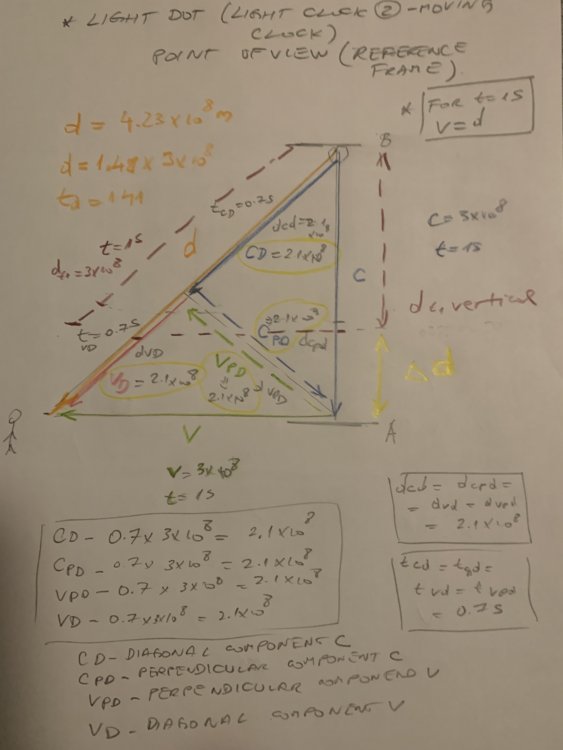
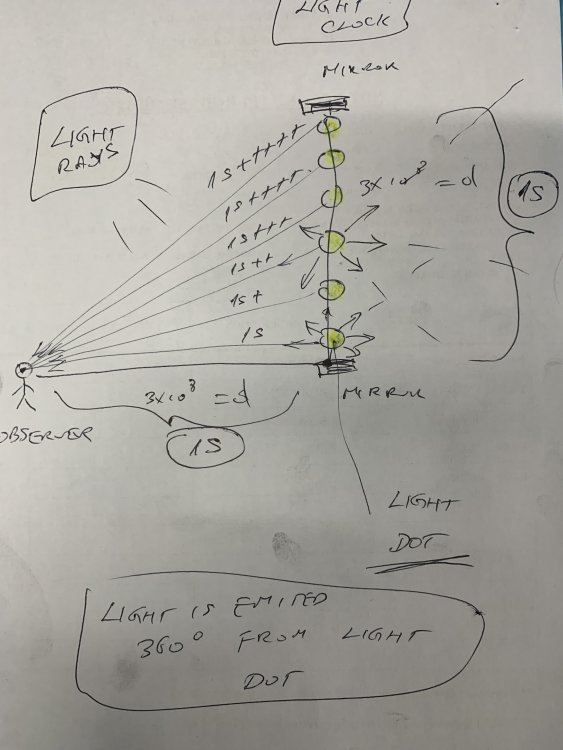
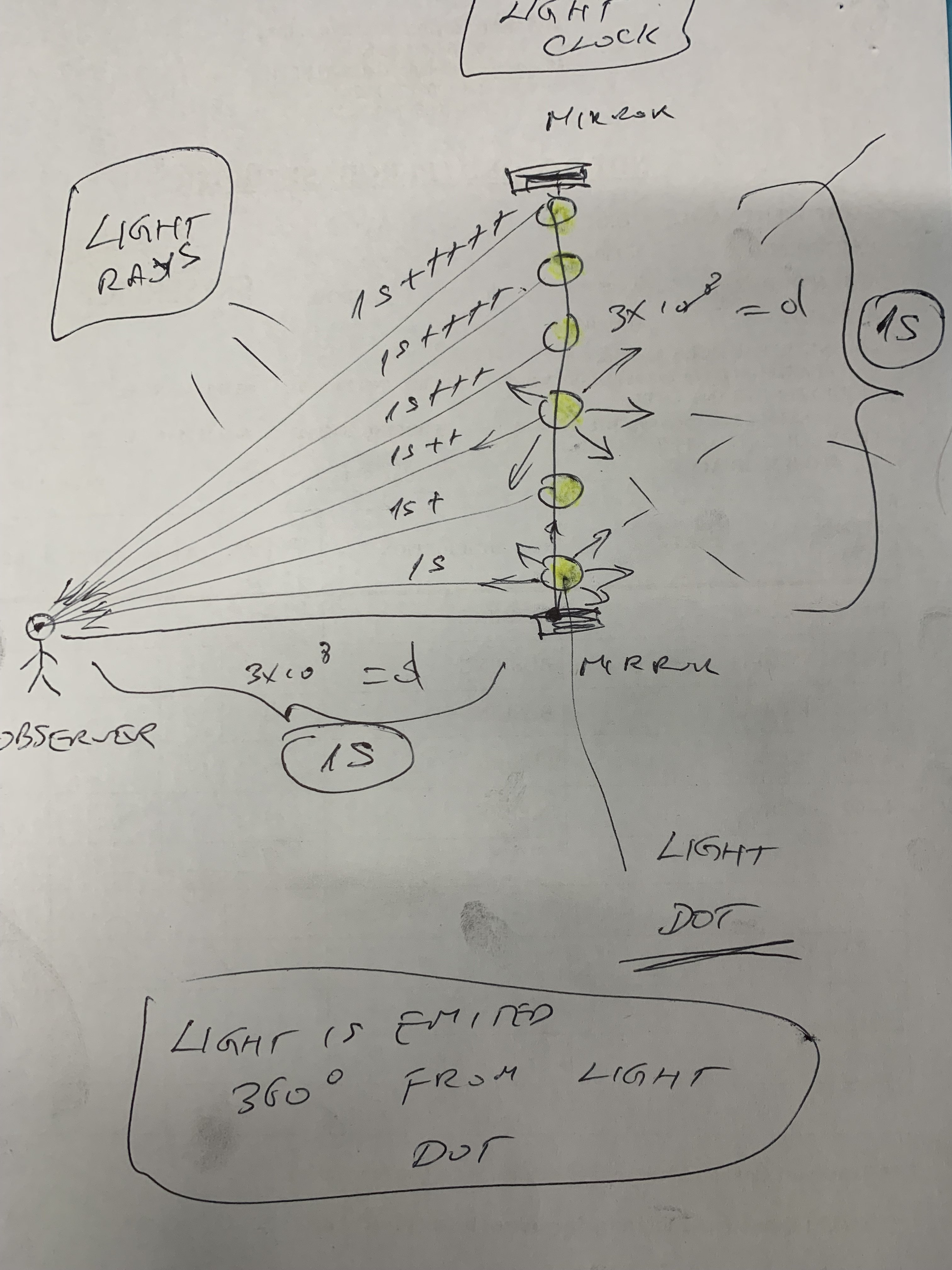
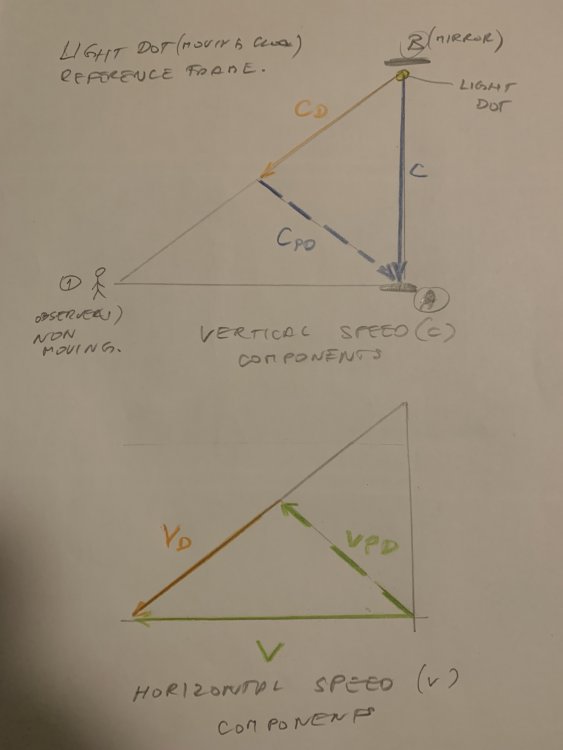 Hi again The couple of things I mentioned are just examples - this works for any speed and any distance . For example let’s put both clocks tilted 45 degrees . Or let’s put light clock from 0 to 360 degrees (relative to speed v2 direction ) and do calculations . Above picture (very rough) drawing is in my humble opinion how Lotentz transformations should be applied . In this picture , the observer is stationary and the clock mirrors are stationary. L=3x10e8m is distance between mirrors- any distance can be used - this is just for better understanding. The distance between observer and light dot is d=3x10e8m it takes 1 second for light beam to reach observer from light dot in position A (mirror A) It takes 1.41 s for light beam to reach observer from position B(mirror B) The speed of light c is constant . The distance has changed and because of this the time has changed . Let’s reverse this - let’s see how is the observer seen by light beam point of view. The observer is moving ,going further away from light dot- the distance is increasing?! And he is moving away at speed of light?! And we observe that observer is stationary. Lotentz transformations work perfectly in any system where signal is emited 360 Degree away from source. And we measure time of signal to the receiver. When source is moving distance of travel is Changing and we observe that time is changed - we can not see the distance .
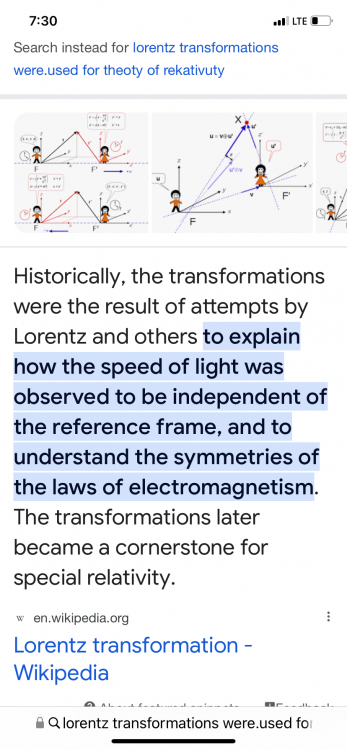
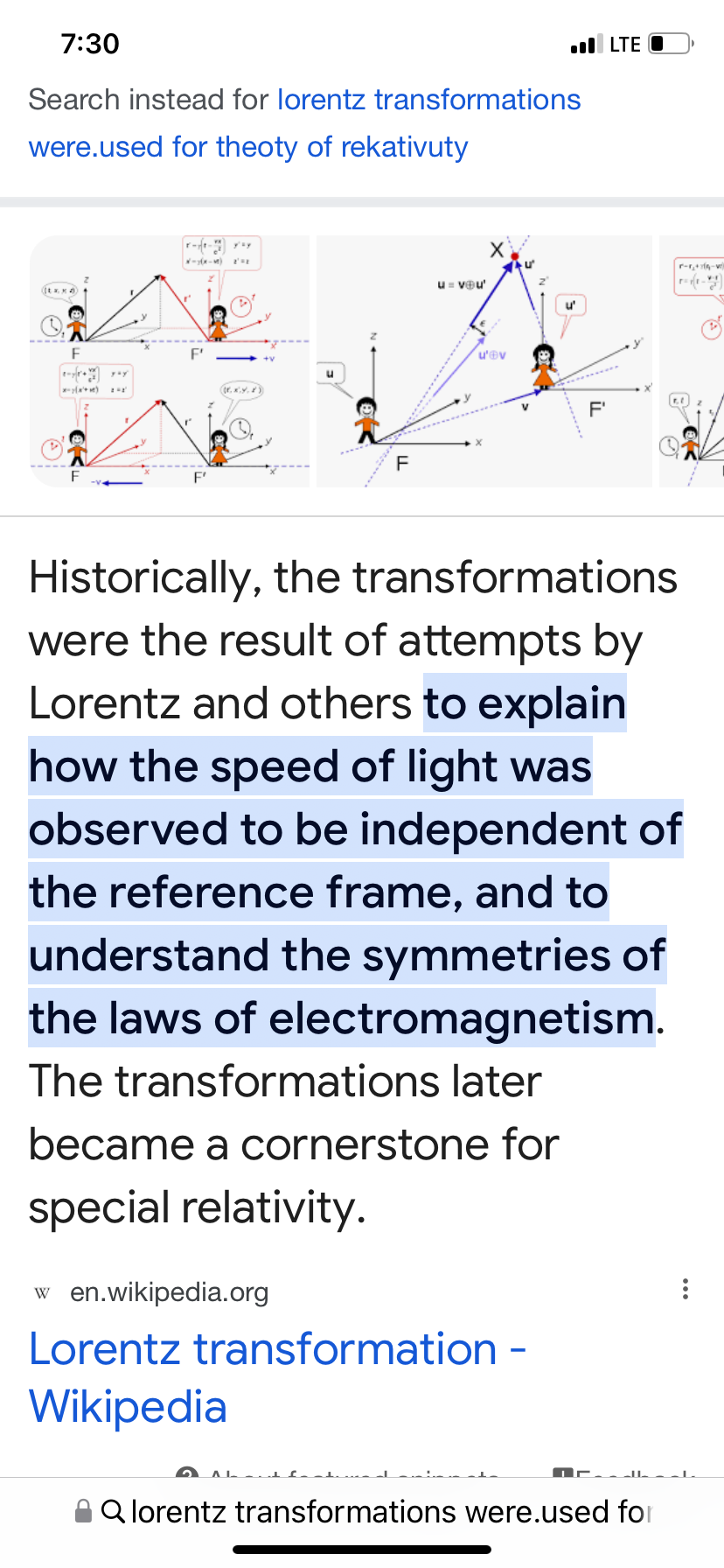
 Hi Mordred In my humble opinion, Lorentz transformations were used to prove that speed of light is constant. They were never intended to be used to explain dilation of time. The overlook that mirrors are simultaneously moving with light dot -these are both parts of the same light clock happened later . Again , I have been saying theory of relativity time dilation is mislabeled increase of distance which light dot travels between mirrors of light clock. The mirrors move at the same time as light clock and they increase the distance . For constant speed c increase of distance will increase the time travelled. I was hoping that from what I have explained so far in this thread it is visible. The last drawing with light clocks flipped 90 degrees clock wise- that is explanation. Lets try to do experiment with train and space shuttle with light clocks positioned so the light dots are not perpendicular bro trajectory. And let’s use L=3x10e8m the distance between mirrors of the clock. I would like to say that the distance L is has to be 3x10e8 to clearly see what is going on. I would like to tackle the decay of particles time- the non moving particle radiates photons in 360 degrees and the receiver of signal is at distance L . Receiver has length D. If particle and receiver are seen as mirrors of light clock ,when particle moves ,the particle is moving mirror . The distance for signal to travel do receiver is increased and we see that as a time dilation . Caesium-atomic clock - as I mentioned in this thread - is modern version of light clock. So increased distance in constant speed c will increase the time of travel. The light clock is reference signal- comparative signal - that is it. Again I am more than thankful to science forums for giving me anll of this space annd time to talk about this overlook . Thanks to all of you for finding time to read and comment .
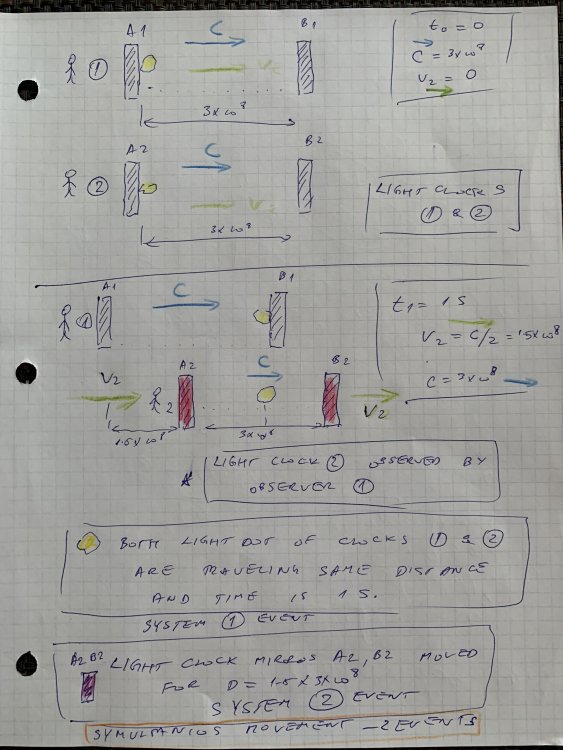
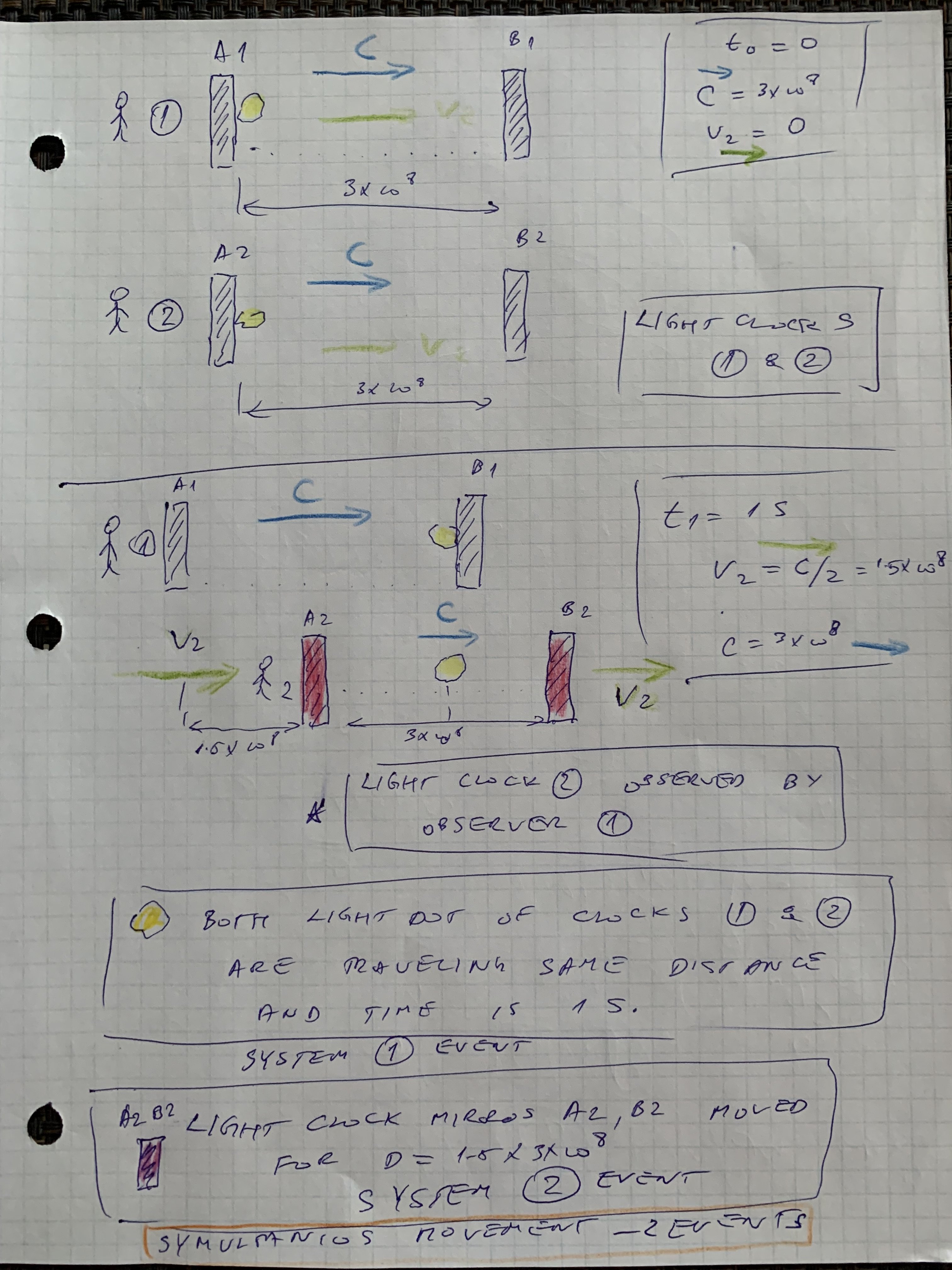
 Here is a bit better drawing for light clocks positioned in line with speed v2. I think this is easier way to see that light for travels at speed of light in both clocks (stationary and moving) and it travels for same time 1 sec. Mirrors are moving simultaneously for one second in the Same direction and the trajectory of light dot is observed shorter. This is direct consequence of two events happaning at the same time . Movement of light dot and movement of mirrors . Again the movement of light dot is reference movement and it will happen simultaneously with any event we observe. That is purpose of light clock- reference signal .
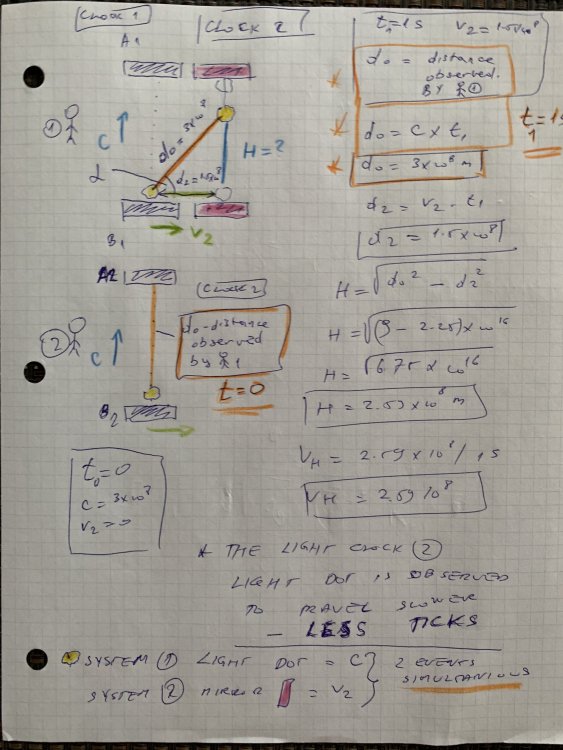
 On previous drawing light clocks were not perpendicular (movement direction of light dot) to direction of movement of mirrors (v2). Here is explanation for light clocks (movement of light dot inside the clock - system / event 1) moving perpendicular to v2(movement of mirrors). The observed length ( orange do) in non moving (t=0)and moving (t1=1 s) of light dot trajectory of clock 2 which is observed by observer 1 id the same when mirrors are at rest and when mirrors are moving at speed v2(clock 2). In both cases speed of light dot of clock 2 is c and time travelled is 1 second. The difference is that when t=0 (time explains that two clocks 1 and 2 and their observers 1 and 2 do not move realtive to each other . Both light dots are moving - they are event 1 - reference event. They both travel at the speed of light c and travel the same distance 3x10e8m This is constant - this never changes. Observed trajectory direction is changing but the distance light travels in 1 second never changes. That is the hole and only purpose of light clock in time dilation experiment - reference light signal. From known light speed of light dots(vertical sytem/event 1) and observed angle Alfa between do- orange observed distance and direction of horizontal speed (system /event 2) we can calculate relative speed v2 between any two objects anywhere in universe . But instead using all of this - why do not we just make xyz greed for time and apply classic physics and get the total time . Than we make xyz greed for distance . Than from formula v=d/t find the speed . ?
 I came up with one more thought experiment - this time there is 3 observers but instead of light clock that have flash lights and stop watches. The speed of light is the only speed we observe. The observed distance- trajectory is changing . speed is always constant . The time change is directly proportionate to change of distance - always . And there is no time change ,or speed change without change in distance (different trajectory) First picture - on the top shows that mirrors of light clock 2 moved to the right 1 m and the light dot of clock 2 is observed to be late (light dot is not in a position at mirror B of second light clock). The light dot of clock one - observed is to be touching mirror B of light clock one). That is why the clock 2 is observed to show slower time. And again this happens because trajectory Of light dot in clock 2 - distance increased.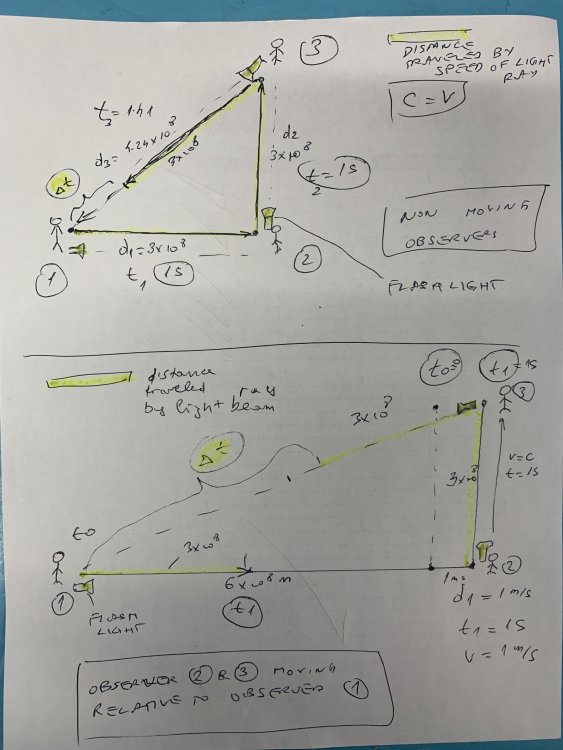
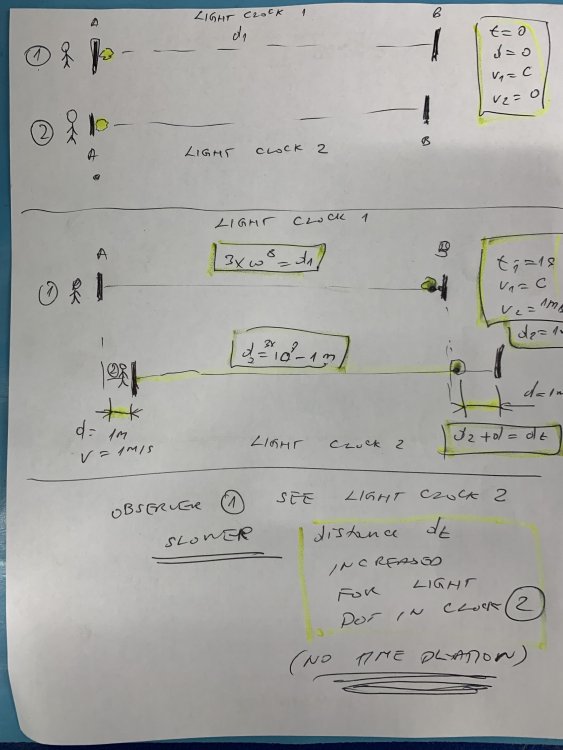 I came up with one more thought experiment - this time there is 3 observers but instead of light clock that have flash lights and stop watches. The speed of light is the only speed we observe. The observed distance- trajectory is changing . speed is always constant . The time change is directly proportionate to change of distance - always . And there is no time change ,or speed change without change in distance (different trajectory)
Here is the closest situation of two Newtonian events happening at the same time . The fast flying aircraft can be seen as a light dot of second (observed light clock) speed is max.(we can see it as c) The slow flying aircraft is seen as a mirrors of second observed light clock. his speed is v2 This situation is the second half of chevron trajectory of light dot. The shortest distance betwen aircrafts (red line ) is L=distance between mirrors of both clocks. We can see that these two aircrafts are traveling at their own trajectories- not related to each other. When fast aircraft travels on red trajectory it travels at max speed (c)and it takes time t1. d1 =cxt1 When fast aircraft travels in angled trajectory it will move at max speed (c) but the trajectory is longer . The time t2>t1 the distance d2=cxt2 we observe the fast aircraft- we do not observe the slow aircraft at all. the slow aircraft always travels at speed v2 and it will be at colossi on point x in time t3 And distance d3=v2xt3 From these totally not related distances and times we can calculate and confirm that speed of fast aircraft on angled trajectory is max speed (c)
I came up with one more thought experiment - this time there is 3 observers but instead of light clock that have flash lights and stop watches. The speed of light is the only speed we observe. The observed distance- trajectory is changing . speed is always constant . The time change is directly proportionate to change of distance - always . And there is no time change ,or speed change without change in distance (different trajectory)
Here is the closest situation of two Newtonian events happening at the same time . The fast flying aircraft can be seen as a light dot of second (observed light clock) speed is max.(we can see it as c) The slow flying aircraft is seen as a mirrors of second observed light clock. his speed is v2 This situation is the second half of chevron trajectory of light dot. The shortest distance betwen aircrafts (red line ) is L=distance between mirrors of both clocks. We can see that these two aircrafts are traveling at their own trajectories- not related to each other. When fast aircraft travels on red trajectory it travels at max speed (c)and it takes time t1. d1 =cxt1 When fast aircraft travels in angled trajectory it will move at max speed (c) but the trajectory is longer . The time t2>t1 the distance d2=cxt2 we observe the fast aircraft- we do not observe the slow aircraft at all. the slow aircraft always travels at speed v2 and it will be at colossi on point x in time t3 And distance d3=v2xt3 From these totally not related distances and times we can calculate and confirm that speed of fast aircraft on angled trajectory is max speed (c)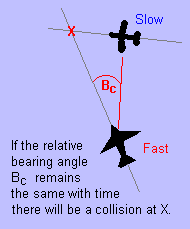 Hi Janus These gifs are awesome. There is no easy way to say this. The movement - observed trajectory/ distance of light dot depends on two speeds. Speed of light c and speeds v1 - horizontal speed of red mirrors and v2=horizontal speed of blue mirrors . speed c is distance d=3x10e8m which light moves in 1 sec. v1 is distance d1 red mirror moves in 1 sec v2 is distance d2 blue mirrors moves in 1 sec. Now again these are two separate systems Movement of light dot inside the clock has constant distance and time of 1 sec. the speed of light c is constant . The distance between mirrors L=3x10e8m is the way to go to see that . The distance d1 and distance d2 are accomplished by something transporting the mirrors - train ,road ,space shuttle…… The mirrors can not move on their own. The overlook is that we have two Newtonian events happening at the same time . The interaction between these two systems is by changing distances between observer 1 And blue clock light dot. The light dot has one distance dc=3x10e8m And distance of d2 =1 m/s(for example) If these events are not simultaneous- the total time to travel distance dc+d2 =d t=3x10e8 +1 m the total time will be tt=2 sec I mean light dot travels 3x10e8 m for 1 second - stops than perpendicular to it blue mirrors transport the dot 1 m to the right in 1 sec. The total speed vt=dt/tt=300000001/2=1500000000.5m/s If these two distances are travelled at the same time the observed trajectory will be Hypotenuse of triangle created by dc and d2 Total dt^2=dc^2+d2^2 The total time tt=1 .42 s tan Alfa =d2/dc for time of 1 sec d=v we can see that tan Alfa =v2/c Than total vt on hypotenuse will be vt=c x tan alfa I used Newtonian physics to solve the theory of relativity problem. How ? Over look is that two systems observed are Newtonian events happening at the same time . And increase in distance in observed trajectory - was misunderstood as a time dilation.The speed of light is constant and it is never at rest. Here is one more thought experiment . The distance 3x10e8m travelled in 1 second could be used as a reference distance to confirm is the the object of system 2 in relative motion to reference point A. As you can see sped of light c is constant . Time t1 for both systems is 1 second. The system one is light clock with distance between mirrors L=3x10e8m And system two can be train,space shuttle, road The light clock is used as a range/speed finder device So I would call this thought experiment light clock as a range /speed finding device . If we apply The Dunning-Kruger effect DUNNINO-KOUSER occurs when a person's lack of knowledge and skill in a certain area causes them to overestimate their own competence. By contrast, this effect also drives those who excel in a given area to think the task is simple for everyone, leading them to underestimate their abilities. May be we can call this thought experiment Dunning -Kruger’s effect of speed of light
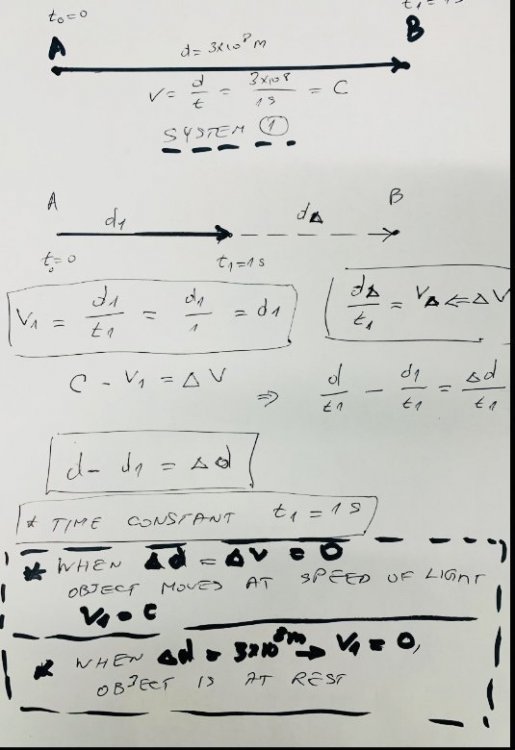 Dunning - Kruger,very interesting. According to the special theory of relativity introduced by Albert Einstein, it is impossible to say in an absolutesense that two distinct events occur at the same time if those events are separated in space. If one reference frame assigns precisely the same time to two events that are at different points in space, a reference frame that is moving relative to the first will generally assign different times to the two events (the only exception being when motion is exactly perpendicular to the line connecting the locations of both events). THE ONLY EXCEPTION BEING WHEN MOTION IS EXACTLY PERPENDICULAR TO THE LINE CONNECTING LOCATION OF BOTH EVENTS. Here verybsimple question from guy who does not know much about theory of relativity - The event 1 - pedestrian 1 motion is perpendicular to event 2 motion of the road? Or is the motion of light dot (in light clock) event 1 Perpendicular to motion of train- event 2 ? I would like to say thanks to science forums for giving me opportunity to present,explain and defend this very simple Overlook. i would like to thank moderators and all of the people who spend time and effort to point out the flows. I was lucky not to know theory of relativity on the level you guys do- because I would not be able to see this very simple overlook. Cheers Motion of space shuttle is perpendicular to the motion of light dot in the light clock relative to the line of observer
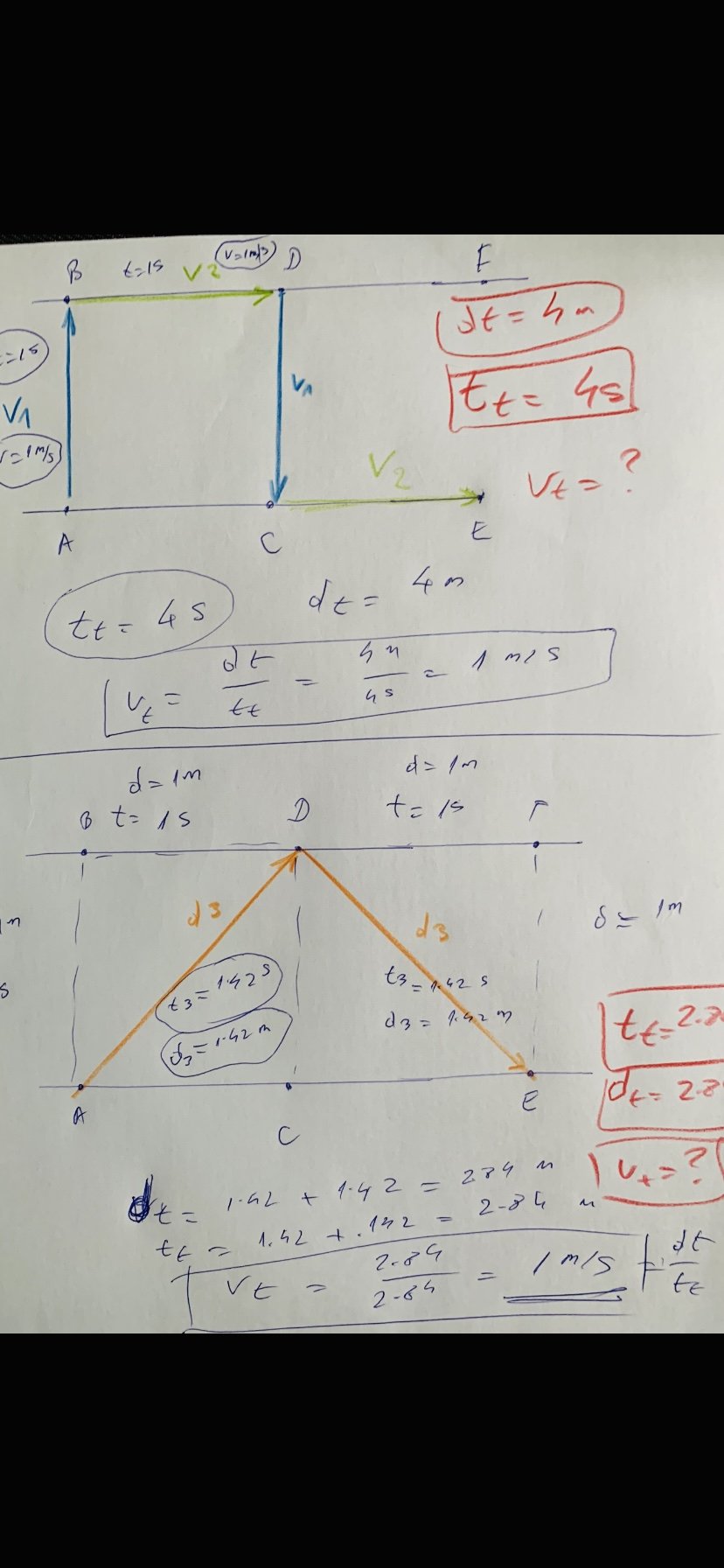
 I was thinking how do I explain this in a more simple way. Here is another try: Case 1 pedestrian 2 will observe two movements occurring separately. The pedestrian 1 goes from A to B,observed - measured distance is 1 m. The measured time is 1 sec. pedestrian 1 stops. Than the road moves to the right - transporting (without his good will) pedestrian 1 from point B to point D Distance is 1 m ,time is 1 sec. the pedestrian 1 moved from A to E in total time tt=4sec pedestrian 1 was traveling for dt=4 m the average speed Vt=dt/tt=1 m/s Observed measured and confirmed - speed v is Constant in all distances . Case two: Both systems - vertical movement of pedestrian 1 and horizontal movement of road (transporting pedestrian 1 - without his own will) horizontally- this is observed by pedestrian 2. The total distance travelled is dt=2.84m(calculated by Pitagora rules for distance . tt=2.84sec total speed is Vt=dt/tt=1 m/s The speed vectors horizontal and vertical are working non related to each other . We can not apply pitagora rules for velocity But , without a will of pedestrian 1 - is moving on trajectory d3=1.42x2 And time spent is 1.42x2 the total speed is vt=1 m/s calculated from observed (measured ) length of trajectories. From reference time / distance vertical movement of pedestrian1 we can calculate any speed v2 (horizontal speed ) form v2 =0 m/s to 1 m/s based on angle alfa=v2/v1 when instead of pedestrian 1 we use light clock , or modern version of light clock (caesium atomic clock) as a reference we can calculate any speed from 0 to c observed by pedestrian 2 anywhere in universe . I hope this clears things a bit better .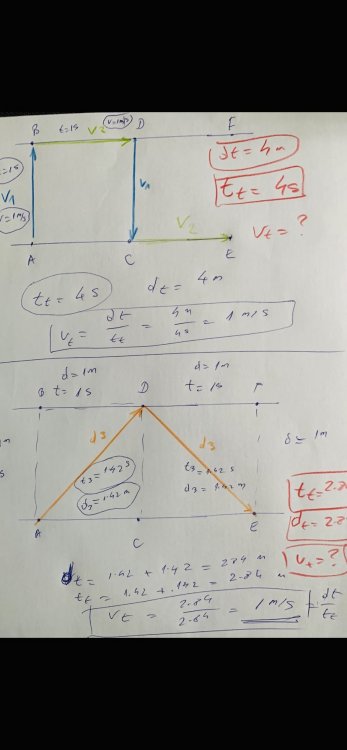





Important Information
We have placed cookies on your device to help make this website better. You can adjust your cookie settings, otherwise we'll assume you're okay to continue.