Prajna
Senior Members
-
Joined
-
Last visited
Everything posted by Prajna
-
Development continues but now I am looking at something quite different. In trying to improve the SFT I have come up with an idea that employs the same principle I have been using in the SFT designs but it operates (if it operates at all) in a different way. Here's a model to examine: That is looking from one side of the device and only shows one pair of carriages. The following image displays two pairs and labels the parts: What you're looking at is a cylinder with two opposed sinusoidal cam tracks running around the sides and slider rods that support carriages carrying a magnet and a bearing each. The carriages can slide up and down the slider rods and the bearings constrain the carriages to follow the cam tracks. The magnets are fitted in the carriages so that like poles are opposed on each pair of carriages. There are ferromagnetic tabs (soft iron or transformer laminations) arranged around the centre of the cylinder at each point where the opposite cam tracks are converging and gaps between the tabs wherever the tracks are diverging. When the cylinder is rotated such that the magnets on one side are closest there is no iron in the gap between them, so the magnets repel, imposing a vector force on the cam tracks that causes the cylinder to rotate to the left. The magnets on the opposite side will be at their maximum separation but they also then encounter a tab in the gap and will be attracted to the tab rather than their fields opposing, thus imposing a vector force on the cam track that also causes the cylinder to rotate to the left (because there the tracks are converging.) A further two sets of carriages should be arranged on the adjacent axes for smoother rotation, to increase power and to provide some assistive thrust when the vectors of the adjacent magnets are aligned to the cylinder axis at the peaks and troughs of the sinewave, (i.e. one set facing you and the other set at the back of the cylinder.) There are five peaks in the sinewave of the cam tracks, so on either side of this image the magnets will be at opposite extremes of their travel, one set pushing and the other pulling. The front and rear sets of carriages will be in an intermediate position, still with one set pushing and the other pulling. The closest magnet pairs will exert the most force (due to the inverse square law) and there will always be one pair of magnets exerting a strong repulsion (or strong attraction.) Hopefully that is enough info to describe the device.


-
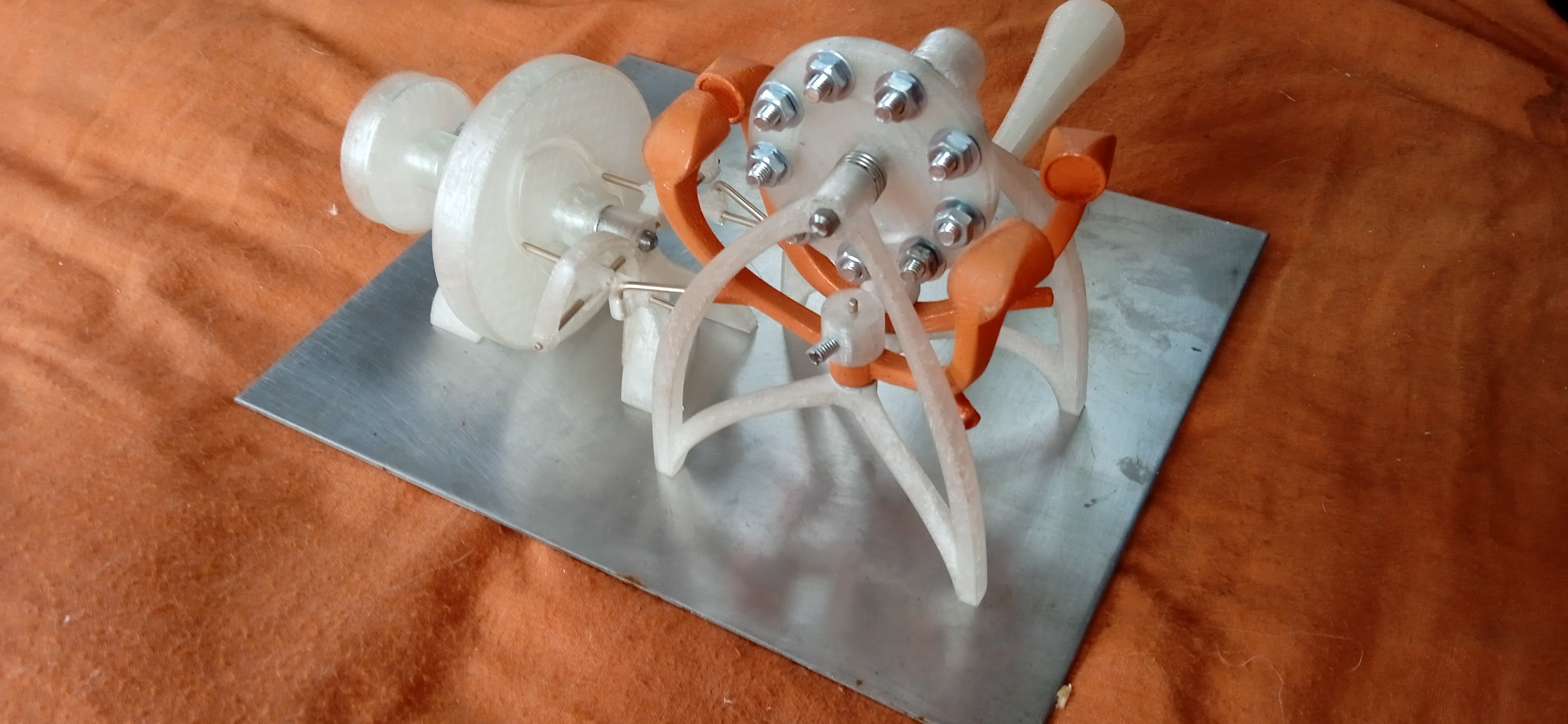
Well, the SFT-Mk5 is all assembled but sadly it is not rigid enough. I'm hoping that if I beef up the supports for the bellcranks that might make it stiff enough to work. The problem at the moment is that the magnets stick to the rotor and the mechanism is supposed to limit their travel so that can't happen but there is too much movement in the bellcrank mounts and that lets the magnets get too close to the rotor. Oh well, iterative process.
-
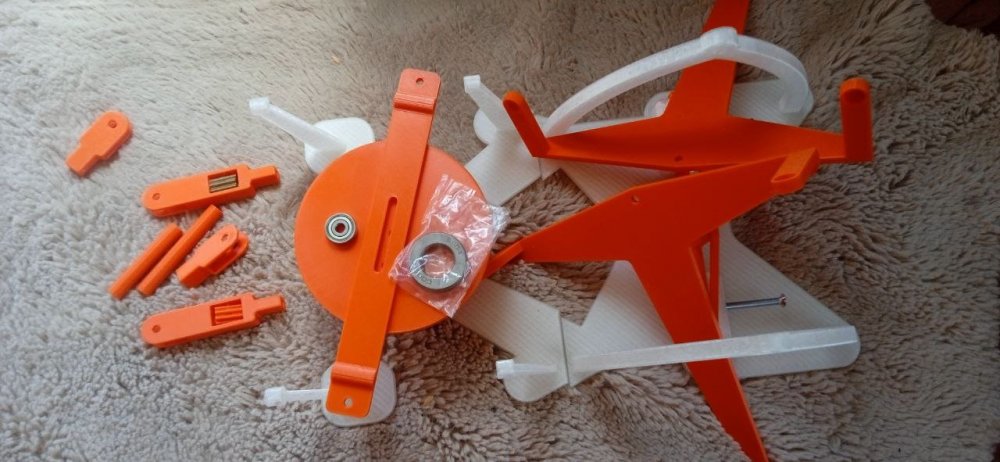
The parts are all printed. I just have the rotor to make. I was going to get my previous design water jet cut but I have redesigned it so that it is easy for me to make with the tools I have.
-
Ah, well I was not so much wanting an answer as hoping for one. I would have thought that a rough answer could be approached by working with the strength of the magnets - N58 10mm x 3mm - and choosing an arbitrary thickness of the fingers, say 1mm, assume the area of the finger in the gap is the same as the area of the magnets, the gap varies between a couple of mm (just so it doesn't reach the finger) and 40mm. But maybe it is much more complicated than that, even for a rough estimate. Sure, there is the overriding law of thermodynamics, dogma++, as it were, that says that one way or other the forces must be balanced but science is about heresy and challenging dogma. In fact, that about sums science up: it is the recorded history of stuff we were certain of but was then successfully challenged and overturned. When we treat science as religion and refuse to even test things because dogma then we get stuck. I realise that scientific laws are even more sacrosanct dogma than theories and hypotheses but there is a small possibility that energy enters the system by some as yet unidentified means and I am not convinced that we have yet fully understood magnetism. Who was it, a member of the Royal Society, who said, back in the 1800s, that we understood all of physics and there were only a few minor details to nail down? I have done a few rough and ready experiments with magnets and sheets of iron, which is where my (perhaps naive) optimism comes from. It seemed to me, and to someone on an engineering forum who did his own experiments, that interjecting a sheet of steel in the magnetic field 1. collapsed the repulsive field causing the magnets to be attracted towards the sheet and, 2. didn't feel to have much in the way of eddy current drag. Maybe physicists understand magnetism at the level of electrons but I'm not convinced many of them have actually picked up and played with them. For all that the field is supposed to be well studied I recently watched a video with Joe May, the inventor of the Joe Cell, who demonstrated some astounding effects with a ring magnet that had been broken apart. Perhaps there is more to know and perhaps there is a way to use the magnetic field as something more than a spring. Because I have no other means, short of some serious study of physics, for me to evaluate the forces in this system I will just carry on developing this prototype and test it. Anyway, empirical evidence is the most convincing. It may (certainly will, according to most of the assessments I have seen) turn out that this is but a very good example to show how 'free energy' is impossible and the laws of thermodynamics are as certain as the law of karma, or perhaps this device will produce more output than what we input by way of the rotor and still not break the laws of thermodynamics (because we might identify where the extra power is coming from). In any case I will end up with an interesting device even if it is just a curiosity. Thanks for your interest and I will certainly keep the forum updated with my results.
-
Hey, thanks for the response and your clear examples. In my view it boils down to a simple question: is the eddy current drag in the metal fingers more than, less than or equal to the energy captured by switching the magnetic flux? I had rather hoped, in posting here, that someone might be able to calculate (or even have an intuitive sense of, what that eddy current drag might be and how it might compare to the forces induced in the Bellcrank by the opposed magnets. There will, of course, be other losses in the system but I am interested to know the answer to the drag Vs magnetic forces in this system. It's all very well illustrating the principles with examples but here we have a simple example that could be analysed and the results would be an explanation on their own. In any case, I have one more day of 3D printing to do and some water jet cutting to arrange and I will be able to assemble and test the device. For the present the rotor is only a first best guess - I may need to change the size of the fingers or thickness to contain enough of the field to switch the flux sufficiently, but we shall see. Thanks again.
-
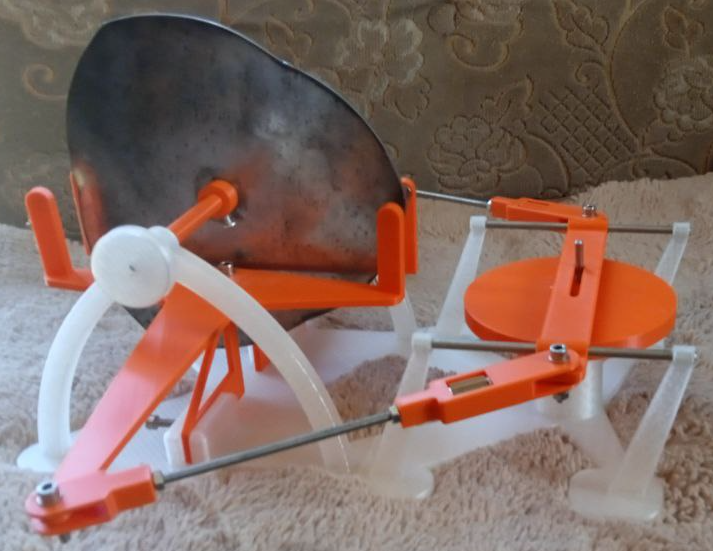
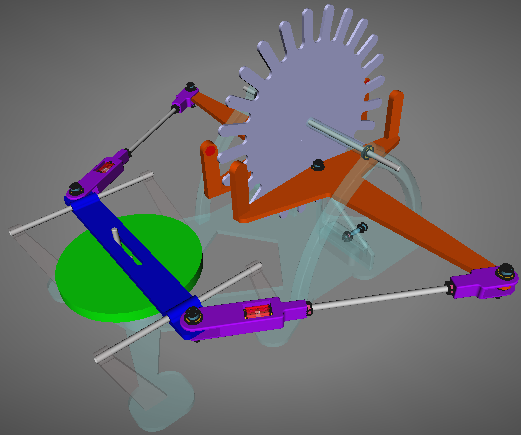
Bigger and better, easier to print, stiffer transmission, looks a bit like the Millennium Falcon, ...
-
Sadly, I need to redesign. At this scale it is very difficult to get the tolerance needed to get this design to work. Also I need to design in adjustment for lining things up. The crank mechanism, whilst beautiful and good in theory is not ideal in practice, so I'll use a much simpler Scotch Yoke system to convert the reciprocal motion to rotary motion.
-
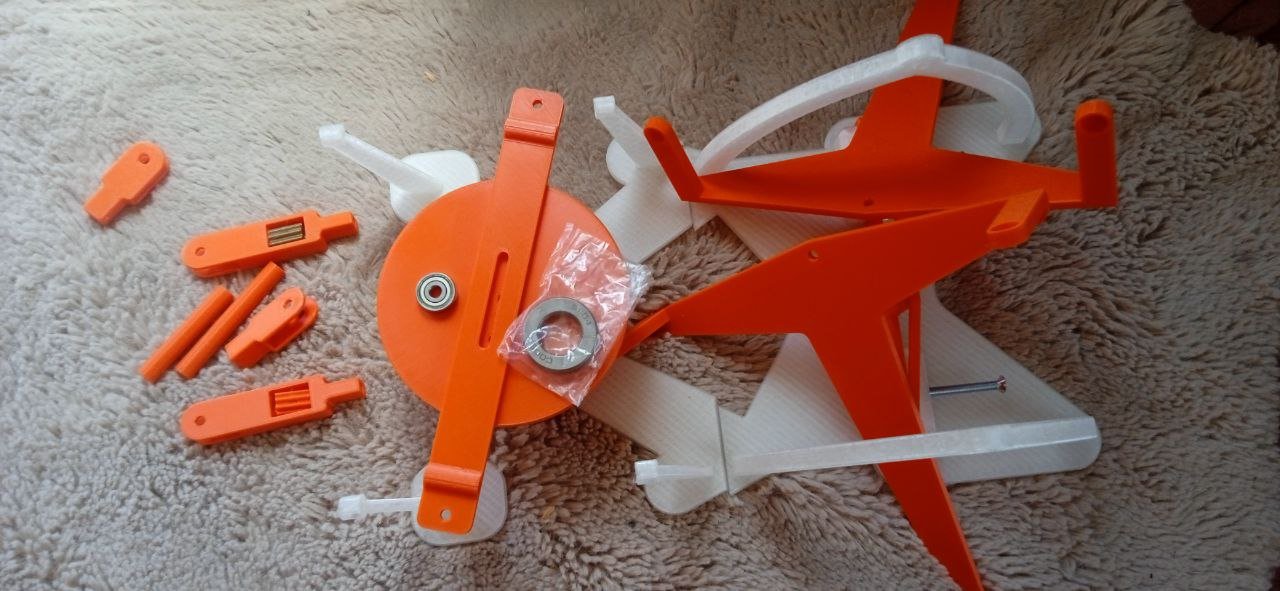
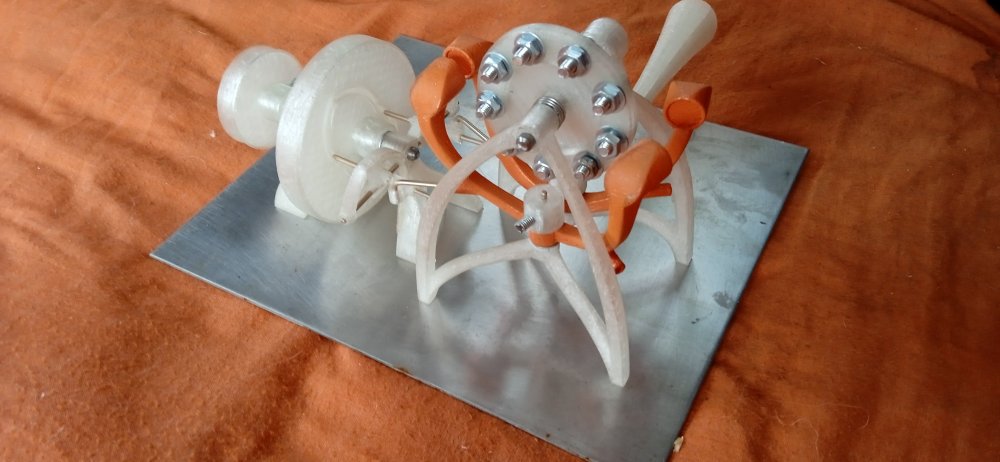
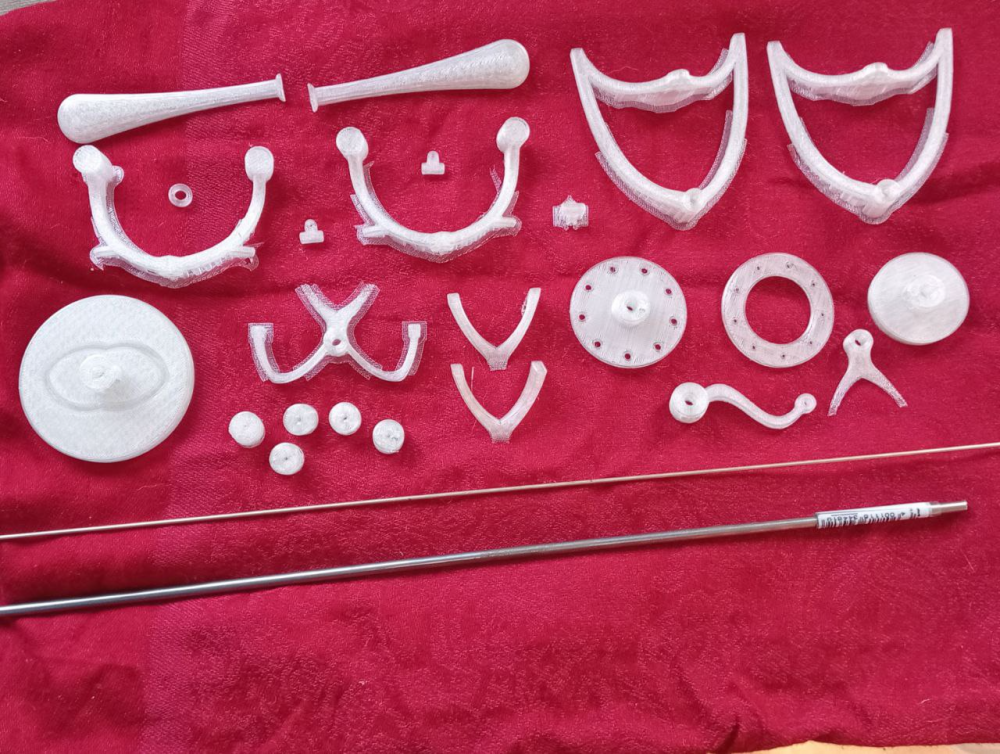
It's like an Airfix kit. I have some cleaning up of supports to do and reaming out some holes for various shafts:
-
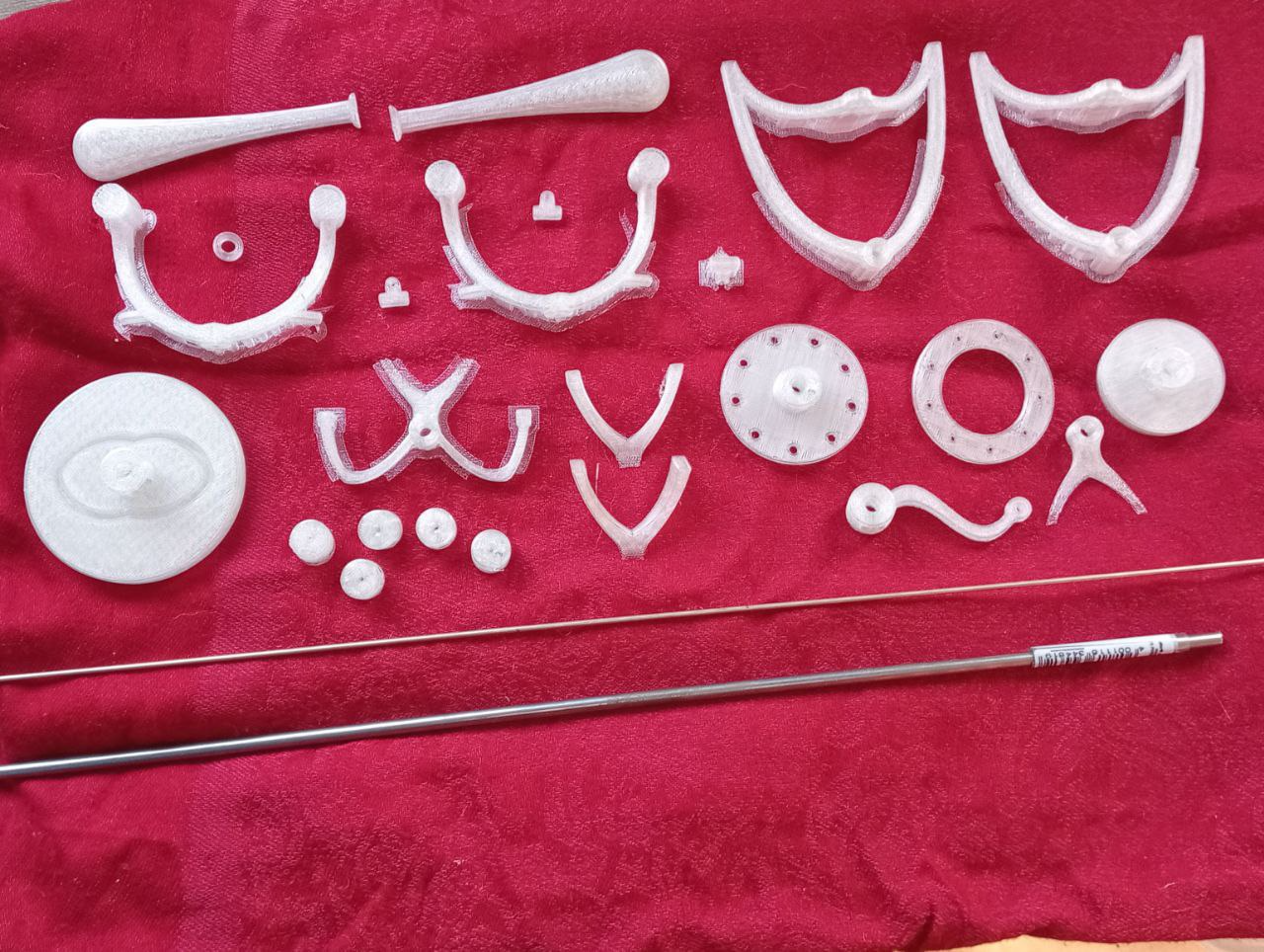
Off to pick up my 3D printed parts tomorrow!
-
-
A poundal is the certain force - or so my dictionary reckoned - to accelerate a pound of weight by one foot per second per second. (written some years ago)
-
A little update: yesterday I went to visit my local FabLab to dicuss getting some support from them. The guy took one look at the model and said, "Oh yeah, we can print that easy," which is rather reassuring, since I've never 3D printed anything and this is the first time I've designed for 3D printing. The FabLab have an event all this week, so are a bit busy, but I have emailed the lab manager and hope to get an appointment to go and discuss the project early next week. Meanwhile, in case anyone fancies getting in ahead, the full project is hosted on my GitHub (referenced above) so you can download and experiment. There are still a few issues with render materials that I am working on with the Render Workbench developer but otherwise the model should be pretty much ready to work with.
-
I have some 10mm X 2mm, I think N52, suitable for this device.
-
Hmm, maybe you can do it with iron nitride magnets. They can be manufactured and then magnetised in place. You'd need an expensive printer to print the shafts, axles and fingers too (I'm planning to get them laser cut).
-
The device is now available on GitHub, for anyone who would like to build and experiment with it. Hopefully today I will get to FabLab to see about printing and assembling one to test. Git is at: https://github.com/prajna-pranab/SFT
-
And from this is where we get the idea that the magnet is redirecting force rather than doing work? Ah ok, it starts to make sense. And really I should be thinking in terms of induced electrostatic forces rather than magnetic forces? Am I getting closer?
-
Watching from the sidelines with avid interest...
-
Splendid. Now all I need is for someone like @exchemist to translate this into simple terms that I can comprehend. I am still studying the wiki, btw, in the hope that I can get to a broad-brush understanding of how magnetism works.
-
You might note that an electric motor will not run until you flick the switch. Although it doesn't take much energy to flick the switch and the real energy that is running the motor comes from the power supply that switch needs to be turned on for it work. Here the operator is turning the rotor, effectively just switching fields in the magnet array, rather than any direct application of force to the rockers, which are what send work to the output. You may well understand how the linkage operates between the switching of the fields and output from the fields (and, apparently, the inviolable recovery of energy back into the field to balance it, if that is what happens) but it's far from clear to me. It seems to me that the connection is via magnetic attraction and repulsion of the switched magnets and by eddy current drag on the rotor tabs or fingers, but quite how that connection operates and how to begin to analyse it is beyond my current knowledge. If you can help me towards an understanding of that then I will be delighted. Leave aside any thought of it being any kind of perpetual motion/free energy/overunity device and look at it as just a transmission system: how is the work done on the rotor translated into work done on the output? You might like to analyse it in terms that a fellow engineer on the welding forum I frequent observed, "That's a very complicated system for what is effectively a brake." I particularly like the way @exchemist has approached analysing the device, I find it clear, logical and easy to relate to. Perhaps his specialisation is not physics but, for me anyway, I appreciate the way he has stated things.
-
True enough, it is only an animation, perhaps even a simulation though not necessarily accurate. I'm not sure I have advertised it in any particular way apart from being a curiosity. As a thought experiment surely I have presented enough to spark a discussion on (at least hypothetical) energy exchange. Thanks for continuing with your attention and thoughts.
-
Well your expertise is (probably) physics and mine is more geared towards engineering. I could divert my attention to studying physics but really my interest is in approaching this from an engineering point of view. If you can help me to understand how the energy exchanges occur in this device, preferably in simple terms, then I will be very happy for that. I can understand any frustration you might have in dealing with a physics-naif who could resort to studying physics rather than asking questions the answers to which might be obvious and intuitive to one with a deep understanding of physics. I hope you will at least admit that this device presents an interesting problem of analysis and the energy exchange is far from obvious (to most people anyway and, I guess, even to some physicists).
-
Here is the updated animation. I have modified the cam groove so that it matches the cam pin movement and generally improved the animation so that it is smoother and less glitchy.
-
Sorry to have been quiet, I've been redoing my animation to better represent movement (or approximated movement) in the device. @exchemist, I do hope to ask for some more detail regarding your analysis, particularly regarding what you consider as Stroke 4 in your analogy. @sethoflagos, I am also interested to explore hysteresis further to estimate what part it plays in the dynamics of the device. @swansont, thanks for the further response. It seems to me that you make bare assertions, such as, "Magnets don't do work" and the above, "The energy for doing stuff with magnets is not contained in the magnetic field." Now, most likely you are right and it just remains for us to research deeply enough to understand your assertions but it would be much more helpful if you would offer some explanations to go along with your assertions. Thank you.
-
There were very helpful comments today.
-
Thank you. Anyway, I hope there's nothing stopping me being able to do it tomorrow.