
KJW
Senior Members
-
Joined
-
Last visited
Everything posted by KJW
-
Actually, it does because if the reaction was stereoselective then there would be two correct answers in contradiction of the given statement that there is only one (the reaction is exergonic). Ok, I was probably mistaken in my view that stereospecific excludes stereoselective, though I am perfectly aware that these two notions are conceptually distinct (as indicated by the textbook figure you presented).
-
No. There is only one answer allowed, and the reaction is most definitely exergonic, thus eliminating the other four choices as the answer. (BTW, E2 reactions are stereospecific.)
-
It seems to me that the new definition of AI is better than the old definition because it basically says that an AI system is intelligent, whereas the old definition can be satisfied by any old computer, intelligent or not.
-
An ideal clock always ticks at the same intrinsic rate regardless of its location and motion. Time dilation is always about the comparison of the length of a trajectory in four-dimensional spacetime of one ideal clock to the length of a trajectory in four-dimensional spacetime of another ideal clock. An important part of this is how the two ends of each of the two trajectories relate to each other.
-
-
E. Exergonic Let's just say that this reaction will proceed irreversibly to the products.
-
You are reading things into my post that aren't there! I'm not reading anything into your post other than that we are on different pages. You introduced the binary tree and I'm saying that I'm not going to accept any arguments from you involving the binary tree, and why. An ellipsis is convenient but is hardly a rigorous way to represent the infinite. And given that this topic is about hierarchies of the infinite, an ellipsis must not be a crucial part of a proof about the infinite. For every Cantor (v), there are 2v sequences in a finite list. Since v is an integer from the set N, there is no largest v. Thus the set of all finite sequences cannot be listed. The list has no end. It's simple. It's not simple. We wouldn't be on page 7 of this thread if it was simple. But I feel I need to clarify what I mean by an "infinite list". An infinite list is a one-to-one mapping between a given set and the set of natural numbers. That is, for every natural number there is an element of the given set to which it maps, and for every element of the given set, there is a natural number to which it maps. The set of sequences can't be listed because regardless of the mapping from the set of natural numbers to the set of sequences, there are sequences for which there is no corresponding natural number. But this is not the case for the set of finite sequences which can be mapped one-to-one with the set of natural numbers. I am NOT questioning Cantor's theorem. The subject is the 'diagonal argument'. You have rejected Cantor's theorem from the outset. Any discussion of the diagonal argument is ultimately about Cantor's theorem. Otherwise, what is the point of discussing the diagonal argument? That's actually not true. For example, relativity is much better understood by modern day physicists than it was by Einstein. That's because in the time since Einstein, physicists have had the opportunity to learn more about the theory than Einstein ever could. Sure, why not? I did say that everyone makes mistakes every now and then. By the way, why is Gauss in this list? Mathematics is not an idea/mental construct. "The set-theoretical axioms that sustain modern mathematics are self-evident in differing degrees. One of them – indeed, the most important of them, namely Cantor's axiom, the so-called axiom of infinity – has scarcely any claim to self-evidence at all" I said it was the validity of a mathematical theorem that is self-evident. I wasn't talking about axioms, which are often said to be self-evident truths. Thus, I am able to verify Cantor's proof to my own satisfaction and without reference to Cantor. Do you think repeating this multiple times will make it true? Do you think ignoring it multiple times will make it false? By assuming that the set of sequences is the same as the list of sequences, your argument against Cantor's diagonal argument is invalid as begging the question. Although Cantor proved that there are sequences in the set of sequences that are not in the list of sequences, even without such a proof, you need to recognise that this is a possibility that needs a proof one way or the other. So, by assuming that the set of sequences is the same as the list of sequences, you have made an error regardless of the validity of Cantor's proof. By contrast, I have not assumed that there are sequences in the set of sequences that are not in the list of sequences, that has been proven, and prior to a proof, it was something to be proven. Don't project your inability to comprehend infinity onto others. In particular, don't project your inability to comprehend infinity onto me.
-
But I'm suggesting that there was about 30 times more sodium than potassium in the earth's crust to begin with, and that over time this became depleted to the ratio we see today. In that case, why does sodium dissolve preferentially? Maybe sodium was in a more soluble form (eg chloride) than potassium (eg something else... I don't know what). While both sodium and potassium tend to form soluble salts, I think potassium is more likely to form a less soluble salt.
-
It could be that the earth's crust has already been depleted of its sodium by all the rainfall.
-
[math]1 + \alpha = \dfrac{(4 - \phi^2) - \sqrt{12 \phi^2 - 3 \phi^4}}{2 (1 - \phi^2)}[/math] From here, I took a shortcut and simply ignored the two [math]\phi^2[/math] outside the square root and the [math]3 \phi^4[/math] under the square root because I could see that these are not going to be a part of the final result. Thus: [math]1 + \alpha = \dfrac{4 - \sqrt{12 \phi^2}}{2}[/math] for [math]x \to 0[/math] (ignoring higher-order terms) [math]1 + \alpha = 2 - \sqrt{3} \phi[/math] However, one can verify that the shortcut leads to the same result as follows: [math]1 + \alpha = \dfrac{(4 - \phi^2) - \sqrt{12 \phi^2 - 3 \phi^4}}{2 (1 - \phi^2)}[/math] [math]1 + \alpha = \dfrac{(4 - \phi^2) - \sqrt{12} \phi \sqrt{1 - \dfrac{1}{4} \phi^2}}{2 (1 - \phi^2)}[/math] The series expansion of [math]\dfrac{1}{1 + x}[/math] and [math]\sqrt{1 + x}[/math]: [math]\dfrac{1}{1 + x} = 1 - x + x^2 - x^3 + \cdots = 1 - x[/math] for [math]x \to 0[/math] (ignoring higher-order terms) [math]\sqrt{1 + x} = 1 + \dfrac{1}{2} x - \dfrac{1}{8} x^2 + \dfrac{1}{16} x^3 - \dfrac{5}{128} x^4 + \cdots = 1 + \dfrac{1}{2} x[/math] for [math]x \to 0[/math] (ignoring higher-order terms) Thus: [math]\dfrac{1}{1 - \phi^2} = 1 + \phi^2[/math] for [math]x \to 0[/math] (ignoring higher-order terms) [math]\sqrt{1 - \dfrac{1}{4} \phi^2} = 1 - \dfrac{1}{8} \phi^2[/math] for [math]x \to 0[/math] (ignoring higher-order terms) [math]1 + \alpha = \dfrac{1}{2} (4 - \phi^2) (1 + \phi^2) - \sqrt{3} \phi (1 - \dfrac{1}{8} \phi^2) (1 + \phi^2)[/math] [math]1 + \alpha = \dfrac{1}{2} (4 + 3 \phi^2 - \phi^4) - \sqrt{3} \phi (1 + \dfrac{7}{8} \phi^2 - \dfrac{1}{8} \phi^4)[/math] [math]1 + \alpha = 2 - \sqrt{3} \phi + \dfrac{3}{2} \phi^2 - \dfrac{7 \sqrt{3}}{8} \phi^3 - \dfrac{1}{2} \phi^4 + \dfrac{\sqrt{3}}{8} \phi^5[/math] [math]1 + \alpha = 2 - \sqrt{3} \phi[/math] for [math]x \to 0[/math] (ignoring higher-order terms)
-
More like, make up your mind, which is it. I actually said: "E0 must be a member of L". I didn't say that E0 is not a member of L. You incorrectly inferred that from: "When the sequences are placed into a list, the diagonal argument shows that although the negation of the diagonal belongs to the set of sequences, it does not belong to the list of sequences". E0 is a member of the set of sequences. E0 is not a member of the list of sequences. This is not a contradiction. The list of sequences is not the set of sequences. Cantor proved that the list of sequences is not the set of sequences. You are not going to convince me otherwise. The infinite binary tree is actually ambiguous. It can represent all possible sequences of 0 and 1, or it can represent all possible finite sequences of 0 and 1, which is still infinite. The latter can actually be made into a list. The former cannot be made into a list. Your argument becomes invalid if you assume the binary tree represents all possible sequences of 0 and 1 but treat it like it represents all possible finite sequences of 0 and 1. Due to the subtlety of the distinction between these two cases, I will not accept an argument from you based on a binary tree and will assert that a binary tree is not a list. That Cantor can define an E0 that is excluded from the list is what proves his theorem. I suspect that you think he has forced a result. It is true that regardless of how a list is constructed, even if it is formed from a set that can be listed, the E0 derived from this list will be excluded from the list. But E0 isn't just excluded from the list. E0 is also a member of the set of all possible sequences of 0 and 1. Therefore, the exclusion of E0 from the list proves that the set of all possible sequences of 0 and 1 cannot be listed. But earlier in this thread, I showed that the set of all finite sequences can be listed. I then applied the diagonal argument to this list to obtain an E0 that is excluded from the list. However, in this case the E0 obtained was also not a finite sequence, and therefore a proof using the diagonal argument that the set of all finite sequences cannot be listed fails. This is just plain silly and brings to mind the term "cargo cult mathematics". One point that you've overlooked is that one doesn't need to consider sequences to prove Cantor's theorem. One can prove Cantor's theorem using sets, and the mappings between their elements and their subsets. So, if you're focusing specifically on sequences, then that won't invalidate proofs based on alternative notions. But one can still make statements that are true for every element of an infinite set. I never suggested that Cantor was infallible. And everyone makes mistakes every now and then. So what? If there was an error in Cantor's proof, then the error isn't just Cantor's, it's all the people who have accepted Cantor's proof as valid, including myself. So, you have to do better than mention Cantor's fallibility. What about the fallibility of everyone else who accepted Cantor's proof? Of course it's irrelevant. We're talking about a mathematical theorem, not Mein Kampf. The validity of a mathematical theorem is self-evident, not based on the author.
-
[math]\times\!\!\!\!\phi^2[/math]
-
[Here you agree E0 is a member of L, which represents M.] [Here you say E0 is not a member of L, which represents M. ?] You think I contradicted myself, don't you? That's because you fail to distinguish between the set of sequences and the list of sequences. You fail to recognise that there are sequences in the set of sequences that are not in the list of sequences. By failing to recognise this, you are unable to understand Cantor's proof because this is precisely what Cantor is proving. By assuming that the list of sequences has all the sequences that are in the set of sequences and using this assumption in an attempt to disprove Cantor's theorem, you are begging the question. By "the list is incomplete", I mean that there are sequences in the set that are not in the list, and that is precisely what Cantor is proving. Having "no last member" doesn't come into it. But by assuming that there is only one infinite, you are assuming that Cantor's theorem is false in your attempt to disprove Cantor's theorem, again begging the question.
-
In terms of what this thread is about... no. But if you invoke physical reality, I will call foul. In your paper, you said that L is a binary tree graph that represents the Cantor set M. Then yes, E0 must be a member of L. That is actually a part of Cantor's proof. But it is not what the diagonal argument is about. It seems to me that you don't really understand what it is that Cantor is proving. The sequence formed by negation of the diagonal is an element of the set of all the possible sequences (it is represented in the binary tree graph). This is actually important to Cantor's proof and is why the negation of the diagonal is made of the same symbols as the sequences. When the sequences are placed into a list, the diagonal argument shows that although the negation of the diagonal belongs to the set of sequences, it does not belong to the list of sequences. Thus, the list of sequences is incomplete, proving that the set of sequences has a higher transfinite cardinality than the list of sequences, which has a transfinite cardinality of [math]\aleph_0[/math]. You appear to fail to distinguish between the set of sequences and the list of sequences, which is what Cantor's proof is about.
-
Not stated but used in the solution is the series expansion of [math]\cos \phi[/math]: [math]\cos \phi = 1 - \dfrac{\phi^2}{2} + \dfrac{\phi^4}{24} - \dfrac{\phi^6}{720} + \cdots = \displaystyle \sum_{j=0}^{\infty} \dfrac{(-1)^j}{(2j)!} x^{2j}[/math] For [math]\phi \approx 0[/math], the terms after [math]\dfrac{\phi^2}{2}[/math] can be ignored, and the closer [math]\phi[/math] is to [math]0[/math], the better [math]1 - \dfrac{\phi^2}{2}[/math] is as an approximation of [math]\cos \phi[/math]. In the limit of [math]\phi \to 0[/math] ([math]n \to \infty[/math]), the approximation is effectively exact. But [math]\phi[/math] can't be exactly [math]0[/math] ([math]\cos 0 = 1[/math]) because then the ratio of the total area of the small circles to the area of the large circle in the limit of [math]n \to \infty[/math] becomes indeterminate. Thus: [math]\cos^2 \phi = (1 - \dfrac{\phi^2}{2})^2 = 1 - \phi^2 + \dfrac{\phi^4}{4} = 1 - \phi^2[/math] for [math]\phi \to 0[/math] (ignoring the [math]\dfrac{\phi^4}{4}[/math] term) [math]2(1 + \cos \phi) = 2 + 2(1 - \dfrac{\phi^2}{2}) = 4 - \phi^2[/math] for [math]\phi \to 0[/math] Also, solving the quadratic equation involved carefully ignoring the higher order terms, leaving only the term that is linear in [math]\phi[/math].
-
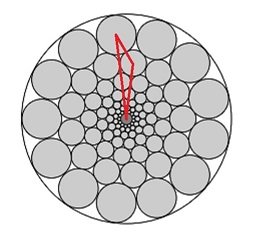
I don't know where you got those numbers from, but have you interpreted [math]\alpha (R-r)[/math] as [math]\alpha[/math] as a function of [math]R-r[/math] instead of [math]\alpha[/math] multiplied by [math]R-r[/math]? [math]\alpha[/math] is the ratio of the radius of the second outermost circle to the radius of the outermost circle. It is also the ratio of the distance between the centre of the large circle and the center of the second outermost circle to the distance between the centre of the large circle and the center of the outermost circle. Thus, [math]\alpha r[/math] is the radius of the second outermost circles, and [math]\alpha (R-r)[/math] is the distance between the centre of the large circle and the center of the second outermost circle. I chose to define the ratio [math]\alpha[/math] rather than the radius and distance themselves. Much of the solution was about finding the value of [math]\alpha[/math], and even then, only for very large values of [math]n[/math]. It should be noted that the same value [math]\alpha[/math] describes both ratios because the second and subsequent outermost layers of circles are scaled down versions of the outermost layer of circles.
-
I know it's off-topic, but I feel the need to say that the message of the article is for people to keep up-to-date with their COVID-19 booster shots, not that the COVID-19 vaccines do not work!
-
The outer event horizon would expand in accordance with the extra mass of the infalling black hole, but the inner event horizon would remain intact as the boundary from which light can't even escape to inside the outer black hole.
-
The Proof of the 3X + 1 Conjecture
-
I have read the suggestion that the universe, represented by the Friedmann-Lemaître-Robertson-Walker (FLRW) metric, can be regarded as the time-reversal of a collapsing matter black hole. I don't know if this is true, but I do see it as plausible. It should be noted that the radial coordinate of a Schwarzschild black hole is timelike to an observer who is inside. Thus, to an observer inside the black hole, the singularity is not located anywhere in space, but in the future. Also, the FLRW metric is conformally flat, which is exactly not the spacetime of a Schwarzschild black hole. But the interior of an infalling matter black hole is not a Schwarzschild metric and may be more like the FLRW metric. A black hole can exist inside a larger black hole. Given that nothing special happens when an object crosses the event horizon of a large black hole, it is reasonable to conclude that a small black hole can cross the event horizon of a much larger black hole completely intact.
-
Considering the Schwarzschild metric, there is no upper limit to mass, and therefore no limit to the size and how close to zero the density can be. However, there may be limits at the cosmological scale. For example, I doubt that a black hole can be less dense than the universe as a whole. If the region surrounding a black hole is denser than the black hole, then the total mass of the black hole and the surrounding region would be large enough for the surrounding region to be also inside the black hole.
-
That's ok, I was curious. How did you solve the second problem?
-
It's worth pointing out that although for a small black hole, the tidal forces may be so intense as to cause "spaghettification" well outside the event horizon, for an extremely large black hole, the tidal forces may be so weak that one might not even be aware that one has crossed the event horizon. Also, black holes have a peculiar property compared to ordinary matter: the mass of a black hole increases linearly with respect to radius, in contrast to the cube-power for ordinary matter. Thus, extremely large black holes have very low density. One only needs to accumulate enough matter into the large volume to form the large black hole... one doesn't need to compress anything.
-
No. This is what Wikipedia says about the use of "arbitrary" in mathematics: This is different to "random", which is associated with chance events and probability, neither of which apply to "arbitrary". Are you talking about finite lists of finite sequences, or are you talking about what Cantor is talking about... infinite lists of infinite sequences? It seems to me that you are talking about finite lists of finite sequences, in which case, you can't argue against Cantor, who is talking about infinite lists of infinite sequences. If you are talking about infinite lists of infinite sequences, then you are not taking into account the infinite nature of the sequences and lists.
-
With the solution to the second problem in place, I decided to provide a solution to the generalised intermediate version of this problem, where the first and second problems are the two extremes. Because much of the solution to the second problem is unchanged in the solution to the generalised problem, I shall only include the parts of the solution that have changed. Let [math]\sigma[/math] be a parameter, [math]0 \leqslant \sigma \leqslant 1[/math], such that [math]\dfrac{\sigma \pi}{n}[/math] is the angle between the line joining the centre of the large circle to the centre of the outermost circle and the line joining the centre of the large circle to the centre of the nearest second outermost circles. Applying the law of cosines and continuing as shown in solution to the second problem: [math](1 + \alpha)^2 \cos^2\dfrac{\pi}{n} - 2 (1 + \alpha) (1 + \cos\dfrac{\sigma\pi}{n}) + 2 (1 + \cos\dfrac{\sigma\pi}{n}) = 0[/math] Note that the angle associated with [math]\cos^2\dfrac{\pi}{n}[/math] has a different origin to the angle associated with [math]1 + \cos\dfrac{\sigma\pi}{n}[/math]. [math]\phi = \dfrac{\pi}{n}[/math] [math](1 + \alpha)^2 \cos^2\phi - 2 (1 + \alpha) (1 + \cos\sigma\phi) + 2 (1 + \cos\sigma\phi) = 0[/math] [math]\phi \approx 0[/math] , [math]\cos\phi \approx 1 - \dfrac{1}{2} \phi^2[/math] : [math](1 + \alpha)^2 (1 - \phi^2) - (1 + \alpha) (4 - \sigma^2 \phi^2) + (4 - \sigma^2 \phi^2) = 0[/math] Solving the quadratic equation for [math](1 + \alpha)[/math] : [math]1 + \alpha = \dfrac{(4 - \sigma^2 \phi^2) - \sqrt{(4 - \sigma^2 \phi^2)^2 - 4 (1 - \phi^2)(4 - \sigma^2 \phi^2)}}{2 (1 - \phi^2)}[/math] [math]1 + \alpha = \dfrac{(4 - \sigma^2 \phi^2) - \sqrt{(16 - 8 \sigma^2 \phi^2 + \sigma^4 \phi^4) - (16 - (16 + 4 \sigma^2) \phi^2 + 4 \sigma^2 \phi^4)}}{2 (1 - \phi^2)}[/math] [math]1 + \alpha = \dfrac{(4 - \sigma^2 \phi^2) - \sqrt{(16 - 4 \sigma^2) \phi^2 - (4 \sigma^2 - \sigma^4) \phi^4}}{2 (1 - \phi^2)}[/math] [math]1 + \alpha = 2 - \sqrt{4 - \sigma^2}\>\phi[/math] [math]\alpha = 1 - \sqrt{4 - \sigma^2}\>\dfrac{\pi}{n}[/math] [math]1 - \alpha^2 = 2 \sqrt{4 - \sigma^2}\>\dfrac{\pi}{n}[/math] [math]\displaystyle \lim_{n\to\infty} P = \dfrac{\pi}{2 \sqrt{4 - \sigma^2}}[/math] For problem #1, [math]\sigma = 0:[/math] [math]\displaystyle \lim_{n\to\infty} P = \dfrac{\pi}{4}[/math] For problem #2, [math]\sigma = 1:[/math] [math]\displaystyle \lim_{n\to\infty} P = \dfrac{\pi}{2 \sqrt{3}}[/math]