Lorentz Jr
Senior Members
-
Joined
Everything posted by Lorentz Jr
-
 Because it's frame-invariant. It's not specific to those observers. All observers will agree that 500 times more time elapsed on Earth than on the spaceship. Their calculations will be different, but their results will all be the same.
 -
But absolute ratios, at least. Clocks (and everything else) on the spaceship ran 500 times more slowly than identical clocks (and everything else) on Earth, even if the astronauts didn't notice it during the voyage. That's a real physical result.
-
Does anyone on this thread realize that @Boltzmannbrain's use of the term "time dilation" is different from its usual meaning in relativity? He doesn't mean external observers see a moving clock as ticking slowly, he means a comoving observer either perceives or can detect some kind of objective slowness in the clock's behavior. (And he's saying that doesn't happen.)
-
Your use of the word "twins" is meaningless. 😄 Apparently there's an infinite number of trolls on the internet. 🙄
-
Your use of the word "happen" is meaningless. What happens to the astronaut is that his beard grows less than his twin's beard, regardless of how he perceives the flow of time, i.e. how time flows "for him". There are only two twins in the twins paradox.
-
What do you mean by "using", martillo? Most people solve rocket problems without every writing down "F = ma". How can they be using F = ma if they never write it down?
-
But I'm not solving a rocket problem, martillo. I'm using F = ma to derive F = dp/dt so people can use F = dp/dt to solve rocket problems. What do you mean by "used", martillo? Most people use F = dp/dt in their calculations. How are they "using" F = ma?
-
Using F = ma (Newton's second law) for the mass dmgas of exhaust gasses, we have the internal force of the rocket acting on the gas: Fint = dmgas (-ve/dt) = -ve dmgas/dt And the action-reaction rule (Newton's third law) says the exhaust gasses exert an equal and opposite force on the rocket. Defining Fext as any external force that might be acting on the rocket, F = ma for the rocket is Ftot = Fext + Fint = Fext + ve dmgas/dt = mrocket a = mrocket dv/dt Defining the final (backwards) speed of the exhaust gasses vx = ve - v, and remembering dmrocket = -dmgas, Fext = -ve dmgas/dt + mrocket dv/dt = -(v + vx) dmgas/dt + mrocket dv/dt = v dmrocket/dt + mrocket dv/dt - vx dmgas/dt Fext = d(mrocketv)/dt + (-vx) dmgas/dt = dprocket/dt + dpgas/dt = dp/dt You can see there are two contributions to dp/dt: The change in mv of the rocket, plus however much (forward) momentum is carried away by the exhaust gasses.
-
I should have said "can be" instead of "is". Is there something wrong with this, in the context of rockets?
-
It sounds like a reference to GR, saying the falling object isn't accelerating downward.
-
F = ma doesn't work in complicated situations involving relativity and quantum mechanics, and nobody cares whether it's the "real" equation for rockets. F = dp/dt is just as correct and easier to use.
-
Same thing. If data comes in continuously, in an analog system, it means averaging over only a short period of time. Not long enough to eliminate the high-frequency noise.
-
A snapshot is the values of all the inputs at some point in time. Yes, "take the average over" is the same as "take the average of", except "over" is more suggestive of a time series, as in "take the average over a period of time".
-
Meaningless word games. If time dilation "happens", it has to happen to the astronaut, because his state of motion changed. Your definition of time is meaningless. The twins are standing right in front of each other, each tugging on the other's beard.
-
That doesn't mean it didn't happen. It only proves that it wasn't perceived in the dilated reference frame. Then it's real. By definition, anything that everybody agrees on is real. Actually, that is the definition of time dilation. If the person noticed something happening, it would be considered some kind of more specific change, not a change in the flow of time itself. By definition, time dilation is when less time elapses in one reference frame than in some other frame. The thread is about time dilation, not length contraction.
-
It's the same thing, martillo. F = dp/dt is derived from F = ma. It's just a simpler form for when the mass of the object changes.
-
Using F = ma (Newton's second law) for the mass dmgas of exhaust gasses, we have the internal force of the rocket acting on the gas: Fint = dmgas (-ve/dt) = -ve dmgas/dt And the action-reaction rule (Newton's third law) says the exhaust gasses exert an equal and opposite force on the rocket. Defining Fext as any external force that might be acting on the rocket, F = ma for the rocket is Ftot = Fext + Fint = Fext + ve dmgas/dt = mrocket a = mrocket dv/dt Defining the final (backwards) speed of the exhaust gasses vx = ve - v, and remembering dmrocket = -dmgas, Fext = -ve dmgas/dt + mrocket dv/dt = -(v + vx) dmgas/dt + mrocket dv/dt = v dmrocket/dt + mrocket dv/dt - vx dmgas/dt Fext = d(mrocketv)/dt + (-vx) dmgas/dt = dprocket/dt + dpgas/dt = dp/dt You can see there are two contributions to dp/dt: The change in mv of the rocket, plus however much (forward) momentum is carried away by the exhaust gasses.
-
Really? Do you have some proof or evidence for that? According to the Lorentz transformations, less time passes for the astronaut in the twin paradox than for the twin who stayed on Earth. In @martillo's language, the earthbound twin's beard is longer than the astronaut's beard. What part of that do you not believe, and why don't you believe it?
-
By convention. For quantitative accuracy, the important thing is that the ratio of the slopes is equal to the reciprocal of the ratio of the speeds. rslopes * rspeeds = 1.
-
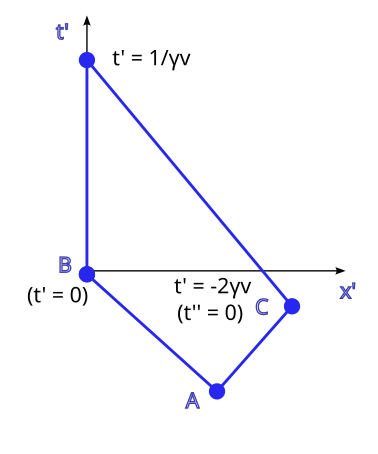
The graph shows t'. That's the reading on B's clock, not on C's clock. The problem is symmetric in A's reference frame, so the elapsed times for B and C are equal. Time passes more slowly on C's clock, and that makes up for the longer elapsed time from C's signal on B's clock.
-
The ratio of 1/γv to 2γv in the diagram is about 6, so we have 1/γv = 6 * 2γv 1 + v2 = 12 v2 v2 = 1/11, so v = 0.30 and γ = 1.05. Point A should be a little bit higher, so the signal paths are closer to 45 degrees (or at least so the slope of the signal lines is 0.3 times the slope of the line from C to the meeting point).
-
For v = 0.866, γ = 2. So 1/γv = 0.577 and 2γv = 3.46. You're right martillo, the diagram is quantitatively inaccurate.
-
Except it's not that simple, martillo. They also transform t, so "midpoint" preservation only applies to equal values of t (simultaneous in A's frame), not equal values of t' (simultaneous in B's frame).
-
More confusion. @martillo keeps trying to analyze the signals from A to B and from A to C in B's frame, and I'm starting to lose patience with it. Notice how he puts A midway between B and C, ignoring the time axis. D is more confusion.
Important Information
We have placed cookies on your device to help make this website better. You can adjust your cookie settings, otherwise we'll assume you're okay to continue.