nir99
Members
-
Joined
-
Last visited
Everything posted by nir99
-
i can't understand to what you aim, the 2 objects move in x axis relative to the floor and mass m moves also in y axis. the 2 objects, N*sin(aplha) is the resultant force that cause the acceleration in x axis but opposite direction so i get from there that -m(ax)=Ma(M)
-
so because mass M is moving to the right and mass m is on top of it, mass m has a net acceleration to the right in the x axis. 2 components : ax(relative to M) to left and a(M) to right and it's resultant in x axis is: a(relative to ground)= -ax(relative to M)+a(M)?
-
i cant think of 3 but 2. it there was no movement of the wedge then it would slide at g*sin(alpha) in angle (aplha) but it has the acceleration of the wedge affect on it too.
-
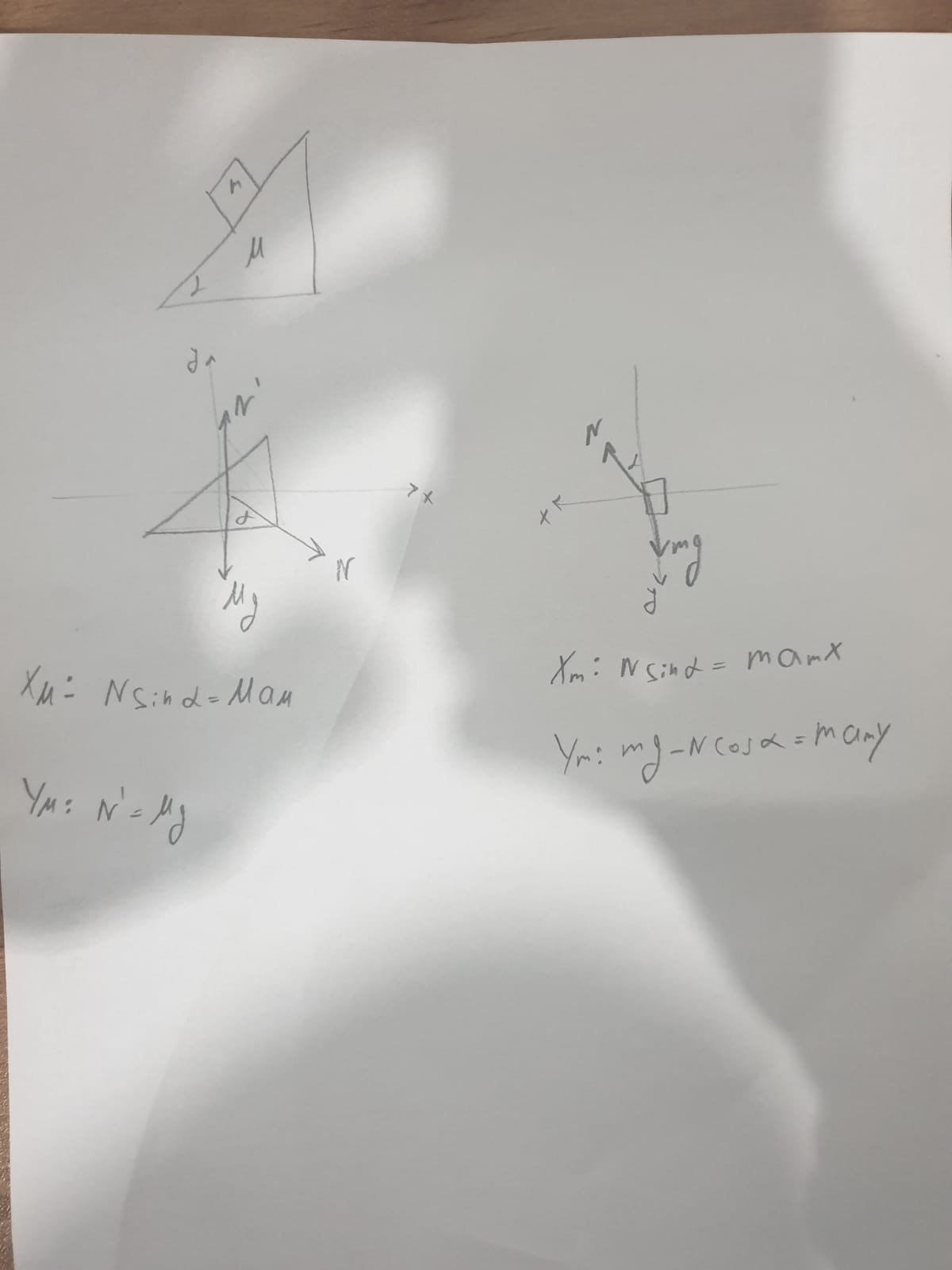
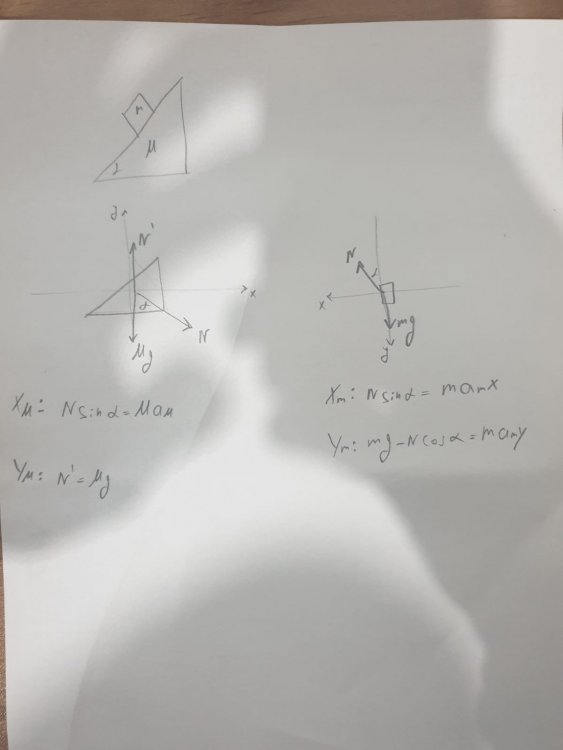
sorry for not being clear , i'm not good at english. there is no friction between the plane and the block. the floor and the plane the movements i think that happen is : block m slides on top of inclinced plane M , inclined plane M has acceleration a(M) reletive to the floor only in x axis. block m has x and y component . his y component that reletive to the ground equal to the one that reletive to the inclined plane because plane M doesnt have y component. i chose the left direction to be the positive x d of m and downward to be the positive y axis mass M right direction is the positive x.
-
you mean like this?
-
they are equal
-
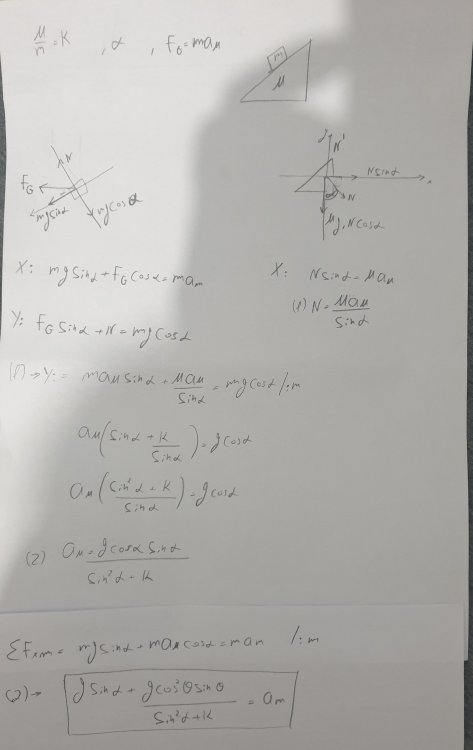
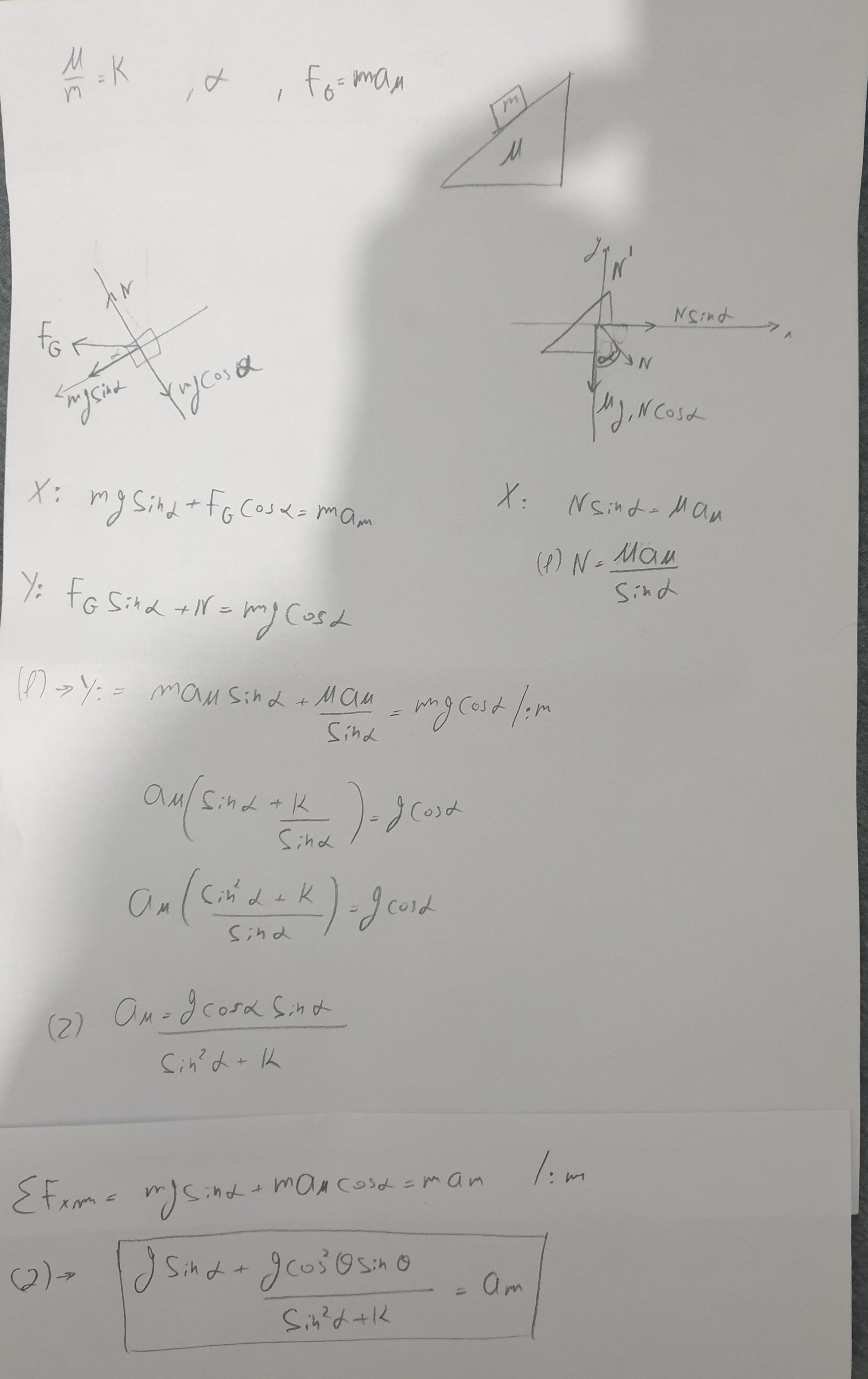
i learned that by including fictitious force i can solve the problem of mass m as i would if it wouldn't be on accelerating plane. in my free body diagram the N that m exert on M has 2 components on x axis as i wrote Nsin(alpha)=Ma(M) and y component that N(with floor)=Mg+Ncos(alpha) and N that M exert on m if i dont add the fictitious force is equal to mgcos(alpha)
-
hello, the question is: there is block m on top of an inclined plane M the ratio of the masses M/m is given by k. angle alpha is given. find the acceleration of the masses. i tried to solve this with fictitious force (F(G)) that exerts on mass m to the left with the magnitude of m*a(M) and my question is if the a(m) that i got is relative to the ground or to the plane, and if it is to the plane then how do i find the acceleration of mass m relative to ground? another question is how can i solve this without using a fictitious force. thanks for the help