Barmaley
Members
-
Joined
-
Last visited
Everything posted by Barmaley
-
I will define it this way: We present arguments pro and con. Then we select randomly reasonable large number of people with sufficient credentials and ask them to read it. The condition is that they are reading the whole board first time but they may have some previous thoughts on the subject. If over 90% of such readers take one side we call it "definitive". If over 80% agree we may label it "convincing etc.
-
I realize my initial question may not have been communicated clearly, which likely explains why I didn’t receive insightful suggestions. Let me rephrase it: In a public forum restricted to qualified experts, is it possible to reach a definitive conclusion—even on a narrowly defined topic—without lingering reasonable doubts? I’ll use Trump’s tariffs as an example of such a focused subject. Defining Success: The First Hurdle A logical starting point would be to establish criteria for success. One straightforward proposal might be: Tariffs are successful if they increase the aggregate wealth of the United States. However, critics could argue that since tariffs function as a regressive tax (disproportionately affecting lower-income groups), a scenario might arise where the top 1% grows richer while 5% of Americans face severe deprivation to the point of starvation—even if total wealth rises. Would we still deem this a "success"? Other complexities (too numerous to list here since I suspect that the posts here have allocated a limited space) further complicate the selection of the criteria. Even defining the core objective of the discussion proves difficult, and each tangential issue would branch into exponentially more subdivisions, rendering conclusive agreement unlikely. This, I suspect, is why many discussions are performative—participants engage without expecting resolution.
-
Unfortunately, they are not. While the main idea there presented thoughtfully it was a one-sided view on the issue. I was trying to google (is there a way to say "to perplexity"?) the tariff info and found that majority of opinions are strongly negative. However, it is hard to find any serous and deep arguments pro tariffs. There are several right wing sources which take Trump's side, unfortunately they are more declarative and not informative. I would really would like to see an expert opinion which can show the thought process of tariffs proponents. I still need to emphasize that issue of tariffs is only 10% if my interest. I would like to focus more on the phenomena that there are very important topics which deserve serious consideration and they are not scrutinized publicly. Another example could be if we need to run standardized text for school children or do statins help against heart disease etc. Will it be accurate to say that the main reason that people are not trying to discuss important topis that the discussions would not be fruitful since of truth discovery is not achievable through such means as professional public collaborative forum? I am sorry if I did not explain myself clear since English is my second language.
-
Here’s a refined and clarified version of your text with improved flow and precision: My primary focus is not on whether tariffs are a good idea but rather on the epistemological and gnoseological dimensions of achieving deep understanding through collaboration among qualified individuals. The tariff question serves merely as an example of issues with significant public importance—worthy of rigorous investigation—yet it is just one among many. It would seem beneficial for society to institutionalize such discussions, yet this has not become standard practice for tariffs or analogous topics. One prevailing view suggests that certainty in these debates is unattainable due to the inherent complexity of the knowledge involved: research trajectories may diverge rather than converge into a coherent body of statements deemed most plausible under scrutiny. The core question, then, is whether topics like tariffs are determinable—amenable to conclusive analysis—or if their factual underpinnings are too ambiguous to resolve decisively.
-
Before addressing the three factors you mentioned, I would like to clarify what I am trying to understand. My primary concern is not the specific economic aspects of tariffs but rather the general mechanics of how a well-moderated, expert-driven discussion could illuminate a complex subject. Specifically, I wonder whether such a discussion could clarify the initial research topic to the extent that a large number of random, smart, educated, and unbiased individuals—who did not participate in the forum—could read through it and arrive at a clear, certain, and similar understanding of the issue. Regarding the factors: A) This scenario is admittedly hypothetical, as implementing such conditions in reality would be challenging. However, for the sake of argument, let’s assume that the forum is well-moderated, consists solely of numerous experts in the relevant field, and that these experts initially hold differing positions but engage in good faith to uncover the truth. B) I chose tariffs as an example because they represent a complex and nuanced topic that likely cannot achieve 100% certainty in conclusions (as might be possible with hard science questions like mathematics). However, tariffs provide sufficient criteria—such as inflation, trade deficit, unemployment rate—for making assertive judgments. The logic and reasoning applied to these measurable factors should facilitate a well-founded conclusion. C) Defining the question itself could be an initial step within the forum’s discussion. For instance, determining what constitutes "good for the USA" might involve criteria such as overall economic effectiveness or common wealth. It’s reasonable to expect that experts could quickly establish such definitions to guide subsequent discussions. The reason I am asking this is due to a recent argument with someone who claimed that even under ideal conditions—free from trolls and bots, with devoted experts working diligently over time—the discussion would diverge rather than converge toward a conclusion. I’m curious whether this assertion holds true or if such forums could indeed produce clarity and consensus
-
If a public forum were created to discuss complex and controversial topics—such as whether Trump's tariffs are good or bad for the USA—and participation was restricted to experts with PhD-level qualifications in economics or political studies, would the discussion eventually converge on a reasonably high level of certainty regarding the issue?
-
Great Dimreepr, I learnt a new word: arborist! On the serious note I can not agree more that the knowledge tree sounds a bit off. Can you think of the better name? We just created a new version of that old project and started populate the front page with titles. You may check it out here: gistlogger.com Any advice will be appreciated.
-
The goal is to make it manageable. It will be hard to scroll through 17 items, I guess it is fasted to scroll down by the tree branch and combine top subjects into groups. Thus one can get to his/her point of interests faster.
-
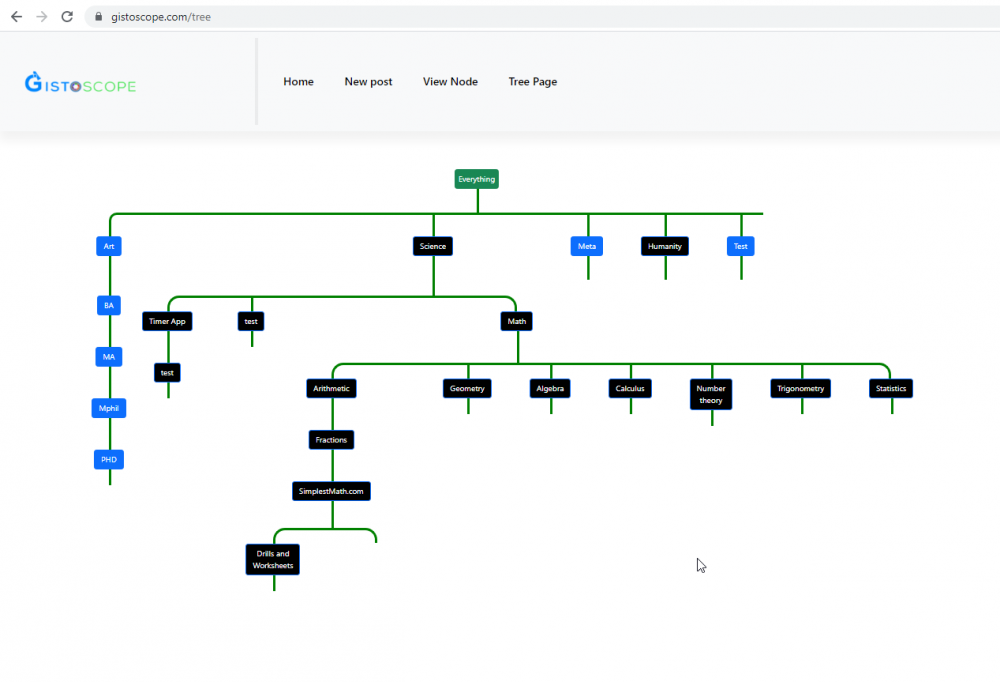
@Peterkin Thank you for wiliness to help! Please, keep in mind that the site is in its infancy and we are working on a beta version to test functionality, so we could define the features for the next version. There are currently two pages which you may suggest changes from aesthetics and them most important, easiness of information retrieval. Obviously, the first is the knowledge page which is currently made without any professional design by developers. Next step would be to decide what is needed to be added to the knowledge tree page. Next step would be how to make it beautiful and easy to navigate. The second page which is challenging here is the main page where users can communicate their ideas. It is similar to a nested forum but provides more options and controls. The objective is to deliberate a selected topic in depth rather then to briefly discuss many topics which typical for standard forums. It should be possible here to examine every essential element if the topic with a goal to achieve a closure in the discussion (as far as it can be achieved). Obviously not every topic worth such efforts, however, if a topic as an essential to us we need a tool to make it fruitful. The thread here is nester where several users can respond to original post as well as many users can provide a response to any reply to the post. It means that a sidetrack post can not distract from the main topic. In addition it is possible to start a branch topic to focus on a part of a post (for instance, to argue one specific statement which seems to be controversial but is an important part of the subject under consideration). In addition the users can instead of sending a reply can comment inside the post or create an edit of the same post. It was found that editing other people writing is another form of communicating your ideas. This is just a brief overview of the tool and it is hard to describe it in a short paragraph. For users who are not in a position to submit a full format post there is an option to comment to other posts, thus each post has comment thread which is essentially a standard nested forum style thread. We created a beta version of the engine and found it to be not too user's friendly. To provide flexibility to review the posts we introduced a mouse drug function of posts so you can re-arrange them on a screen in any possible way but the screen can easily become a mess and we decided to convert it from drug to scroll for easier users experience. Since there are two major types of posts (replies and edits) we have to provide two ways of scroll: vertical and horizontal. It may take several day for me to provide with screen shots of the main page made in the scroll mode. I know that this description was not clear to understand without seeing it in actions but I did the best I can provided that English in not my native language. Thank you very much the suggestion! It is really useful, I was actually was looking for already tested solutions like this. The next top level subject I can steal to our knowledge tree would be entertainment. For the most part I have problems with this classification and I am sure it is a fruit of my ignorance. 0 is Science and Knowledge. 9 is Geography.... History. I thought that geography are history are science? If 0 is science then 3 3 Social sciences should be a sub-subject of 0 science I guess... The most fun I had with #4. If this is not patented I am going to steal this idea and use it! I am still looking for a one word term for human-centric subject which can host a bunch of sub-categories. Are there any objections on having on the first level Science, Art, Events, Entertainment and Esotericism? The goal of the tree is to provide fast and intuitive way to get to any subject on knowledge in the minimum number of steps on the tree.
-
Excellent point! I would even go further and make it Events instead of Current Events following the same logic - for how long events are current? This help could be very essential since we are trying to solve another hurdle: the structure of the site is multi-nested (it means that you may nest elements inside a larger element which can be nested to its parents). In addition we will allow multiple entries (edits) of the same article which makes it a 3D structure which we must show on a flat 2D screen. We have several solutions and and still working on design and aesthetics of layout. Is your site still live and is it available to public to see? Not really. We are working on a tool for deliberation of complicated concepts and theories. So far I can see only 4 subjects which deserve to be starters for all branches of knowledge: Science, Art, Events and Esotericism (Religions, conspiracy theories and all forms of unknown). Am I missing something here or everything can be squeegeed in one of those categories?
-
This is the only based on usability of the website screen site which has to contain all the subjects on one page for better users experience. We thought that it was always possible to combine sub-subject into a group to which we can provide descriptive title. For instance if you use "cats" as a parent the do not have to list all the cats in the next level as children but divide them first into Large Cats, Medium Cats, Small cats and Cats without stripes to kind of evenly divide the children into groups. The benefit of this approach is efficiency for a user to get to his subject quickly since if are you looking for a tiger you do not need to review a list of 300 types of cats but first select large cats and then look for tigers. @Peterkin, since you have experience of working with a child/parent classification list we would appreciate any advice you may give us in the knowledge tree construction. It is important to note that we are not only focus on science subjects but all real word thing. For instance we need a chapter for "News" since in the portal which we are trying to do we need to foresee all possible area of human interest which people many be willing to discuss. This is what does not let us sleep at night! LOL. In our case we have to give an option to users to be able to contribute to the tree development (which obviously will be heavily moderated). He hope that after initial push the tree will grow itself.
-
Hello Everybody, I need your help in a project which I am trying to do on the web. Part of the project is what I call a Tree of Knowledge. We would like to let our users to get to any subject of general knowledge by dividing global knowledge into sections. It is easier to explain in example. If we have a starting subject as Math, then we can make sub-subjects like Algebra, Arithmetic, Geometry, Statistics etc. At the same time sub-subject Geometry can be in its turn to be divided to lower level sub-subjects like Axioms, Definitions, Nonlinear Geometry etc. To make the tree manageable we decided to limit to 8 number of children each parent subject my have. Now the challenge: how to start. We think that the very top it easy: we call it Everything and it is a starting Subject. Now we need to divide it into first 8 sub-subjects on the most rational way. Obviously, we can start with Science, Art, and Humanity. Some people suggest to add Religion as a top sub-subject. What does philosophy prescribe as the top level of knowledge division? Sorry for this unusual request but we hope to be forgiven considering the fact that our technical university in the former Soviet Union taught us Communist's philosophy instead of real thing, so you help will be highly appreciated!