markg85
Members
-
Joined
-
Last visited
Everything posted by markg85
-
I really like this idea! With a little twist to it though The apartment has a water loop for specifically heating. Existing radiators are connected to that. However much i love to cut that loop out of my house (as i don't use it and it only costs me money), i sadly can't temper with it in anyway. Funny how being the owner of an apartment still doesn't mean you're allowed to do anything you want with it. So tempering with that is no option. But you gave me a great idea! I can just add a radiator and let cold water flow through it. It might even be possible in a closed loop system where i'd just put a water reservoir somewhere along with a water chiller connected to that reservoir to get it at a constant cold temperature. This concept is basically the same as closed loop water cooling in a pc just on a much larger scale + with an added chiller as i think only a radiator with some fans won't get it down to ~5 degrees Celsius. This sounds like a fun doable project! Thank you so much for the inspiration! Well, for the walls inside my house that shouldn't matter much. The outer walls facing outside did have brown as color. That recently changed to white though i have no clue if that paint contains Titanium Oxide. I'll have to check that as they are still painting those walls. Well, yes and no. I do have a separate hot water loop for only the radiators. That's a loop along the edge of my whole apartment. The exit point is the "colder" water after it passed through all the radiators. However, tempering with that is a very big no-go! Also, that water is freaking hot, so if i were to add in cold water that would be a waste for the whole apartment building heating system. For you all. Sorry for being so extremely late in responding. I literally had this page open for months in my browser to "respond tomorrow" and kept forgetting it. I do really appreciate the ideas you folks have given me!
-
Hi @Externet Regarding the mains water temperature. Right now that's around 4 Celsius. Nice and fresh! I sadly didn't measure the mains cold temperature in the summer but i believe it's still rather cold. I'm guessing between 6 and 8 Celsius. As for ground source well in the vicinity. The downside of living in an apartment is not having a garden. A ground source well is kinda ruled out due to that. I i were to have a normal house with a garden then a ground source (a liquid/liquid heat pump) would definitely be my first option here. For the windows AC. That's both yes and no. I'm not allowed to do that in any windows that end up in the corridor (my bedroom). I am allowed to do that for balcony side windows. That being said. In my hypothetical setup in the first post i'd be having a glycol chiller. That one would be placed on my balcony with piping going from there to my bedroom. It's the same for an AC using, just the piping would be different to handle those refrigerant liquids.
-
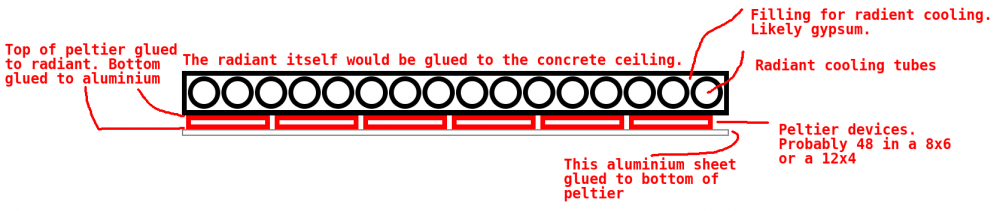
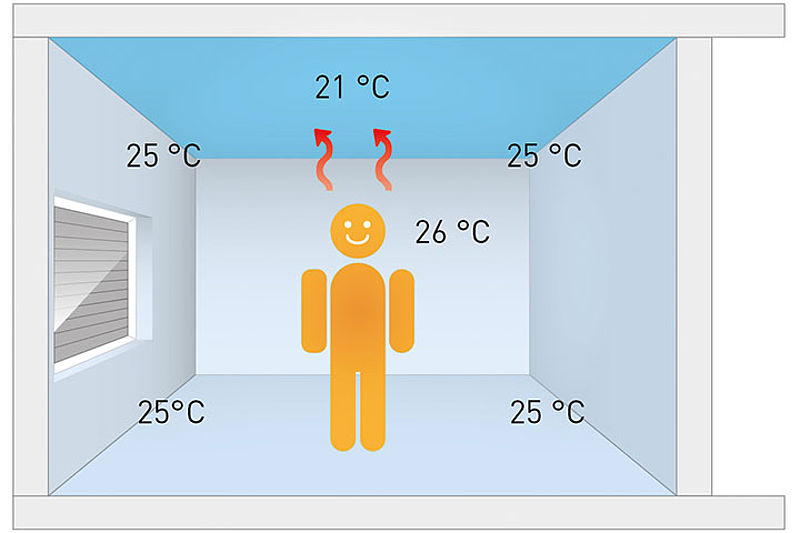
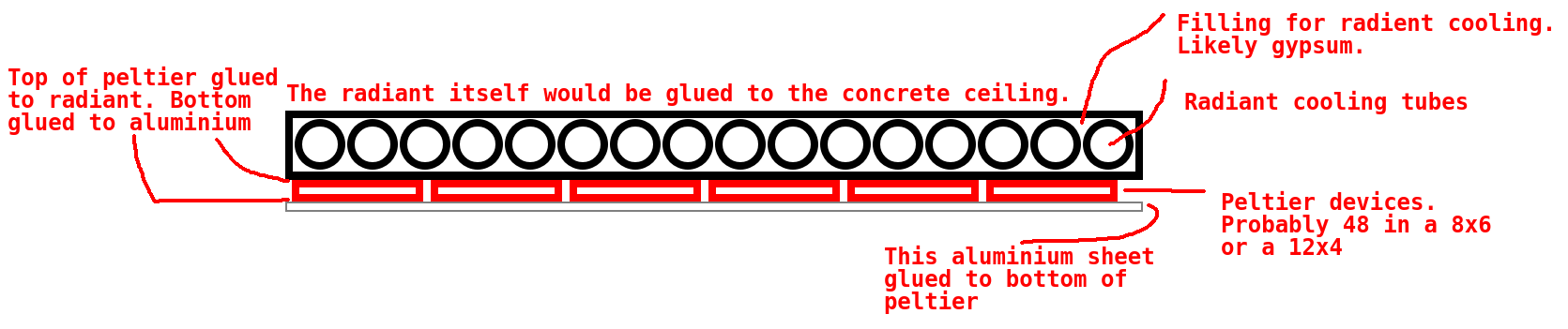
Hi, Sorry for this huge post. You've been warned For this to make any sense at all, i must first explain a bit why i'm thinking about room cooling and make a post in this forum. I'm living in an apartment in The Netherlands on the first floor. I have neighbors on my left, right and above. Below my apartment are storage rooms. The ceiling of those storage rooms (that would be my floor) are covered in hot water pipes. If you see my apartment as a rectangle then the two long sides are made of concrete, the walls between my apartment and my neighbors. The remaining sides are just the façades where there are windows with double layered glass. Of all the rooms in my apartment, my bedroom is right next to the corridor. Meaning that i can't open windows at night as people walking by would be too clearly audible in my room. It's like they stand in my room. Take that as a given fact. There's hardly anything i can do about that setup besides selling my house That was just to set the stage to give a bit of a mental picture of what i have to deal with. Now in this house i'm having a severe heating problem. Because i'm quite literally "boxed in" by "entities" that heat up "my walls", i'm effectively getting a warmed up house without doing anything. This at first glance might sound like "ohh, so you have free heating, lucky you"... Well, i hate it I'm not in control of the temperature in my house at all because of it and that's getting a bit too extreme. For reference, when i'm not doing anything, it's already like 22-24 Celsius in my house. Actually, i only need to turn on my heating when it's freezing like -10 Celsius outside or when there's a strong chilling wind. That effectively is only 1 or 2 weeks a year here. Opening up the windows (which are often open) does help and makes it ok-ish most of the time. Except in my bedroom, as that room is placed in the most inconvenient way to make airflow quite tricky. Now i can nearly hear you ask: "How are your neighbors handling this issue? Surely they have the same?". My neighbors indeed have the same issue. But there's a bit of a difference. Most of the neighbors that have this issue have bought an airconditioning. Those that remain have a different internal apartment layout (most notable the bedroom on the backside of the apartment (thus not aligned with the corridor) which allows them to open windows and just have a lot less trouble with heat. How about buying an AC(air conditioning)? I refuse. I did ask for a couple different companies for a quotation. But because my bedroom is on the corridor side, the piping needs to go through my entire house (depth wise) to be placed on the balcony. On top if that, the prices were around 5000 euro's for a split unit + installing all of it. To add to that, it would be a super heavy power user of about 2 KWh. Granted, it would have been 2 indoor units with one for my bedroom and one for my livingroom. Still, none of this sounded like something i wanted. Also, i'm not too fond of air quality claims of AC units (which are apparently not that healthy). And i'm quite heavily against power consuming suckers like that, i just think there are much better approaches. Too bad an apartment kinda rules out most alternatives. Perhaps it's temporary? I've been living here for about 6 years now. It's a constant issue. As soon as the outside temperature gets above ~15 degrees, my house just doesn't cool down enough anymore. My bedroom in particular then is a steady 24-26 degrees Celsius. I'm fine in the rest of my house at those temperatures, just my bedroom really needs to be a lot cooler (like at most 20, preferable 18). Some possible solutions As this problem is going on for years already, I've done quite a lot of research (googling) into cooling techniques. I considered: Mobile AC unit. Impossible as the tube would have to go to the corridor. And that's not allowed according to the apartment rules. Nothing is to be placed on the corridor in a permanent way. A few (high powered) fans. I have them, they relieve it a bit. But in only gives circulation, not cooling. Swamp cooler. I tried that, but that gets too darn sticky and moist after a while. Thinner sheets.... The only thinner way possible is no sheets, let's put it that way I even build wind tunnels with blower fans to create an airflow from the back of the apartment right into the bedroom. It worked somewhat but the noise level was too much to be sanely usable. I have been researching heat exchanges to somehow apply it here. As my room is substantially higher in temperature then the concrete ceiling in my corridor. It's like a 18 degree temperature difference. But then again, i'm not allowed to place things there so that went nowhere. I went through various ways in an effort to get the apartment VvE (association of owners) to invest in isolating the hot water piping much more below the first floor. They can't do it more then has already been done as more would be prohibitively expensive. And so much more (researching room temperature phase change materials, special windows that let air pass but block sound, ....) On to my idea, radiant ceiling cooling! People are probably familiar, to some degree, with radiant floor cooling. I'm assuming you are. Ceiling cooling is literally that but upside down. You cool the ceiling to create a huge thermal mass that then slowly cools your entire room. Also, warmth rises (towards the cool ceiling) and cool air drops (from the ceiling). This effectively makes you feel comfortable even at higher ambient temperatures. How that works exactly is a bit beyond this post, i merely want to do the same concept. This image nicely illustrates how it's supposed to be working. The temperatures in there are coincidentally roughly matching my bedroom (just plucked the image from google images, i didn't edit it). How i envision this is like the classical radiant floor/ceiling way but with a few extra layers. I want to add a layer of peltier devices. They would be glued to the radiant ceiling. Then the other side of the peltier would be glued to one big aluminium plate. When standing below it all you should see is one flat aluminium surface. The following picture represents a cross cut of how that would look like. Note that this is very far from to scale! It merely serves an illustrative purpose. I plan to make this on a 1x2 meter surface. (i see i messed a couple words in my image. Most importantly, the 8x6 and 12x4 are meant as grids) Why the peltier'? Why the layers? Explain yourself! With this cooling idea i plan to use a "glycol chiller" like this one: https://www.youtube.com/watch?v=gBsHgKk9zuk Please do note that i'm merely using it for it's cooling capability. In my purpose it has nothing to do with beer brewing. The chilled water would be pumped through the radiant ceiling tubes. That chiller probably (assumption) has enough cooling power to cool a bedroom under normal conditions. So when the outside temperature is till about 25 degrees Celsius or so. As far as i could find, a decently sized glycol chiller also is quite friendly in regards to power usage. The chiller from the linked video sucks up ~155 watt. I plan to cool the aluminium plate down to about 10 degrees. Though this is dynamic in temperature range. I want to cool it down to just above the dew point temperature. So that it's as cool as it can be without forming condensation. If that temperature is below 10 degrees then 10 is the max, it doesn't need to be cooler. In the case the temperature drop alone can be done by the chiller alone, the peltiers are just powered off. And i suspect this to be the case for, say, 80% of the time. It kinda depends on how fast the chiller can cool down water that was warmed up by having it's run through the loop. When the chiller alone can't cool the area anymore (remember, 1x2 meters for now, the bedroom itself is about 4x that size) then the peltiers kick in to drop the temperature the last part. And as the peltier is glued to the radiant cooling tubes (chilled by the chiller) the "hot side" of the peltier should already be substantially below ambient temperatures. I can therefore use the peltier devices in their ideal situation where they merely need to lower the temperature by about 5 or at most 10 degrees. This, according to the peltier COP curves, puts them in their sweet spot of actually being efficient with a COP rating of anywhere between 1.5 and 3 (that is if i understand the charts correctly). And they aren't using much power at all when then need to reduce a temperature by just 5-10 degrees. Refrigerant vs water A massive benefit in the above setup is water (glycol can be added if needed, but i don't plan to go below freezing). If i were to go for an AC system, i'd have to play with tubes that carry refrigerant. I'm not allowed to do that - by law - and i don't want to play with those chemicals anyhow. The fact that the above linked chiller, while using refrigerant internally, uses water makes it quite easy to get the piping done. Your thoughts? I'm really curious to know what you folks think of this idea! Would it even have a potential to work? I think it has, otherwise i wouldn't have spend about 3 hours writing this post Still, i'm not entirely sure so i'm looking for some opinions on this. Best regards, Mark