Arnav
Senior Members
-
Joined
-
Last visited
Everything posted by Arnav
-
Thank you studiot for the in depth explanation
-
Could you please elaborate what do u mean by "charge"? I mean, are u refering to "kind of charge(+ or -) on the droplets"? One of my ideas is this: The oil droplets caught both - and + charges,(some caught only -, some only +, while some both). Millikan knew how he had arranged the electrodes in the apparatus and how positive and negative charges would interact with them. If the charge on a droplet was net +, it would accelerate down when Electric field strength was increased while it would decelerate if it had net - charge. If it was neutral, there would be no effect. So, Millikan could determine the kind of charge on the droplet just by observing the effect of changing electric field on its vertical speed. Could the situation have been like this? Do you mean that he discovered that the charge was negative on every droplet? If so, why no + charge was found?
-
I was told to find the range of a function f(x) = (x²-1)/(x-1) where x cannot be 1. I know the proper solution is this : Since x cannot be 1, f(x) reduces to x+1 therefore Range = R - {2} Bu at my first attempt I did this: let y = (x²-1)/(x-1) yx - y = x²-1 x² - yx + y -1 =0 For x to be real, the discriminant of this equation should be >= 0 Therefore y² - 4(y-1) >= 0 (y-2)² >= 0 y can take all real values. Now, where did I go wrong? Why is 2 also coming in the range with the second method? How do I distinguish when to find the range using the 2nd method and when not?
-
In Millikan's oil drop experiment, when the oil droplets fell through the hole in the top plate, and passed through the ionised air, did only electrons get attached to the droplets? Or both the electrons and the cations? In my book, only electrons are shown as attached to the droplet. Why only electrons got stuck? Why not the positive ions as well? Or did they?
-
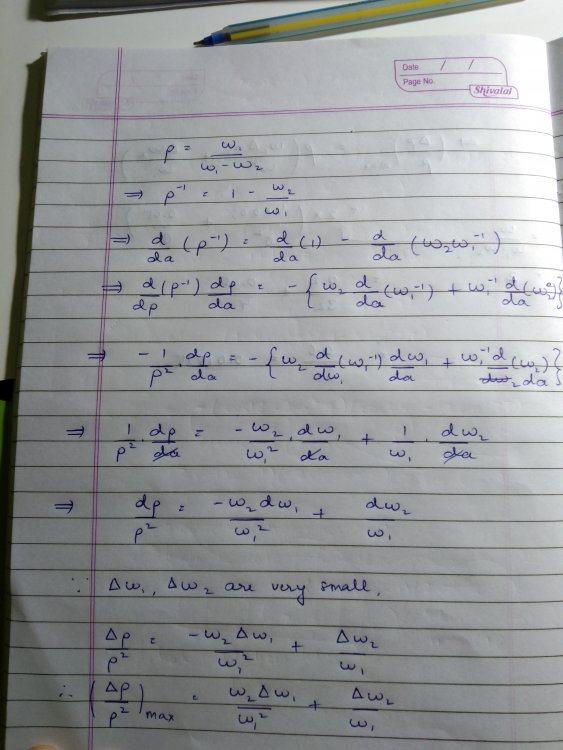
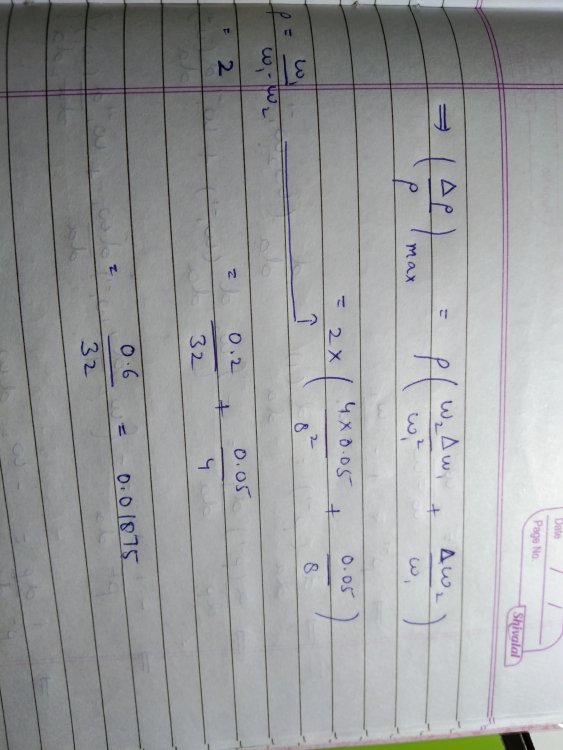
I was required to do the error analysis for an experiment with the aim of finding the relative density of a body. In the experiment, the weight of the body in air war found to be w₁ = 8.00 +- 0.05 N while the weight of the body in water was found to be w₂ = 4.00 +- 0.05 N. Using the relation, ρ = weight in air / (weight in air - weight in water) where ρ denotes relative density, I did the error analysis as shown in the attachment. However, my friend did the error analysis as this: ρ = w₁/(w₁- w₂) Δρ/ρ = Δw₁/w₁ + Δ(w₁- w₂)/(w₁- w₂) Δρ/ρ(max) = Δw₁/w₁ + (Δw₁+Δw₂)/(w₁- w₂) Δρ/ρ(max) = 0.05/8 + (0.05+0.05)/(8-4) Δρ/ρ(max) = 0.03125 Now, which one of us is right? who did it wrong?and how? in which of tge ways should we report the measurement? 2.00 +- 1.88% or 2.00 +- 3.12% ?
-
Oh ok I understood. Thanks !
-
It definitely does! Thanks Hey cuthber, could you please elaborate what do you mean by this?
-
There is a question, a satisfactory answer to which I haven't received for long. In alpha decay, the number of protons in the parent atom decreases by two while the number of electrons in the atom remains same. Does the parent atom on undergoing alpha decay convert into an anion? In the same way, in beta minus decay, the following transformation takes place : ₀¹n ----> ₁¹p + e⁻ + v̅ the proton remains in the nucleus and electron and the antineutrino are ejected. From this, one could conclude that the positive charge on the atom increases by 1 while negative charge remains the same. Does the atom convert into a cation? Similar is an observation for beta plus decay, which appears to convert the parent atom into an anion. Is this ionisation of decaying substance observed in real situations? Or does it not even take place?