Kuyukov Vitaly
Senior Members
-
Joined
-
Last visited
-
In multidimensional models, the behavior of the string and membrane is considered. The membrane is not suitable for the role of quantum particles. You can consider information membranes based on the Fisher metric. B.pdf
-
The nature of the time is counterdiced. On the one hand, the disappearance of time in Wheeler's equation. On the other hand, Penrose talks about the reality of time. There is another definition, in the form of a holographic hypothesis $$ t=\frac{Gh}{c^2} \int \frac{dS}{r} $$22.pdf
-
Solution for space-time metric $$ S = \frac{dV}{dt}=g_{ik}^|g_{ik}V+ π_{ik}g_{ik}V $$
-
Thickness axons ( L ) in the neural network limits speed signal transmission $$ v = \frac{Gh}{c^2} \frac{1}{L^2} $$
-
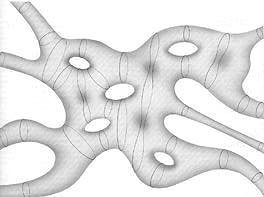
I fully agree with the concept of gravity based on quantum theory. I offer you your point of view. In general, my work is based on a Cotton flow for a gauge field. Let's see further. The theory of everything is mainly associated with the general theory of relativity and the standard model. On the one hand, the equivalence principle and on the other hand the gauge principle. The two principles are completely opposite to use, one for space-time geometry, the other for quantum fields. For the union is looking for a way called quantum gravity. Canonical quantization of gravity is called Wheeler equation. However, there are difficulties, lack of time and the inability to combine with quantum fields. The equation is purely wave and geometric. All fundamental laws are usually symmetrical in time, even the gauge fields of the standard model are reversible. However, in the real world, time has a strict direction to the future. This is another problem. We believe that the quantum gravity equation is not linear in time. This trip is supported by Roger Penrose and Lee Smolin. At the fundamental level on the scale of the Planck, time is real and has an arrow due to the nonlinearity of the quantum gravity equation. In the recent work we generalized the concept of Cotton Flow is not in the form of a metric, but in the form of a gauge field. This equation describes the behavior of nonlinear in the time of the gauge field on the scale of the Planck. $$ \frac{\partial S}{\partial t}= kC $$ $$ A_{i}=\partial_{i} S$$ $$ K_{in}=\partial_{i} A_{n}+A_{i}A_{n}$$ $$ C=e^{inj}C_{inj}=e^{inj}\partial_{i} K_{nj}$$ $$ k=\frac{Gh}{c^2}$$ In this equation for the gauge field, the solution itself is interesting in the form of finding the local phase of the wave function. $$ S=S(x,y,z,t) $$ $$ \psi=e^{iS} $$ The general solution of the nonlinear equation in time will be $$ S=k\int Cdt + \int A^{i}dx_{i} + f(x,y,z,t)$$ Thus, a series of compounds and splitting of cylindrical pipelines together creates a topological structure of a gauge field as a web or in the form of neural networks on the scale of the Planck. The neural network of the gauge field is subject to a nonlinear equation so that it develops in the future and expanded. This neural network is dynamic in time. Consider some solutions for special cases. Gravity and gauge field the scale Planck. In this chapter, we will show how the gauge neural network on the scale of the Planck creates gravity on a large scale, where there is a classic world. Consider the equation of the neural field. We make an assumption that on a large scale curvature of the field due to the least $$\frac{\partial S}{\partial t}=kC=e^{inj} A_{i}\partial_{n} A_{j}$$ Can be determined in the form of a function from the local phase. Decision in the form of a reduction in the rule of differentiation of derivatives $$\frac{\partial S}{\partial t}=ke^{inj} \partial_{n}S \partial_{n}\partial_{j}S $$ Decision in the form of a reduction in the rule of differentiation of derivatives $$v_{i}=\frac{dx_{i}}{dt}=ke^{inj} \partial_{n}\partial_{j}S $$ As can be seen, there is some idea of the speed of movement, that is, the initial concept of kinematics. We introduce the transverse surface in the form of an area $$ dF_{i}=e^{inj} dx_{n}dx_{j} $$ As a result, an additional solution for the local phase of the gauge neural field will be $$ S=k\int Cdt + \int A^{i}dx_{i} +\frac{1}{k} \int v_{i}dF^{i}+ f(x,y,z,t)$$ Moreover, now we will see the appearance of gravity. Consider the kinematic action for the gauge neural network $$ S=\frac{1}{k} \int v_{i}dF^{i}$$ Let the reference system accelerates $$ a_{i}=\int v_{i}dt $$ Then the action will be accelerated $$ S=\frac{1}{k} \int a_{i}dF^{i}dt $$ This definition of action in the form of a function of time, besides, if there is matter in this gauge neural network, the overall action will be $$ S=\frac{1}{k} \int a_{i}dF^{i}dt+ \int Mc^2dt$$ As a result, when variations are obtained, the Gauss theorem is obtained for the source of the gravitational field. $$ \int a_{i}dF^{i} =-4\pi G M$$ Thus, we have the Poisson equation for the gravitational field, which is true in the classical world, when taking into account the signal transmission limit at the speed of light the theory of gravity is described by the general theory relativity. Gravity is a curvature of space-time. On the other hand, our theory also describes gravity as a dynamic state of the gauge neural network. Thus, the source quantum state of space-time is like a neural network on a scale Planck based on a gauge principle. In fact, quantum gravity is a non-linear quantum field theory on the scale of the Planck. WG.pdf