Frenzypopcorn
Members
-
Joined
-
Last visited
-
I am really lost here, is it okay to request for a visual example if you don't mind? The ratios confuses me a lot.
-
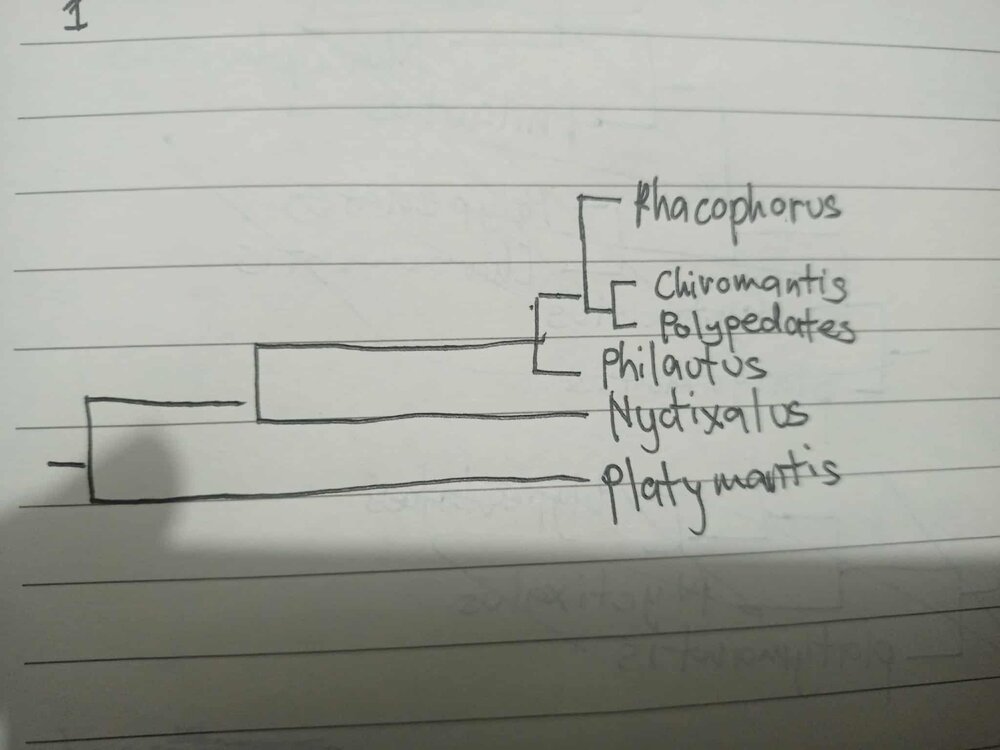
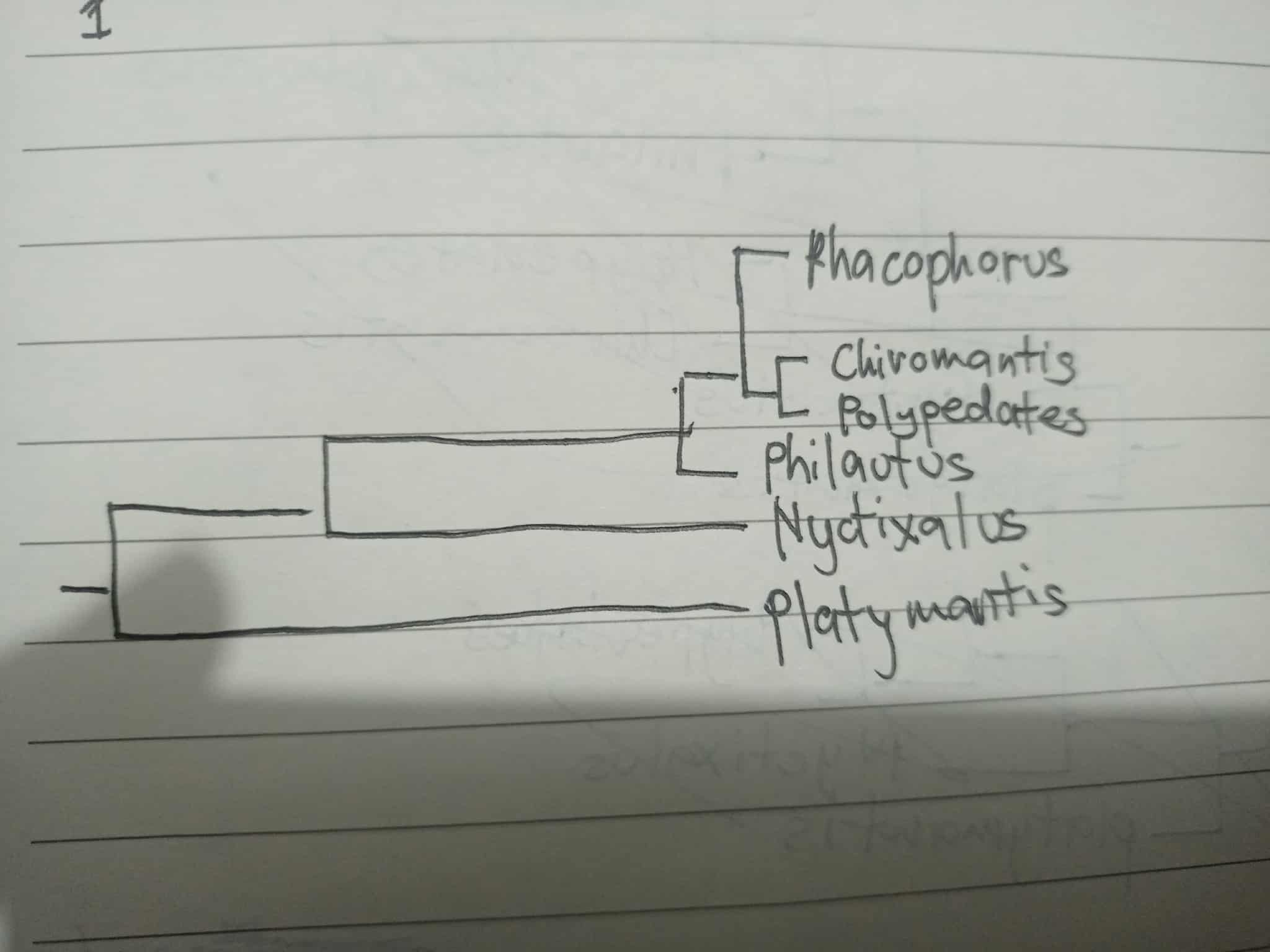
Thanks for the reply, that is really insightful as there is more to it that I didn't know. I actually had a hard time understanding this distance matrix, but our class is just introductory to phylogeny, so I don't think the distances of the branches doesn't matter that much here? What my prof wants us to know is how to relate them based on traits I assume. So Chiromantis and Polypedates would form one cluster, I get that but where do I place Rhacophorus? Should it branch from the Chiromantis and Polypedates clade? Should it have it's own branch? It's actually the one with the most derived traits. So if our prof decided not to combine Chiromantis and Polypedates should I just make this alongside Rhacophorous into a Polytomy? It would greatly help me to know this to avoid similar situations if they arise again. Thank you!
-
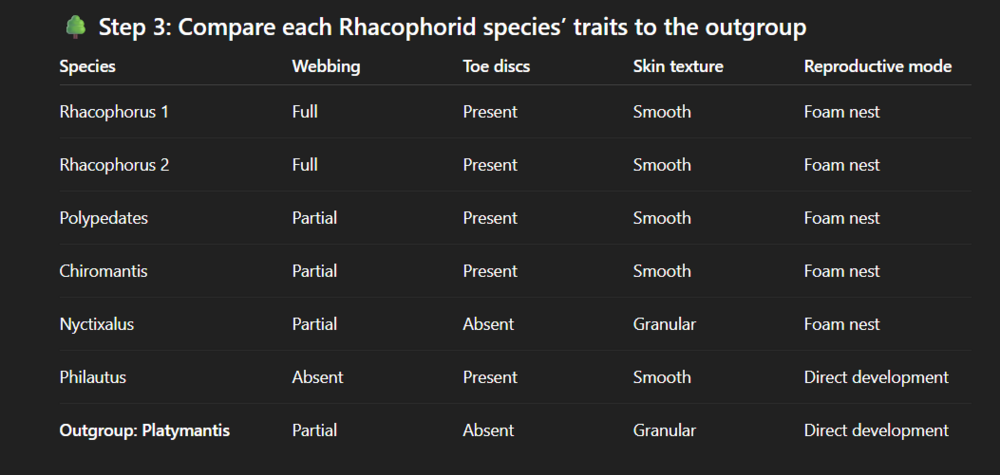
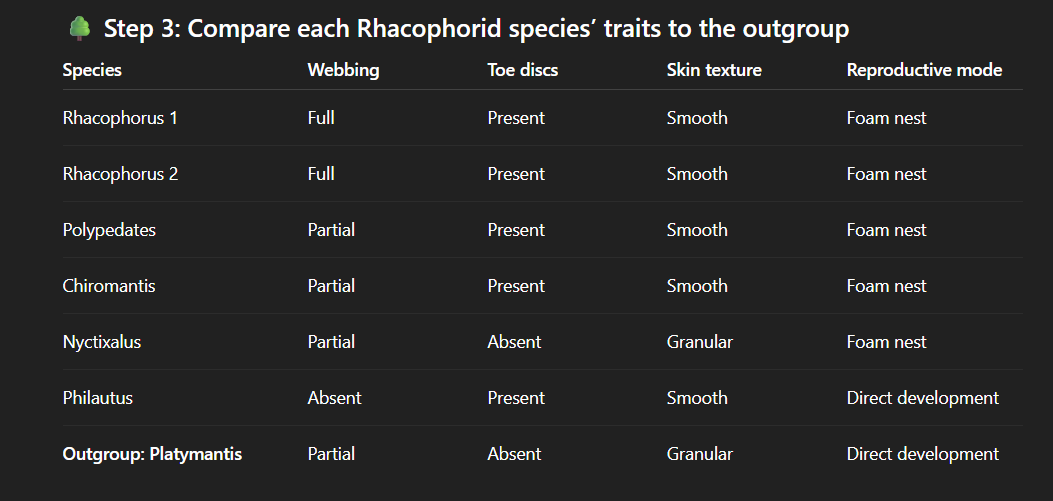
So hi! I can't access my other account since I can't login through facebook at the time so I created this other account. Hi Fellow scientists, I'm a grad student in Wildlife Science and I can't seem to wrap my head in building a phylogenetic tree involving multiple genera. It's not really an assignment but I am kinda falling behind in my class due to this. A help would be greatly appreciated! We had a similar thing in the lab class but this thing is similar to it as we try to list traits and determine their characters states across genera. My conclusion here is that Nyctixalus is the closest to the outgroup; therefore, more basal than the rest. What I start to have trouble with was with Philautus, Chiromantis, Polypedates, and Rhacophorus. Philautus had 1 ancestral trait it shares with Platymantis (Direct Development), at the same time Polypedates and Chiromantis also share 1 ancestral trait which is Partial Webbing. But Polypedates and Chiromantis also share multiple derived traits with Rhacophorus. My fellow group also had came across the same problem when we were doing the activity like how do we construct this. This is my assumption: But I realized that this make Rhacophorus related to Philautus at the same level as Chiromantis and Polypedates when Rhacophorus is more related to Chiromantis and Polypedates due to Foam Nests than it is to Philautus. How do I fix this? I tried consulting AI and it can't show me a proper construction of the tree. A help would be gladly appreciated.