Vladimir M. Tsenov
Members
-
Joined
-
Last visited
-
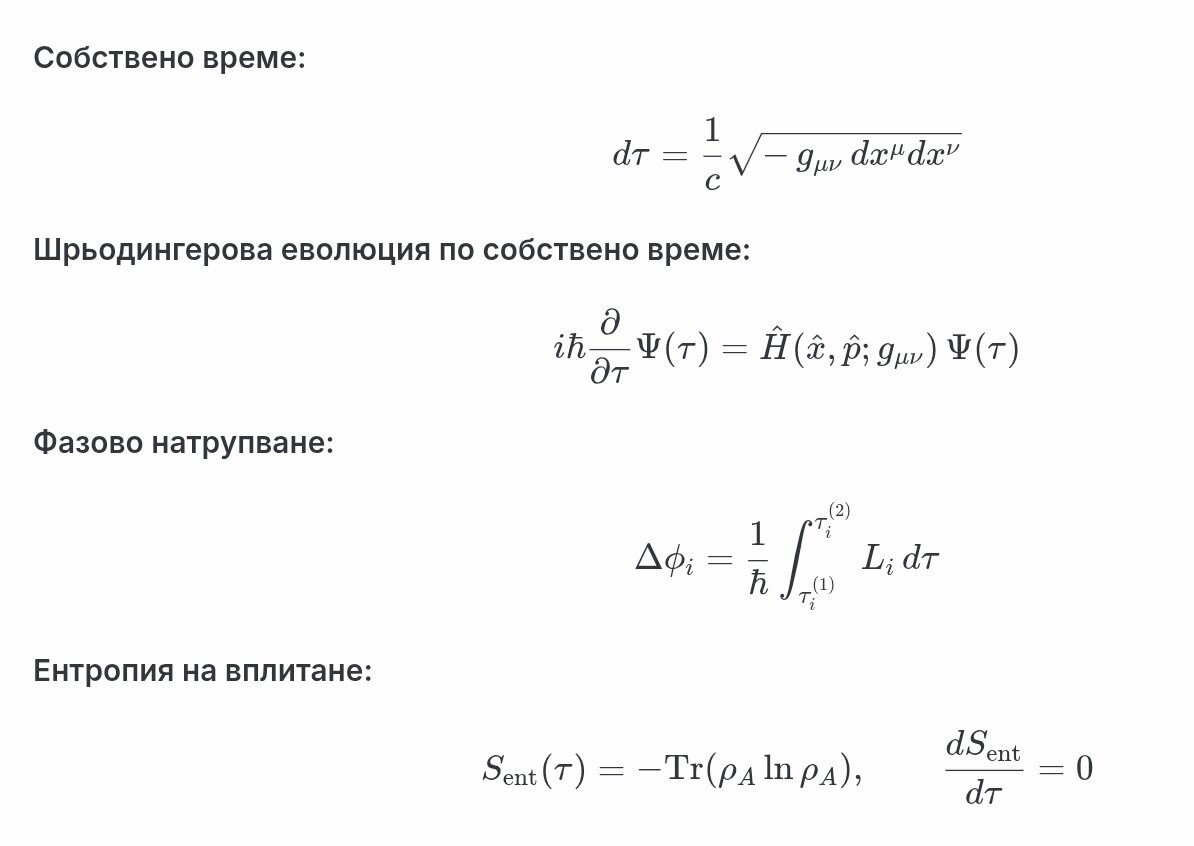
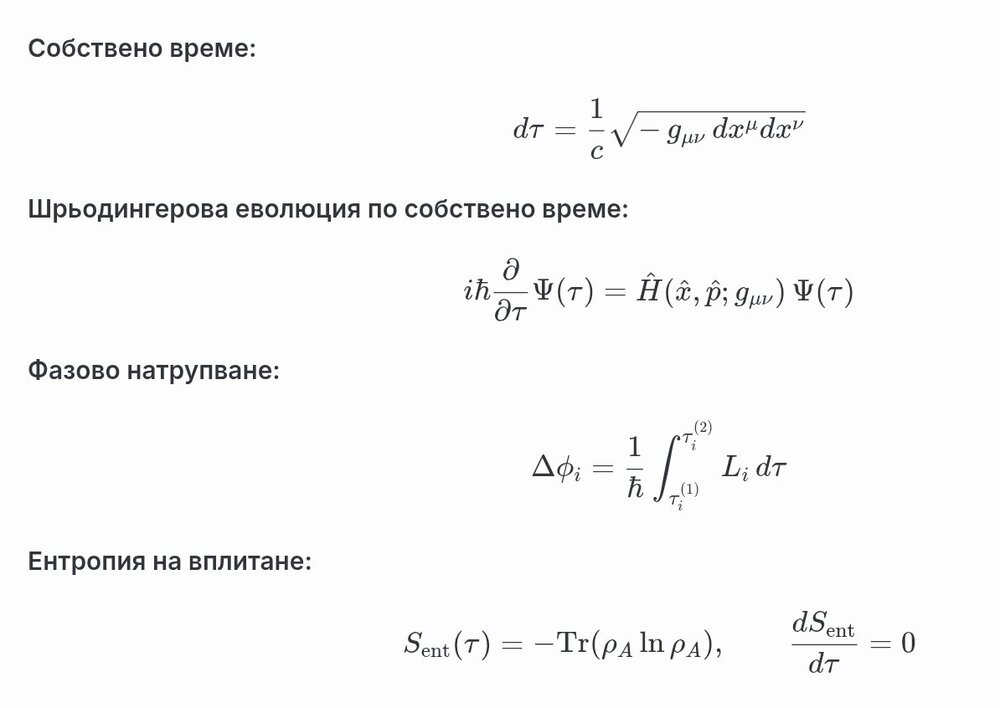
Phase grows linearly with each system’s proper time, even when local clocks disagree. In entanglement, the correlations show that synchronization comes from the shared phase evolution of the state, not from external clocks.
-
Experiments show that the phase of each quantum system increases linearly with its “internal time,” remaining consistent even under differing local conditions. Entangled systems demonstrate that their internal times can stay synchronized despite differences in local clocks, revealing the quantum nature of time.
-
The body of experiments—from COW, through atomic interferometers, to satellite tests—tells us the same story: every quantum system exists in its own time, measured by its phase. Entanglement reveals that these internal times can remain in harmony beyond the differences of local clocks, and future quantum clocks in superposition will demonstrate that time itself is a quantum quantity. In this way, the paradoxes of information and entropy dissolve—because they are not problems of being, but of the mismatch between different internal times. COW (1975): Neutron interference shows phase accumulation compatible with Δφ × Δt. Atomic interferometers (Kasevich–Chu and successors): Confirm a linear dependence of phase on time. Satellite experiments (QUESS/Micius): Entanglement persists over hundreds of kilometers despite differing local times. Quantum clocks in superposition (theoretical): Could potentially demonstrate the quantum nature of proper time through loss of interferometric visibility.
-
The Observer-Centric Reformulation of the Black Hole Information Paradox Vladimir M. Tsenov Independent Researcher Plovdiv, Bulgaria Abstract The classical formulation of Hawking's black hole information paradox assumes that information is an objective, observer-independent property of physical states. This paper argues that such a premise is both philosophically and physically incomplete, contradicting the epistemological essence of information and the fundamental role of the observer in quantum mechanics. Information, properly understood, requires the possibility of perception or decoding. By recasting the paradox from a question of "objective information loss" to one of observational inaccessibility, we propose an observer-centric reformulation that offers a path toward a new interpretation of black hole information dynamics. Keywords: Black Hole Information Paradox, Observer Effect, Quantum Mechanics, Epistemology of Information, Relational Quantum Mechanics 1. Introduction The black hole information paradox (Hawking, 1976) remains one of the most debated problems at the intersection of physics and philosophy. Traditional approaches—ranging from holography (’t Hooft, Susskind) to the firewall hypothesis—treat information as an objective property of physical states, potentially lost through black hole evaporation. This treatment presupposes that information can exist independently of any observer. However, both the philosophy of knowledge and the foundations of quantum mechanics challenge this assumption. Information is not merely a physical arrangement of states; it requires interpretability. Quantum theory further reinforces this dependency by making observation fundamental to the manifestation of states. This paper argues that ignoring the observer in the information paradox leads to a conceptual incompleteness. The following sections will critically examine the prevailing views on information, propose an observer-centric reformulation of the paradox, and discuss the theoretical implications of this new perspective. 2. Classical and Quantum Notions of Information In classical physics, information is regarded as an objective arrangement of matter-energy states. For a classical observer, information can be stored or lost independently of whether it is ever decoded. This perspective allows for the paradox of "absolute loss." In contrast, an epistemological and quantum definition of information suggests that it exists as a potential that becomes real only through measurement or perception. The uncertainty principle and the collapse of the wave function illustrate that informational content is inseparable from observation. For instance, the position of a particle is not a fixed, objective fact but a relational property that becomes defined only upon measurement. Thus, the very meaning of "information" depends on relational and observer-dependent contexts. 3. Reformulating the Information Paradox The conventional paradox is framed as a direct contradiction: Quantum theory requires unitarity (information cannot be destroyed). Hawking radiation appears thermal and featureless, implying information loss. Therefore, a contradiction arises. We propose a different framework by integrating the observer as a fundamental element: Premise (R1): Information cannot exist independently of an observer capable of perceiving or decoding it. Premise (R2): Quantum measurement already integrates the observer as fundamental. Conclusion (R3): The question of "objective information loss" in black holes is ill-posed, because it presupposes observer-independent information. Instead, the paradox should be recast: How does the observer’s relational role in quantum information affect the interpretation of black hole evaporation? This shift transforms the problem from an apparent violation of fundamental laws to a deeper inquiry into the nature of informational reality itself. 4. Implications The observer-centric view offers several key implications for the information paradox: Conceptual Resolution: The paradox is not about the absolute loss of information but about the conditions under which information is meaningful and accessible. If information is relational, then the perceived loss is a consequence of the observer's inability to retrieve it from beyond the event horizon, not a true disappearance from the universe. The information hasn't been destroyed; it has simply become observationally inaccessible to a particular frame of reference. Alignment with Relational Frameworks: This view aligns directly with relational quantum mechanics (Rovelli, 1996), where physical states—and thus information—exist only relative to observers. A particle falling into a black hole may have a defined state from the perspective of an observer falling with it, while for an outside observer, that information has become unknowable. Bridging Physics and Epistemology: This approach bridges physics and epistemology, suggesting that the notion of information as an independent entity is a classical remnant inconsistent with quantum theory. The paradox serves as a powerful reminder that our physical models must account for the fundamental role of the observer. A Secondary Paradox: Recent developments in Vortex Field Theory (VFT) propose that black hole radiation is coherent and information-rich, generated by vortex instabilities in a structured quantum vacuum. Even within such frameworks, however, information recoverability may face practical limits—what we call a "secondary information paradox"—due to gravitational reabsorption and the exponential dilution of emitted signals, making much of the encoded information observationally inaccessible. 5. Conclusion The observer-centric reformulation dissolves the classical framing of Hawking’s information paradox. By recognizing that information is inseparable from observation, the paradox shifts from an apparent violation of unitarity to a deeper inquiry into the relational nature of quantum states and their epistemological foundations. Future research should explore formal models of black hole evaporation that explicitly incorporate observer-dependent definitions of information and account for practical limits to information retrieval, paving the way for a more complete understanding of black hole dynamics. References Hawking, S. W. (1976). Black holes and thermodynamics. Physical Review D, 14(10), 2460–2473. Rovelli, C. (1996). Relational quantum mechanics. International Journal of Theoretical Physics, 35(8), 1637–1678. Susskind, L. (1995). The world as a hologram. Journal of Mathematical Physics, 36(11), 6377–6396. ’t Hooft, G. (1993). Dimensional reduction in quantum gravity. arXiv:gr-qc/9310026. Tsenov, V. M. (2025). A Secondary Information Paradox in the Context of Vortex Field Theory: Practical Limits to Information Retrieval from Black Hole Radiation. Available via Academia.edu . © 2025 Vladimir Tsenov This work is licensed under a Creative Commons Attribution-NonCommercial-NoDerivatives 4.0 International License. https://creativecommons.org/licenses/by-nc-nd/4.0/
-
The black hole information paradox remains one of the most profound unsolved problems in modern theoretical physics. Traditionally, it is assumed that information falling into a black hole is lost forever when the black hole evaporates, seemingly violating the principles of quantum mechanics. In his new work, Vladimir M. Tsenov offers a radically different perspective. He argues that the paradox arises from the mistaken assumption that information is absolutely objective and independent of the observer. According to Tsenov, information is fundamentally observer-dependent: what appears inaccessible or “lost” to one observer may still be present for another. Tsenov reformulates the paradox, shifting the focus from the loss of information to the observer-dependent inaccessibility of information. This subtle but profound shift has deep philosophical and physical implications, challenging how we understand quantum mechanics, general relativity, and the role of the observer in the universe. This article is not just a new proposal—it invites a complete rethinking of fundamental concepts concerning information, observation, and the nature of reality itself. For anyone interested in theoretical physics, the philosophy of science, or the deepest laws of the universe, the full text provides detailed analysis and arguments that cannot be overlooked. Read the full article here: The Observer-Centric Reformulation of the Black Hole Information Paradox
-
Hello everyone! I want to share and discuss a new idea I’ve been working on — the Temporal Congestion Paradox. This paradox differs from classic ones because it doesn’t focus on individual time travelers but on the mass convergence of many travelers to the same key moment — the first activation of a time machine (t₀). Main idea: If a time machine is invented within a single, self-consistent universe, it will attract enormous interest in the future. Many future travelers will want to return exactly to the moment of its creation (t₀) to observe or influence this event. This would cause an accumulation of countless “travelers” at the same spacetime point, creating a temporal congestion. This congestion could cause a collapse in the structure of space and time — for example, a gravitational collapse or an “ontological collapse” at the location and time t₀. As a result, the machine or the moment t₀ becomes inaccessible, making backward time travel impossible. Significance and implications: The paradox imposes a fundamental limit on the possibility of backward time travel within a single-continuum universe. It introduces the idea of a “self-negating prophecy” — if time travel exists, it will cause its own limitations, rendering it unusable. This complements or restricts classic paradoxes like the Grandfather Paradox or Novikov’s Self-Consistency Principle by addressing the collective behavior of travelers. What follows: The paradox might be avoided through concepts like parallel universes or simulated realities, where the temporal load is not concentrated. The idea offers a new perspective for theoretical research in physics and philosophy of time. You can read the full paper here: https://www.academia.edu/129719109/The_Temporal_Congestion_Paradox_A_Logical_Limit_to_Time_Travel_in_a_Single_Continuum_Universe Also related publication: https://www.academia.edu/129781623/The_Collapse_of_the_Temporal_Block_A_New_Argument_Against_Static_Time_Based_on_the_Temporal_Congestion_Paradox My profile: https://independent.academia.edu/VladimirTsenov DOI: 10.17605/OSF.IO/TSZ3Y I would appreciate your thoughts, critiques, and ideas ! Thank you for taking the time to read about this concept.