Gxpalou
New Members
-
Joined
-
Last visited
-
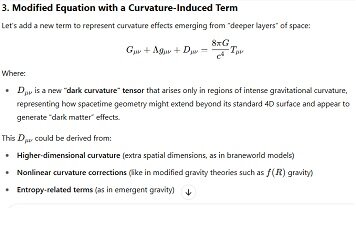
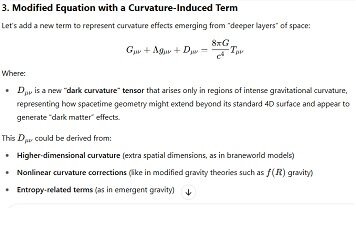
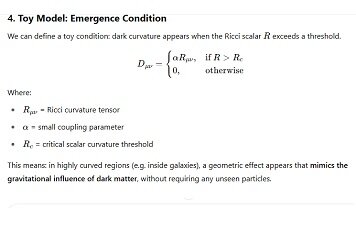
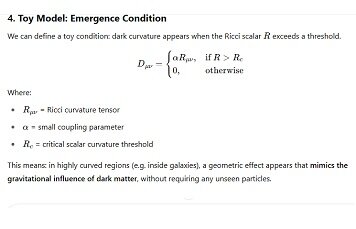
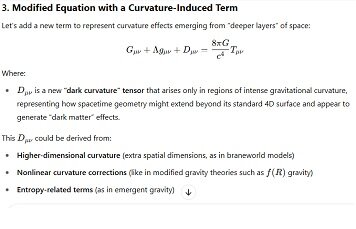
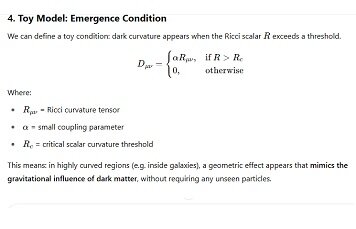
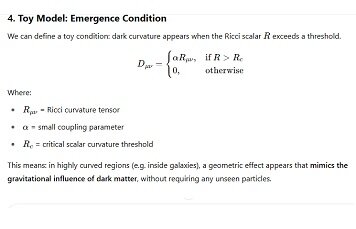
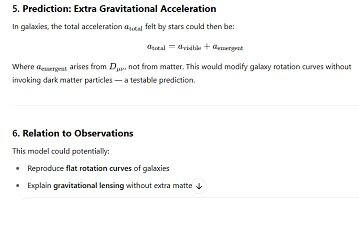
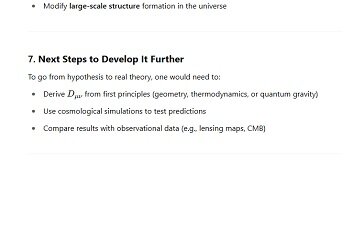
Title: Reimagining Dark Matter: An Emergent Phenomenon from the Curvature of Space Abstract: This is a conceptual exploration into a novel hypothesis about dark matter, proposing that it may not be an unknown particle or substance, but rather an effect arising from the curvature of space itself. The theory suggests that space could be structured like a surface, with multiple layers beneath it. When large mass structures, such as galaxies or galaxy clusters, cause significant curvatures in the fabric of spacetime, this curvature might extend into deeper layers of space, where dark matter could emerge. If this hypothesis is correct, dark matter might not be a mysterious particle we have yet to discover, but rather a consequence of the bending and stretching of space itself. If proven, this concept could open new pathways for understanding dark matter and the nature of the universe. Introduction: Dark matter has remained one of the greatest mysteries in modern science. While it is believed to constitute a substantial portion of the universe's mass, it cannot be directly observed or detected. Current theories suggest that dark matter might be composed of particles such as WIMPs (Weakly Interacting Massive Particles) or axions, but no conclusive evidence for their existence has been found. In this conceptual hypothesis, I propose an alternative explanation: dark matter may be an effect of the curvature of space itself, rather than a novel particle. This theory builds on the idea that space might be structured in layers beneath its surface. When massive objects, such as galaxies or clusters of galaxies, create significant curvatures in the fabric of spacetime, these curvatures could influence deeper layers of space. In these layers, dark matter might emerge as a natural consequence of the space’s curvature. Although this idea is speculative, it could dramatically shift how we think about dark matter and the fundamental nature of the universe. The Concept: Space with a Surface and Layers Beneath Rather than conceptualizing space as a simple, empty void, this theory imagines space as having a surface, much like a rubber sheet. Massive objects such as stars, galaxies, or black holes create curvatures in this surface when they warp the fabric of spacetime. This concept is already central to general relativity, where gravity is described as the result of these distortions in spacetime. However, my hypothesis suggests that space does not merely have a flat, two-dimensional surface but has deeper layers beneath this surface. When massive objects create curvature in the fabric of space, this curvature may not only affect the immediate surface but could extend into these deeper layers. In these layers, the effects of the curvature of space might be responsible for the formation of dark matter. How Curvature Could Lead to Dark Matter The idea is straightforward: large masses bend the fabric of spacetime, creating curvature in space. This curvature could influence the deeper layers of space, where dark matter might emerge as a side effect of the bending and stretching of spacetime. Rather than being an undiscovered particle, dark matter could actually be the result of the curved nature of space itself, a byproduct of how space behaves when subjected to the gravitational pull of large masses. Just as gravity pulls objects toward the center of a planet, the curvature of space might "pull" dark matter into specific regions. Why Dark Matter is Tied to Massive Structures We observe dark matter primarily in areas with large gravitational fields, such as galaxies and galaxy clusters. These regions are where space is most curved, making them ideal candidates for testing the idea that dark matter may be a consequence of spacetime curvature. For example, the rotation curves of galaxies show that stars on the outer edges of galaxies move much faster than expected, suggesting the presence of additional, unseen mass. This could be due to the curvature of space in these regions, pulling dark matter into the galaxies, even though we cannot directly observe it. Similarly, gravitational lensing—where light bends around galaxy clusters—suggests that unseen mass is responsible for this bending. This may be dark matter, and it could be a manifestation of space itself curving under the influence of the mass of galaxies and clusters. Testing the Concept Although this theory is speculative and lacks direct evidence, there are several potential avenues for further exploration: Studying Gravitational Lensing: By analyzing how light bends around massive galaxies or clusters, scientists could look for patterns that suggest space is curving in ways that produce dark matter. Simulating Cosmic Structures: Advanced simulations of galaxy formation could help determine if this theory can explain the observed distribution of dark matter in the universe. Exploring Gravitational Waves: If space is indeed bending and curving as suggested, gravitational waves could carry vital clues about the structure of spacetime and how dark matter emerges as a result. Conclusion This conceptual hypothesis proposes that dark matter may not be a particle or substance, but rather an emergent property of how space behaves under the influence of large masses. The curvature of space, caused by objects like galaxies and clusters, could extend into deeper layers, where dark matter forms as a consequence of this curvature. If this theory holds true, it would radically shift our understanding of dark matter and suggest that it is not a mysterious particle but a feature of spacetime itself. Although this theory is speculative and lacks direct evidence, it offers a new perspective on the origin of dark matter and invites further research into the nature of spacetime, gravity, and the universe. By exploring this idea, we might uncover new insights into the fundamental forces that govern the cosmos. 🔭 Dark Matter as an Emergent Effect of Spacetime Curvature A Conceptual Framework Inspired by the hypothesis of George Xatzipalou 1. Motivation In general relativity, the gravitational effects we observe in galaxies are attributed to spacetime curvature caused by visible matter. However, many observations (e.g. galaxy rotation curves, gravitational lensing) suggest the presence of additional "invisible" mass — dark matter. This hypothesis proposes that dark matter may not be a particle or substance, but an emergent result of how spacetime behaves in highly curved regions, particularly due to interactions with deeper geometric layers of space. 2. Standard Einstein Field Equations In general relativity, gravity is not a force but the effect of spacetime curvature. The Einstein Field Equations are: What if dark matter is geometry, not matter? Written by: George Xatzipalou, Greece / Komotini Just a Theory Copyright 2025 Not a scientist, just a lover of space