taste
Members
-
Joined
-
Last visited
-
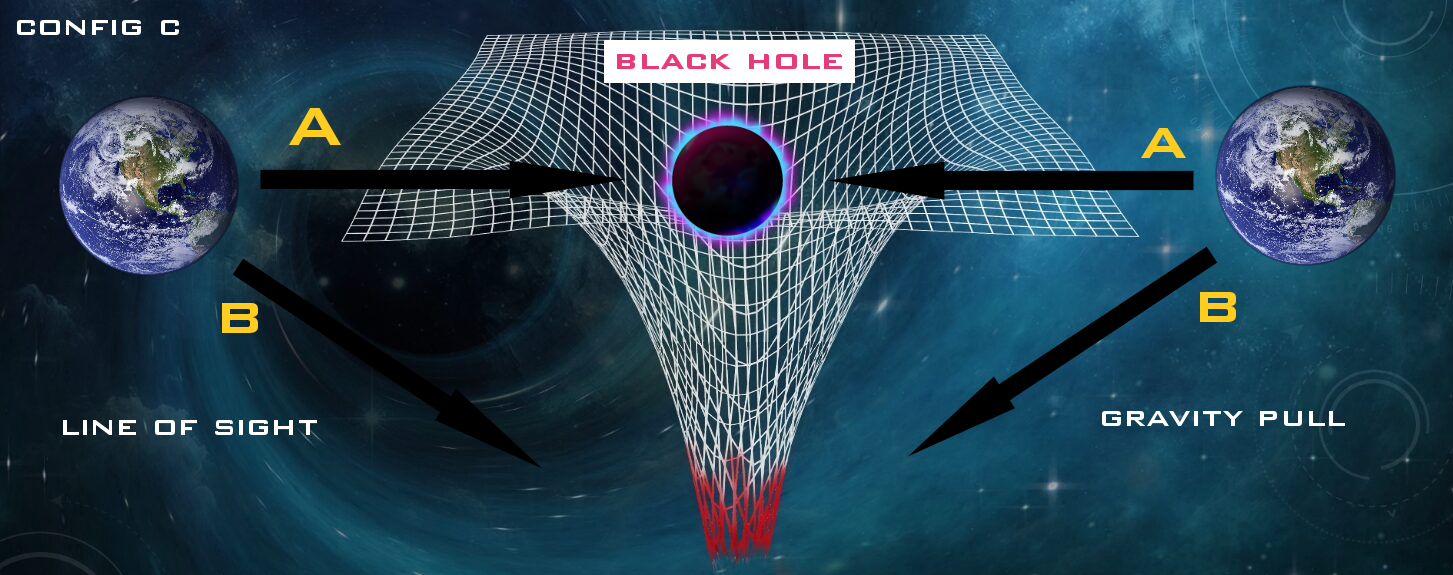
thank you for response. this leaves me with some questions, but do not take it the wrong way, I am just thinking out loud. define surface please, is it the outer atmosphere, at ground level or somewhere in between? if gravity is strongest on the surface, why is the heaviest of the elements drawn inward to the center of the body? doesn't this contradict the understood physics of a black hole (the 4th image in the OP) I imagine 3 scenarios a) a rocky planet with an earth-like atmosphere, a lighter outer crust, and a heavier inner core, much like the earth. 66% of this planets mass is from the core, while the remaining 33% is split between the outer layers and the atmosphere. Its mass is not proportional to its volume. tough,... its not off by much. b) a fictional gas giant, about a thousand times larger than earth, with a core about 100 times that of earth itself, with a total weight twice that of jupiter. its core is extremely dense and heavy. is the gravitational pull the greatest on the surface of its core or the surface of its atmosphere? c) a fictional supermassive black hole with a Schwarzschild radius of about 1 lightyear. a heavyweight no doubt, is its mass spread out evenly or is it mostly near the singularity? wouldn't the center of mass in the black hole be the singularity? or am i understanding that incorrectly thanks in advance.
-
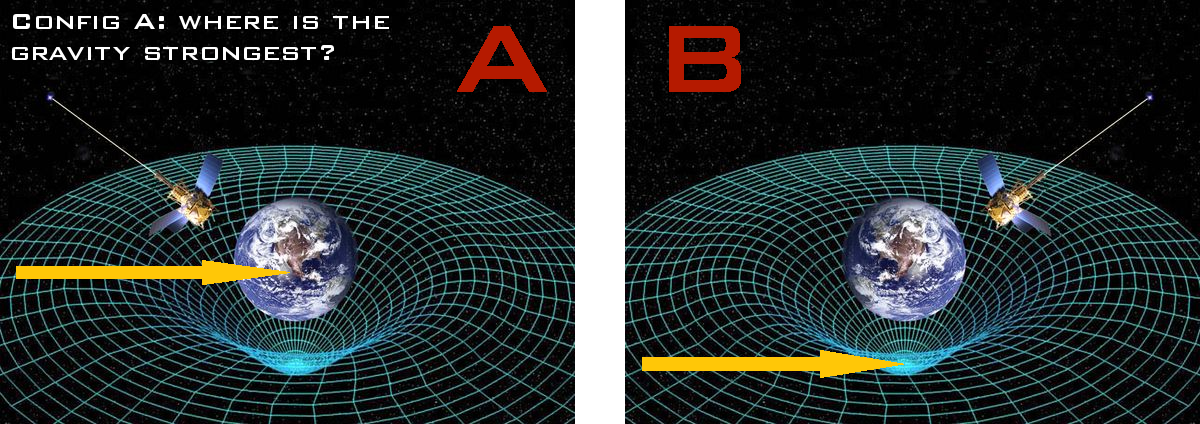
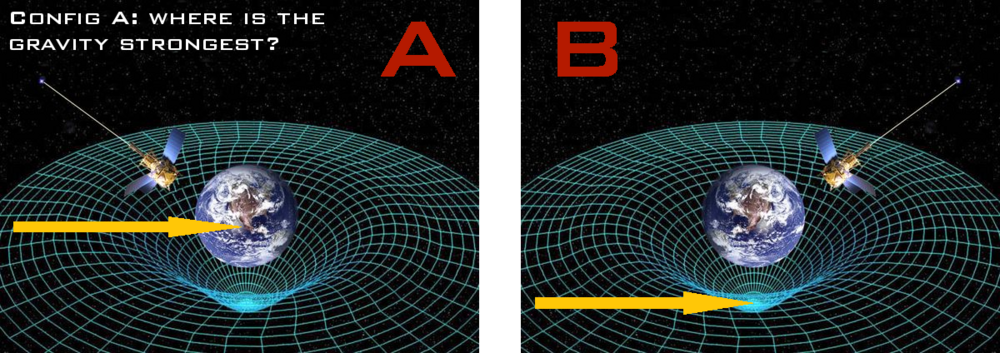
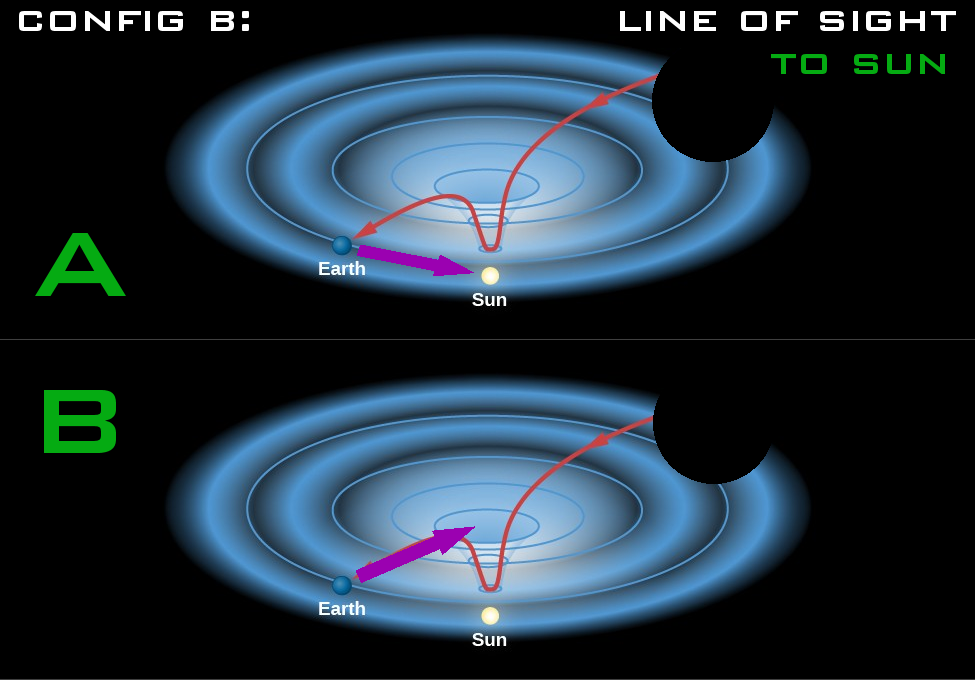
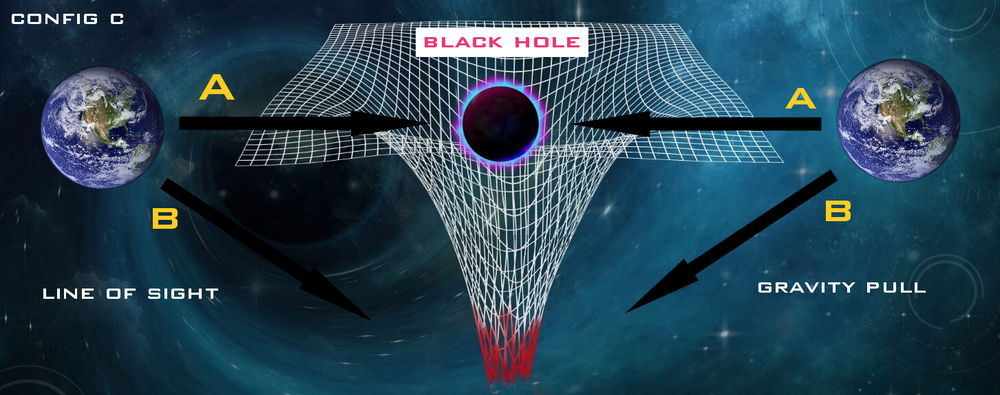
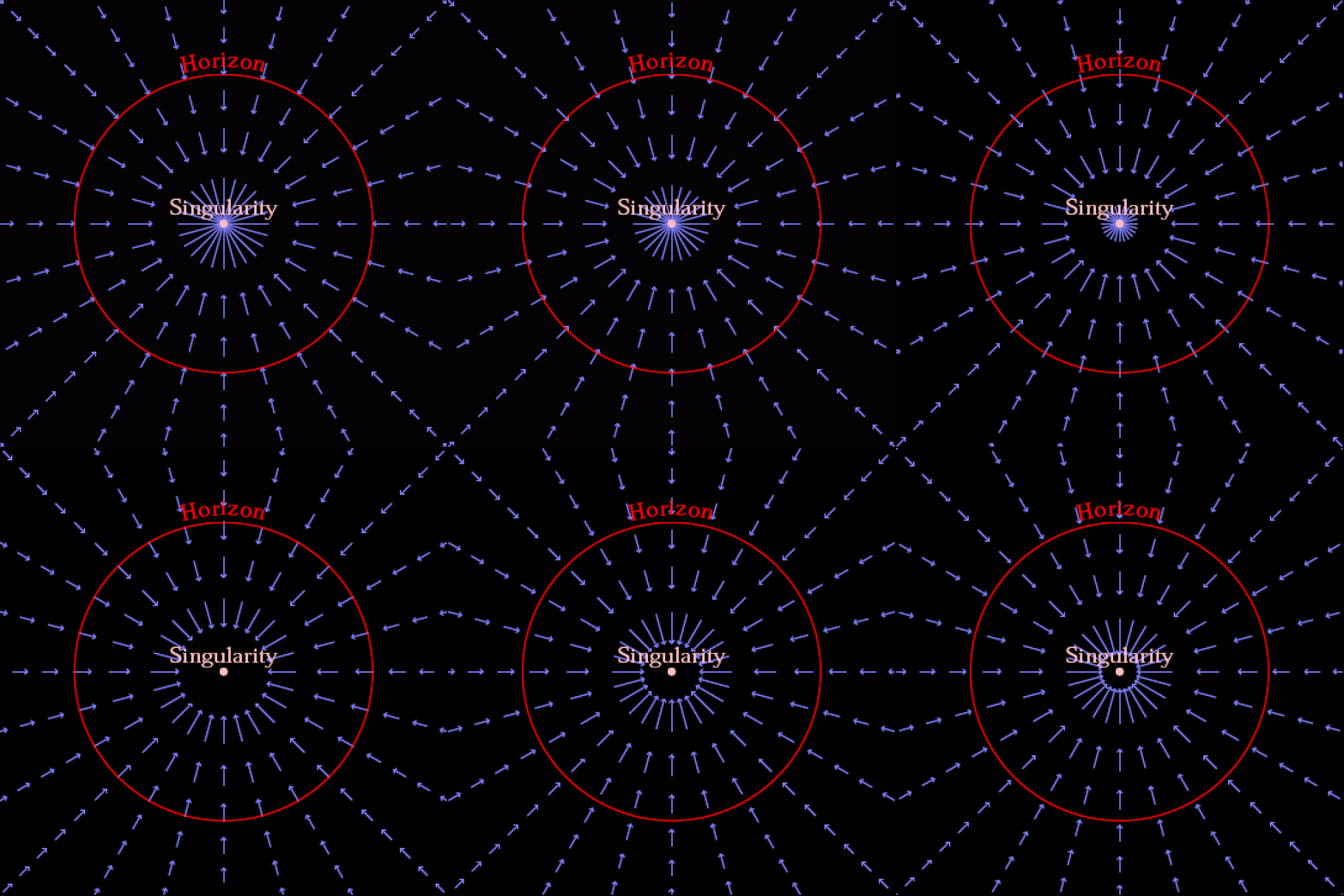
I have put together 3 configurations, the first (config a) depicting gravity's strongest point, I am assuming the answer is "A", but if its not, please explain why. the second (config b) depicting light of sight, again, I am assuming the answer is "A" (nevermind where the sun is in the image), but if its not, please explain why. the third (config c) is depicting both of what config a and b did, I am assuming "A" is the correct answer for both. either way, if the answers are "A" why is the spacetime curved like such? if the answers are "B" then why is the line of sight way off? for example, I wanted to be sure to use a black hole in config c, to show the exaggerated effect on spacetime compared to that of our earth, moon or sun. if the line of sight and/or the point of strongest gravity is "B" wouldn't that have the black hole pulling from outside the galaxy, let me clarify. lets imagine there is a planet where the bottom left or right arrow is (in config c), its the same distance from the black hole as earth is, but on a different "plane" for lack of better words. would it have the same pull from the black hole, and where is that light of sight to the black hole from there? its hard (for me) to imagine spacetime as both 2-Dimminsional (illustrations) and 3-Dimminsional (actual) at the same time. I have added in a animated gif of a singularity in a black hole as it is understood (but not proven) wouldn't that same gravity pull (from all directions, 3D-360 degrees) be how other not just heavy, but all objects apply? thanks in advance.
-
maybe i worded it wrong. by opposite, I mean, what is zero in terms of speed and are we at it or not. so the speed of light is "299 792 458 m / s" .... how do we get to 0.0 m/s ?
-
I have no degrees in anything but here is my opinion on this: Its chance. I would like to introduce sports into the answer. Tom Brady for example. He was a backup for his team when the starting quarterback got injured. The chances of Tom Brady having the career he did if he never got that starting role by his teammate getting injured is considerably lower. In other words, backups who never get the opportunity to showcase their skill-set in a live game often just get overlooked and eventually replaced. We can use that example in a lot of things. A meteor strike, a car accident, a solar eclipse, etc etc. For every action, there is a reaction, so we play the game of "chance". Lets say "input any famous scientist" parents never met due to some foreseen accident, would their scientific breakthroughs eventually be learned? quite possibly, but that time difference of if and when it did would have a great impact on the future compared to the other planets in your model.
-
I was doing some new learning as I do from time to time the other day learning a little about the history of neutrino's. The thing that stood out the most for me was the discussion on whether they oscillated or not and the reasoning behind it. It was once thought they had no mass, and without mass it was impossible for them to oscillate, so therefor either there were different types of neutrino's or they had mass to allow them to oscillate. In return, this gets the blood flowing on the thought of speed of light vs time. The argument against the neutrino's not having mass was that they would experience no time because they would be restricted to moving at the speed of light. So, with that fact out of the way, I ask, what is the opposite of the speed of light and how do you achieve it. Are we currently moving at or near the bare minimum of relative speed? Are we in fact perceiving time at its fastest state? Or does the expansion rate, galactic orbit rate and the solar orbit rate contribute to our relative speed. I often wonder if our universe forms and evaporates as fast as the explosion of two particles colliding in a particle accelerator, and we just perceive it differently. thank you for your time.