
ZGeorg
Members
-
Joined
-
Last visited
-
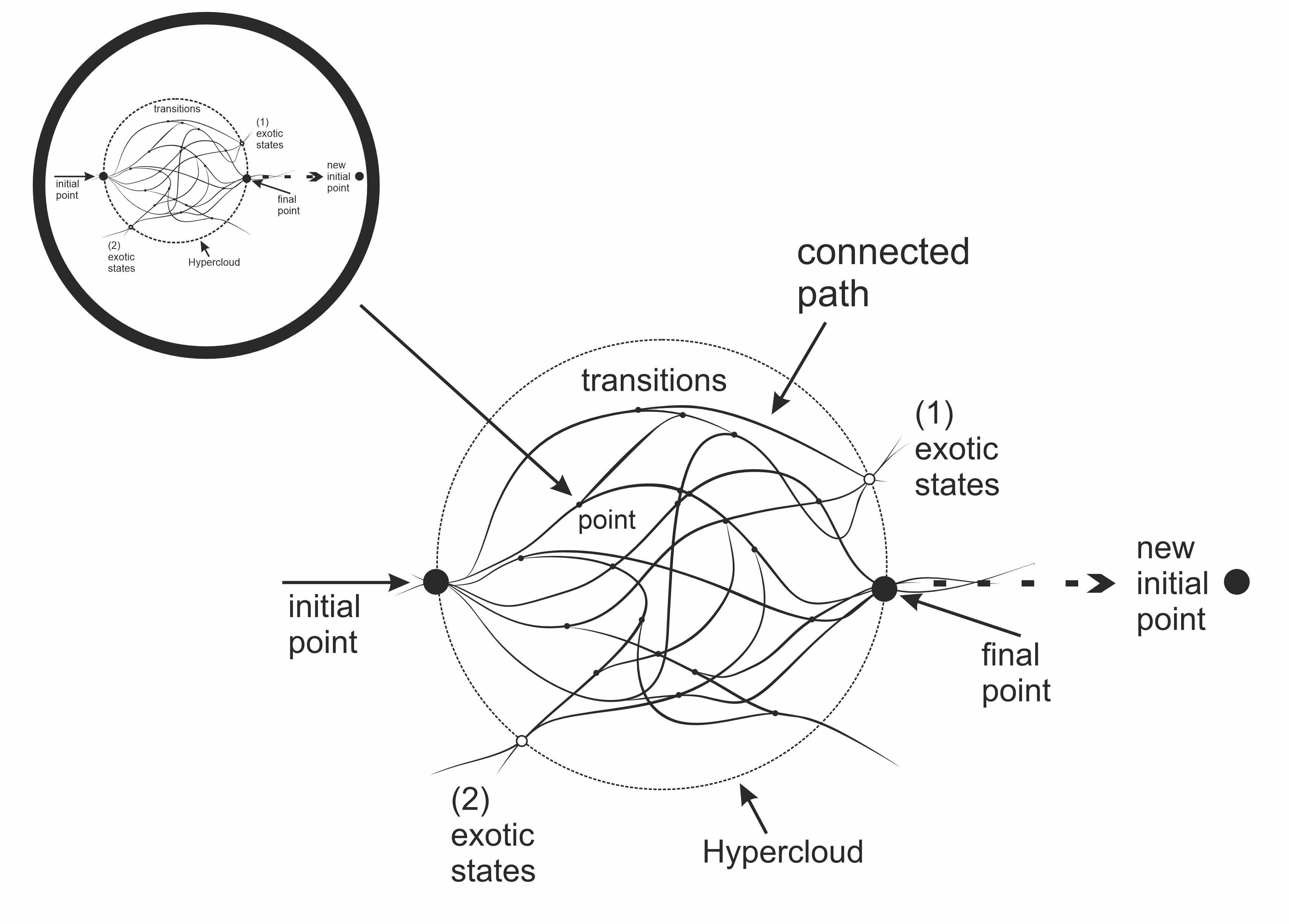
Thank you for the question — it’s a very important one. The number 1.58 I use as the Hausdorff-Besicovitch dimension of time in my model is not random. While it’s still more of an intuitive choice than a rigorously derived result (for now), it’s based on specific reasoning. In this hypothesis, time is not represented as a one-dimensional line, but rather as a fractal hypercloud of possible trajectories. The time we perceive is just a coherent path through this hypercloud. The fractal dimension reflects the local complexity of branching — how diverse the nearby paths can be around each point. Why 1.58 specifically? Because it lies between 1 and 2: 1 represents a classical linear trajectory (no variation), 2 would be a full two-dimensional field of possibilities (no direction), and 1.58 reflects a fractal structure, where direction exists, but branching is also present. This value is very close to the golden ratio (φ ≈ 1.618), which often appears in self-similar and recursive structures — exactly the kind I associate with the nature of time. I continue working toward a future derivation of this value, perhaps from a consistency principle — such as entropy flow, or quantum decoherence across alternative trajectories.
-
Thank you for your question. Yes, I do use AI — as a tool for translation, clarifying phrasing, and, to some extent, assisting in the development of the mathematical framework. But let me be clear: the core of the hypothesis, its logic and conceptual structure, was developed by me — alone, over many years of reflection and personal inquiry. I live in a country currently at war. My resources are extremely limited. I have no access to computational power, laboratories, or academic support. And yet, despite everything, I continue to explore an idea that touches on the fractal nature of time, quantum structures, and the fundamental logic of the universe. Using AI is simply using the tools available — just like scientists rely on supercomputers to analyze data from the Large Hadron Collider, or mathematicians use code to test and refine equations. It would be strange to blame someone for using what is accessible. No one questioned the validity of Albert Einstein’s contributions, even though the tensor calculus of General Relativity was largely developed with the help of Marcel Grossmann. Science has always been a collaborative process, with varying levels of contribution across all kinds of work. I do not compare myself to Einstein — but I humbly ask for the same logic to be applied here. I could even provide photographs of my old handwritten drafts — they are in Russian, but they show that this line of thinking predates any assistance from AI. The AI helped me bring things together — it did not invent the hypothesis. And, more importantly — I have never pursued this for profit. I have never asked for recognition. I have not sought prestige. Even when my posts went unanswered, I didn’t stop. I kept writing in the hope that someone — someone above, or someone capable — might see something in it. That they might find meaning in it for themselves, and perhaps carry it forward. If that is a sin — then what exactly is my fault? That I dared to think outside the walls of institutions, without formal credentials or funding? I never tried to deceive anyone. I’ve always welcomed dialogue. And I’ve always been open that English is not my native language, and that I rely on translation tools. I just chose not to put that fact on display — precisely to avoid reactions like the one we’re having now. If you wish to challenge the logical core of the hypothesis — I genuinely welcome that. Let’s talk about the content, about the structure and implications. I am not claiming to be someone I am not. I’m just a person who believes that thinking is not reserved only for the privileged few. And if I may ask — could anyone here provide a single example of a physical interaction or observable phenomenon that exists independently of the fundamentality of time? If such an example exists, I’m open to hearing it. I believe that’s a fair and honest starting point for discussion. If this topic remains open, I will continue my research. The scope of the hypothesis is simply too vast to be explored fully — either philosophically or mathematically — in such a short time. My hope remains that someday, someone might approach it from a new perspective, perhaps more professionally, but no less sincerely.
-
I continue to develop my idea of the HyperFractal Time Theory (HFTT), building on the initial hypothesis presented in this thread . This Version 2.0 https://zenodo.org/badge/DOI/10.5281/zenodo.15873952.svg includes refinements based on gravitational wave data from O4 (May 2023 – November 2025), with calibrations to GW170817 and S250319bu. The model explores time as a fractal hypercloud, linking it to gravity, particle creation, and dark matter, with considerations for potential quantum gravity integration. The PDF is available on Zenodo as a continuation of my previous 'Fractal Structure of Time as the Foundation of Matter' (DOI: 10.5281/zenodo.15726080) and is attached to this post. Feedback or suggestions for further development are welcomed. HyperFractal Time Theory (HFTT)_Zenodo.pdf
-
Fractal Structure of Time as the Foundation of Matter Quarks, Gravity, and Dark Matter as Aspects of the T Field Supplement and Mathematical Formalization to a Previously Published Hypothesis Author: Georgiy Zelenetskiy Date: June 24, 2025 Abstract: This work proposes a theoretical model in which time is not merely a coordinate or parameter but a fractal field, denoted as T, which underlies the emergence of space, matter, and all physical interactions. By applying tools from fractional calculus (with a fractal derivative exponent of approximately 0.79) and using a Hausdorff dimension of time near 1.58, I offer interpretations for gravitational phenomena, quark confinement, and the nature of dark matter. The model aligns with data from gravitational wave event GW170817 and the Planck mission, and offers predictions for LISA and Belle II. Preface: Most modern physical theories treat spacetime as a smooth, continuous manifold where time is either a passive parameter or one of the four coordinates within a pseudo-Riemannian geometry. However, such approaches remain unable to fully address quantum gravity or explain high-order anisotropies in the cosmic microwave background (CMB). This work challenges that foundation. I propose that time is a primary multidimensional and fractal field, denoted as T, from which all observable structures emerge. Space, particles, forces, and even the concept of motion appear as derivative effects from the gradients and topology of the T-field. The work presented here is not a full quantum field theory but rather a preliminary theoretical framework. Its novelty lies in several key hypotheses, particularly: The field T has a nested, fractal structure, forming a complex cloud of future possibilities, with observable time being just one of its coherent flows; Gravity is a macroscopic manifestation of fluctuations in T, and is described by a discrete, non-local variational principle (a modified action); Quarks correspond to topological knots in the T-field, specifically where its third homotopy group is nontrivial (i.e. certain configurations are topologically stable and cannot be smoothly deformed); Dark matter is interpreted as metastable concentrations of T-field gradients that are not integrated into the coherent flow of ordinary matter, but still influence gravitational structure. This model builds upon my previously published hypothesis and is offered here with more formalism and mathematical support. It is not yet a complete theory, but a structured sketch intended to guide future developments and experimental tests. Note: The detailed mathematical formalism, including field equations, scaling laws, and data comparisons, is presented in the attached PDF. There, the reader will find definitions of the action, the fractal derivatives, solutions for gravitational fields, connections to particle topologies, and proposed experimental verifications. fractal_time_model.pdf
-
Thank you for your interesting response, which moreover sets a direction for our discussion. I’d prefer not to give a hasty and poorly considered reply, so I will work on your questions and strive not to delay my response. You are absolutely right that my use of "linear" is somewhat unfortunate and may conflict with its mathematical meaning. Perhaps "coherent trajectory" would be more accurate. I will endeavor not to delay. With respect.Once again, I apologize for my prolonged absence, the reasons for which I briefly outlined, and I extend my apologies in advance for any potential delays in responding. Unfortunately, the second reason cannot simply disappear as easily as the first. The overall topic, which has long troubled my mind, is quite expansive and, at this stage, more philosophical than anything else, though it theoretically holds potential for development into stricter, more scientific forms. Regarding the key aspect related to the fractal nature of time, I will strive to present it as structured as possible to avoid any confusion. In my hypothesis about the existence of a multidimensional fractal structure of time, time is not viewed as a linear scale but as a complex, nonlinear, and multidimensional field. Within this framework, the linear time we are accustomed to (i.e., the observed sequence of events) is a derivative of a deeper structure—the nonlinear time-field. For the sake of terminological precision, these concepts must be clearly distinguished to avoid confusion. It would likely be wise to devise specific terminology for each to prevent the need for constant clarification in future discussions about what we are addressing. This has not been done yet because I keep it all in my head and in dozens of text documents that only I read and ponder. 1. Core Structure of the Hypothesis Unlike traditional models of time, which describe movement from point A to point B as a linear process with possible branchings (e.g., within interpretations of the many-worlds quantum mechanics), this hypothesis posits that in the initial (zero) state of time, each potential unit (particle, event, system) possesses the full spectrum of all possible future states and interactions. This state can be envisioned as a hypercloud (a term I use for the multidimensional set of potential time states) of points—a multitude of potential developmental variants, analogous to positions in phase space (in terms of classical mechanics) but expanded into a fractal topology that includes not only coordinates and momenta but also possible transition variations. Each point within this cloud (provisionally denoted as A₁, A₂, ..., B₁, B₂, ...) represents a potential state of the system, which can connect with other points to form coherent trajectories. These connections create tree-like structures of possible developmental histories. However, only a portion of them forms coherent, logically consistent chains, which we perceive as "reality." 2. Linear Time as a Coherent Slice Linear time—the observed sequence of events—arises as a result of selecting one of the possible coherent trajectories within this hypercloud. This selection does not necessarily imply an act of consciousness; rather, it reflects the coordinated progression of transitions within stable connections between states. Thus, the "linear flow of time" is not a fundamental phenomenon but a manifestation of a deeper, hidden structure. Much like a video sequence formed from individual frames, linear history consists of a series of coherently linked points from the hypercloud. However, unlike a video stream, the hypothesis of fractal time suggests the existence of multiple possible "video sequences," logically permissible and potentially parallel, yet inaccessible to an observer confined within one of these trajectories. 3. Principle of Fractality The fractality of time is expressed in the fact that each point in the hypercloud is not an indivisible entity but a structurally similar cloud at a lower level. As an illustration, consider an initial point—let’s take "plasticine" as an example—which may encompass variations of chemical states, structures, and forms (sphere, cube, pyramid), each containing its own "clouds" of potential properties. These structures repeat across all scales—from subatomic to cosmological—while their structure and density of variants depend on the dimensionality and energetic characteristics of the level under consideration. Fractality not only ensures self-similarity across different levels but also maintains logical consistency within each "slice" of time. For instance, a trajectory leading to a "cube" state cannot include properties exclusive to a "sphere"—this ensures the internal coherence of the flows. Moreover, this nested structure may account for quantum phenomena, where the fractal density of points in the hypercloud creates conditions for states of superposition, transitioning into stable trajectories upon observation. 4. Quantum Fluctuations and the Observer Effect In this model, quantum fluctuations are not "noise" but regions of the hypercloud with particularly high branching density. These are areas where "reality" seems to hover in anticipation until a direction is chosen. It is precisely at these points that the observer effect may occur: upon measurement, the multitude of potential trajectories collapses into one—the most stable and consistent with the history of the current temporal branch. This perspective could explain the collapse of the wave function and quantum superposition as a result of interactions within the dense branchings of the hypercloud. On a larger scale, these branchings may expand, forming macro-trajectories interpreted as separate universes. Based on the above, this could account for: - The collapse of the wave function; - Quantum superposition and tunneling; - The quantum Zeno effect and delayed-choice experiments. These "anomalies" within classical physics may serve as windows into the fractal structure of time, where the system oscillates between several nearby scenarios before settling on one. 5. Theory of Multiverses as Fractal Branches Existing cosmological models, such as the theory of inflationary bubbles, allow for the existence of multiple "universes." Within this hypothesis, they are interpreted not as separate worlds with different physical laws but as macro-branchings of fractal time—resulting from the divergence of various coherent streams from the common hypercloud of initial states. Yes, these "universes" do not intersect with our current temporal branch, but: - They may share similar structures and laws; - They can exhibit "echoes" from the common pool of potentials; - Some fundamental constants may coincide—as a result of fractal self-similarity. Thus, the multiverse is not a collection of spaces but a multitude of macro-trajectories within the fractal matrix of time. 6. Information, Entropy, and the Shadow of the Hypercloud The fact that an observer cannot directly "see" the hypercloud does not mean it remains unmanifested. We perceive its shadow: - In the limitation of observable variants compared to the possible; - In the increase of entropy as a marker of trajectory pruning; - In the form of stable patterns—"physical laws"—that emerge as a consequence of movement along a narrow stream from a broad base of potential transitions. From this, in my view, physics is not about "how reality is structured" but about what remains stable and observable during coherent movement along a chosen temporal tract. At the same time, everything that does not fall within the observed tract may be no less real but remains unrecordable within our current experience. 7. Probability as Density of Transitions What if probability is not randomness but the density of variants within the hypercloud? Then: - A "random event" is simply movement through an area with the highest density of coherent trajectories; - Low-probability events are regions with low connection density; - Statistics, chaos theory, and probabilistic AI computations can be reinterpreted as navigation through a fractal field of trajectories. If we consider all this as plausible, it could potentially pave the way for new principles in machine learning, modeling, and forecasting, where the key lies not just in selection but in analyzing the density of connections between variants. This is a slight detour from the main topic—to illustrate that this could have practical utility. Just one of many examples. But I didn’t post this in the "Speculations" thread without reason. If there’s interest, we could explore various facets of this speculative hypothesis. I would be delighted to discuss different aspects of this speculative hypothesis. Questions and constructive criticism are not only acceptable but highly desirable—they allow for refining, sharpening, and expanding the boundaries of understanding. For now, it is presented as such. With respect.I sincerely apologize for the delay—I've been completely exhausted by illness, likely a viral respiratory infection, and the ongoing military conflict in my country hasn’t made it any easier to focus on deep reflections. In a couple of days, I will share my perspective on fractality, along with a description, based on the context of the hypothesis I’ve outlined.I apologize for the delay in responding. I have been ill with a high fever and severe cough but am now recovering. I need a little time to regain my strength, after which I will return to the discussion and address your comment. Thank you for your understanding and interest in the model.Thank you for your question. At this stage, the fractal time model is still under development, and it does not yet provide quantitative predictions, such as specific signals for LIGO or parameters for CMB analysis. The topic is complex, and current efforts focus on refining the logic, identifying directions, and ensuring the coherence of the framework. Predictions remain qualitative, and i are working to explore paths toward greater specificity.ZGeorg changed their profile photoI appreciate your approach of starting with a set of points and building structure. You’re right that connectivity is crucial for motion and exchange, and I agree coordinates often bring unwanted constraints. In our hypothesis, we flip the traditional view: it’s not spacetime, but time-space, where time is the fundamental, nonlinear foundation. Picture time as a network of nodes, each linked in a fractal pattern that repeats across scales. These nodes aren’t just points—they carry a "time intensity" that defines their connections, forming a matrix with a fractal dimension (around 1.5 to 2.5). Space emerges as a byproduct of these temporal links, not as an equal partner. Your mention of invariants, like relativistic intervals, fits well. In the time-space matrix, each node’s intensity acts as an invariant, shaping paths between nodes A and B without relying on coordinate grids. The fractal structure means these paths aren’t linear—they branch and loop, reflecting time’s nonlinear nature. This avoids the extra equations you noted in conventional relativity, as the matrix’s topology drives interactions like gravity or quantum effects. You raised global and local properties, which ties into an idea I’m exploring: the matrix’s fractal nature might unify micro and macro scales. The same temporal patterns could govern electron orbits and galactic spins, differing only in strength based on scale. For instance, I recently read about sonoluminescence—where a collapsing bubble in water emits light, like a micro-scale star. Could this be a node in the matrix concentrating time’s potential, mirroring cosmic processes? The light’s spectrum might even show fractal scaling. I’d be curious to explore the path between nodes A and B with you. Your graphical idea sounds promising, and I can offer a simulation of the node network to visualize how fractal connections shape time-space. What do you think—could a time-first matrix explain similarities across scales, like quantum or cosmic phenomena? Any tests to probe its structure, like fractal patterns in CMB or quantum correlations? Looking forward to your sketch and thoughts!Hi studiot, thanks for the thoughtful feedback and kind words! I’m thrilled you think I’m making progress on fractalizing time, and your critique really helps sharpen the idea. Since English isn’t my first language, I hope my response is clear, but I’m happy to clarify if needed. Your point about coordinates and dimensionality is super helpful, and I see where the confusion lies. Let me clarify how I picture the fractal time matrix and address the issues you raised: Coordinates (x, y, z, t): I mentioned (x, y, z, t) as a shorthand to connect the model to physics, but the fractal time matrix isn’t embedded in standard 4D spacetime. Instead, it’s a network of nodes (like a web) where each node represents a state of the universe, not a point in space or time. The fractal structure lives in this abstract network, not in a 1D time axis. Fractal Dimension: You’re absolutely right that a fractal with Hausdorff dimension ( p \geq 1 ) needs at least ( p + 1 ) dimensions to exist. In my model, the time matrix’s fractal dimension (say, ( D \approx 1.5–2.5 )) comes from the connectivity of the network, not a physical dimension. Think of it like a social network graph: it can have a complex, fractal-like structure without needing a 3D space to sit in. The nodes and edges create a topology where patterns repeat at different scales, like a tree where each branch mimics the whole. Nodes and Scaling: I see your concern about nodes "jumping" or not being points. In the model, nodes aren’t single points in time but states (like snapshots of the universe). When you zoom in, a node reveals smaller nodes (sub-states) that look similar, keeping the fractal pattern stable. They don’t jump because their connections are fixed in the network, though I admit this needs clearer math to prove consistency across scales. Why Fractal?: This setup lets time organize complex phenomena—like gravity (nodes with less "time intensity" pulling others) or quantum entanglement (nodes syncing across scales)—in a repeating, self-similar way. It’s speculative, but I’m hoping tests, like odd gravitational wave patterns via LIGO, could hint at this structure. I realize the model is rough, and your dimensionality point makes me rethink how to define the network’s topology better. Maybe I need to specify how the fractal dimension emerges from node connections or consider extra abstract dimensions for embedding. What do you think—am I on the right track, or is there a flaw I’m missing? Any suggestions for tackling the scaling issue or defining nodes more rigorously? Thanks again for pushing me to refine this! If you’d like, I can share a simple simulation of the node network or dig into the math (e.g., how node connections create a fractal dimension). Looking forward to your thoughts! You’re absolutely right that the model is speculative, and I’m excited to share some specific predictions that could test it. The idea is that the fractal structure of time—think of a network where each node repeats the pattern of the whole, like a tree with mini-tree branches—should leave unique traces in physical phenomena. Here are a few testable predictions: Odd patterns in gravitational waves: If time has a fractal structure, the way nodes connect might cause slight irregularities in how gravity ripples through space. Detectors like LIGO could pick up unusual wave patterns, like unexpected frequency shifts or bursts, that don’t quite match standard general relativity predictions. For example, we might see brief "echoes" in wave signals tied to the fractal scaling of time nodes. Fractal-like signals in the cosmic microwave background (CMB): The early universe’s time matrix might have left imprints in the CMB, the "baby photo" of the cosmos. Telescopes like Planck or future ones could spot subtle fractal patterns in the CMB’s temperature map, such as power spectrum anomalies that scale non-linearly, hinting at the matrix’s repeating structure. Rare events in particle accelerators: The fractal time network could affect how particles behave at high energies. In experiments like the LHC, we might see unexpected particle events, like excess energy spikes or rare decay patterns, as if tiny "pockets" of time density briefly alter collision outcomes. Unusual quantum correlations: If quantum entanglement comes from nodes syncing across fractal scales, Bell-test experiments might show correlation patterns that vary with distance in a fractal-like way, unlike the smooth curves we expect. This could be tested with precise quantum setups. These predictions are early ideas, and I’d love your take on how to refine them! For instance, what kind of LIGO signal would you consider a good test, or are there CMB analysis techniques I should look into? I’m also working on a follow-up post about how this fractal time drives the universe’s unfolding (like how space and gravity emerge), which ties into these tests. Any suggestions for making these predictions sharper or more feasible?Thank you for your question and for engaging with the hypothesis! I appreciate the opportunity to clarify what makes time fractal in this model, especially in light of other discussions on fractal time. Since English is not my native language, I apologize if my explanations seem less polished, but I’ll do my best to be precise and am happy to elaborate further if needed. In this model, time is fractal because it is structured as a graph-like matrix with self-similar, recursive properties at multiple scales. Here’s a detailed explanation of what makes time fractal and how it differs from a linear or continuous view: Definition of Fractality: The time matrix is a graph ( G = (V, E) ), where ( V ) represents nodes (states of the universe) and ( E ) represents edges (transitions). Each node has a time density ( T_i ), which varies across the graph. Self-Similarity: Every node contains a subgraph that mirrors the structure of the entire matrix. Zooming into a node reveals a smaller copy of the same tree-like topology, much like a Mandelbrot set where each part resembles the whole. Non-Integer Dimension: The matrix exhibits a fractal dimension (e.g., ( D \approx 1.5–2.5 ), depending on connectivity), as the number of active nodes scales non-linearly with the "distance" (edge weights) from the root. This can be quantified via: [ N(r) \propto r^D, ] where ( N(r) ) is the number of nodes within a radius ( r ), and ( D ) is the fractal dimension. Physical Manifestation: Hierarchical Structure: The matrix organizes time into a tree-like hierarchy, where "root" nodes (( T \to 0 )) represent high-energy states (e.g., early universe), and peripheral nodes (higher ( T )) represent later states. Each node branches into sub-nodes, creating a recursive pattern that governs physical evolution. Unfolding Process: The universe "unfolds" by activating nodes iteratively, driven by gradients ( \nabla T_{ij} = \frac{T_j - T_i}{d_{ij}} ). This recursive activation mimics fractal growth, as each new node spawns sub-nodes with similar properties. Gravitational Effects: Gravity emerges as ( \vec{a} = -k \cdot \nabla T ), where the fractal distribution of ( T ) creates complex, scale-dependent attractions, unlike uniform Newtonian fields. Quantum Correlations: Quantum entanglement may arise from synchronized nodes across scales, reflecting the matrix’s self-similar connectivity. Distinction from Other Models: Unlike linear time (a 1D continuum) or cyclic time, this model’s fractality allows infinite complexity within a finite structure. Each node encodes a subset of universal states, enabling the matrix to represent all possible histories recursively. Compared to other fractal time proposals, this model ties fractality to observable phenomena (gravity, quantum effects) and proposes tests, such as: Gravitational Wave Anomalies: LIGO could detect irregularities in wave patterns due to non-uniform ( T ) distributions. Quantum Entanglement Patterns: Bell tests might reveal fractal scaling in correlation distances. CMB Signatures: The cosmic microwave background may show fractal-like power spectrum anomalies. Mathematical Support: The fractal nature is modeled via iterative node activation: [ T_i(t+1) = T_i(t) + \sum_{j \in \text{neighbors}} \alpha \cdot (T_j - T_i), ] where ( \alpha ) controls the unfolding rate, and the recursive structure ensures self-similarity. The spatial metric emerges from node distances: [ ds^2 = g(T) , dx^2, ] where ( g(T) ) reflects the fractal topology, creating a scale-dependent geometry. I acknowledge that this model is speculative and lacks direct empirical support, which is why I’m eager for your critique. Regarding the other fractal time thread, I haven’t seen it, but I’d be happy to discuss how this model differs or aligns. Could you share what specific issues were raised there to avoid similar pitfalls? If you have suggestions for refining the fractal definition (e.g., specific metrics for ( D )) or testing its implications, I’d love to hear them. I can also provide more detailed math or visualizations (e.g., a graph-based simulation) if desired. Thank you again for your question, and I look forward to your thoughts!Speculative Model of Universe Unfolding via a Fractal Time MatrixIntroductionThe standard cosmological model describes the universe’s evolution from the Big Bang, driven by mechanisms like inflation and dark energy. However, what if the universe’s emergence is not a singular event but an iterative process governed by a structured entity—time itself? Building on a speculative hypothesis of time as a fractal matrix, this model proposes that the universe "unfolds" from a pre-existing time structure, generating space, particles, and physical interactions. This post outlines the unfolding process, its mathematical basis, and testable predictions, inviting rigorous critique to refine or challenge the idea. Core Hypothesis: Time Matrix as the Scaffold of UnfoldingWe hypothesize that time is a fractal, graph-like matrix composed of nodes, each representing a potential state of the universe. The unfolding process is the iterative activation of these nodes, driven by variations in time density (( T )), which produces the observable universe—space, matter, gravity, and quantum phenomena. Structure of the Time MatrixFractal Graph: The matrix is a graph ( G = (V, E) ), where ( V ) is a set of nodes (states) and ( E ) is a set of edges (transitions). Each node has a time density ( T_i ), with ( T \to 0 ) at "root" nodes (high-energy states, akin to the early universe) and higher ( T ) at peripheral nodes (later, low-energy states). Fractality: Each node contains a subgraph that mirrors the entire matrix, ensuring all states are encoded at every scale. Time Density Gradient: The gradient of time density, ( \nabla T ), is defined between nodes: [ \nabla T_{ij} = \frac{T_j - T_i}{d_{ij}}, ] where ( d_{ij} ) is the edge weight (effective distance). Gradients drive the unfolding by triggering state transitions, analogous to phase changes in physical systems. Mechanism of UnfoldingThe unfolding of the universe is an iterative process where nodes in the time matrix are activated, transforming potential states into physical reality. Steps of UnfoldingInitiation: Unfolding begins at a root node with minimal ( T ), representing a high-energy, compact state (similar to the Big Bang singularity). This node serves as the seed, with ( T \approx 0 ), containing all possible states in a latent form. Node Activation: Each "tick" (discrete time step) activates new nodes connected to the root or subsequent nodes. Activation is driven by ( \nabla T ), where nodes with lower ( T ) "pull" states from higher-( T ) nodes, creating a cascade of state transitions. Equation for node activation: [ T_i(t+1) = T_i(t) + \sum_{j \in \text{neighbors}} \alpha \cdot (T_j - T_i), ] where ( \alpha ) is a coupling constant governing the rate of unfolding. Emergence of Physical Phenomena: Space: Distances between activated nodes (( d_{ij} )) define an effective spatial metric: [ ds^2 = g(T) , dx^2, ] where ( g(T) ) is a metric tensor modulated by time density. As nodes activate, space expands, resembling cosmological expansion. Particles: Energy in nodes, tied to ( T ), condenses into particle-like states via: [ E_i = h(T_i), ] where ( h ) is a function mapping time density to energy, akin to field quantization in quantum field theory. Gravity: Particles move toward nodes with lower ( T ), producing gravitational attraction: [ \vec{a}i = -k \cdot \sum{j \in \text{neighbors}} \frac{T_j - T_i}{d_{ij}} \hat{r}{ij}, ] where ( k ) is a constant and ( \hat{r}{ij} ) is the unit vector between nodes. Quantum Effects: Fluctuations in ( T ) introduce probabilistic states: [ \psi_i(t) = \sum_j c_{ij} e^{i \phi(T_{ij})} \psi_j(t), ] where ( c_{ij} ) are amplitudes and ( \phi(T_{ij}) ) are phases, enabling phenomena like entanglement. Iterative Expansion: Each tick activates more nodes, increasing the number of active states and expanding the effective volume of the universe. This mirrors cosmic inflation and subsequent expansion, with ( T ) gradients shaping the rate of growth. Physical ImplicationsThe unfolding model offers novel interpretations of key physical phenomena: Cosmological Expansion: The activation of new nodes corresponds to the universe’s expansion, with the rate controlled by ( \nabla T ). Unlike standard inflation, expansion is not driven by a scalar field but by the fractal structure of time. Gravity: The gravitational equation ( \vec{a} = -k \cdot \nabla T ) aligns with Newtonian gravity for small gradients and may approximate general relativity for large gradients near low-( T ) nodes (e.g., black holes). Implication: Black holes are regions where ( T \to 0 ), creating steep gradients that dominate local dynamics. Quantum Phenomena: Entanglement arises when nodes share synchronized ( T ), allowing instantaneous state correlations. Superposition and wavefunction collapse may reflect the probabilistic activation of nodes with fluctuating ( T ). Testable PredictionsTo ensure falsifiability, the model proposes experimental tests: Gravitational Wave Anomalies: Detectors like LIGO could detect irregularities in gravitational wave patterns, suggesting non-uniform ( T ) distributions near massive objects. Expected signal: Frequency or amplitude deviations not predicted by general relativity. Particle Accelerator Events: High-energy collisions in the LHC might produce rare events with anomalous energy distributions, indicating "micro-unfoldings" driven by rapid ( T ) changes. Expected observation: Excess particles or energy spikes inconsistent with standard model predictions. Quantum Correlation Patterns: Bell test experiments could reveal fractal-like patterns in entanglement correlations, tied to the matrix’s structure. Expected result: Correlation distances scaling with a non-integer (fractal) dimension. Cosmic Microwave Background (CMB): The CMB power spectrum might show subtle fractal signatures, reflecting the matrix’s topology during early unfolding. Expected signal: Anomalous power at specific angular scales, detectable by Planck or future telescopes. Limitations and ChallengesThe model is speculative and faces significant hurdles: Mathematical Formalism: The fractal matrix and ( T ) field need rigorous definitions to integrate with quantum field theory and general relativity. Empirical Support: No direct evidence currently supports a fractal time structure, requiring novel experiments. Complexity: The iterative unfolding process must be computationally modeled to predict precise outcomes. Compatibility: The model must reconcile with established frameworks, such as the FLRW metric and particle physics. We acknowledge these challenges and seek critical feedback to address them. Conclusion: A Call for DiscussionThis speculative model posits that the universe unfolds from a fractal time matrix, offering a new perspective on space, gravity, and quantum phenomena. While preliminary, it provides a framework for testable predictions and invites scrutiny from the scientific community. Can a fractal time structure explain cosmic evolution? What are the model’s flaws, and how can we test it further? We welcome rigorous critique, experimental suggestions, and alternative interpretations. Let’s explore this idea together! I’d like to add a quick note to my posts. English is not my native language, so I apologize if my wording or explanations seem unclear or unconventional. Additionally, the mathematical formulations in my hypothesis were challenging to translate from my original text, which may have resulted in a less polished presentation. I’ve done my best to convey the core ideas, but I recognize there may be gaps in clarity. I’m eager to engage with your feedback and would be happy to clarify or expand on any points if you’re interested. If you have questions or suggestions for refining the model, please let me know, and I’ll do my best to provide more precise details. Thank you for taking the time to read and consider my ideas!A Speculative Model of Time as a Fractal Matrix: Implications for Gravity and Quantum PhenomenaIntroductionIn mainstream physics, time is often treated as a passive parameter—a scalar dimension alongside space. However, what if time is an active, structured entity that fundamentally shapes physical phenomena? This post proposes a speculative model where time is a fractal matrix, influencing gravity and quantum effects through its non-uniform density. While unconventional, this hypothesis aims to spark discussion and invites rigorous critique to explore its potential. We present the model, its mathematical foundation, and testable predictions, encouraging the scientific community to challenge and refine it. The Model: Time as a Fractal MatrixWe hypothesize that time is not a linear continuum but a fractal, tree-like structure composed of discrete nodes, each representing a state of the universe. The density of time, denoted ( T ), varies across nodes, creating a dynamic framework that drives physical interactions. Structure of the Time MatrixFractal Topology: The matrix is organized as a tree-like graph, where each node is connected to others via edges, forming a hierarchical yet recursive structure. Each node contains a subset of the universe’s states, and the entire matrix is self-similar: zooming into a node reveals a smaller copy of the whole tree. Mathematically, the time density ( T(x, y, z) ) is a scalar field defined on the graph, with ( T \to 0 ) at certain "root" nodes (e.g., high-energy events like the Big Bang) and higher values at peripheral nodes. Time Density and Dynamics: The variation in ( T ) creates gradients, denoted ( \nabla T ), which influence particle motion and field interactions. Nodes are updated iteratively, with each "tick" representing a transition between states, analogous to a discrete time step in numerical simulations. Mathematical RepresentationThe time matrix can be modeled as a graph ( G = (V, E) ), where ( V ) is the set of nodes (states) and ( E ) is the set of edges (transitions). The time density at node ( i ) is ( T_i ), and the gradient between nodes ( i ) and ( j ) is: [ \nabla T_{ij} = \frac{T_j - T_i}{d_{ij}}, ] where ( d_{ij} ) is the distance (e.g., edge weight) between nodes. Physical effects emerge from these gradients, as detailed below. Physical ImplicationsThe fractal time matrix offers a novel perspective on two key phenomena: gravity and quantum effects. Gravity as a Time GradientWe propose that gravitational attraction arises from gradients in time density. Particles move toward regions of lower ( T ), mimicking the effect of a gravitational field. The acceleration of a particle is given by: [ \vec{a} = -k \cdot \nabla T, ] where ( k ) is a constant with appropriate units (e.g., ( m/s^2 )). This resembles Newtonian gravity but replaces mass with time density. Connection to General Relativity: The gradient ( \nabla T ) may correspond to spacetime curvature, where regions of low ( T ) (e.g., near massive objects) induce stronger curvature. Example: Near a black hole, ( T \to 0 ), creating a steep gradient that accelerates particles, consistent with observed gravitational effects. Quantum Effects as Node SynchronizationQuantum phenomena, such as entanglement, may result from synchronization between nodes in the time matrix. If two nodes share correlated states (e.g., due to a shared parent node), changes in one node’s state can instantly affect the other, resembling non-locality. Mathematical Description: For two nodes ( i ) and ( j ), their states are described by wavefunctions ( \psi_i ) and ( \psi_j ). Synchronization occurs when: [ \psi_i(t) = f(\psi_j(t), T_{ij}), ] where ( T_{ij} ) is the time density between nodes, and ( f ) is a correlation function. Example: Entangled particles may correspond to nodes with synchronized ( T ), explaining instantaneous correlations without violating causality. Testable PredictionsTo ensure the hypothesis is falsifiable, we propose the following predictions: Gravitational Anomalies: If gravity is driven by ( \nabla T ), gravitational wave detectors (e.g., LIGO) might detect anomalies in wave patterns, indicating non-uniform time density near massive objects. Expected signal: Irregularities in wave amplitude or frequency, deviating from general relativity predictions. Quantum Entanglement Patterns: Experiments testing entanglement (e.g., Bell tests) could reveal statistical patterns suggesting a matrix-like structure, such as preferred correlation distances tied to ( T ). Expected result: Anomalous correlations that scale with a fractal dimension of the time matrix. High-Energy Collisions: Particle collisions in accelerators (e.g., LHC) might produce unexpected distributions of energy or particles, indicating "micro-expansions" caused by rapid changes in ( T ). Expected observation: Rare events where energy conservation appears violated due to time density fluctuations. Limitations and Open QuestionsThis model is speculative and faces challenges: Mathematical Rigor: The fractal structure and ( T ) field require a formal definition to align with existing theories. Empirical Evidence: Current data does not directly support a fractal time matrix, necessitating novel experiments. Integration with Standard Models: The model must reconcile with general relativity and quantum field theory, which treat time differently. We acknowledge these limitations and seek feedback to address them. Conclusion: An Invitation to CritiqueThis speculative model reimagines time as a fractal matrix, offering a new lens on gravity and quantum phenomena. While preliminary, it provides a framework for testable predictions and invites rigorous scientific scrutiny. We encourage the community to challenge this hypothesis, propose experiments, and suggest refinements. Why not explore time as an active, structured entity? What are the flaws in this model, and how can we improve it? Let’s discuss!

Important Information
We have placed cookies on your device to help make this website better. You can adjust your cookie settings, otherwise we'll assume you're okay to continue.