HEK-293-DDR1b
Members
-
Joined
-
Last visited
Everything posted by HEK-293-DDR1b
-
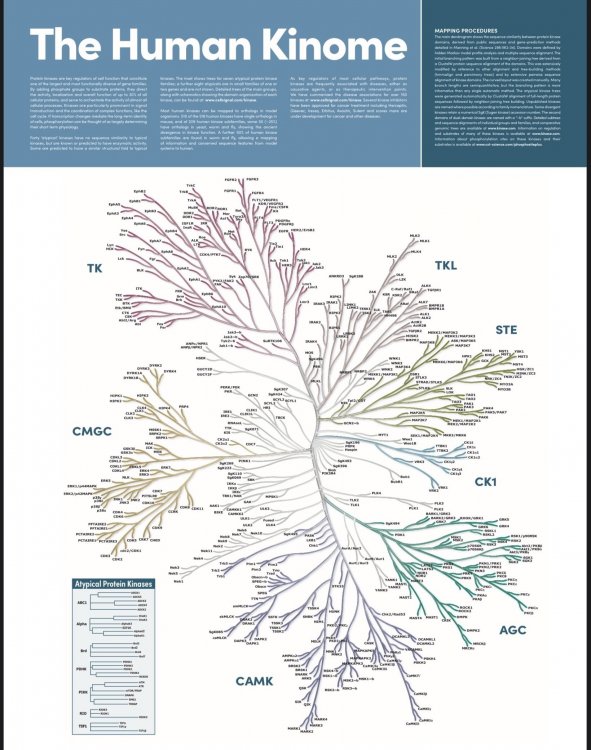
Hello all, I found a cool infographic produced by Cell Signaling. It showcases the human kinome, though I was not sure about some of its features. I was lost on what exactly the white branches indicate, why are these kinases unclassed? Also, I noticed some kinases were left out. Why is Raf kinase not included but Erk is? If there's a helpful resource that helps me understand the development of the human kinome that would be really helpful. Thanks in advance! the following image was reproduced by Cell Signaling Resources: Protein Kinases | Cell Signaling Technology
-
Hello forum community, As a pre-med/pre-science student, I have found that reading literature, writing reflectively on the content in summary, and being able to synthesize data and findings to identify knowledge gaps and develop "research-able" questions are fundamental to the thinking required in medical school and beyond. In fact, I have written two successful grant applications in the materials sciences which apply the same rules. My question here, anyhow, was directed to synthesizing a review paper for the biological or biomedical sciences (I feel less experienced/underqualified to write a clinical review paper that's meaningful). I understand what goes into a review paper--design the lit search, database diversity, exclusion criteria, quality test, etc... and register the protocol with PRISMA--though I was more concerned with how feasible this is for an undergraduate to design, register, write, and submit a systematic review into an undergraduate or professional academic journal. A secondary question I had relates to writing "mock review papers." Like a prelaw student participating in "mock" trials, I was curious whether writing a mock clinical review paper would help make my experiences competitive for MD/PhD (MSTP) applications. Of course, other experiences are more critical than this alone, but would this be something worth mentioning to display interest and experience? All in all, I have found that writing a systematic review paper leads you to learn A LOT about a particular field, whether the quality of the paper itself is publishable or not. It also allows you to practice designing research-able questions for your own future directions etc. Please let me know what the forum community thanks! I am also open to collaborating with anyone writing review papers themselves With Gratitude, HEK-293-DDR1b
-
Five passengers believed dead after missing submersible imploded near remains of Titanic, Coast Guard says This was very difficult to hear.
-
Thank you all for the responses. I will certainly consider my options carefully to ensure the best route for success for my project and my developing career. To address my involvement in the two totally different disciplines, I would say my intention is certainly medical practice and biomedical science (MD/PhD). Though, for the work-study assignment at college, I was assigned to woodworking two years ago. I was essentially a part-time craftsman generating a work-study aid toward tuition. Somewhere within the midst of it all, I discovered lignin modification in wood to engender novel functionalities in wood materials. The opportunity was brought forth to my labor supervisor and then O-chem professor and we initiated an independent study. My mentors have provided me with the training and resources, but I have executed most of the research. What once began as a simple desire to get into the lab (I never had an opportunity in high school [pandemic], so I created one first year in college) is growing into the possibility of a design patent and/or a small, undergrad-level publication. Hopefully, it will look competitive for professional school applications, as I now have molecular biology and materials science under my belt.
-
Hi all, I am a biochemistry premed undergraduate entering my third year in the fall. Presently, I study at the Division of Nephrology at Vanderbilt University Medical Center where I have interned for the summer (hence, inspiration for the name "HEK-293-DDR1b"; we study kidney fibrosis!😉) Anyway, I write to address my concerns about undergraduate collaboration in science across institutions amongst other students and faculty. My undergraduate studies are at a small liberal arts college. Though, nonetheless, I have been able to write two successfully funded grant proposals within the field of wood-based translational materials science. While the lab resources are minimal (yet still effective), I am currently a one-person research group. I have acquired results for a poster presentation in the fall, but sometime within the next few years or so I would like to publish in an undergraduate journal. Obviously, I will need a few team members to help assist with that endeavor, especially as I cannot generate the research output at the institution I attend. Here's my series of questions: Is it advisable to connect with other students, professors, and research faculty at other institutions (network via LinkedIn, etc.) to facilitate the generation of research, data analysis, and science writing? Would I make my intellectual property, so to speak, vulnerable to getting scooped? --especially as I do not have the resources to generate a mass research output as these R1 schools can? Am I being too overly protective of my work (I worked really hard to get this far, I just don't want to lose everything)? Please let me know any thoughts or opinions. Know of any schools with an openness to collaboration? I know science is competitive, and while my "idea" is not noble prize-winning, it is genuinely a project I've worked on and I am now looking to upscale. All responses are welcome. For further discussion of the specifics of the project, please private message me. With Gratitude, HEK-293-DDR1b