
henk jan
Members
-
Joined
-
Last visited
-
Oh this helps a lot, thank you so much
-
I thought the path length difference had to be 1 wave length so I multiplied this with the frequency of 40 kHz, this gave me an average speed of sound of around 250 m/s
-
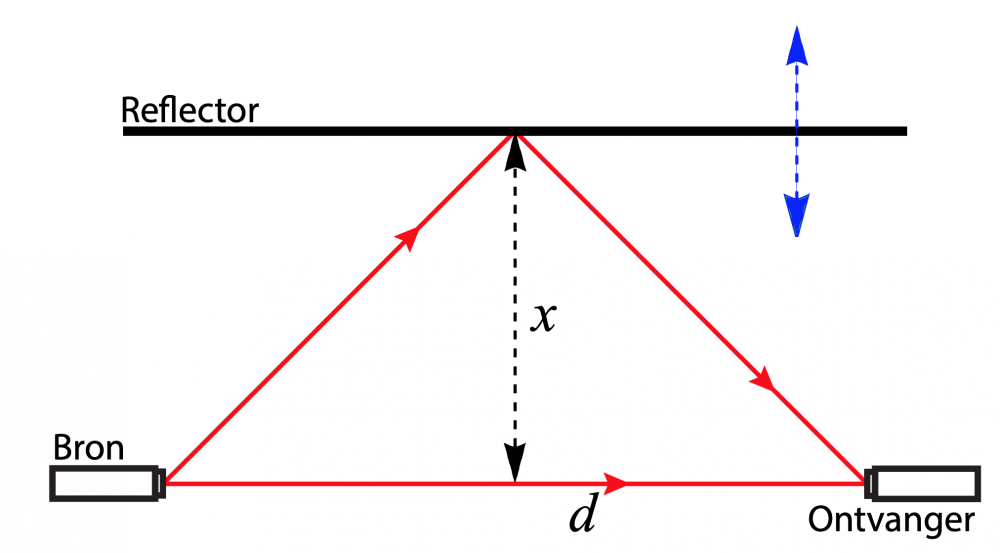
2*sqrt((d/2)^2+a^2)-2*sqrt((d/2)^2+b^2) . With d the distance between transmitter and receiver, a is x at an antinode and b is x at the next antinode I am using the formula as stated above and this is the graph that we got, but I am primarily using the numbers from the data set, instead of the actual graph

-
But a pi phase shift will only mean half a wavelength, so multiplying by two would give me a speed of sound of 500m/s right Sorry, we have a sound transmitter with a frequency of 40 kHz and a sound receiver , with 40 cm between them. We have a sound mirror (just a steel plate) on a moving axis perpendicular to the axis of the transmitter and receiver (optical axis). As the mirror moves towards optical axis, the receiver will take measurements and show these on a graph. This gives a graph with nodes and antinodes. Now we have to calculate the speed of sound using this graph. We tried calculating the path length difference between two antinodes, but this gives the wrong result I have put a picture of the setup, here bron means source and ontvanger means receiver
-
Ok so now I have calculated the path length difference between two fringes, that should give the wavelength, right? But it gives answers that are wrong, a speed of of sound of roughly 250 m/s where it should give about 343 m/s
-
Yes, fringes form because of destructive and constructive interference, and I understand that if the waves are in the same phase its constructive, but I dont know ow to calculate the wavelength if you know the length between fringes
-
For an experiment I have to calculate de wavelength of a sound using a Lloyd mirror, the reciever and transmitter are fixed and the sound mirror is moving towards the optical axis. I know i have te work with fringe spacing or something like that but I dont know how exactly
