
Passenger
Members
-
Joined
-
Last visited
-
test...password lost
-
Test...the password is missing
-
If someone divides by zero, your own reason. For example, division by zero is allowed in the generation of the least squares polynomial.
-
Where do I need an IT expert.
-
/****************************************************************************** * Jouni Aro * * 20.2.20 * * * * The multidimensional algebra * * * * The possibilities of algebra is associated with a sort of tool, with which * * parallel causations can be harnessed and approximated into compact * * functions. When you draw a roughly smooth curve into the screen with the * * mouse, the algebra is able to approximate the given set of dots into a * * short function. The craft of algebra is in its ability to describe * * phenomenons and the nature. * * * * What if you draw curves of different colors into the screen? The white set * * of dots is the temperature, the yellow is the direction of the wind, the * * orange is the time of year, the blue would represent the humidity etc. * * Every set of dots can be described as an individual phenomenon, but what * * about the function, that alone would describe the causations of the whole * * set? * * * * The relation of the function can also be asymmetrical. When the input of * * the weather function can be n number of initations, the output can only be * * a relatively blurry parameter between 0 to 1, whether you should go fishing * * or not. * * * * *** * * * * The computer can be programmed to study mathematics. With the solid axioms * * of algebra and the consistent development of series, the bit monster can * * immerse itself further into geometry and symmetry. In the final solution * * the computer was partly forced to abandon the symbolic concepts which * * include the positive, the negative, the real and the imaginary. The algebra * * doesn't need to share its opinion on in what direction the monitor is put * * on the table. * * * * The algorithms of algebra are constant and its objects can describe * * whatsoever. One of the most beautiful formulae of the algebra is the * * polynomial adaption of the smallest sum of squares: * * * * If the object that is placed in the formula is valid and balanced with * * itself, the algebra will process the substance with rational results, * * otherwise not. A good example is the quaternion. The algebra does not * * editorialise to the inner calculation logic of the quartenion. * * * * *** * * * * i^2 is -1, but what is the object that gives the result of -i when squared? * * There's an interesting connection between the companions of the i, * * |e^(xi+yj+zk+...)| = 1. The multidimensional algebra also connects the pi * * and the number one. pi^z limit on the real axis approaches the value of 1, * * when the z-unit vector is excited further and further from the real axis. * * At the same time, the sum of the absolute values of the axises approaches * * to the pi. * * * * Next up are the simple calculation rules of the recomplex number with the * * C++ examples. The class itself can do almost as such in the MatLab -tool. * * * * ~ recomplex * * ~ order * * ~ specification of class * * ~ addition * * ~ subtraction * * ~ multiplication * * ~ products of vector basis * * ~ division * * ~ abs(recomplex) * * ~ pow(recomplex, int) * * ~ ln(recomplex) * * ~ exp(recomplex) * * ~ pow(recomplex, double) * * ~ pow(recomplex, recomplex) * * ~ sin(recomplex) * * ~ cos(recomplex) * * ~ the port example of the smallest sum of squares * * ~ the connection of the pi and number one * * ~ code attachment * * * * *** * * * * The complex number is a real subset of the recomplex number. Real numbers * * and imaginary numbers for their parts are real subsets of the complex * * number. The prefix "re" points to the feedback, repeating the same basic * * logic in the next scale. * * * * ~~~ order ~~~ * * * * The order goes in power of two, 1, 2, 4, ..., 2^n. The real numbers are * * adjusted with the order of 1. The complex numbers come into effect with the * * order of 2. In the order of 4 the complex numbers get a complex object on * * their side, functioning by the stopper logic. The union of these makes * * simple function maps for the parallel causation phenomena possible, among * * other things. * /*****************************************************************************/ /****************************************************************************** * ~~~ class specification ~~~ * * * * C++ implemented an operator load, when especially the calculation * * operations of the numeric structures on the computer don't differ from the * * regular straightforwardness. * ******************************************************************************/ #include <math.h> #include <stdio.h> #include <conio.h> #include <memory.h> #include <stdlib.h> class recomplex { public: /************************************ * The dimension should be: * * 1, 2, 4, ..., 2^n * * DIMENSION 1 -> real numbers * * DIMENSION 2 -> complex numbers * * DIMENSION 4 -> 4D complex numbers * * DIMENSION 8 -> 8D complex numbers * ************************************/ #define DIMENSION 4 double e[DIMENSION]; recomplex(void); ~recomplex(void); recomplex(double*); recomplex(int); recomplex(int, int); recomplex(int, int, int, int); recomplex(double); recomplex(double, double); recomplex(double, double, double, double); friend void print(recomplex); friend double abs(recomplex); friend recomplex sqrt(recomplex); friend recomplex operator-(recomplex); friend recomplex operator+(recomplex, recomplex); friend recomplex operator-(recomplex, recomplex); friend recomplex operator*(recomplex, recomplex); friend recomplex operator/(recomplex, recomplex); friend recomplex operator*(recomplex, double); friend recomplex operator/(recomplex, double); friend recomplex operator*(double, recomplex); friend recomplex operator/(double, recomplex); friend recomplex pow(recomplex, int); }; /****************************************************************************** * ~~~ addition ~~~ * * * * If you're unfamiliar with the C, a few words about it. The basis of C is * * to save sheets. Every excessive and unnecessary rambling is eliminated * * from the syntax. The operators if C are very effective. For example +=, *=, * * /=, ... perform the operation in question and after that the assignment. * * a.e[n]+=b.e[n] means the same that a.e[n]=a.e[n]+b.e[n]. Because the latter * * style consumes more of paper, the shorter version of the same thing * * a.e[n]+=b.e[n] is used in the C. * ******************************************************************************/ recomplex operator+(recomplex a, recomplex b) { for (int n=0; n<DIMENSION; n++) a.e[n]+=b.e[n]; return a; } /****************************************************************************** * For example: * * * * recomplex A(2, 3, -5, 7); * * recomplex B(7, 5, -3, 2); * * print(A + B); * * * * Prints a value of 9 + 8i - 8j + 9k. * ******************************************************************************/ /****************************************************************************** * ~~~ subtraction ~~~ * ******************************************************************************/ recomplex operator-(recomplex a, recomplex b) { for (int n=0; n<DIMENSION; n++) a.e[n]-=b.e[n]; return a; } /****************************************************************************** * For exsample: * * * * recomplex A(2, 3, 5, 7); * * recomplex B(7, 5, 3, 2); * * print(A-B); * * * * The value of the difference is -5 - 2i + 2j + 5k * ******************************************************************************/ /****************************************************************************** * ~~~ multiplication ~~~ * * * * The multiplication first requires a product definition of the base vectors. * * Looping the product does not editorialise to the formal positive, negative, * * real, imaginary, etc. definitions. The product of the multiplication is * * returned to the sum form so far only in the last loop. * ******************************************************************************/ recomplex operator*(recomplex a, recomplex b) { int *BasisVectors(void); int *R = BasisVectors(); int i, j, n=DIMENSION*2; double x[DIMENSION*2]; double y[DIMENSION*2]; double t[DIMENSION*2]; for (i=j=0; i<DIMENSION; i++, j+=2) x[j+1]=y[j+1]=t[j]=t[j+1]=0.0, x[j]=a.e[i], y[j]=b.e[i]; for (i=0; i<n; i++) for (j=0; j<n; j++) t[R[i*n+j]]+=x[i]*y[j]; for (i=j=0; i<DIMENSION; i++, j+=2) t[i]=(double)(t[j] - t[j+1]); return *(recomplex*) t; } /****************************************************************************** * For exsample: * * * * recomplex A(2, 3, 5, 7); * * recomplex B(7, 5, 3, 2); * * print(A * B); * * * * The outcome is -32 + 32i + 87k. The multiplication is commutative. If A and * * B are complex, the outcome is complex. * * * * recomplex A(2, 3, 0, 0); * * recomplex B(7, 5, 0, 0); * * print(A * B); * * * * You'll get the output -1 + 31i * ******************************************************************************/ /****************************************************************************** * ~~~ the products of the base vectors ~~~ * * * * The products of the base vectors are generated by the recursive function. * * All the products of the base vectors associated with the order of 4 are * * assembled in the chart: * * * * # 1 | -1 | i | -i | j | -j | k | -k | * * ############################################ * * 1 # 1 | -1 | i | -i | j | -j | k | -k | * * ---#----|----|----|----|----|----|----|----| * * -1 # -1 | 1 | -i | i | -j | j | -k | k | * * ---#----|----|----|----|----|----|----|----| * * i # i | -i | -1 | 1 | k | -k | -j | j | * * ---#----|----|----|----|----|----|----|----| * * -i # -i | i | 1 | -1 | -k | k | j | -j | * * ---#----|----|----|----|----|----|----|----| * * j # j | -j | k | -k | i | -i | -1 | 1 | * * ---#----|----|----|----|----|----|----|----| * * -j # -j | j | -k | k | -i | i | 1 | -1 | * * ---#----|----|----|----|----|----|----|----| * * k # k | -k | -j | j | -1 | 1 | -i | i | * * ---#----|----|----|----|----|----|----|----| * * -k # -k | k | j | -j | 1 | -1 | i | -i | * * ---#----|----|----|----|----|----|----|----| * * * * For example ijk = -i, and particularly k^2 = -i. Commutativity remains, * * because still: * * * * ikj = jik = jki = kij = kji = -i * ******************************************************************************/ void GenerateTheProductsOfTheBaseVectors(int *R, int n) { int I=0, J=n-1, i; int X=n, Y=J+n, j; int k=DIMENSION*2; for (i=I; i<=J; i++) for (j=I; j<=J; j++) { R[i*k+X+j]=R[i*k+j]+X; R[(X+j)*k+i]=R[i*k+j]+X; R[(Y-i)*k+Y-j]=J-R[i*k+j]; } if (n+n < DIMENSION*2) { GenerateTheProductsOfTheBaseVectors(R, n+n); } } int* BasisVectors(void) { static int R[DIMENSION*DIMENSION*4]={-1}; if (R[0] == -1) { int FirstThereWasZero=0; R[0x00]=(int)FirstThereWasZero; GenerateTheProductsOfTheBaseVectors(R, 1); } return R; } /****************************************************************************** * ~~~ division ~~~ * * * * In division, a complex conjugate is produced for the divisor, with which * * the divisor and the dividend are multiplied. In the end of every loop step * * there's a half less of axel values of the divisor (the rest are summed up * * to nulls). When the value of the divisor is real, the elements of the * * dividend are divided by the value. For example 2 + 3i + 5j + 7k the mounted * * number is 2 + 3i - 5j - 7k. * ******************************************************************************/ recomplex operator/(recomplex x, recomplex y) { recomplex z; for (int i, n=DIMENSION; n>=2; n/=2) { for (z=y, i=n/2; i<n; i++) z.e[i] = -z.e[i]; x=x*z; y=y*z; } return x/y.e[0]; } /****************************************************************************** * For exsample * * * * recomplex A(2, 3, 5, 7); * * recomplex B(7, 5, 3, 2); * * print(A / B); * * * * The product of division is 0.5488136 - 0.1575801i + 0.7181670j + 0.3977540k.* * If A and B are complex, the result is complex: * * * * recomplex A(2, 3, 0, 0); * * recomplex B(7, 5, 0, 0); * * * print(A / B); * * * * The output of the value is 0.3918919 + 0.1486486i * ******************************************************************************/ recomplex operator/(recomplex x, double k) { for (int i=0; i<DIMENSION; i++) x.e[i]/=(double)k; return x; } recomplex operator*(double k, recomplex x) { for (int i=0; i<DIMENSION; i++) x.e[i]*=(double)k; return x; } recomplex operator*(recomplex x, double k) { return k*x; } recomplex operator/(double k, recomplex x) { return recomplex(k)/x; } /****************************************************************************** * ~~~ abs(recomplex) ~~~ * * * * In the absolute value x is multiplied by its complex conjugate repeatedly. * * The value then returns the breaking power collected by j. * ******************************************************************************/ double abs(recomplex x) { recomplex z; double r, c; int i, j=1, n; for (n=DIMENSION; n>=2; n/=2, j+=j) { for (z=x, i=n/2; i<n; i++) z.e[i]=-z.e[i]; x=x*z; } r=fabs(x.e[0]); c=1.0/(double)j; return pow(r, c); } /****************************************************************************** * For exsample: * * * * recomplex A(2, 3, 5, 7); * * recomplex B(7, 5, 3, 2); * * printf("%25.20f\n", abs(A/B)); * * * * The double of the C is precise, because the absolute value of the result is * * exactly 1.00000000000000000000 * ******************************************************************************/ /****************************************************************************** * ~~~ pow(recomplex, int) ~~~ * * * * The limit of x^0 is 1, when x approaches the null. Calculators have * * variable interpretations, whether the 0^0 is about 1 or is the calculation * * aborted and is the output of the status an error. In the polynomial * * adaption of the smallest sum of squares x^0 has to be 1 also with the x's * * limit null. An exponent n can be a positive or a negative integer. * ******************************************************************************/ recomplex pow(recomplex x, int n) { if (n) { recomplex t=x; int i=n<0? -n: n; for (--i; i; i--) t=t*x; return n>0? t: recomplex(1) / t; } else { return recomplex(1); } } /****************************************************************************** * ~~~ print(recomplex) ~~~ * * * * Somewhere around 20 element, when the marking of the base vector is bigger * * than 'z', the marking of the base vector can be a symbol differentiated * * from the letter. In the calculations themselves the symbols are not * * editorialised. * ******************************************************************************/ void print(recomplex a) { printf("%0.9f ", a.e[0]); for (int n=1; n<DIMENSION; n++) printf("%c %0.9f%c ", a.e[n]<0? '-': '+', fabs(a.e[n]), 'h'+n); printf("\n"); } /****************************************************************************** * These functions still need to be explored * * * * ~~~ ln(recomplex) ~~~ * * ~~~ exp(recomplex) ~~~ * * ~~~ pow(recomplex, double) ~~~ * * ~~~ pow(recomplex, recomplex) ~~~ * * ~~~ sin(recomplex) ~~~ * * ~~~ cos(recomplex) ~~~ * ******************************************************************************/ recomplex::recomplex(void) { memset(this, 0, sizeof(recomplex)); } recomplex::~recomplex(void) { } recomplex::recomplex(double *a) { memset(this, 0, sizeof(recomplex)); for (int i=0x00; i<DIMENSION; i++) e[i]=a[i]; } recomplex::recomplex(int a) { memset(this, 0, sizeof(recomplex)); e[0]=(double)a; } recomplex::recomplex(double a) { memset(this, 0, sizeof(recomplex)); e[0]=(double)a; } recomplex::recomplex(int a, int b) { memset(this, 0, sizeof(recomplex)); e[0]=(double)a; e[1]=(double)b; } recomplex::recomplex(double a, double b) { memset(this, 0, sizeof(recomplex)); e[0]=(double)a; e[1]=(double)b; } recomplex::recomplex(int a, int b, int c, int d) { memset(this, 0, sizeof(recomplex)); e[0]=(double)a; e[1]=(double)b; e[2]=(double)c; e[3]=(double)d; } recomplex::recomplex(double a, double b, double c, double d) { memset(this, 0, sizeof(recomplex)); e[0]=(double)a; e[1]=(double)b; e[2]=(double)c; e[3]=(double)d; } /*************************************************** * Returns the square root of parameter c. Function * * has been implemented in Newton's processing. * ***************************************************/ recomplex sqrt(recomplex c) { int i; recomplex x; double R[DIMENSION]; for (i=0; i<DIMENSION; i++) { int sgn = rand()%0x02? -1: +1; R[i]=sgn*rand()/(double)32767; } x=recomplex((double*)R); for (i=0; i<1024; i++) x=x-(x*x-c)/(2.0*x); return (recomplex)x; } /********************************************** * the mainfunction tests the income swap law. * **********************************************/ int main(void) { recomplex x(0.12, -0.34, 0.56, -0.78); recomplex y(0.98, -0.76, 0.54, -0.32); printf("x = "); print(x); printf("y = "); print(y); printf("\n"); printf("x*y = "); print(x*y); printf("y*x = "); print(y*x); printf("\n"); getch(); return 0; }
-
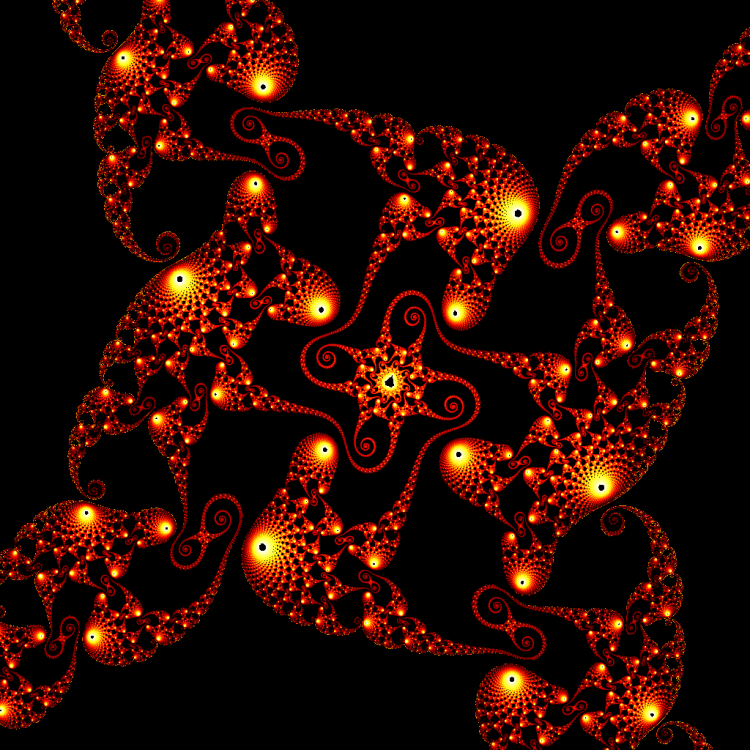
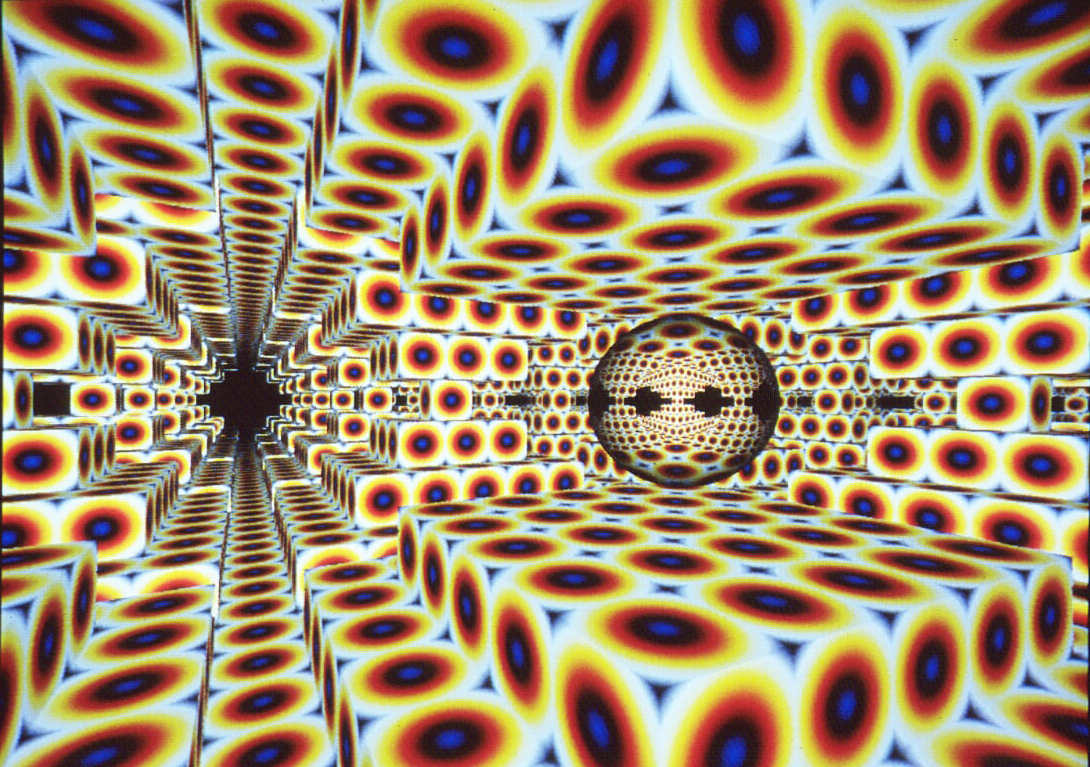
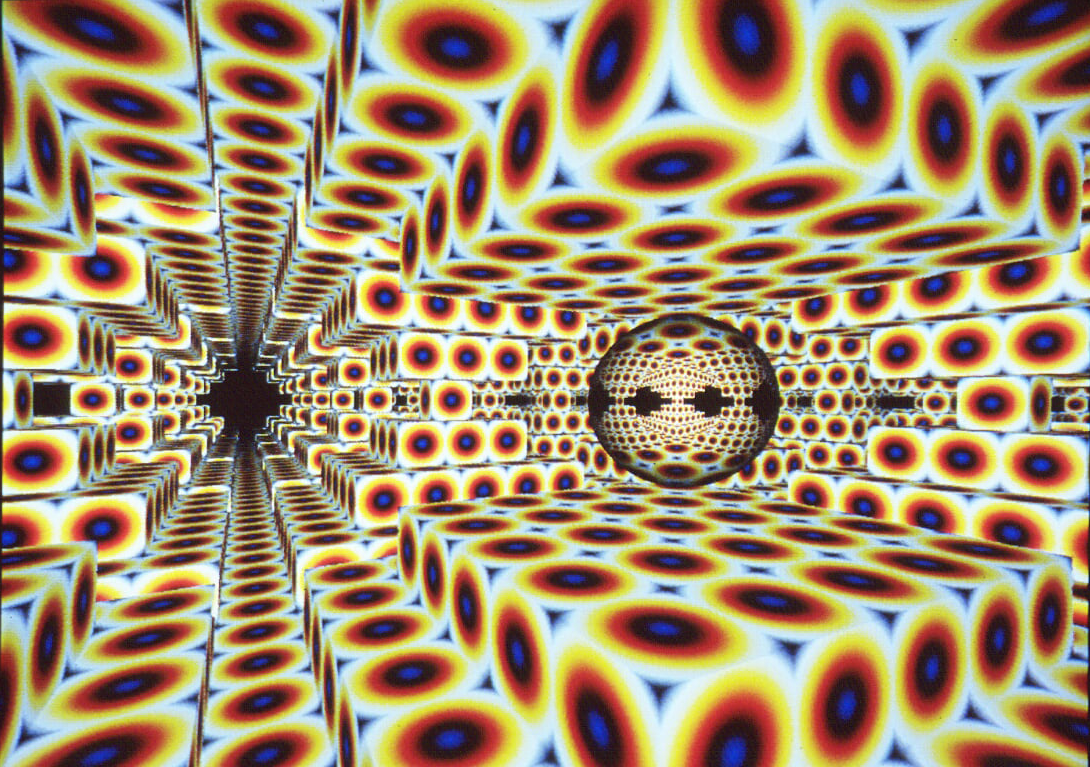
I calculated this fractal with 4D complex numbers. (j and k axis fractal zoom)
-
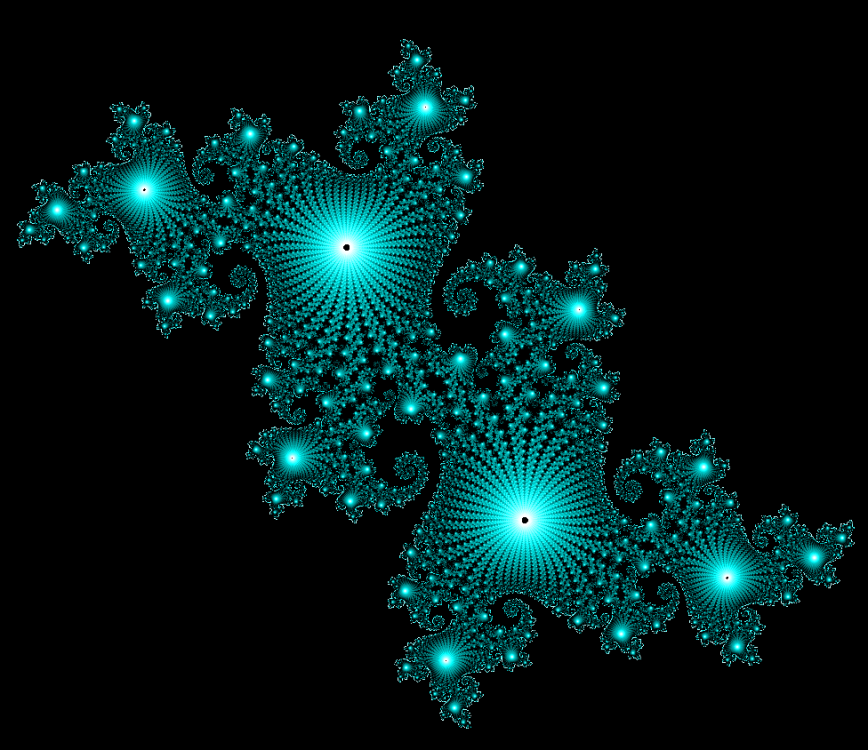
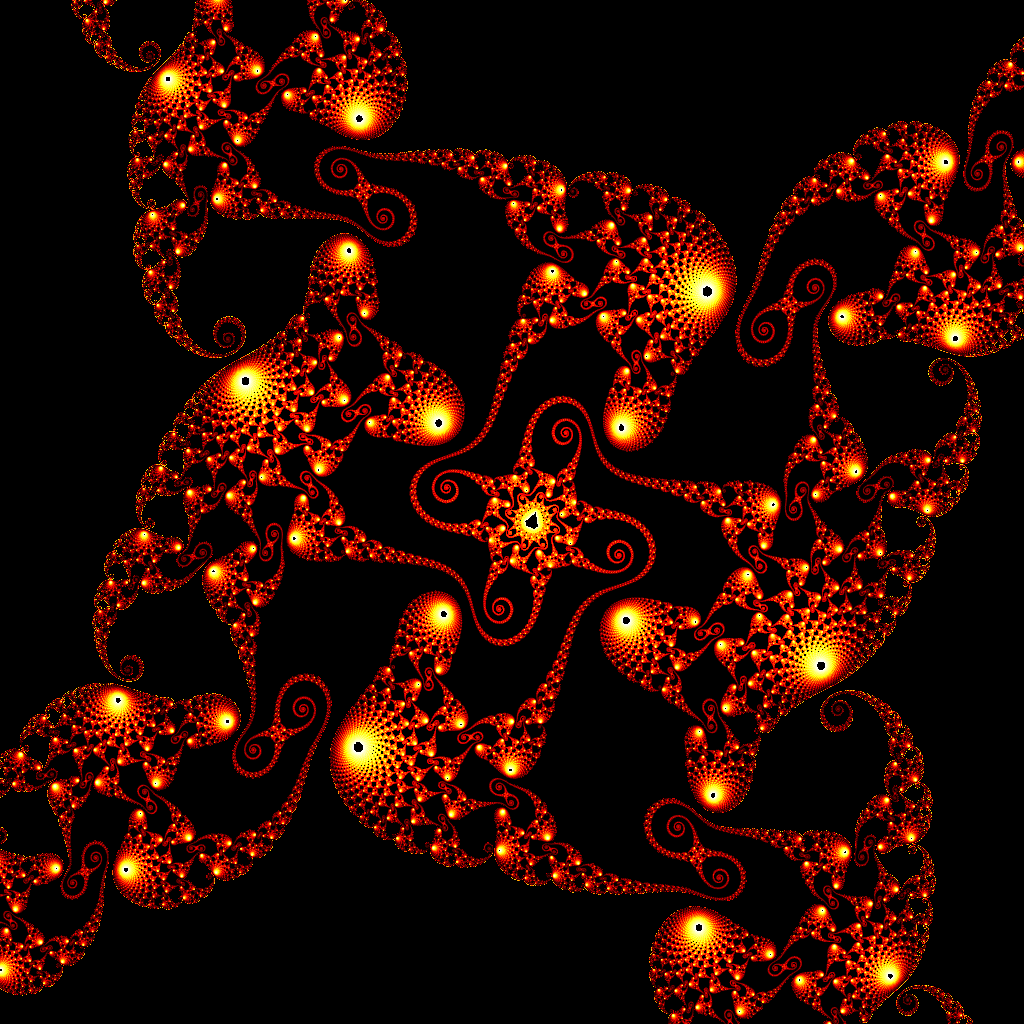
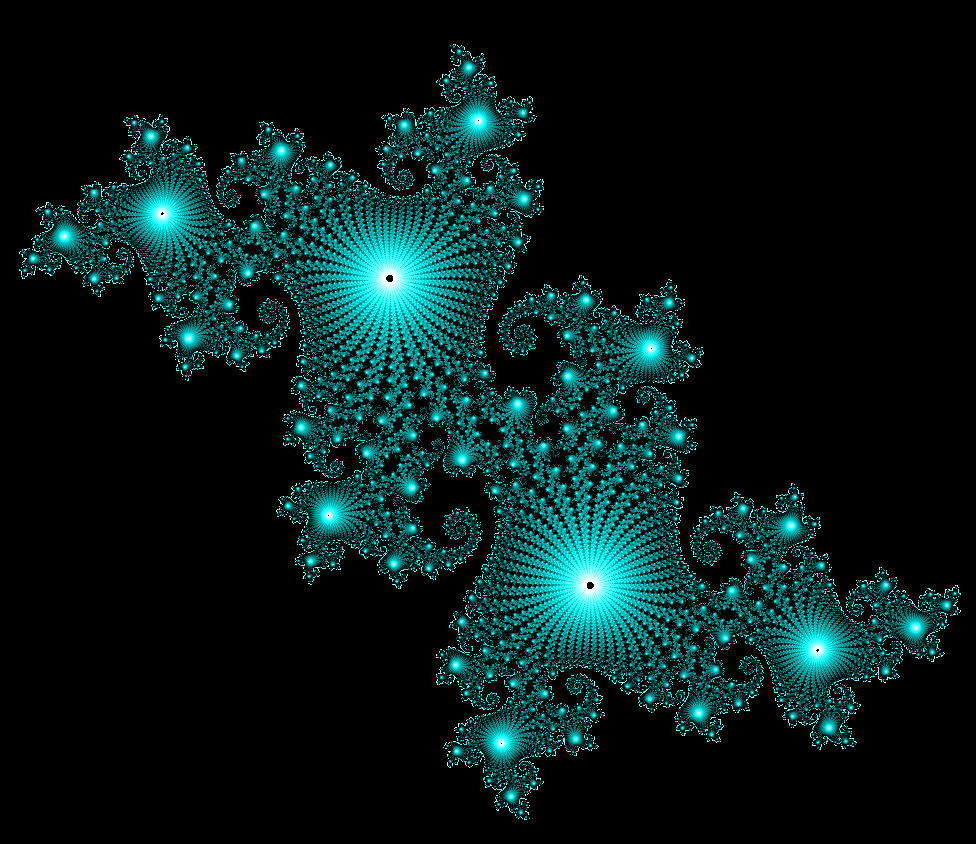
Zooming Julia's crowd. I programmed this image sometime in the early millennium.
-
Scale over 20 years ago. I program now the fractal carbon colors. Each pixel contains 256 * 256 mosaic information, resulting in an image resolution of 216 (65 536).

-



Important Information
We have placed cookies on your device to help make this website better. You can adjust your cookie settings, otherwise we'll assume you're okay to continue.